Other than that, the same boomer lib platitudes one would expect: a lot of psychologizing "anxiety", conflating a lot of entirely different people into one "just so" story, a plea for their harmless and neutered type of masculinity, etc.
Ezra Klein brought some dumb broad on his show to discuss "masculinity", "anti-feminism", etc. and, of course, they brought up BAP (again).
It's amazing how these people, despite their oh so impressive degrees, are completely uneducated midwits, lacking any insight or curiosity
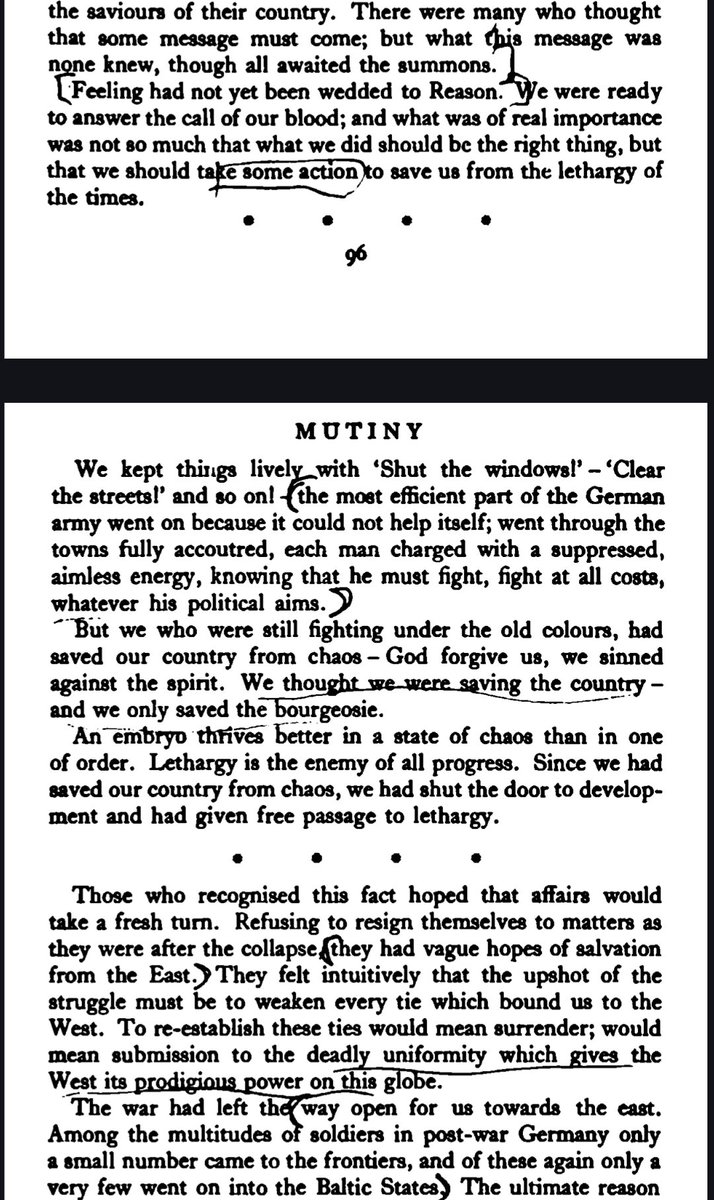
The woman mentions that BAP decrying the preservation of mere life at the expense of things that are exciting great and free, is not something people would say after the first world war... I doubt she ever heard of Jünger or von Salomon at Oxford.
I mean, it's a good question. Why hasn't human civilization naturally developed into a brutal aristocracy of the highly moral and high-IQ? Why don't we have a global "130 IQ high-trust Anglo" paradise already?
What mysterious force obviously overcomes and beats intelligence?
@ElonFatigue@LuciferGroyper The weirdest part of this is, when they claim that Saxon-Anhalt has the fewest Christians "worldwide".
Certainly not true percentage-wise, and even in absolute numbers, you can probably easily find some province in Asia or Africa, where the number of Christians is close to 0.
He literally said that basicslly the entire program of the (communist) early 20th century German SPD has basically been adopted by "every Western country" and that we shouldn't think of the 20th century as Capitalism beating Communism, but as "Social Democracy" triumphing.
I really wonder how a Western liberal can visit any major East Asian city, like Tokyo or Singapore, and not start to reflect on their worldview. Surely, they have to wonder about the lack of beggars accosting them, the lack of vaguely threatening youths outside train stations...
@VittelMax The seems like the obvious outcome tbh. One might even say, that it's already a fait accompli.
But we can take solace that after Greece and Rome, there was Europe; and after Europe, there will be something else... one day at least.
@bronzeagemantis Hasn't that always been the only option if we want more than just a return to 90s "end of history" liberalism?
An end to massdemocracy won't be achieved by a at the ballot box, but only through a new noblesse d'épée.
The problem with all these "Gentlemen's fashion" tips is that it requires a society, or at least certain strada of society, that believes in them.
This just comes of as larping at the Renaissance Fair or being really invested in some new Fantasy movie getting the costumes right.
Gentlemen:
If you’re going to a black tie event for New Year’s Eve tonight, remember that its a faux pas to wear a watch (whether with a metal or leather band) with black tie
Those who know will notice. Leave the watch at home
🥂
Ernst Jünger - Remembering a Century
An interview with Luis Meana, 1995.
LM: Mr. Jünger, on the 29th of this month you will be one hundred years old, something unusual, especially among writers. What does this mean to you?
Among friends in Switzerland, I remember the story of the farmer who had just turned a hundred years old and was asked by his family and acquaintances whether he wasn't afraid that things couldn't go on like this for much longer. The farmer replied: "No, I'm not afraid, because I very rarely read in the newspaper that someone has died at the age of a hundred." I would like to add a few things. I was born in 1895, the year in which Rontgen discovered his invisible rays and the year in which the Dreyfus Affair reached its climax. These two events had great significance for our century, at least for the first half of it. Without the Rontgen rays, which Laue later used for certain measurements of objects that were already beyond human comprehension, the atomic bomb would not have existed. And the Dreyfus trial was actually the clash between conservative and democratic forces that helped the latter to gain momentum, which was to have a lasting effect for years to come. My first memories of my childhood are dominated by my father's dinner-table conversations about these events.
LM: Somewhere in your work you quote an aphorism attributed to Lichtenberg: "One should not stretch one's hopes, like one's shins, so far forward." Was this your formula for reaching such a biblical age, or is there another one - physical or mental - for such an unusual achievement?
That depends on each individual. In any case, you should go to the doctor as rarely as possible, and if you have a certain amount of vitality, you don't do that either. But there is no universal formula. Each person should live according to their own style. Perhaps this is already predetermined in your genes. You should live for every day, carpe diem, the rest will logically come by itself.
LM: The figure of the soldier plays a major role in your work. It is surprising that in this century the officer and militarism have ceased to be state-forming factors. We went from the officer to the civilian and from the civilian to the economist as the one who shapes society. Is the economist the new soldier of the new infantry?
Certainly, the soldier has disappeared, he has had to subordinate himself to the technician. I explained this in detail in "The Worker." I personally agree with a maxim I read in Marx. I acquired my attitude to heroism as a reader. The little war of 1870/71, which was so much talked about in our country and which gave Germany a certain arrogance, never seemed particularly awe-inspiring to me. Ariosto's songs, on the other hand, made a profound impression on me. During the First World War, I had Ariosto with me in my pocket. And when, as a reader, you move forward in the ideal world, you feel detached from reality. Marx put it particularly succinctly. Heroism is not really possible when you're armed with gunpowder. And this has been repeated over and over again since the beginning. Technology is inherently opposed to the great deeds of the warrior. An old Sicilian tyrant is said to have exclaimed when he heard about the invention of a special projectile throwing machine: "My God, the gods and heroism are at an end." And this has always been repeated. This contradiction has existed since the beginning and has now reached its peak with the atomic bomb, which actually rules out wars completely. I talked about all this in this room with Moravia, who visited me here.
LM: That means there are no more wars in the classical sense. And what are wars like the one in the Balkans, in the Gulf or other similar ones?
No, there are no more wars, and if there was one because someone carelessly pressed the red button, it would be devastating for both sides, because the weapons could not only wipe out an entire region, but could even reach and wipe out the entire globe. This is one of the reasons why the world state is actually indispensable. As far as the above-mentioned wars are concerned, they must be viewed from two perspectives. Firstly, the Balkan war is comparable to the wars of the Diadochi, and secondly, these wars will contribute to a greater concentration, as can already be seen from the role of the UN.
LM: You wrote that we need philosophers of history much more than nuclear physicists. But we are confronted with the paradoxical fact that there are fewer and fewer philosophers of history and that science is behaving as if it had a monopoly on interpreting the world. What can you say to this?
Nietzsche made some prophetic statements. In my opinion, Nietzsche is the prophet of the age of the titans. He said: "The 21st century is my home." I would agree with him, in the sense that the accumulation of energy will be so enormous that people will no longer know how to control it. As Nietzsche demanded, a new type of person will have to emerge, which he calls the Übermensch. For me, it was the figure of the worker, a term that has been misinterpreted, even by exceptional minds. Both Spengler and Carl Schmitt were in front of me, talking after the proletariat's mouth. But this is not the case, because it is a neo-Platonic view of the worker, i.e. a view of titanic substance.
LM: With regard to Titanism, you have repeatedly interpreted the 21st century as the century of the battle between the gods and the Titans; you have announced the reappearance of the gods and claimed that the 21st century will be the century of the Titans. What can you tell us about this today?
That is correct. This battle between Titans and Gods is, as Hesiod and the Greek philosophers said, eternal and timeless. It begins with time and goes beyond time, and it was already underway long before humans and organic nature could be conceived. The gods have supratemporality as their home, while the Titans live entirely in time, and at this moment time is in their blood. With our apparatuses we measure the dissolution of atoms and similar things that already reach the last limits of supertemporality, and the same with our expeditions into space and our telescopes, with which we penetrate to the limits of the universe.
LM: You wrote that the bourgeois age came to an end with the Second World War, and in general you were harshly critical of the bourgeoisie and the society we now call liberal. Now, after the fall of the Berlin Wall, it seems that instead of the end of the bourgeois age, we are witnessing its triumph over fascism, socialism and communism. Has your position on the bourgeois age not been refuted?
But the fall of the Wall, which I was very happy about, is only an ephemeral phenomenon within the great changes that are taking place. You first have to look at East and West and these gigantic contrasts that are already appearing with history and will disappear when the world state comes into being. And in practice, i.e. technically and perhaps philosophically, this world state already exists. There are no more opposites. With regard to what I said about Burgundianism, I was corrected today, Spengler also accused me of this. But the disappearance of the Wall is an ephemeral act which, I repeat, delighted me, but it is only one event in a progressive process that establishes a certain balance between East and West.
LM: In your life, fantasy and adventure have always been opposites. You yourself said somewhere that adventure was reduced to a kind of nature park. Today, adventure has degenerated into tourism. And we do the same with ideas as we do with tourism: we only see the clichés that are contained within intellectual tourism. Are we facing the destruction of any adventurous or unconventional path?
Well, maybe you could say that. Of course, technology is partly destroying adventure. In other words, if I visit a beach, an uninhabited beach, and return ten years later, there will be a whole row of hotels there. My father already advised me: "If you like a place, never go there again, it will only disappoint you." But when someone flies to the moon, it's also a bit of an adventure. Which of course also brings with it a kind of disappointment, because the old goddess Selene is deflowered in a way.
LM: Your diaries contain a number of critical observations about Hitler and the weakness of his character. Looking back, how do you judge Hitler and his consequences today?
I think it was completely disastrous that he grew up in Vienna, where Leuger and others spread his monstrous anti-Semitism. If Hitler had not followed this anti-Semitism, if he had not been infected by it in his childhood, the world would look completely different today. He transformed the world, but in a very unpleasant way.
LM: And if we compare him with other dictators of the time, with Mussolini or Franco, do you see a significant difference?
There are differences. You could say a lot about that. Mussolini went down mainly because he leaned too much on Hitler's ideas.
LM: In his "Glossarium", Carl Schmitt refers to the anger that your "cold gaze" of a "seismograph" arouses in critics and opponents, and Schmitt comments that this is like "the anger of the spa director at the doctor" who "diagnoses a case of plague at the spa." Do you agree with this view of things?
Carl Schmitt, who was a good friend, even godfather to my son Alexander, although he was Catholic, apparently resented me, just like Benn, for not joining the movement like them. But I don't blame him. I warned him, for example, when we were walking down the street one day and he said: "The Führer creates order"; to which I replied: "In the field of law you can perhaps have a discussion about it, but politically you are in great danger." And I was right in my prophecy. I only read the "Glossarium" superficially. I started with the list of people and saw there that I was probably the one who bothered him the most, because my list was much longer than the others. Our common starting point was certainly the Treaty of Versailles, but I didn't believe that Hitler in particular could do anything about it, at least not in the long term. He only achieved a partial success, which did him and even more us all great harm.
LM: Do you believe that the "Old Powderhead" Nietzsche, as you call him, was the last great philosopher?
There's no telling what is yet to come, but so far, let's say both dynamically and qualitatively, I would give him the clear preeminence over Heidegger. For me, Spengler is not only a historian, but also a philosopher insofar as he does not believe in the optimism of progress. For him, development takes the form of a cycle, which means that there is a seed around which a culture develops, which reaches its flowering, then its fall and its demise. This organic view seems more appropriate to me than the purely dynamic-progressive view.
LM: What can you say in retrospect about such a long life that has been so full of events, great moments, criticism and also disappointments?
I have already said that, in my opinion, I have not lived an active life, but that of a Platonist; a Platonism that consisted above all in reading the great classics and the great philosophers, and when I interfered with reality, it essentially disappointed me. And I should note that I agree with Léon Bloy, who said that in the moment of death we enter into the fabric of history. And what was the fabric of history? Not time, but the supratemporal. You can find something similar in Thomas Aquinas. I would like to ask you, if you publish this interview, to do so with great caution, because you know that if I release a small mouse, my opponents will immediately turn it into a dinosaur.
LM: But you took part in two world wars and saw death and many other horrors up close.
As far as the atrocities are concerned, I have to say that I had nothing to do with them. I belong to the Prussian officer corps, and there you don't attack people who are defenseless. I can say that such a thing would never have even crossed my mind. I took an active part in the First World War as a lieutenant and in the Second, in keeping with my age, I was already on the command staff. And with Cocteau, Montherland and Giraudoux, I only came out of my war experiences with friends. Which is something completely different.
LM: After so many years and having met so many people who played an important role in the course of this century, is there anyone who has made a particular impression on you? Did you single anyone out?
Who did I single out? There were many, indeed many, but not the ones everyone talks about. I spoke to Ludendorff personally, I saw Hindenburg almost every week, but I wasn't left with much of an impression. Kaiser Wilhelm once said, so the story goes, that Ernst Jünger had said that a prince must fall surrounded by his last loyalists in battle, and that he had enjoyed talking to me about it. His second wife told me this. My brother Friedrich George was particularly important to me.
LM: And among the writers, thinkers and artists?
For me, as for many young people, Rimbaud became a fundamental event. It was like an explosion. Speaking of explosions, Borges, sitting here at this very table, told me that reading "The Storm of Steel" when he was seventeen was an explosive event for him.
LM: What impression did Borges make on you?
First of all, the experience of being with a blind man. He sat down here and I held his arm. We were instinctively sympathetic, yes, and we talked about the ant colony; he told me that a single ant was almost nothing, which I took for granted.
LM: Why did you doubt that?
Because I don't know, but when I observe an ant, I see that it performs very intelligent movements and that nature's ant colony is much better and more well-rounded than ours.
LM: That's right, you are also a recognized entomologist in addition to your work as a world-renowned author. Several insects bear your name. How do you see our relationship with nature from the perspective of a naturalist?
The relationship with nature today is painful, not only for me but also for many other people. The primeval forests of the Amazon are being destroyed, the seas are being overfished, the atmosphere, well you can see what state it's in; in a word, we are going directly against the elements. Perhaps the Titans know a way to change this, even if destruction is nothing out of the ordinary for the Titans. In this sense, Hitler also had a titanic streak, he wanted to destroy everything. Sometimes you get the impression that we are heading for an ecological catastrophe. Perhaps we need to do much more to protect nature, the environment and everything else. We have a lot of unemployed people, we would have to engage the great masses of unemployed people to do that; it didn't have an immediate effect, but it did in the long run.
LM: Will nature survive our imposition?
Doubtful, at least the universe will survive us.
LM: In your diaries, dreams about dreams appear again and again. What do you think of Freud's interpretation of dreams?
Well, I don't have a firm opinion about that, because he concentrates very strongly on almost medical concepts. In this sense, I almost prefer the old books on dreams, in which one can also find interpretations. And I have to say, that is sometimes frightening. My first wife Gretha told me on the day my son died in the World War that she felt like she'd had a tooth pulled out, and I told her that's what they usually say when someone dies, without us having thought of any such connection. Today, I almost always dream the middle chapters of novels. So there must have been a beginning and an end, but my memory only focuses on the middle part; so in dreams you experience terrifying worlds.
LM: As far as reading is concerned, you say in one of your books that since your childhood you had had the feeling when reading that you were committing robbery against society, and that you had not let go of this for the rest of your life. Is this still the case?
My mother always turned off the light when she went to bed and I would turn it back on and read novels. I became part of a society by reading novels by authors who are now obsolete, but who were fashionable back then. And when it got light again, I turned off the light and slept for maybe two hours. Afterwards, I continued to sleep at school, which earned me the worst grades ever awarded at my grammar school.
LM: You never had a high opinion of the school. In many of your writings, school appears to be opposed to all fantasy, adventure and real life experience.
Well, I knew more than the teachers, but I couldn't show it, that was one of my problems. Let's put it this way, the superiority of the student's ideas over the teachers. These people had a phenotype, and I was genotypically far superior to them. That is tragic. Afterwards, when people grow up, they can laugh about it, but in the classroom they suffer a lot.
LM: I wanted to ask you about something that is of general interest: drugs, since you did those experiments with mescaline and tried different drugs. What do you feel, what do you learn, what do you discover with all these experiments?
How did Huxley put it? You knock on a door.
LM: And what do you discover behind the door?
Well, that they can change your personality, can't they? You know that I tried LSD with Albert Hofmann, a good friend of mine, when people didn't know that particular name yet. These days an interview program of mine with him is being broadcast, in which Hofmann says that he advocates the liberalization of LSD without restrictions.
[Junger's wife spontaneously intervenes.]
Liselotte: And you?
LM: And you?
I believe that, like the mysteries of Eleusis, it should be reserved for a certain elite.
LM: But, Mr. Junger, are there still elites?
Of course! The larger the masses, the smaller the elite, but all the more efficient.
LM: There is a curious note in Schmitt's "Glossarium." Schmitt says that a graphologist, a student of Klages, analyzed the handwriting of Spranger, Smend and you. Spranger's diagnosis was that he was a barren, malicious egotist, Smend's that he was a dangerous schemer. When he saw your handwriting, Schmitt says that he said: "This man has a strong penchant for the fairer sex." Was the graphologist right?
Well, what man doesn't have a weakness for the opposite sex, I would like to emphasize that.
Liselotte Junger: As you can see, the graphologist couldn't stand Spranger, that must have been the deeper reason for the graphologist.
LM: To conclude, what are you working on at the moment?
Volume four "Seventy Gone" has just been published and the manuscript of the fifth is finished. I also have an unfinished novel, maybe I'll get around to it one day. It deals with the relationship between a superior schoolboy and his know-it-all teacher.
LM: How does a normal workday look?
Lisolette: Like in an office. These days are, as you can imagine, very special. Lots of mail and hustle and bustle. But otherwise he has breakfast, goes for a walk in the garden, which is very important, then he spends a little time with insects or something similar. This is followed by several hours of work at his desk. He gets up late, we skip lunch and have dinner at six o'clock. He doesn't eat anything in between so that he can concentrate and work without interruption, three to four hours a day.
@captive_dreamer I think he is right in so far as people want deportations, they just don't want to see or hear about them.
Of course, picking up a million+ people per year without some footage that will scare the normies is basically impossible.