🚨 Anthropic just showed a 27-minute workshop on how to actually do prompts for Claude.
Taught by the people who built it.
Free. No registration. No paywall.
I've seen $300 courses that don't cover what they teach in the first 8 minutes.
Watch it and bookmark it now.
18-minute breakdown of Claude + Higgsfield MCP.
Here's what the video walks through.
1. Research across TT, IG, YT
2. Production calendar by the agent
3. UGC, motion design, carousels
4. Approval gate before spend
5. Integrate Meta Ads MCP
Marketing agency in your laptop.
Motion design with Claude Code + Higgsfield MCP:
1. Pull references with Pinterest API in Claude Code
2. Storyboard 6 scenes via GPT Images 2.0 in Higgsfield MCP and feed the on-screen text
3. Drop the board into Seedance 2.0 via Higgsfield MCP
Motion Design, solved.
Claude Design + Shopify is f*cking ridiculous 🤯
You can now publish pages from Claude Design → Claude Code → Shopify.
Built 100% with Claude Design, Claude Code, and the Shopify CLI.
Perfect for DTC brands and agencies who want to skip the design → dev handoff entirely.
Here's how it works:
→ Design any landing page in Claude Design
→ Export as a zip and drop it into Claude Code
→ Install the Shopify + Shopify AI Toolkit plugins
→ Prompt Claude to convert the HTML into a Shopify page template + push to live theme
→ Claude uploads the images, deploys the files, and creates a published page
No more handing designs off to a dev and waiting 2 weeks for a Shopify page.
What you get:
- A workflow that turns any Claude Design page into a real Shopify page template
- Editable sections so your marketing team can swap copy, images, and CTAs without code
- Images uploaded straight to Shopify Files automatically
- A files-only deploy that only touches what's new in your live theme
- A repeatable pipeline you can use every time you design a new landing page
This is essentially the design-to-deploy pipeline brands have been waiting for.
I put together a step-by-step playbook for going from Claude Design → published Shopify page.
Every install, every plugin, every command, and the exact prompt that runs the whole thing.
Want the playbook for free?
> Like this post
> Comment "SHOP"
And I'll send it over (must be following so I can DM)
If I was FORCED to make $20K/month selling ebooks online with AI in 30 days, starting from 0, here's exactly what I would do in 20 steps:
Days 1–3: Build the content machine with AI
1. Find the #1 creator in a profitable niche (ecom, fitness, finance, dating)
2. Scrape their top 100 posts — already proven to get views
3. Feed them into AI and generate 300 posts in your voice in under 15 minutes
4. AI schedules 5–10 posts/day automatically via TweetHunter
5. At 7 posts/day that's 210 posts in 30 days. Even if only 2% go viral, that's 4 viral posts. One viral post = 50K–200K impressions minimum
Days 4–7: AI builds your product in 48 hours
6. Prompt AI to write a 80–120 page ebook on your niche in under an hour
7. AI designs the cover, formats the pages, exports as PDF
8. AI writes the entire sales page and checkout page copy
9. AI builds your Whop or Gumroad store in 30 minutes
10. Price it $197–$497. Total cost to create: $0. Total time: 2 days.
Days 8–20: AI runs the entire sales machine
11. TweetHunter's AI auto-DMs fire to every liker and commenter 24/7 while you sleep
12. AI writes the DM sequence : free lead magnet offer, follow up, pitch
13. AI generated the lead magnet too (short ebook or checklist, built in 20 minutes)
14. AI wrote every email in your follow-up sequence
15. Example: 1 post gets 500 comments → AI sends 500 DMs instantly → 150 click the free magnet → 8 buy your $297 ebook = $2,376 from one post, fully automated
Days 21–30: AI scales what's working
16. AI identifies your top performing posts and generates 10 variations of each
17. AI writes a second upsell ebook at $497–$997 in 15 minutes
18. AI handles objections in DMs automatically
19. You're not doing anything manually at this point
The conservative math:
> 200 AI-sent DMs per day × 30 days = 6,000 DMs
> 50% click AI-generated free lead magnet = 3000 leads
> 1.5% buy $297 AI-built ebook = 45 sales
* 25% take $497 AI-written upsell = 11 upsells
* Total: $13,365 + $5,467 = $18,832 in 30 days
That's the floor. One viral post can do $5K–$10K in 24 hours alone.
Every product — AI.
Every post — AI.
Every DM — AI.
Every sales page — AI.
Every follow up — AI.
Just set it once and collect.
Comment "X" and I'll send you the full system.
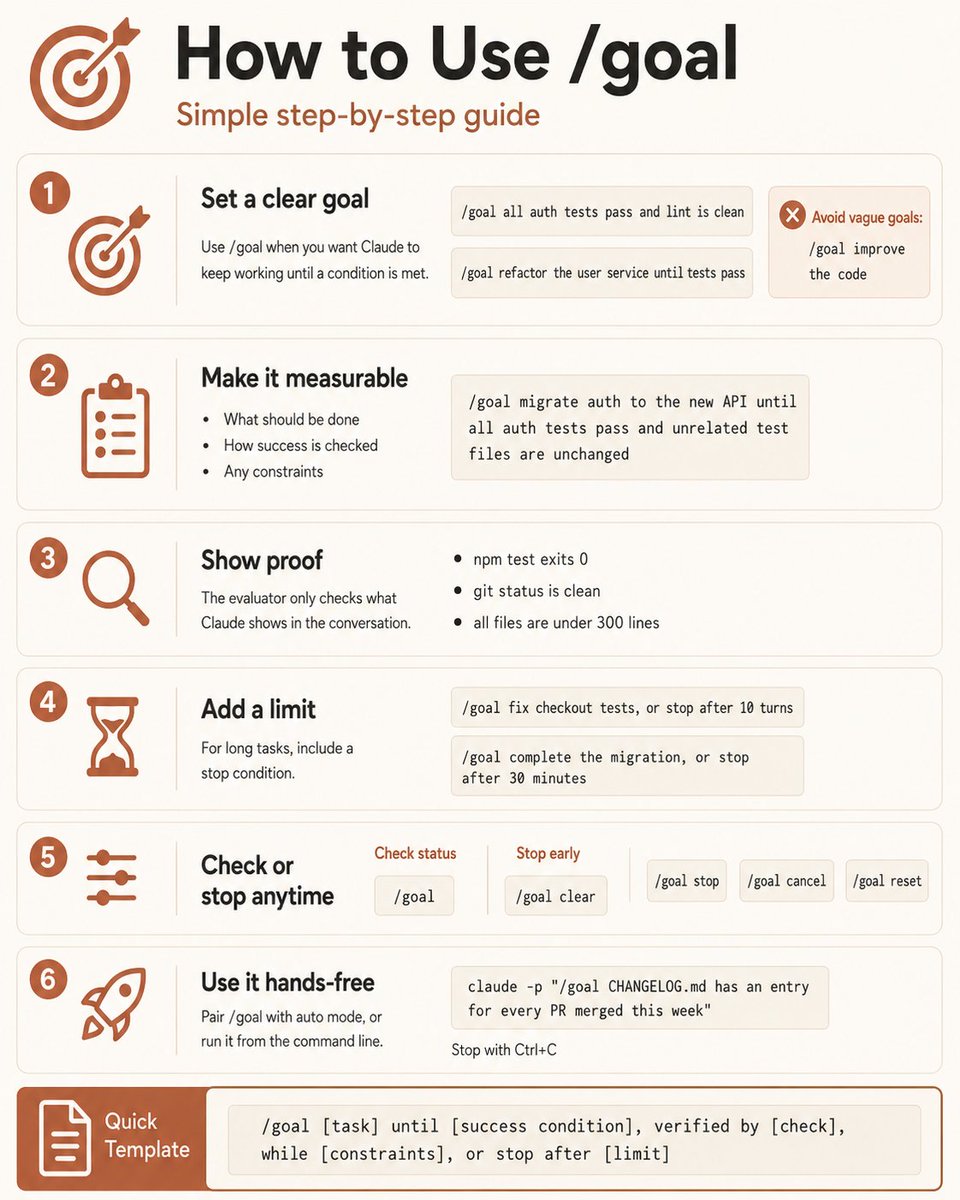
Claude Code /goal is way more powerful when you stop treating it like a todo.
> Set a clear goal.
> Make it measurable.
> Show proof.
> Add limits.
Bookmark this.
Holy sh*t.
Creative agencies are absolutely cooked.
Claude can now connect to Higgsfield and run creative workflows end to end.
Not just “make me a video.”
I mean:
→ understand your brand
→ research your market
→ plan the campaign
→ generate product shots
→ create ad visuals
→ make video concepts
→ organize everything
This is the part people are missing.
AI video is no longer just prompt → clip.
It is becoming an agentic creative team that can take a product, understand the positioning, and generate the entire launch system around it.
Tiny teams are about to look like full agencies.
Introducing Higgsfield Supercomputer
The first ever cloud-native, self-learning AI agent for end-to-end task execution.
40+ built-in tools. Three layers of memory. Access via browser or Telegram.
Powered by enhanced Hermes Agent.
My 30+ observations on the greatest opportunities in AI agents right now:
And some ideas that are keeping me up at night.
1. The new buyer on the internet is an AI agent. Imagine billions of new customers showing up with money to spend but they only shop via MCP. That's what's happening. No MCP server means you're invisible to the fastest growing buyer on the internet.
2. Every franchise system in America (30,000+) needs an agent layer and none of them have one. One founder per franchise vertical. That's 30,000 businesses waiting.
3. Everyone said "distribution is the only moat" a year ago. Now I'd add that the only moat is distribution plus memory. The company that has your audience AND your agent's accumulated context is impossible to leave.
4. Consumer mobile is more interesting than it's been since 2012. Apps can finally DO things for you instead of showing you things. The next wave of $100M apps are being built right now.
5. The most interesting startup nobody has built is an agent marketplace where you rent access to someone else's trained agent. A recruiter spent 6 months training a sourcing agent on healthcare hiring. That agent is worth renting to every other healthcare recruiter on earth. The agent itself becomes the product.
6. A sorta strange phenomenon that's happening right now is agents are developing preferences. Give the same agent the same task 100 times and it starts developing patterns in how it approaches it. Nobody is studying this yet. But the agents that develop good patterns are worth more than the ones that don't. That's a new kind of asset.
7. Dead internet theory is about to become dead SaaS theory. Half the apps you use will quietly replace their support team, their onboarding team, and their content team with agents. You won't notice for months. Then you'll realize you haven't talked to a human at that company in a year.
8. The most valuable data in the world right now is sitting in the support tickets of small or mid tier SaaS companies. Every ticket is a customer telling you exactly what to build next. Mine this.
9. The most interesting pricing problem nobody has solved is how do you price a product when your costs change every time OpenAI or Anthropic updates their model pricing? Your margins can swing 40% overnight based on a decision made in San Francisco. The company that builds dynamic pricing infrastructure for agent-based businesses solves a problem every AI company has.
10. The best AI products feel like they're reading your mind. The worst ones feel like filling out a form with extra steps.
11. An interesting arbitrage I've noticed lately is hiring a human VA for $20/hour to supervise an AI agent that does $200/hour work. The human just checks the output.
12. The managed AI agent business is becoming the new agency model. $5k/month per client. You build it, run it, maintain it. The client gets a digital employee they never have to think about. This will be a $50 B+ category.
13. The first "shadow agent" scandals are about to drop. Employees running personal agents on company infrastructure without telling anyone. Using company API keys. Agents accessing internal docs. IT departments have little visibility into this right now. Lots of opportunity to build companies here. Definitely a painkiller not a vitamin type of business.
14. Right now there are probably millions of agents running on autopilot that their creators forgot about. Still burning tokens. Still sending emails. Still scraping websites. Still costing money. The "find and kill your zombie agents" tool is a product that writes itself.
15. Companies are starting to hire based on someone's agent portfolio instead of their resume. "Show me 3 agents you built that are running right now." It's REALLY early but it's starting.
16. Your Slack archive is a product. Every company's internal Slack has thousands of messages explaining how they actually do things. The company that lets you point an agent at your Slack history and auto-generate SOPs and agents from it will be enormous.
17. We're watching the cost of intelligence fall faster than the cost of distribution. Which means distribution is now the expensive thing.
18. The most underrated asset a human can have in 2026: the ability to sit in a room with another human, make eye contact, and have a real conversation. As AI handles more of the transactional stuff, the humans who can do the relational stuff become disproportionately valuable. The soft skills people used to dismiss as fluffy are becoming the hard skills. The hard skills people spent decades acquiring are becoming the soft ones.
19. There are MANY huge companies to be built around the fact that most people's agents are running on their personal laptops which they also use to browse the internet, check email, and download random files. The attack surface is enormous. One compromised Chrome extension and your agent's API keys, customer data, and workflows are exposed.
20. There's a new type of burnout forming that doesn't have a name. It's not from working too hard. It's from context switching between human work and agent work 50 times a day. Reviewing agent output, correcting it, approving it, reviewing again. The mental load of supervising agents is different from the mental load of doing the work yourself. Some founders are telling me they were less tired when they did everything manually because at least the cognitive pattern was consistent.
21. The cheapest form of market research: search "[your industry] spreadsheet template" on Google. Whatever people are tracking manually is your product.
22. Half the YC companies pivoted within 8 weeks of demo day. Not because they failed. Because agents let them test 5 ideas in the time it used to take to test one. The concept of "committing to an idea" is dissolving. Serial pivoting is becoming the default because 1) AI lets you move fast 2) the world is moving fast.
23. The loneliest job in tech right now is being the only person at your company who understands what the agents are doing. You can't explain it to your boss. You can't hand it off to a colleague. If you leave, everything breaks. You've become a single point of failure for an entire automated system. That person needs a title, a team, and a backup plan. Most companies haven't figured this out yet.
24. Your browser history is the most valuable training data you own and you're giving it away for free. Every site you visit, every product you research, every competitor you study, every pricing page you screenshot. That behavioral data, structured and fed to an agent, would make it understand your business better than any onboarding call. The company that lets you turn your browser history into agent context builds something nobody can replicate.
25. Everyone is building AI wrappers. Nobody is building AI unwrappers. The tool that takes an AI-generated document and tells you which parts a human wrote and which parts were generated.
26. Stripe just became the most important company in the agent economy and they barely had to do anything. Every agent that sells something needs Stripe. Every agent that buys something needs Stripe. They're the payment rail for the entire agentic internet by default.
27. The most undervalued API in the world right now is the US Postal Service address verification API. It's practically free. Every local business lead gen agent needs it. Every real estate agent needs it. Every direct mail agent needs it. Boring government infrastructure is quietly becoming the backbone of agent-native businesses.
28. The concept of "business hours" is for humans. Your agent closed a deal in Tokyo at 3am, processed the payment, sent the onboarding email, and updated the CRM before your alarm went off.
29. What happens when agents start recommending other agents? Your research agent finds that a competitor's sales agent is better and suggests you switch. Agent referral networks are forming organically. The first agent affiliate program is probably 6 months away.
30. Cal dotcom closed their source code. That's the canary. When open source companies start closing up, it means agents were cloning their product too easily. Every open source company is quietly asking the same question right now.
31. "AI for pet groomers" sounds like a joke and that's exactly why it will work. 150,000 of them in America. Zero tech. All scheduling by phone or IG DMs. The joke ideas always win.
32. The thing that will seem most obvious in hindsight: we spent 2025-2026 arguing about which model is best while the entire value was in the orchestration layer. The model is the CPU. Nobody buys a computer based on the CPU anymore. They buy it based on what they can do with it. Makes so much sense in hindsight. What else will be obvious in hindsight?
I'll share more notes soon.
I can't sleep with all that's going on. Maybe you too.
What an incredible time to be building.
my entire content strategy is this
give you free startup ideas + growth playbooks that work
i won't hold back
and every time you build something from my tweets/pod I'm sippin' a martini & cheering you on
your success is my ultimate flex
now go ship something & make me proud
I built an AI agent to run a local liquidation arbitrage business.
Overnight it scanned 327 restaurant listings and flagged 10 deals.
The best one: a kitchen hood with a 300% spread.
Here's the simple breakdown:
Scrape: The agent monitors closing restaurants across:
- BizBuySell
- AuctionZip
- BidSpotter
- Craigslist
- County bankruptcy court
Runs every day. Surfaces fresh listings.
Value: It pulls comps for 40+ equipment types and cross-checks live eBay sold prices.
You see market value, asking price, and the spread on one card.
Broker: It posts the best deals to Slack, ranked by margin.
You bring buyer to seller and charge 15–30%.
Zero inventory. Zero storage.
Think:
- Scrape = where the deals live
- Value = what they're really worth
- Broker = how you get paid
Boring business.
Real margin.
Build your own agents: https://t.co/7wAVKHJwaA
YES! This is the one feature from OpenAI that I've been wanting more than anything else. I've become a fan of Codex lately but the biggest downside was that I needed to be at my computer to steer it! This is huge for my workflows!
We invited Claude users to share how they use AI, what they dream it could make possible, and what they fear it might do.
Nearly 81,000 people responded in one week—the largest qualitative study of its kind.
Read more: https://t.co/tmp2RnZxRm
We're shipping a new feature in Claude Cowork as a research preview that I'm excited about: Dispatch!
One persistent conversation with Claude that runs on your computer. Message it from your phone. Come back to finished work.
To try it out, download Claude Desktop, then pair your phone.
Introducing Claude Opus 4.6. Our smartest model got an upgrade.
Opus 4.6 plans more carefully, sustains agentic tasks for longer, operates reliably in massive codebases, and catches its own mistakes.
It’s also our first Opus-class model with 1M token context in beta.
Wild.
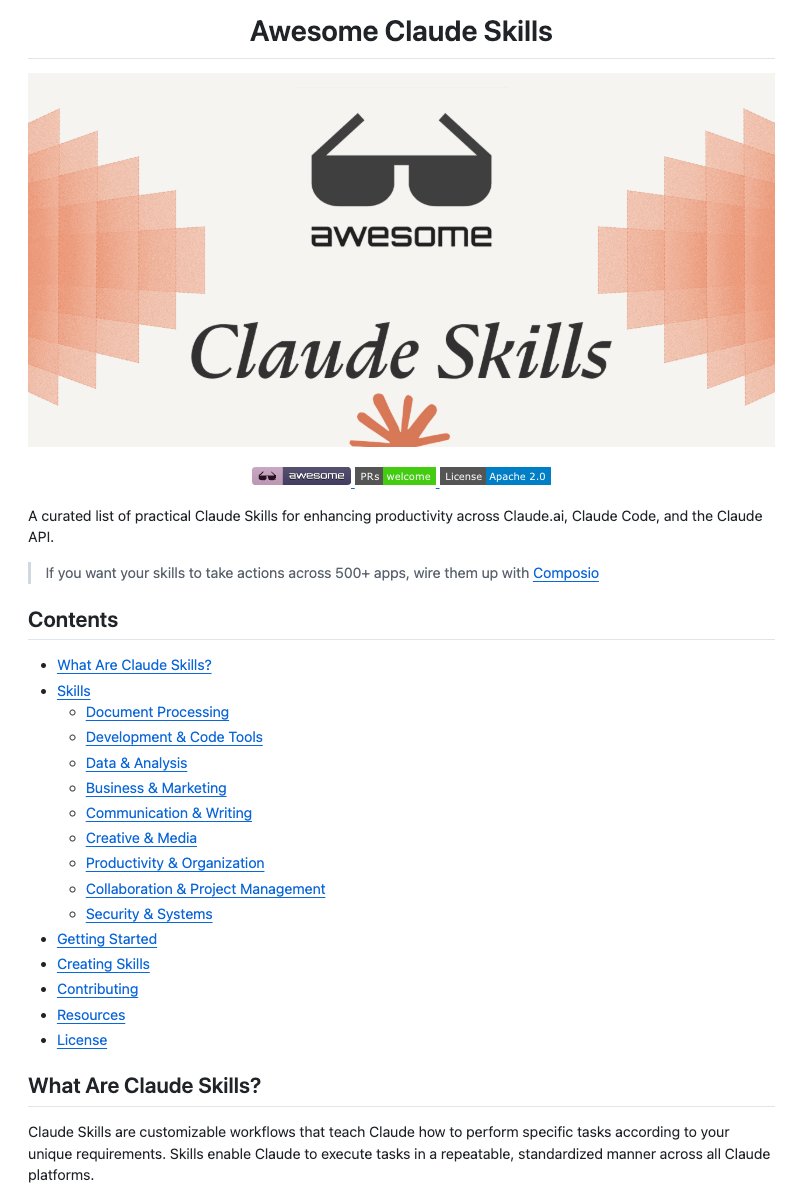
By far the most complete Claude Skills repo yet 🤯
@Composio’s Awesome-Claude-Skills packs 100`s of ready-to-use workflows:
↳ PDF tools, changelog generation
↳ Playwright automation
↳ AWS/CDK tools, MCP builders
... and much more!
Free and open-source.
Repo in 🧵↓