Everyone is talking about context engineering now.
We've been dealing with this at CrewAI for 2 years. Just didn't have a name for it.
Context engineering goes way beyond better prompting. It's everything your agent operates inside: memory, tools, state, task history, retrieval. The whole environment, not just the instruction.
After billions of agent executions, the pattern is obvious. Teams stuck in POC purgatory almost always have a context problem, not a model problem.
Most teams treat context as static. Build a prompt, ship it, done. But production context is alive. It shifts with every execution, every user, every edge case the prompt never anticipated.
And then the opposite mistake: dumping everything in. More data must be better, right? No. Noisy context is worse than no context. The agent can't separate signal from noise.
The biggest one though is that teams don't compound. Every run starts from zero. Same discovery, same mistakes, same ceiling. Run it a thousand times and the thousand-and-first is no smarter than the first.
This is why compounding memory became central to what we do at CrewAI. The system should get better because it ran before. That's the whole point.
The term is already getting watered down tho. Seeing "context engineering" on every landing page now. The actual hard work, dynamic selection, relevance scoring, memory that actually compounds... barely anyone has cracked this. Including us. Still so much to figure out here.
Here's a test I keep using with enterprise teams.
If your AI stopped working tonight, would a person notice, or would only a dashboard catch it?
Person notices → ad-hoc AI. Human-driven, self-correcting. If it gets something wrong, you catch it and move on. Blast radius is one person.
Dashboard catches it → embedded AI. Running whether you're thinking about it or not. When it fails, it fails at scale, silently, until something downstream breaks.
Most teams don't make this distinction clearly enough. They build embedded workflows with ad-hoc tooling and wonder why production falls apart.
Ad-hoc needs to be fast, creative, good with half-formed context. Embedded needs to be reliable, deterministic, sharp enough to pull clean signals out of messy systems every single day without getting creative about it.
Different problems. Different tooling. Most of the industry is still building for one and hoping it covers both.
Most agent projects I see are negative ROI. Not because the agents don't work. Because they never make it to production.
We run most of our agents on GPT-4o mini. The models are fine. What actually kills enterprise agent projects is the trust gap. Governance they can't meet, data exposure they can't control, no observability layer. The org just won't let it go live.
We work with PepsiCo, the Department of Defense, DocuSign. Every one of them went through the same realization that building is actually the easy part and all the real work goes into making the system trustworthy enough to deploy.
If you can't observe it, you can't trust it. I keep saying it because I keep watching it play out.
this is the most underrated update in the agent space right now.
your AI workflow runs for 47 minutes, burns 312 LLM calls, then crashes at step 8.
most frameworks make you restart from zero.
@crewAIInc just shipped checkpointing. think google docs autosave, but for your agent's work-in-progress. every flow method becomes a recovery point.
resume in one line. fork from any saved state into a new branch. edit past outputs and watch changes ripple downstream. visual TUI to inspect everything.
your pipelines stop being fragile one-shot jobs. they become resumable, inspectable, branchable processes.
zero extra infra. 100% open-source.
get started with CrewAI here: https://t.co/bPGE0cGOIm
(don't forget to star it ⭐️)
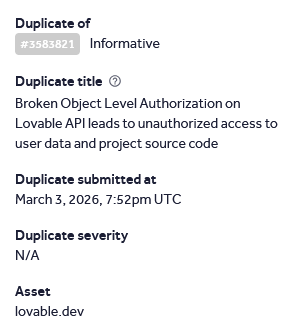
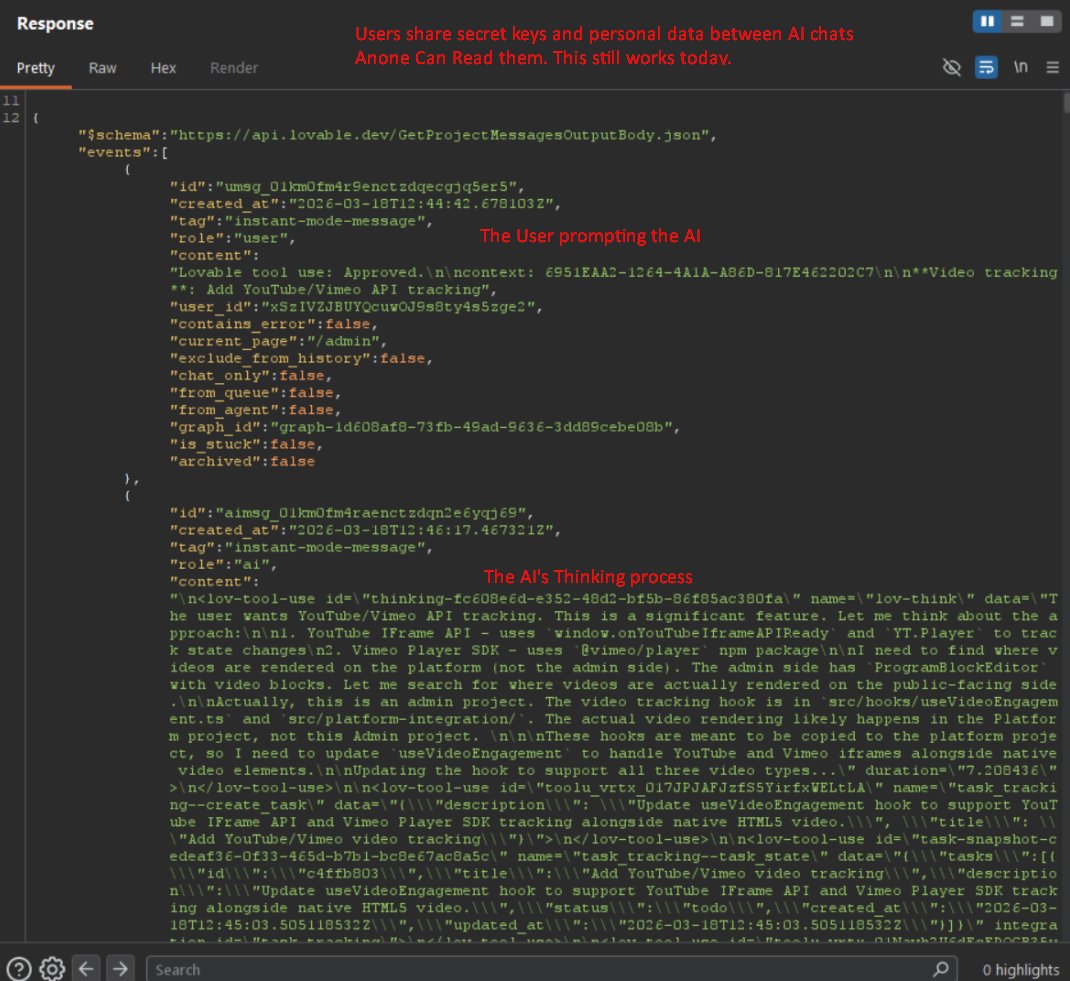
Lovable has a mass data breach affecting every project created before november 2025.
I made a lovable account today and was able to access another users source code, database credentials, AI chat histories, and customer data are all readable by any free account.
nvidia, microsoft, uber, and spotify employees all have accounts. the bug was reported 48 days ago. its not fixed. They marked it as duplicate and left it open.
We grew the company around 10% last month, meanwhile engineering output and cross department perception of quality and speed is 2-4x.
It’s definitely getting closer and closer to a brand new future of company building.
Our financial model for CrewAI for this year has been to double the team, I’m now thinking of revisiting that. On top of that average selling price keeps going up, time to close going down and as we focus on the hard pieces.
There is a lot of marketing going on in the industry, some wishful thinking, but no matter what things are getting interesting by the day! Take your shot
Breaking news! CrewAI was just named to the 2026 Enterprise Tech 30 Early Stage list!
Special thanks to our team and customers, but also recognizing the real story here which is enterprise adoption of AI agents is accelerating fast, and we’re grateful to be an enabler of it.
Huge thanks to @Wing Venture Capital and @EricNewcomer for the recognition.
#ET30
https://t.co/CeLh6EFNAV
We didn't just add a https://t.co/dqANE44wEO() to CrewAI.
We built an agentic system to manage the agentic system.
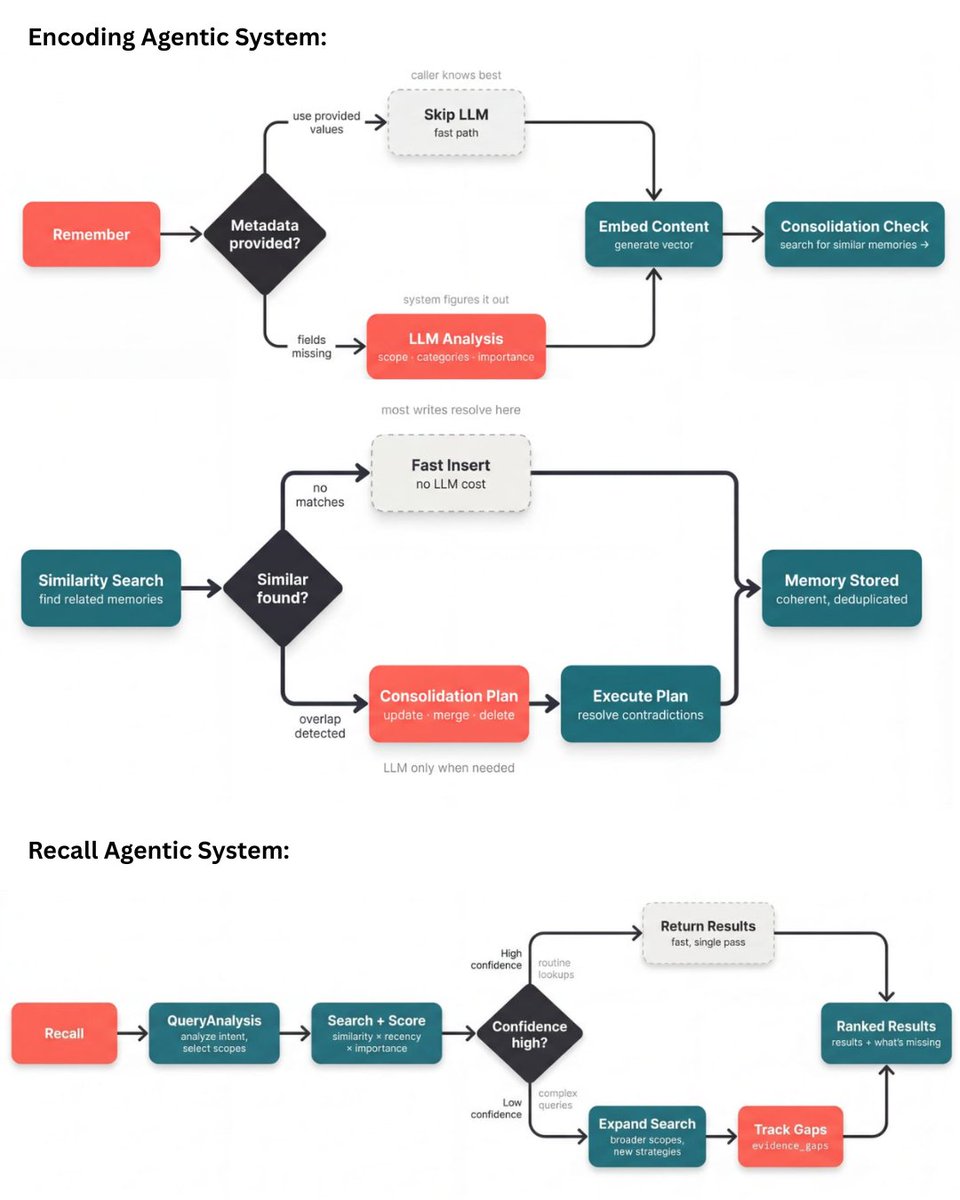
Here's what actually happens when you call memory.remember():
You're triggering a full cognitive pipeline with 3 layers that most memory implementations have never attempted.
Most AI memory implementations store 500-word blobs and retrieve by rough vector similarity.
That fails in production because context bleeds, facts contaminate each other, and a trivial note from yesterday outranks a critical architecture decision from 6 months ago.
The result is an agent that confidently recalls the wrong thing.
We solved this with 3 layers:
1. Atomic Facts (Encoding Flow)
Raw output gets decomposed into discrete, self-contained facts.
"Postgres is the DB" and "Budget is $2k" are stored and processed independently, not as a blob.
Each fact can be recalled, updated, and scored without contaminating anything else.
2. Composite Scoring (Recall Flow)
score = (similarity x w_sim) + (recency x w_rec) + (importance x w_imp)
A critical architecture decision from 6 months ago outranks a trivial note from yesterday that happens to mention "database."
Pure vector search returns the trivial note. Cognitive scoring returns the decision.
3. Evidence Gaps
If recall confidence is low, the system doesn't guess. It knows what it doesn't know.
The Recall Flow broadens its search scope, tries different retrieval strategies, and tracks what's missing as evidence_gaps — a live record of uncertainty.
That's hallucination mitigation built into the memory architecture itself, not bolted on after.
All 3 layers fire from memory=True.
One flag activates an agentic system that encodes, recalls, and knows what it doesn't know, running underneath your agents so they don't have to manage it themselves.
That's the inception.
Building with memory enabled or have questions about how any of these layers work? Drop them below. I'll answer.
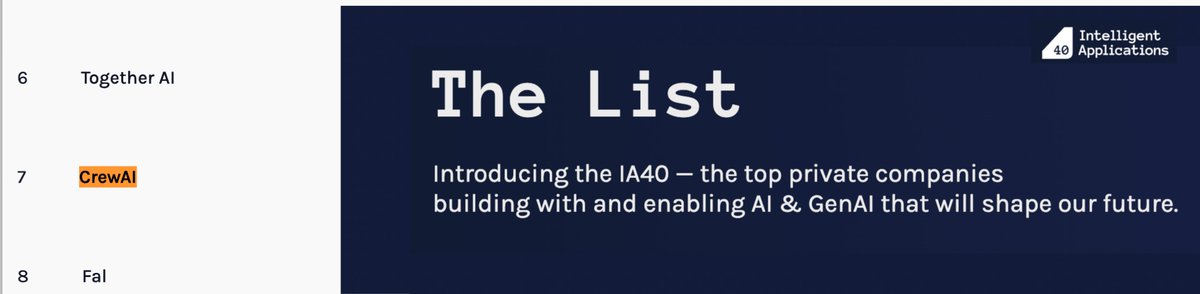
😱😱 CrewAI is the only Agentic Management Platform on the 2025 IA Enablers List — alongside OpenAI & Anthropic.
And we got here with a fraction of the capital. 👇
Not a demo. Not a pilot. This is production.
PwC just launched Agent OS — and CrewAI is a piece at the core.
🧵 Here’s how we’re scaling real AI agents across global enterprise systems:
🚨 Just dropped a no-BS deep dive with Brandon on AI agents, CrewAI’s architecture, and what it really takes to run agents in production.
Link in the next tweet.
Agents aren’t toys anymore.
Here’s what we covered — and why it matters 👇
Build an Agentic RAG Recommendation Engine in minutes vs months! 🔥
Using @crewAIInc, #Docling, @ExaAILabs, & @weaviate_io, learn how to:
✅ Build a recommendation engine with agents
✅ Agentic rag in action
✅ Turn spreadsheets into vectors
[link in next thread]









![crewAIInc's tweet photo. Build an Agentic RAG Recommendation Engine in minutes vs months! 🔥
Using @crewAIInc, #Docling, @ExaAILabs, & @weaviate_io, learn how to:
✅ Build a recommendation engine with agents
✅ Agentic rag in action
✅ Turn spreadsheets into vectors
[link in next thread] https://t.co/gTs0DcuH4d](https://pbs.twimg.com/media/GiVRzsTWYAAdZAP.jpg)





