mere alfaaz sirf dukh nahi,
yeh mohabbat ki misaal hain,
har lafz ek dastak,
jo sirf uske dil ke darwaze pe bajti hai.
main likhta hoon,
kyunki har sher uska naam hai,
har misaal uski yaad,
aur har jumla sirf ek baat kehta hai—
mohabbat abhi zinda hai.
🚨 FIFA chief Mattias Grafstrom tells staff that “individuals + unfortunate episodes come & go” as pressure mounts on Gianni Infantino. Adds: “sad & reproachable series of events… thankfully concluded with FFE project permanently abandoned” @TheAthleticFC https://t.co/zmVqMfDaSh
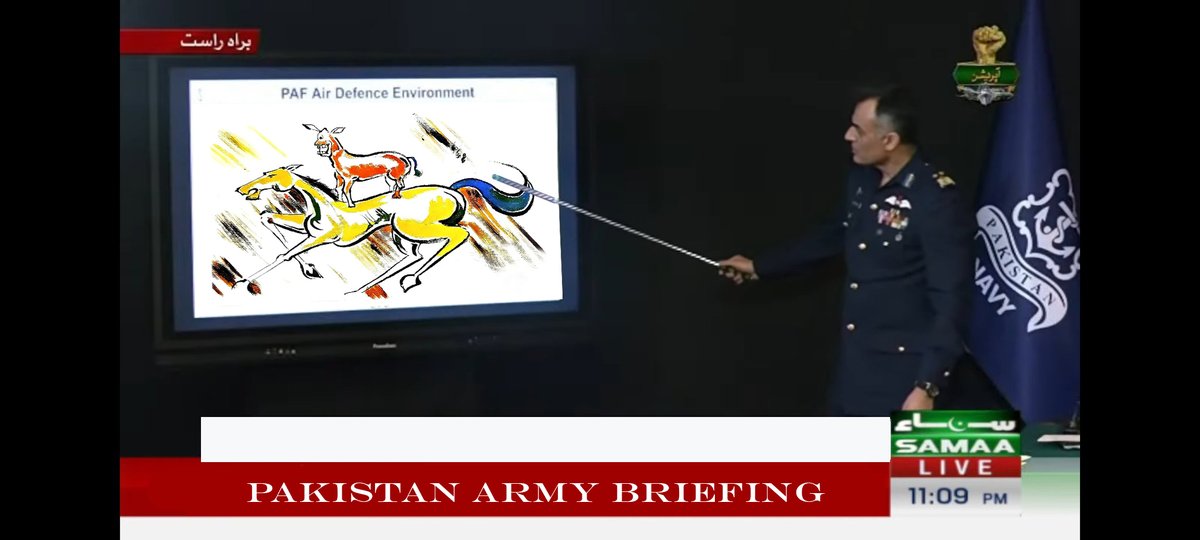
Indian military press briefings: Every word backed by satellite imagery, surveillance data, and video proof.
Pakistani military press briefing: Every word backed by memes and tweets.
LOL, I just spoke to Sqn Ldr Shivangi Singh, the woman IAF pilot these clowns at Al Jazeera are claiming has been captured by Pakistan. She’s at her base and on duty.
India has struck 11 Pakistani airbases.
Nur Khan, Murid, Sialkot, Rafiqui, Sukkur, Pasrur, Chunian, Sargodha, Skardu, Bholari, Shahbaz/Jacobabad.
That’s what made Pakistan freak out and dial India.
Absolute and utter humiliation.
History will remember Shehbaz Sharif not as a leader, but as the man who fast-tracked Pakistan’s downfall. A legacy of begging bowls, blunders, and national humiliation.
This is what victory looks like.
India’s 90 minutes targeted strikes on major Pakistani airbases during #OperationSindoor marked a decisive shift in regional military dynamics. These preemptive and precision attacks dismantled Pakistan’s ability to maintain air superiority, coordinate national defense, and project any meaningful counter-response. Each base served a critical function, and its destruction inflicted strategic and psychological damage on the Pakistani military establishment.
1. Nur Khan/Chaklala Airbase (Rawalpindi)
India’s strike on Nur Khan disrupted the heart of Pakistan’s air logistics and high-level military coordination. As the base closest to Islamabad, often used for VIP transport and military logistics, its neutralization severed critical links between the Pakistan Air Force (PAF) leadership and its operational units during the conflict.
2. PAF Base Rafiqui (Shorkot)
Rafiqui, a key fighter base hosting frontline combat squadrons, was rendered inoperable. The destruction of its aircraft shelters and runway infrastructure significantly weakened Pakistan’s ability to launch counter-air operations, especially in central Punjab. This move effectively removed one of PAF’s sharpest offensive tools.
3. Murid Airbase (Punjab)
By targeting Murid, India disrupted a vital training and potential missile storage hub. The strike degraded Pakistan’s long-term air force readiness, cutting off a critical node in the pilot training pipeline and eliminating logistical depth for future operations.
4. Sukkur Airbase (Sindh)
India’s destruction of Sukkur Airbase cut Pakistan’s southern air corridor. Sukkur had been essential for troop and equipment movement across Sindh and Balochistan. Its loss severed key logistical arteries and reduced Pakistan’s operational range in the south.
5. Sialkot Airbase (Eastern Punjab)
Sialkot, situated close to the Indian border, was neutralized early in the conflict. This base had served as a forward-operating platform for launching sorties toward Jammu and Punjab. Its loss created a significant blind spot along the eastern frontier, exposing Pakistani ground forces to unchallenged Indian aerial dominance.
6. Pasrur Airstrip (Punjab)
Though smaller in scale, the Pasrur facility played a role in dispersal and emergency aircraft operations. By taking it out, India reduced Pakistan’s tactical flexibility and forced aircraft to concentrate at more vulnerable, high-profile locations.
7. Chunian (Radar/Support Installation)
Strikes on Chunian disrupted radar coverage and communications infrastructure vital for central Punjab’s airspace monitoring. This left a gap in Pakistan’s early warning systems, allowing Indian aircraft deeper penetration with reduced risk.
8. Sargodha Airbase (Mushaf Base)
The destruction of Sargodha was a strategic masterstroke. As the most critical base in Pakistan—home to the Combat Commanders School, nuclear delivery platforms, and elite squadrons—its decimation crippled Pakistan’s command-and-control structure. The blow was both operational and symbolic, shattering the myth of an invulnerable PAF.
9. Skardu Airbase (Gilgit-Baltistan)
India’s neutralization of Skardu degraded Pakistan’s northern surveillance and air operations near the Line of Actual Control. It also disrupted logistical links that could have supported Chinese-Pakistani coordination in the high Himalayas. The strategic advantage in the northern theater now firmly belongs to India.
10. Bholari Airbase (Near Karachi)
As one of Pakistan’s newest airbases with dual-use naval and air roles, Bholari had symbolized future ambitions of southern force projection. Its destruction erased those aspirations, compromising coastal defense coordination and leaving Karachi vulnerable to further strikes.
11. Jacobabad Airbase (Sindh-Balochistan)
Jacobabad’s neutralization further isolated western Pakistan. Historically used for rapid troop deployment and even by U.S. forces during the war on terror, its destruction cut off internal mobility, supply chains, and Pakistan’s western air surveillance.
In conclusion, India’s swift and coordinated strikes on these airbases delivered a strategic knockout to Pakistan’s aerial capabilities. The dismantling of radar networks, command hubs, and strike platforms left the PAF blind, grounded, and disoriented. More than just battlefield wins, these were structural demolitions—designed to disable Pakistan’s ability to fight today and deter it from even contemplating aggression in the future.
This operation not only demonstrated India’s technological and tactical superiority but also redefined the rules of engagement in South Asia. The destruction of Pakistan’s airbases sent an unambiguous message: India now holds the initiative, and the cost of provocation will be catastrophic.
Operation Sindoor vs. Operation Bunyan Ul Marsoos
Some of the firsts
One :
Realizing the stalemated status or irrelevance of the UNSC, India didn’t seek to request sympathy from the five of the 1945. Operation Sindoor clearly demonstrated a strong sense of self-confidence and real strategic autonomy and sovereignty.
Two:
For the first time, India shredded the notion that terrorists are separate from terrorist backers and thus targeted both. The notion that certain powerful rogue officers of Pakistani State authorize terrorist attacks was also shredded. This is a new paradigm. Another type of deniability must be invented.
Third:
There was a battle going and a war being planned. In the midst of the battle, Pakistan negotiated for a loan from the IMF, which surprisingly approved it. It matters because most likely Pakistan isn’t fit enough to finance a war but has capabilities to engage in battles. A war can't be won with IMF loans anyway.
Fourth:
The strategic patience and cultural restraint have a limit. That limit was tested on April 22 by the Lashkar Teyba terrorists. Perhaps they wanted what followed. They didn’t benefit from their adventure though. Perhaps they wanted to humiliate India publicly. They seem to be mentally stuck in 2008.
Fifth:
Size matters. Every inch of Pakistan was under reach. I always thought the Nur Khan airbase was the best defended base of Pakistan. It isn’t. The grarrison town of Rawilpindi as the heart of Pakistan’s military and its best-known airbase was hit.
Sixth:
Pakistan lost the monopoly over Islamic Fatwa. The Indian ulema presented a fatwa of their own to their own government. Thus, the religious dimension always exploited by Pakistan to earn sympathy from the Muslim Ummah evaporated. Deoband is located in India by the way.
Seventh:
Keeping secrets in a democratic society is next to impossible, but very little leaked out of India, which shows enormous skills in adhering to principles of operational silence and public unity to assist in safeguarding of secrets.
Note: I have seen very little or no visuals from Operation Bunyan Ul Marsoos to comment on. Seemingly, it never took off the way it was propagated. The ceasefire saved Pakistan’s skin. Pakistan military leadership has made statements and claims over their own achievements, but the Indian skies remained open, flights weren’t cancelled, and I haven’t seen visuals of missiles landing in Delhi or Amritsar.