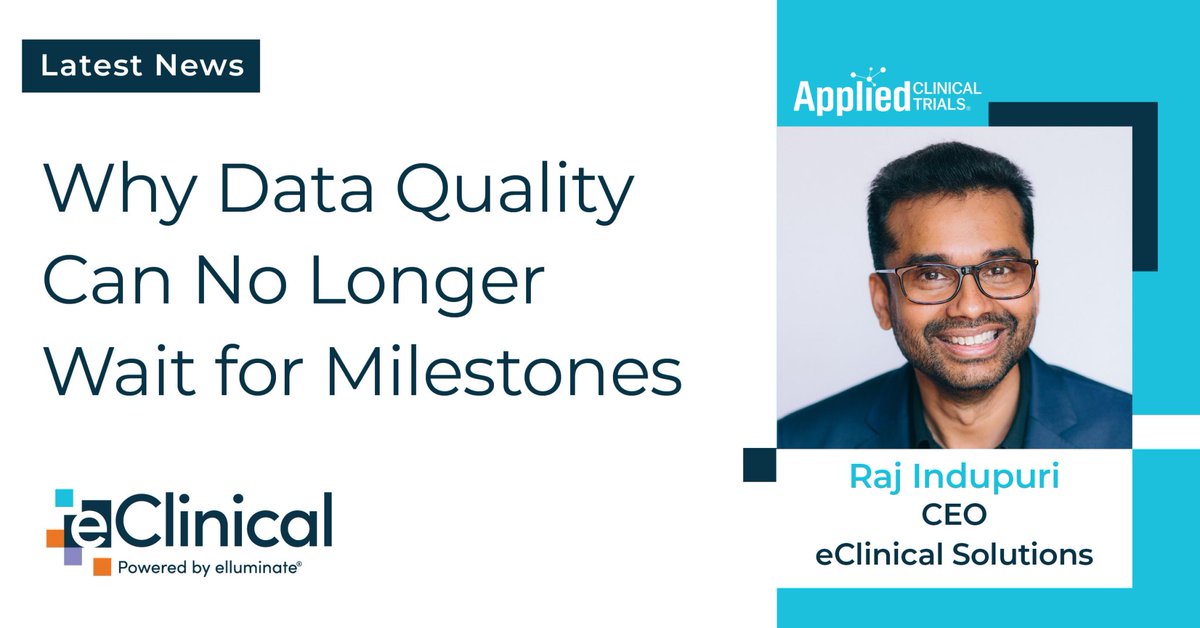
Clinical development is often run as a sequence of handoffs. But what if it could operate more like a continuous learning system?
eClinical Solutions Co-Founder and CEO Raj_Indupuri recently joined the Life Sciences Today Podcast by @hcittoday to discuss how the industry can move beyond milestone-based, sequential trials and toward a more agile, data-driven model.
Listen to the full conversation here: https://t.co/d9TCQaTcAM
The FDA's push toward real-time clinical trial data review requires not just a technology upgrade, but a fundamental change in how data quality and governance are practiced.
eClinical CEO and co-founder @Raj_Indupuri explains how governance and quality must be built into every stage of the trial lifecycle—not only enforced at database lock or submission—and what that requires from teams and technology.
Full interview with @Clin_Trials is here: https://t.co/SUEEjAbuJZ
When agents run on a governed foundation, the gains are clear. Large-scale data review moves from hours or days to minutes.
AI works best as a teammate that handles volume and patterns while humans stay accountable for judgment and patient impact.
Grateful for the conversation on The Scope of Things podcast.
Full episode here:
https://t.co/m8UUVaV3m6
When data foundations are fragmented, agents scale the confusion instead of solving it. In regulated environments, governance needs lineage and explainability, not black boxes. The real shift is redesigning workflows, not just adding tools.
Alex Karp’s take this week hit the nail on the head.
The real move isn’t renting tokens. It’s owning your data stack and governance so AI becomes an extension of your own capability, not a black box.
This is exactly the principle we have doubled down on. In the clinical development arena, that ownership is table stakes for running trusted agents at scale.
elluminate gives sponsors full control of their clinical data intelligence layer. It is a governed backbone they can extend with their own logic. Combined with our deep biometrics domain expertise, it creates a software and services flywheel that delivers true ownership and speed.
The result? A bigger opportunity than we modeled, and execution that is actually defensible.
Grateful to see this approach resonating.
Strong piece and incredibly well written.
Completely agree that clinical development is where the real bottleneck and lasting value creation will be as discovery becomes abundant.
At eClinical, this is exactly why we are focused on building the infrastructure that enables high quality trials that are faster and cheaper: unified data, strong governance, and validated execution layers that allow AI to be deployed safely and effectively.
While AI is already automating many routine tasks in clinical development, I believe it will never fully replace the challenges of patient heterogeneity, real-world safety monitoring, nuanced human judgment, regulatory accountability, and sponsor-specific contextual decision-making required in regulated trial execution.
The winning platforms will be those that best combine powerful models with a trusted execution layer.
Excited to see more innovation focused on solving the clinical side of the equation.
One question I keep hearing from life sciences leaders:
“We have powerful AI models and good data. Why is moving from pilot to real impact still so hard?”
The missing piece is usually the bridge between data, expertise, and daily clinical operations.
The real progress comes when you convert deep services knowledge (biometrics patterns, regulatory judgment, workflow context) into reusable infrastructure and agentic capabilities.
That services-to-product translation is what turns AI from impressive demos into safe, scalable execution in regulated environments.
Leaders who invest here early are pulling ahead.
How are you approaching this in your organization?
#AIinHealthcare #ClinicalData #VerticalSaaS
AI won’t kill vertical SaaS in regulated industries. It will make the gap between leaders and everyone else much wider.
In clinical development, the real differentiator has always been the ability to turn fragmented, high-stakes data into governed, validated, and accountable execution. This requires deep domain knowledge and infrastructure that general AI tools don’t have and can’t easily build.
As agents become more capable, this advantage compounds. Companies that have already embedded execution intelligence into their platforms can move faster and more safely. Those without it will continue to struggle with pilots that never scale.
The result isn’t commoditization. It’s a widening gap between vertical platforms that own the execution layer and those that don’t.
#VerticalSaaS #AIinHealthcare #ClinicalData
“This is where the opportunity for industry impact becomes extremely exciting.” - @Raj_Indupuri, CEO of eClinical Solutions
Earlier this month, the FDA announced it is seeking input from industry stakeholders on how it can better tap into the potential of existing drugs.
For many pharma organizations, this represents a major opportunity. Companies already hold enormous volumes of underutilized data from across the clinical trial spectrum — data that could help uncover new insights, identify new use cases, and accelerate innovation.
But these datasets are often collected and stored across a patchwork of systems and databases, making meaningful analysis increasingly complex.
Raj spoke with Alivia Kaylor about how AI and machine learning can help organizations identify relationships and signals across datasets that may not be apparent through traditional analysis.
Read more in @PharmaVoice: https://t.co/HojmHv9pYr
This gets to the heart of it. In vertical SaaS and regulated domains the key is owning the learning loop. That means building the infrastructure, governance, and execution layer that keeps institutional knowledge proprietary and agents reliable.
In clinical development we have seen how this foundation turns years of governed data and services context into the difference between pilots and production-grade agentic systems.
The ones who get this right will create durable value instead of commoditizing it.
The argument against replacing enterprise platforms with custom AI builds is even stronger in regulated verticals like clinical development.
You’re not just replacing software. You’re replacing governed data infrastructure, validated lineage, auditability, and the accountable execution layer that regulators and sponsors require.
AI becomes an incredibly powerful capability inside these trusted platforms — not a replacement.
The moat is clearer than ever.
The "SaaSpocalypse" seemed to be over.
But over the last two weeks:
$NOW went from $139 to $102
$CRM went from $211 to $165
$PLTR went from $163 to $127
$ADBE went from $274 to $204
The market is once again questioning whether AI will replace enterprise software.
The CEO of $NOW explained it perfectly:
"The market thinks maybe I can do everything with a language model and build the software myself. But that's not gonna happen. Why would companies rebuild software like $NOW and pay 10x more?"
Building software with LLMs is possible.
Replacing mission-critical software used by thousands of enterprises is a completely different challenge.
Custom-built solutions are more expensive, harder to maintain, and create additional complexity.
Meanwhile, companies like $NOW and $CRM are integrating AI directly into their platforms.
AI isn't replacing enterprise software.
It's becoming another feature inside it.
One underappreciated advantage in regulated vertical SaaS is already having a strong services business in place. It gives deep operational context and functions as a services execution layer. We’re actively leveraging both as we build and embed agents.
This makes the trusted execution layer more powerful. The agents aren’t operating in a vacuum. They’re grounded in real workflows and domain accountability that took years to develop.
The moat isn’t the agents or the services in isolation. It’s the combination of governed data infrastructure, validated processes, and services context working together.
How are you seeing teams integrate services context when moving agents from pilots into production? @lukesophinos
Really like this framing on services as a moat. We’re fortunate to have a strong services business that gives us deep context and functions as a services execution layer. We’re actively leveraging both as we build and embed agents. It makes the trusted execution layer even more powerful because the agents aren’t starting from scratch. They’re grounded in real operational workflows and domain accountability that took years to develop.
The moat isn’t the agents or the services in isolation. It’s the combination of governed data infrastructure, validated processes, and services context working together.
Curious how you’re seeing services context get integrated when teams move from pilots to production agents in other verticals.
This shift from pilots to enterprise orchestration is exactly where the real challenges and opportunities emerge. In clinical development, moving beyond point solutions requires deep investment in data infrastructure, governance, and accountable execution layers. These areas are still underdeveloped in most organizations.
This is an important point. In clinical development, AI governance goes far beyond model accuracy. It touches data infrastructure, workflow redesign, accountability, liability, and trust. The organizations that treat the full execution layer as a core capability will have a real advantage.
This is a clear signal of where enterprise platforms are heading.
As AI agents become more capable, the real advantage shifts to platforms that can expose governed, secure, and well-structured capabilities via APIs and headless interfaces rather than relying on traditional UIs.
We’ve been moving in this direction with headless elluminate for the same reason: enabling intelligent agents to interact directly with clinical data in a compliant, auditable way.
The companies that win will be the ones that make their core capabilities safely and reliably consumable by agents.
#Headless #AgenticAI #ClinicalData
Welcome Salesforce Headless 360: No Browser Required! Our API is the UI. Entire Salesforce & Agentforce & Slack platforms are now exposed as APIs, MCP, & CLI. All AI agents can access data, workflows, and tasks directly in Slack, Voice, or anywhere else with Salesforce Headless 360. Faster builds, agentic everything. 🚀
#Salesforce #Agentforce #AI https://t.co/g67TxpNIpT
The SaaSpocolypse narrative assumes AI will kill SaaS by commoditizing features. That view misses what actually matters in vertical SaaS, especially in regulated domains.
In clinical development, the real advantage was never another dashboard or workflow. It was building the infrastructure that turns fragmented data into governed, validated, and accountable execution using deep domain knowledge. AI doesn’t erase that layer. It makes owning it significantly more valuable.
The companies that did this work years ago now have a foundation general AI tools can’t easily replicate.
#SaaSpocolypse #VerticalSaaS #ClinicalData
This is very true. We’re still early, especially in high-stakes, regulated domains.
In clinical development, the models are improving fast, but the real constraint isn’t model capability. It’s the execution layer underneath: the data infrastructure, governance, lineage, and accountable workflows that actually allow agents to operate reliably at scale.
Most of the hard work still lies in building (and continuously maintaining) that trusted execution substrate. Without it, even advanced models remain limited to pilots and narrow use cases.
The gap between what AI can do and what it can reliably do in production is still enormous in complex verticals.
This resonates. In clinical development, vertical AI doesn’t replace domain expertise. It amplifies it.
We’ve spent years converting deep biometrics and execution knowledge (data review, mapping, statistical workflows, sponsor-specific patterns, and regulatory judgment) into reusable infrastructure and agentic capabilities. That “services-to-product” translation is what allows agents to operate reliably inside regulated environments instead of just in demos.
The teams that will win aren’t the ones with the best models. They’re the ones who’ve turned hard-won domain execution knowledge into the foundation agents can actually run on.