Bengaluru's Bold New Plan: Funding Infrastructure Through Real Estate
One of the most interesting real estate policy proposals to emerge from Bengaluru is Value Capture Financing (VCF).
The Detailed Project Report (DPR) for the proposed ₹1,300 crore, 11.6 km elevated corridor connecting Indiranagar to Silk Board suggests funding the project through a levy on properties that benefit from improved connectivity, instead of tolls. The logic is straightforward: if public infrastructure increases the value of surrounding land, a portion of that value should help pay for the infrastructure itself.
Globally, this isn't a new idea. Cities like Hong Kong, London and Singapore have used versions of value capture to fund transport networks and urban development. Bengaluru could be taking its first meaningful step in the same direction.
That said, the proposal has both merits and concerns.
On the positive side, it creates a sustainable way to finance infrastructure without burdening the wider taxpayer. It aligns the cost with those who directly benefit, reduces dependence on public borrowing, and could accelerate the delivery of much-needed infrastructure. Better roads and connectivity also tend to drive higher property values, stronger rental demand and increased economic activity over the long term.
However, there are legitimate concerns. Additional levies increase the holding cost of real estate, particularly for homeowners and developers already facing high approval costs and property taxes. If the levy is poorly designed or applied too broadly, it could discourage investment or unfairly impact owners who do not immediately realise the benefits of appreciation. Transparency in how the funds are collected and utilised will also be critical to building public trust.
It is important to note that this remains only a proposal within the DPR and has not yet received government approval.
Regardless of whether it is implemented in its current form, it reflects a broader shift in urban planning. As our cities grow, infrastructure and real estate are becoming increasingly interconnected. Going forward, developers and investors may need to evaluate not only the upside of infrastructure-led appreciation, but also the possibility of sharing in the cost of creating that value. For those of us building cities, this is a conversation worth following closely.
Bengaluru's proposed move to raise the high-rise threshold from 15m to 21m may appear technical. It is anything but.
Cities do not become global economic engines by expanding endlessly outward. They mature by learning to accommodate more people, more productivity, and more opportunity within the same footprint.
This proposal is less about six additional metres and more about a philosophical shift: from sprawl to density, from horizontal growth to vertical efficiency.
The biggest beneficiaries may not be large developers, but smaller urban builders capable of redeveloping underutilized plots in established neighbourhoods. The true unlock is not height—it is land productivity.
If supported by investments in transit, water, and civic infrastructure, this could mark the beginning of Bengaluru's most important urban transformation since the IT boom.
The future of Bengaluru will not be built at its edges.
It will be rebuilt from within.
Karnataka has launched a 100-day “My e-Khata, My Hakku” drive that could reshape Bengaluru real estate.
B-Khata property owners can now convert to A-Khata at just 2% of guidance value instead of the earlier 5%.
Potential impact:
• Nearly 7 lakh properties affected
• Improved legality & documentation
• Easier home loans
• Higher resale value
• Faster approvals & transactions
This is not just a citizen scheme.
It’s one of Bengaluru’s largest real estate formalisation moves ever.
Infrastructure creates value long before buildings do. This is a rule of Real estate investing.
Bengaluru’s proposed second airport in South Bengaluru + a 9,000-acre AI City in Bidadi could quietly redraw the city’s real estate map.
North Bengaluru was the airport trade.East Bengaluru was the tech trade.South-West Bengaluru may be the next land trade.
Airports compress distance, attract capital, and change where demand wants to live.
In real estate, the biggest returns often come from spotting infrastructure before it becomes obvious.
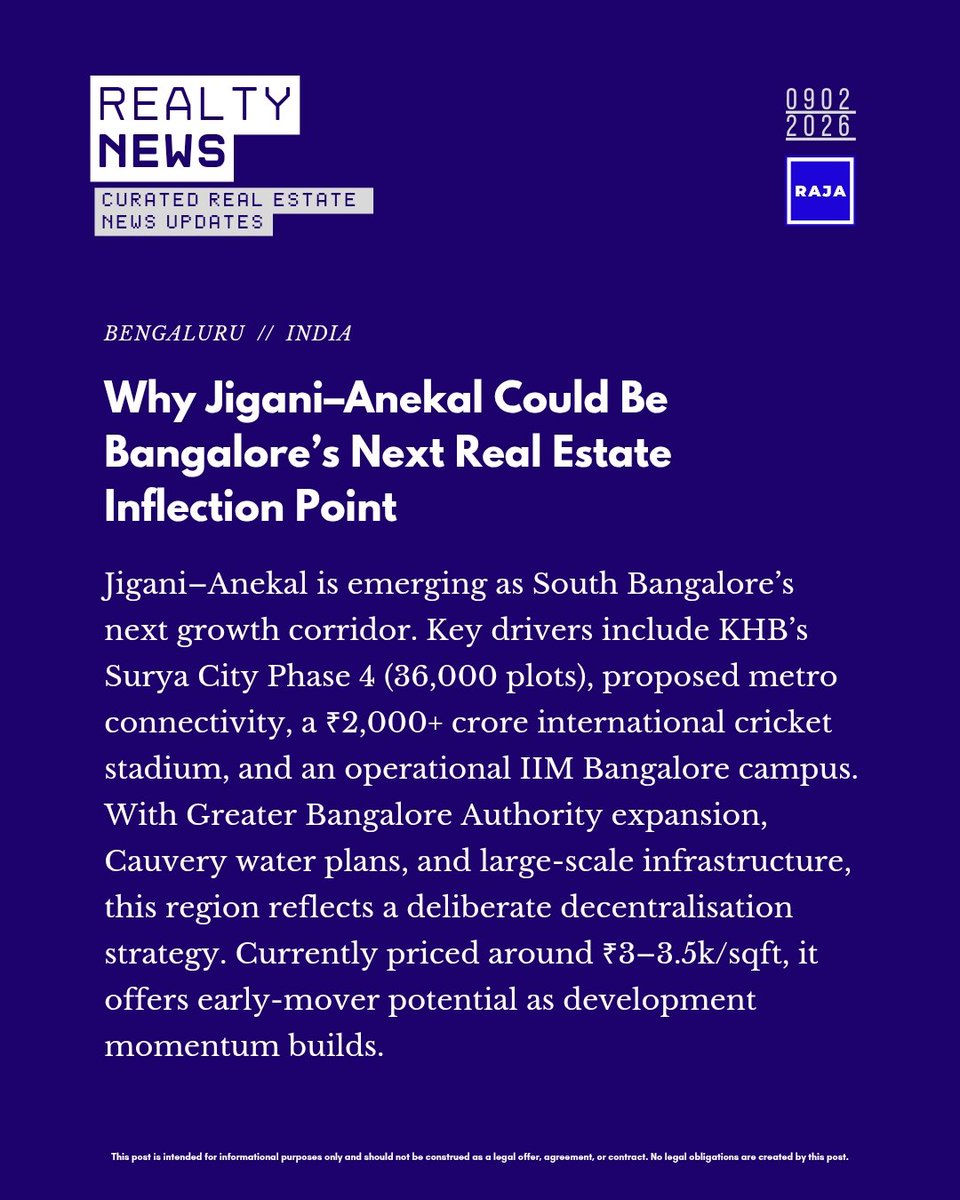
I’ve tracked every major infra & policy move around Jigani–Anekal. The data points are stacking up
• KHB Surya City Phase 4: ~36,000 plots (Asia’s largest residential layout)
• Metro extension (planned) via Deccan Herald — alignment runs through Surya City
• ₹2,000+ cr international cricket stadium, 80,000 capacity (Indlawadi)
• IIM Bangalore campus already operational in Jigani
• Greater Bangalore Authority expansion + Cauvery water rollout
Current pricing: ~₹3–3.5k/sqft
Empty today. Structurally set for growth.
Not advice. Just sharing what I’m seeing on the ground.
Transitory economies reward speed over substance and that is a problem !
Capital moves fast. People move often. Decisions are made for short holding periods, not long lives. Cities expand before social and civic institutions mature and real estate becomes a trading instrument before it becomes shelter, neighbourhood, or legacy.
The impact is visible:
• Homes designed for exit value, not living
• Investors replacing end users
• Communities with high turnover and low trust
• Infrastructure built to unlock land prices, not improve daily life
On paper, prices rise.
But beneath the surface, social capital erodes. When people don’t expect to stay, they don’t invest emotionally in schools, streets, neighbours, or shared futures.
Real estate, at its best, anchors society. It gives people reason to belong, to care, to plan across https://t.co/bqdmmSwJc7 its worst, in transitory economies, it accelerates rootlessness.
Enduring cities are built differently. They reward patient capital, long-term ownership, and design that ages well. They treat real estate not just as an asset class.but as a social contract.
Real wealth isn’t created by how fast property changes hands. It’s created by how long people choose to stay.
The Boring Path to 10,000% Returns
Across the internet, real estate is often dismissed as a poor investment. Many of the critiques are valid. But just as with equities, the problem is rarely the asset class; it’s the price you pay and the patience you bring.
Like picking a good stock, picking good real estate is not a step to miss. I stand as a quiet beneficiary of this asset class, along with many others who don’t often speak about it.
I recently sold a plot at ₹10,000 per sq. ft., developed by our company in the mid-2000s. That translates to ~10,000% absolute returns over a 20-year holding period, or roughly a 26% CAGR.
There was no brilliance involved.
Time did the heavy lifting.
Equities and real estate are simply different tools. A well-constructed portfolio doesn’t chase narratives; it manages downside. What not to do is rush into real estate at fully priced valuations and then endure years of stagnation.
We see the same in equity markets; richly priced stocks can go nowhere for years, sometimes never reclaiming their highs.
Both asset classes reward the same virtues: judgment, patience, and discipline.
For every example that shows real estate outperforming, there’s a counterexample where equities do better. That debate misses the point.
The real goal while structuring a portfolio is diversification across asset classes; and real estate, bought right and held well, deserves its place.
Buy right. Sit tight. Stay calm.
@XHandles@premium My character limit has not increased even after subscribing for a premium account. Please look into this as I am still limited to 280 characters.
5/
Big picture: Kanakapura Road is evolving into a connected urban spine — supported by existing social infrastructure and layered growth.
These are the corridors that compound value over decades, not cycles.
1/
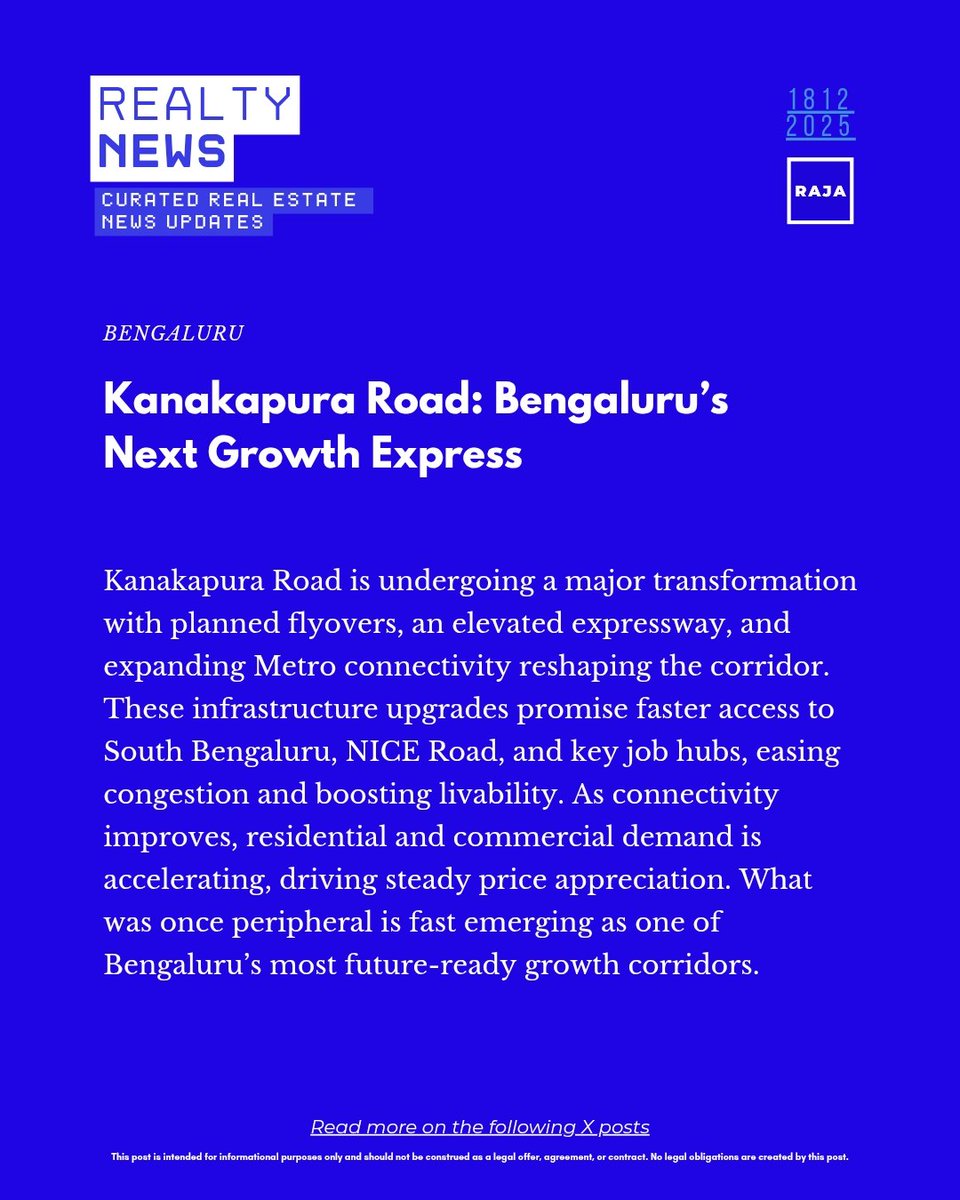
Kanakapura Road is entering its infrastructure payoff phase.
Flyovers, an elevated expressway, and strengthened Metro connectivity are quietly reshaping this South Bengaluru corridor from “upcoming” to future-ready.
4/
Better connectivity brings predictability.
Direct NICE Road access, reduced congestion, and shorter commute times are driving stronger residential demand and steady price appreciation.