IF YOU DIED TOMORROW🚨,
YOUR FAMILY WOULDN'T BE ABLE TO ACCESS A SINGLE THING YOU OWN DIGITALLY.
BANK ACCOUNTS. PASSWORDS. CLOUD STORAGE. ALL OF IT PERMANENTLY LOCKED AWAY.
HERE'S HOW TO FIX IT IN 30 MINUTES:
Most founders accidentally train their customers never to pay them.
@MadhavanSF (the "pricing guru" of Silicon Valley - having worked with LinkedIn, Uber, and 30+ unicorns) calls it the 20/80 Pricing Trap
• 20% of your features drive 80% of the willingness to pay
• Founders give that 20% away for free to gain distribution
• You are left trying to monetize the remaining 80% of features - the ones users don't actually value.
The result? You build a charity, not a business.
In this week's episode of The Library of Minds, we discuss the science of monetization and deconstruct how to architect ‘Profitable Growth’ - the core framework from his new book, Scaling Innovation.
03:33 - Netflix vs Blockbuster: The Pricing Decision That Changed Tech
08:06 - Why Most Startups Get Pricing Wrong
11:39 - Freemium vs Paid: When Free Destroys Value
15:38 - Pricing Models Matter More Than Price
16:28 - The AI Pricing Framework: Autonomy vs Attribution
21:49 - The Biggest Pricing Mistake Ever
25:05 - Why Steve Jobs Was a Pricing Genius
26:44 - Behavioral Pricing: How Founders 10× Deals Without Changing Product
31:02 - Data vs Conviction: How Great Founders Make Pricing Decisions
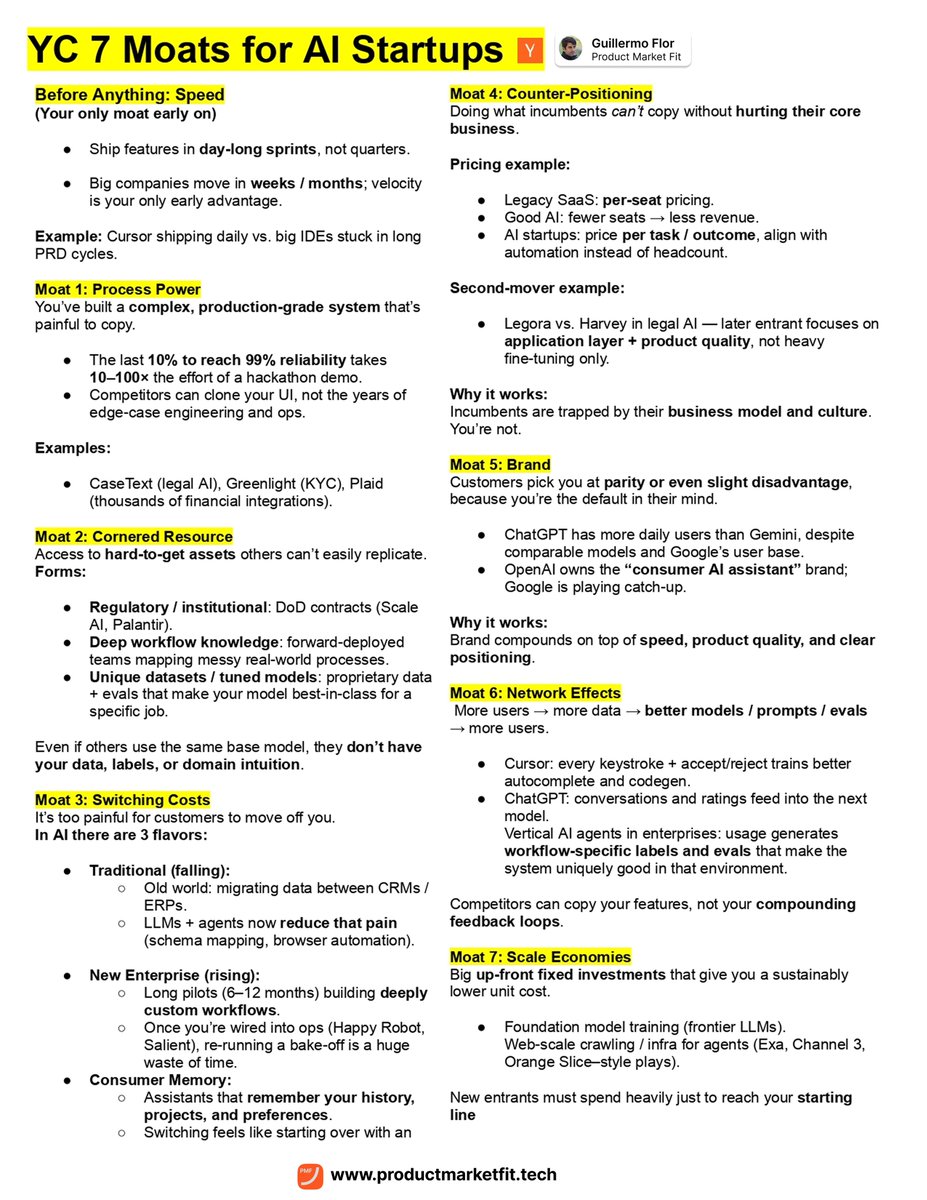
YC just laid out the 7 most powerful moats for AI startup 👇
Here’s the founder-friendly version you should have in your head before you ship your next feature:
0) The moat before all moats: SPEED
In the beginning you don’t need a moat. You need to move faster than anyone else can.
Cursor-style: short sprints, ship daily, learn in public.
1) Process Power
The “boring” 10% that takes 90% of the work.
Evals, monitoring, recovery flows, compliance, edge cases.
If it’s mission-critical and you make it production-grade, it becomes hard to copy.
2) Cornered Resource
Something others can’t easily get: proprietary data, relationships, distribution, regulatory access, domain embedding.
Not “we fine-tuned a model.”
More like “we own the workflow and the labels of what good looks like.”
3) Switching Costs
AI will lower old switching costs (agents can migrate data).
But it raises new ones when your agent becomes the customer’s operating system (custom logic + integrations + trust built over months).
4) Counter-Positioning
Do what incumbents can’t afford to do.
Example: per-seat SaaS vs task-based pricing (AI reduces seats, which kills their revenue model).
Or second movers winning by focusing on the application layer and shipping a better product.
5) Brand
When customers pick you even at parity.
“ChatGPT” became the verb. That’s not a feature. That’s compounding advantage.
6) Network Effects (AI-style)
Usage → data → better evals/models → better product → more usage.
Not “social graph.”
More like “feedback loops that competitors can’t replicate without your volume.”
7) Scale Economies
Pay big fixed costs once (infra, data, integrations, compliance) and amortize across many customers.
The YC punchline:
Don’t use “moats” to talk yourself out of starting.
Pre-product, you have nothing to defend. Find a hair-on-fire pain, ship fast, then deliberately deepen 1–2 moats.
Scientists identified a single bacterium responsible for 76% of all stomach cancers.
It already lives inside roughly half the human population.
Most carriers feel perfectly fine.
Years later, cancer appears without warning.
This is what it is (and how I’d prevent it):
In what seems like a lifetime ago, I was diagnosed with an autoimmune condition that made me switch all cooking fats in my kitchen for organic ghee.
Then I’ve had one big realization:
Most people have absolutely no idea what industrial fats can do to their bodies.
(🧵)
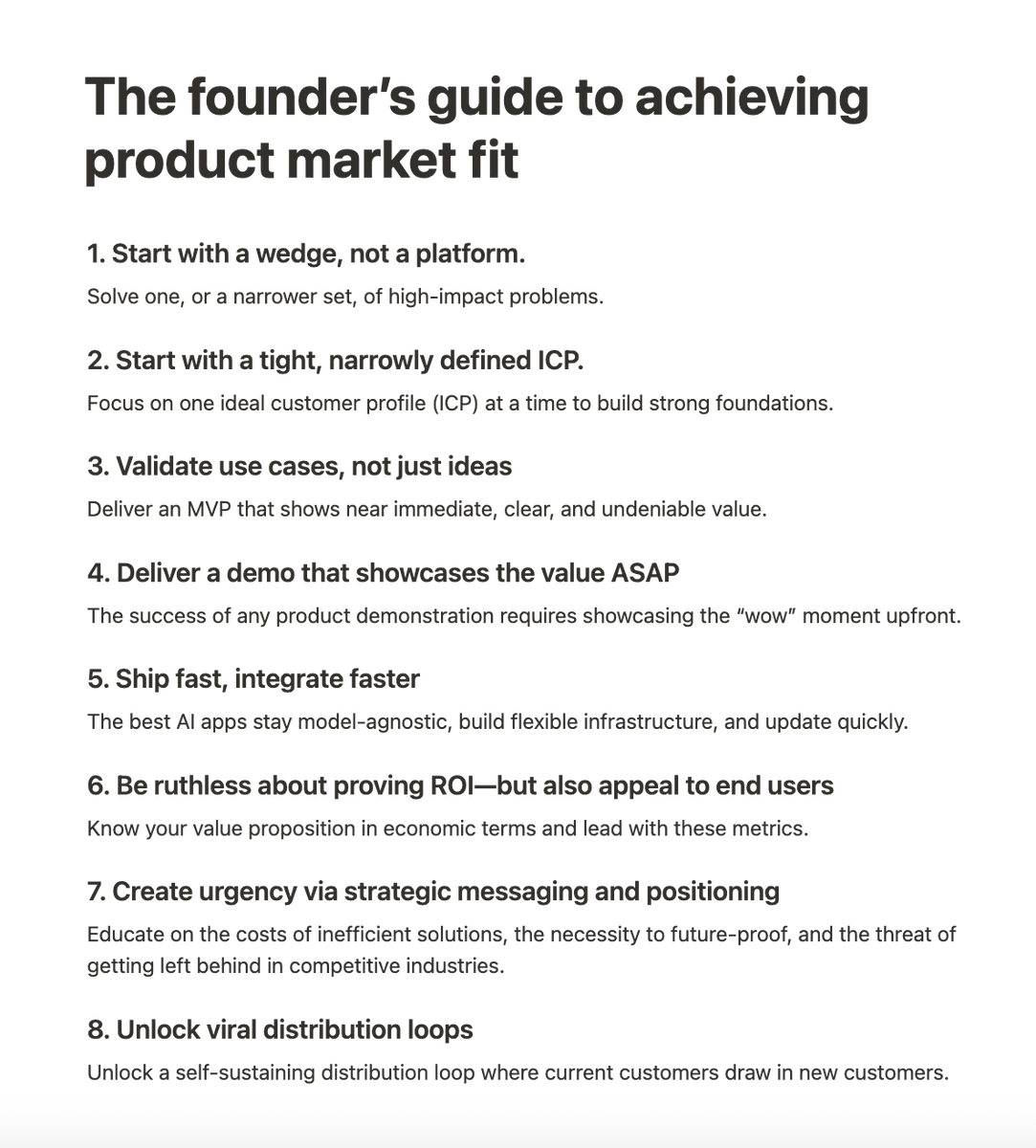
Early traction ≠ product-market fit.
When you’re building in AI, it’s easy to mistake curiosity for commitment.
That’s why we built a playbook to help founders build real PMF with sharper metrics, stronger use cases, and ideas for lasting adoption.
Read the playbook: https://t.co/5OIFTzyxIE
DECOUPLING FROM DOLLARS
The US sends India billions in printed dollars for valuable goods. This is actually the US government ripping off India, like it does Vietnam, and everyone else, including its own citizens...not vice versa.
To be precise: last year India exported $87B of valuable goods to the US for $42B of goods plus $45B worth of increasingly worthless dollars:
That difference of $45B was, effectively, made up by money printing, which the Fed does at will:
The current administration incorrectly thinks this is a bad deal for America, because they haven’t fully thought through the fact that the US can print dollars. India was giving America something that's always valuable (namely goods) for something that America can just print out of thin air (namely US dollars):
So...who was really ripping off whom?
As mentioned, this is the same trade America had with Vietnam. Vietnam worked hard to send America shoes, while America sent Vietnam printed dollars. And it’s the same trade America had with many countries, before the trade war. The world sends the US valuable goods, and gets mere Federal Reserve database entries in return:
The only reason the US had the right to do that — to run the financial database of the world, to print trillions for itself, and to freeze and seize the funds of billions — is because it set up what we call the rules-based order, what is in reality the American Empire. And of course it profited from that empire tremendously, but so did most of the empire's participants.
But now MAGA is dismantling that empire. It’s cutting off trade, talent, and even tourism. It’s abandoning its military commitments and telling allies to fend for themselves. It’s cutting off foreign aid and domestic universities. It is, in short, becoming a country not an empire.
The reason is because MAGA is fundamentally confused. It romanticizes 1945 America (the manufacturing country) without fully admitting that 2025 America makes its money in a completely different way, by managing the hub of a global financial empire.
Because the US is in denial about what it is — a money printer, not a manufacturer — it's currently on track to lose both the money-printing and the manufacturing. For example, the tariffs target the entire world (thereby reducing demand for the dollar in global trade) while also cutting off machine tools and raw materials from US entrepreneurs (thereby inhibiting the buildout of domestic manufacturing).
Anyway, I won't linger on the outlook for the US. It's made its decision and will live with it. Perhaps it will indeed be a Golden Age of Reindustrialization. And perhaps the transition to a "republic, not an empire" will go much better than the similar imperial climbdown of the UK or the USSR.
What should countries like India and Vietnam do?
They should turn a necessity into a virtue. The trade war has provided a powerful Schelling Point for the entire world to simultaneously stop using the dollar at the same time. This is also what America says it wants, for foreigners to stop "exploiting" it by accepting its printed dollars for hard goods.
So: abide by America's wishes and stop trading goods with America for dollars. Instead, trade goods with each other for local currencies (rather than USDs) and use gold for storing value (rather than USTs). Because there is no global reserve currency issued by a single country, trade remains roughly balanced over time.
Singapore's former PM calls this "world minus one." It's the continuation of global capitalism, just without America, who has voluntarily taken itself out of the game. Yes, there's a short-term adaptation cost, but the quicker that a country can decouple from the dollar the better.
Start saving in hard money instead.
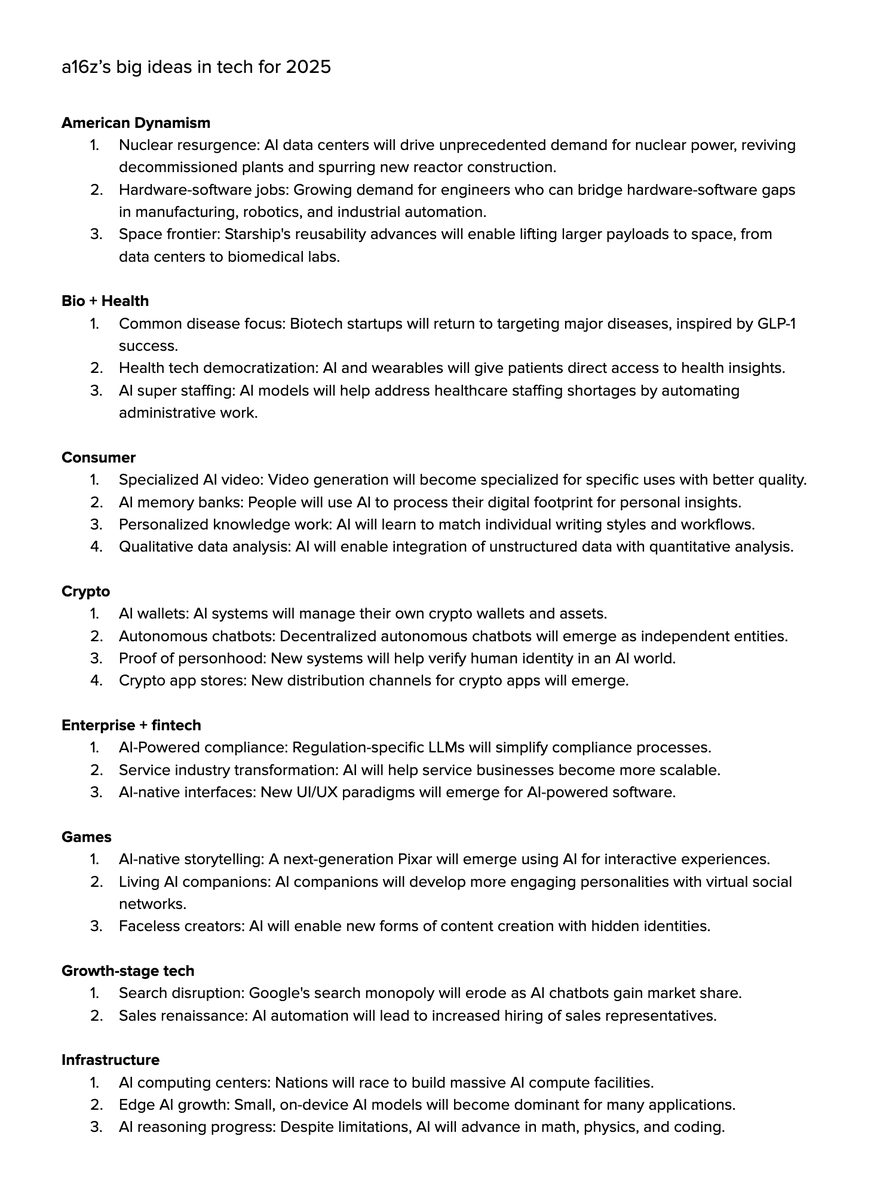
2025 is shaping up to be the "year of AI agents".
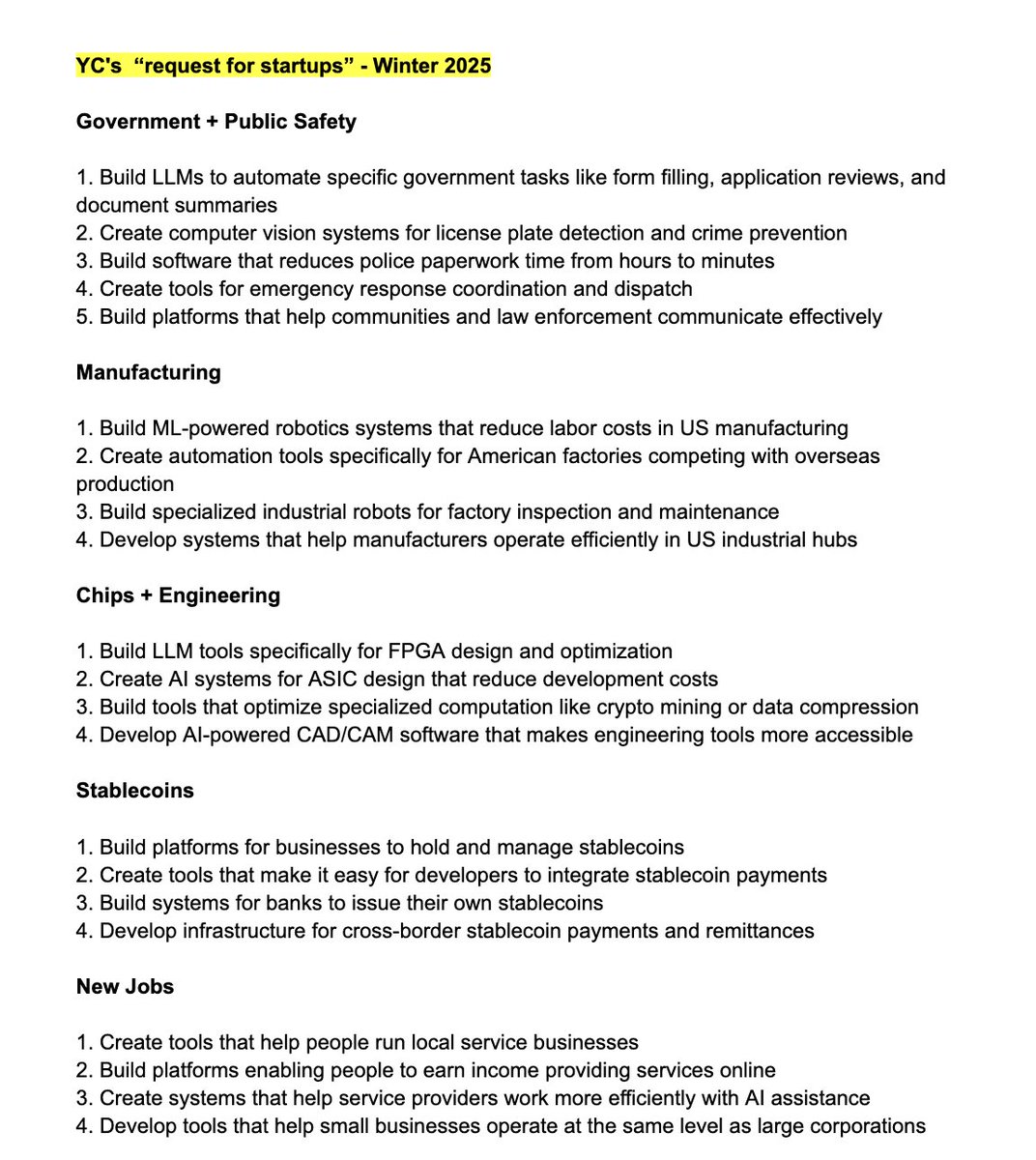
We've put together a list of startup ideas that we think are especially promising— some draw attention to trends that are already in full swing, and some of them are where we think things are going next.
https://t.co/AbQWcpKCZX
After 10 years of building consumer social apps, I've decided to start exploring new areas. Building these products is an unforgiving grind—but I learned a lot along the way.
For those embarking on this path, here's everything you need to know:
TIME FOR A THREAD 👇