I am the lead engineer at https://t.co/4qSBGGFmTs.
We had $78 million to work with.
$70 million went to the domain.
$8 million went to the Super Bowl ad.
I got the rest.
"The rest" was $500 and a Cloudflare free tier.
This ratio -- 156,000 to 1, marketing to engineering -- is not a bug. It is the business model of the entire artificial intelligence industry in 2026.
You do not need a product. You need a name. Preferably two letters. Preferably letters that made investors lose bladder control in 2024.
I built the website in a weekend. I didn't build it, actually.
I described it to OpenClaw (previosely Moltbook), (previously, reviously Clawdbot) and the AI built it.
We are, after all, an AI company. Using AI to build the website felt appropriate.
The AI charged us nothing. We are charging users $20 a month. This is called "margin."
We have a free tier and a paid tier. The free tier gives you access to a product that doesn't exist. The paid tier gives you access to the same product that doesn't exist, but with more input tokens.
No one has asked "input tokens for what." This is the kind of question that delays launches.
Nobody checked if it worked.
Nobody checked if it scaled.
Nobody checked if it did anything at all.
We were too busy approving the logo.
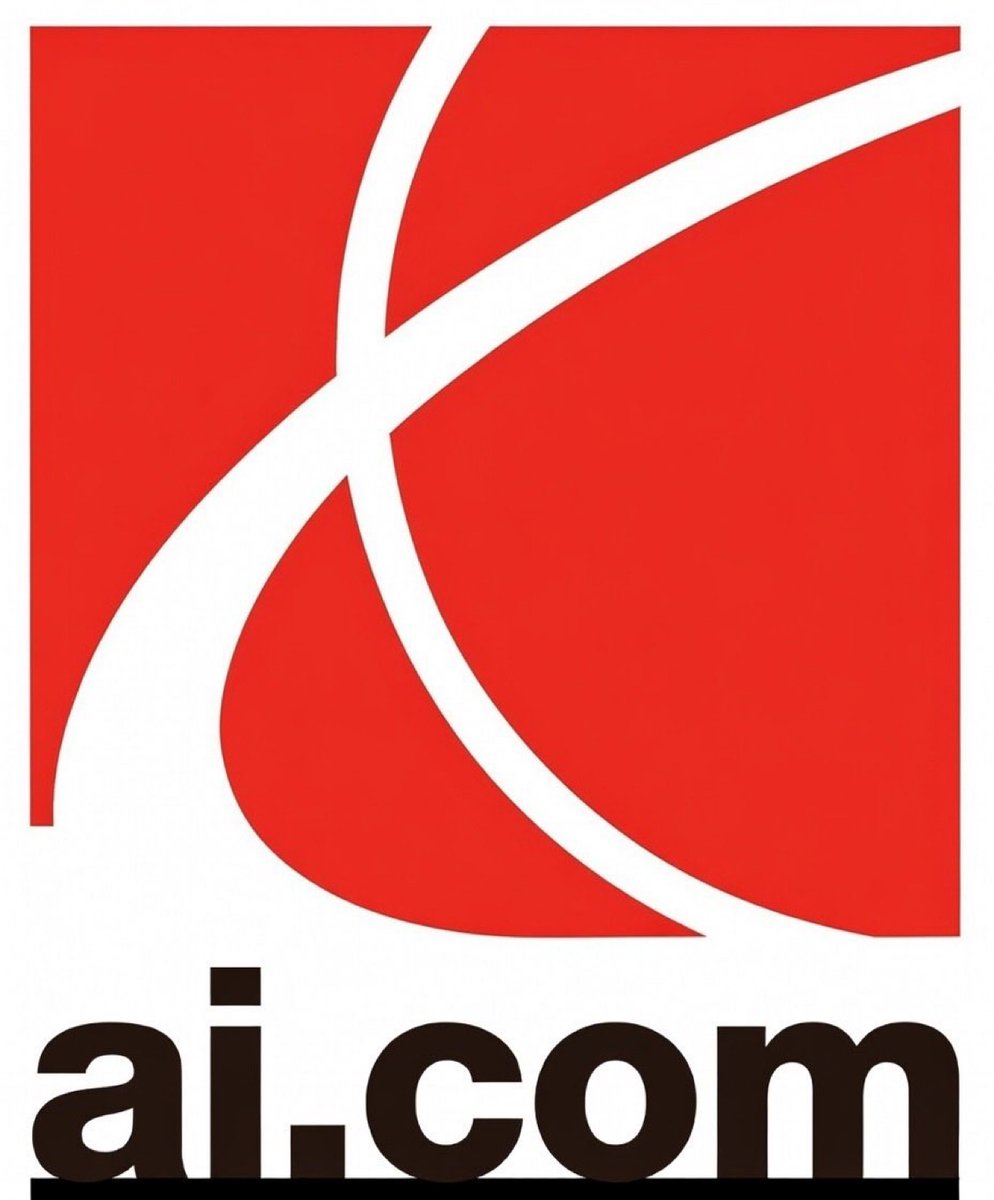
The logo is a planet with a ring around it. Someone said it looked like the old Saturn car logo. Saturn went bankrupt in 2010. But the logo was free and our design budget went to the domain, so here we are, orbiting a dead brand at $70 million per revolution.
Our product is an "autonomous AI agent" that "organizes work, sends messages, and executes actions across apps."
Which actions. Which apps. At what cost.
In the AI industry, these are called "implementation details." Implementation details are beneath us. We are a vision company. The vision cost $70 million. The implementation cost $500.
The gap between the two is where shareholder value lives.
Our press release promises the agent will "trade stocks, automate workflows, and update your online dating profile."
We are building artificial general intelligence so it can fix your Hinge bio.
This is on the roadmap. The roadmap is longer than the codebase.
Our marketing says you can create an AI agent in 60 seconds. This is technically true. You type a username. You click "generate." You receive a loading spinner. Sixty seconds.
What you do not receive is an AI agent. But the experience of waiting for one is, I'm told, "the product."
Our press release describes a "decentralized network of billions of agents." We used the word "decentralized" because our CEO comes from crypto. In crypto, "decentralized" means "we haven't decided how it works yet." We have not changed the definition.
This is not unique to us.
OpenAI has raised $40 billion. Their product loses money on every user.
Anthropic has raised $15 billion. Their stated goal is to build something they believe might destroy humanity, and investors are fighting to give them more.
Microsoft has committed $80 billion to AI infrastructure this year. Their Copilot product tells people to put glue on pizza. The entire industry is a $300 billion screensaver with a loading spinner.
We fit right in.
Our CEO is the https://t.co/O1AIXWbNAm guy.
He previously spent $700 million to rename a basketball arena and hired Matt Damon to tell America "fortune favors the brave" six months before crypto lost 70% of its value.
He paid for our domain in cryptocurrency. I am told this was "tax efficient." I have learned not to ask follow-up questions about things that are "tax efficient."
He is now pivoting from crypto to AI. In the industry, we don't call this "pivoting." We call it "convergence." Convergence means the last bubble popped so you inflate the next one using the same PowerPoint deck with different nouns.
The Super Bowl ad ran during the fourth quarter. Thirty seconds. It told 130 million Americans to visit our website.
The ad was thirty seconds. That's $266,666 per second. Each second of airtime cost more than our entire engineering budget.
Second fourteen showed the logo. Second fourteen cost more than the website.
They did visit. All of them, apparently, at once.
The website went down.
"Prepared for scale, but not for THIS," our CEO tweeted, adding three fire emojis.
The fire emojis were load-bearing. They were doing more work than our infrastructure. The entire site was hosted on Cloudflare's basic tier, which is designed for food blogs and wedding photographers, not for absorbing the combined curiosity of a nation told to visit a two-letter domain during the biggest television event on earth.
But the crash was, in a way, perfect. It is the most honest thing the AI industry has produced. A $78 million promise that, when 130 million people showed up to collect, returned a loading spinner and the words "please refresh and try again."
Every AI company should adopt this as their mission statement.
The previous owner of https://t.co/4qSBGGFmTs was OpenAI. They used it to redirect to ChatGPT -- a product that exists, built by thousands of engineers who were paid more than $500, running on billions of dollars of compute. We bought the domain from them to redirect to a page that asks you to pick a username.
OpenAI also ran a Super Bowl ad this year. They sold us the domain, then bought ad time in the same broadcast to promote the product they used to host on it.
We are now competing with the company that built the thing we may or may not be reselling. During the same commercial break. On the same channel. For the same audience.
The AI industry is a snake eating its own tail, except the tail cost $70 million and the snake can't stay online.
That's the product. A username. For an AI agent that doesn't exist yet. On a website that couldn't survive its own launch. Sold by a crypto CEO during a crypto winter. Wearing the logo of a bankrupt car company.
Twenty-three percent of Super Bowl ads this year were AI companies. That's 15 out of 66.
In 2000, it was dot-coms. https://t.co/xcdZKv7NgR ran a Super Bowl ad. They went bankrupt nine months later.
Their sock puppet mascot outlived the company. I'm not saying history repeats. I'm saying it rhymes, and the rhyme scheme is expensive.
But none of that matters. What matters is the domain. Two letters. Seventy million dollars. The most expensive thing we own is our name. The least expensive thing we own is everything the name is supposed to represent.
In the AI industry, this is called "brand-first development."
In every other industry, it's called something else.
Anyway, we're hiring.
Backend engineers preferred.
Budget: whatever's left.
@bamazizimesh Still remember the first coffee chat we had in SF. You definitely stood out from the numbers of founders I have seen. Looking forward for the next billion(s)!
Who Will Buy The SaaS Companies?
We’re sitting on a problem many don’t want to talk about: the traditional SaaS exit playbook is breaking down. Even for very, very good SaaS companies.
For years, it was predictable. Build to $20M-$50M ARR, maintain decent growth, buyers would come. PE would write checks. Strategic acquirers would see tuck-ins.
Not anymore.
💸 The VC Money Has Gone to AI
In H1 2025, AI companies attracted 58% of global VC (64% in the US). AI funding hit a $377B annualized run rate—already exceeding 2023’s full-year total.
Average AI deal size: $35.9M, double the prior year.
For traditional SaaS? Mega-rounds collapsed from 147 deals in 2021 to just 21 in the 12 months through mid-2025.
🥶 PE For Traditional SaaS Has Cooled Significantly
Q1 2025 saw 210 enterprise SaaS M&A deals—but total value dropped 24.8% to $29.1B. Five deals accounted for half the value.
Thoma Bravo remains active but brutally selective. After 600+ acquisitions, Orlando Bravo says he’s “working the hardest I’ve ever worked in 30 years.” They’re only buying category leaders with AI integration and paths to 40%+ EBITDA.
Exit multiples have reset hard. Software companies are selling at 15x EBITDA, not 25x. You need real operational improvement.
🤖 Corporate M&A Is All-In on AI
Strategic buyers have one mandate: AI capabilities. AI M&A jumped 20% last year and is growing another 32% in 2025.
The biggest deals? Synopsys’s $35B acquisition of Ansys, Cisco’s $28B acquisition of Splunk, HPE’s $14B acquisition of Juniper. All for AI.
🤔 The IPO Bar Is Brutally High
You need $400M+ ARR growing 30-50%+ to have a shot. Klaviyo IPO’d at $600M growing 57%. Rubrik at $780M growing 47%.
Public markets don’t want your $200M ARR, 35% growth company.
🔮 What Happens to the “Pretty Good” SaaS Companies?
There are hundreds of solid SaaS companies at $20M-$100M ARR, growing 25-40%, with good retention. These are *good businesses*.
From 2012-2023, they had clear exit paths. Now those paths are blocked.
🤷♀️ What Should You Do?
Get profitable. Invest in AI capabilities, but they have to move the needle. Fake or performance AI copilots that don’t reignite growth don’t really help. Expect no more funding. In fact, expect no exit per se. Take any decent one that comes. And … back to the grind.
I called the branch and talked to a real rep to tell them their phone number is being used.
Scammers claim they are the security department of Wells.
Just because the caller ID seems legit, it doesn't mean it's not a scam. Be careful everyone
Stupid scammers are spoofing the real Wells Fargo branch 303-682-4560 from Colorado. I have been getting 5 calls a day from this number and they try to ask for my credit card 16 digits.
The thing is, I don't have a Wells Fargo credit card, lol.
#ScamAlert#Scam#ScamAwareness
Bought the tickets for the GSW vs Rockets game next Saturday! Buying for a family of 5 is nearly a bankruptcy level expense, but I hope it will be worth it! (And yes, it will be a second floor seat, lol)
LFG Warriors!!
#warriorsvsrockets#warriorsrockets
So happy that I moved away from Mailchimp for my wife's business. The fees were jacking up, and moreover, those hidden fee was so evil. The company values and culture has massively changed. RIP #mailchimp
Although I do tons of cold outreach on Linkedin to meet founders for investment opportunities, I hate it when I am being solicited right after I accept a random Linkedin connection request. Most of them are sales / leadgen related.
The Circle of Life...
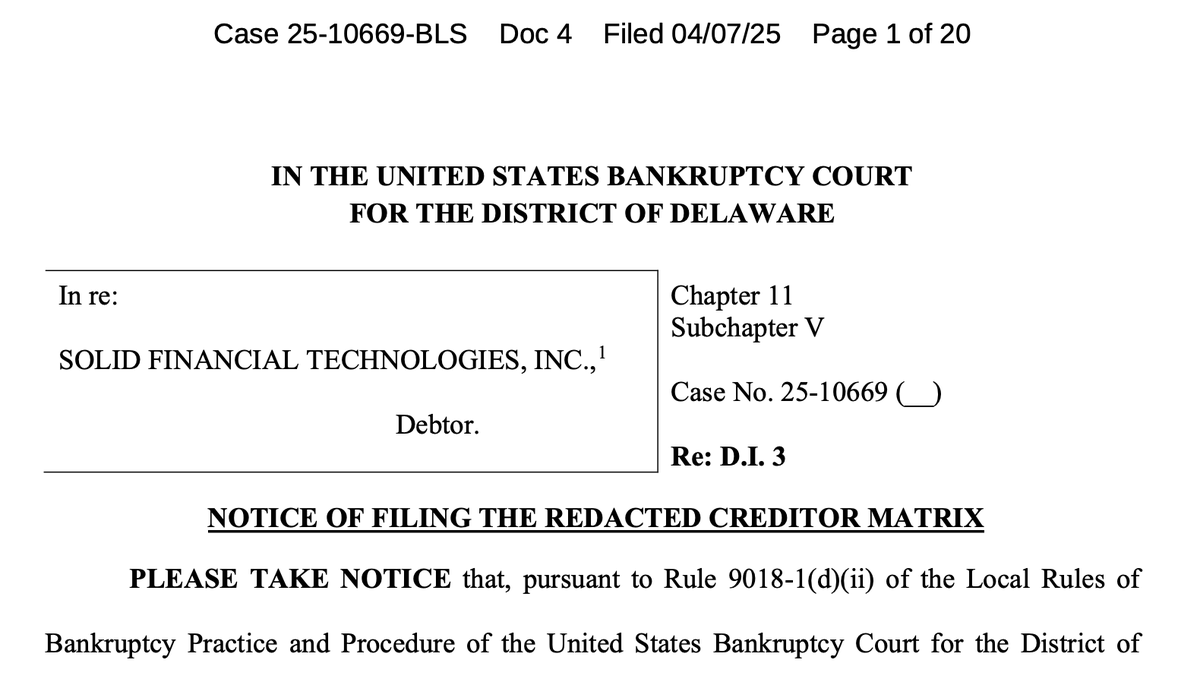
SCOOP: Another BaaS platform bankruptcy (yes, it involves troubled Evolve Bank & Trust)
BaaS platform Solid declares bankruptcy; it had partnered with Evolve Bank & Trust, CBW Bank & Lewis & Clark Bank.
What we know:
Solid memorably was sued by its own investors, FTV, who accused the company of manipulating revenue numbers during its Series B fundraise. The matter was ultimately settled with Solid buying back FTV's stake at a 56% discount.
Solid and Evolve have also been embroiled in lawsuits stemming from Solid's relationship with EZBanc, an entity with links to a convicted Russian money launder.
Suits stemming from the EZBanc relationship accuse Solid and Evolve of fraud, negligence, and breach of fiduciary duty, among other allegations.
Now, the company is seeking Chapter 11 bankruptcy protection, according to a petition filed in U.S. Bankruptcy Court in Delaware on Monday, April 7th.
Some elements of the filings worth noting:
-The 20 largest unsecured creditors include Amazon (AWS), regulatory consulting shop FS Vector, Visa, Plaid, Trulioo, Spade, and law firms that include Quinn Emanuel Urquhart & Sullivan, Young Conaway Stargatt & Taylor, and Perkins Coie.
-The company's balance sheet as of Feb 28 shows about $9.6 million in cash in bank accounts at Brex, Evolve, First Republic, Lewis & Clark, and other entities (including an overdrawn account at Wells Fargo); the balance sheet also reflects about $638,000 in other current assets.
-The balance sheet reflects over $4.1 million in current liabilities, including accounts payable, accrued payroll, and customer reserves.
-According to an FBAR filed in 2023, Solid maintained bank accounts in India at Axis Bank and IDFC First Bank.
-According to Solid's 2023 tax return, it took in about $4.5 million in gross sales and posted a net loss of $12.7 million.
-Solid has 69 current shareholders, 25 holders of options or restricted stock units, and 131 former shareholders.
Based on the February P&L including in the bankruptcy filing, it appears there are still programs live and running through Solid, as the statement includes revenue from platform fees, interchange, and customer deposits (eg interest payments from bank partner(s)).
A quick scan of sites that list T&Cs that include Solid suggest programs that may still be live could include Prosperiti, which appears to be a kind of neobank for Seventh Day Adventists, Re-entry Pay, a neobank for the formerly incarcerated, Exhale, an employer-distributed EWA/cash advance product, and Struxtion, a construction management platform.
It couldn't immediately be confirmed if these programs are currently live on Solid (or at all.)
A Chapter 11 bankruptcy is for a reorganization; according to the docket, Solid has elected to file under Chapter V, which is a streamlined process that does not require creditor approval of the reorganization plan, if the court deems it to be "fair and equitable."
There were new filings filed as I wrote this, so stay tuned here or to Fintech Business Weekly for more on this as it develops.
Zara is opening a flagship store in Union Square! This expansion is another vote of confidence in our city. We will continue to work every day to deliver safe and clean streets in Union Square and across the city, and let the world know that San Francisco is open for business.