@garganirudh Right… most people don’t understand the market dynamics. By the time they get a feel of it, it’s already too late. And then they keep blaming the markets
Dear Friends,
Markets have been going through a turbulent phase. In just the last few weeks, the Nifty 50 has corrected over 15% from its highs, small cap index is down more than 20% from its peak, and FIIs have pulled out nearly ₹1.15 lakh crore in March alone.
Amid constant panic headlines, many investors are either frozen in fear or making decisions they may regret later.
I am hosting an exclusive webinar to discuss what is really happening in the markets, what it means for our investments, and how this phase can actually be used to our financial advantage
This session is for investors who want to think clearly and act wisely during uncertain times.
*Webinar will be conducted online on 3rd April at 11AM on good Friday(Holiday)*
To attend , kindly register to get the joining link in your mail id. You may like to share this with your friends, families
👉 Register here by clicking the link below👇
https://t.co/HejVmjcDDh
#marketcorrection
#letsinvestwisely
Over the last 20 years, the 100-week EMA has acted as a “line in the sand” for the Nifty trend, with the COVID (2020) and Global Financial Crisis (2008) being the only clear breakdowns.
When the index holds above the 100-week EMA, it usually indicates the primary bull trend is intact.
Currently, Nifty 50 is trading around 24450, just 400 points away of touching the 100-day EMA on weekly charts.
Let's hope this long term support is respected and the markets show some stability before resuming the long term bull run.
Volatile Markets.
Are You Still On Track Financially?
Most investors are tracking the markets every day and get worried when it goes down
Very few track whether they are actually on course to meet their financial goals.
And that gap often decides their financial future.
For the last one and a half years, Indian equity markets have been quietly testing investors.
Not just through price corrections, but through something even harder, time correction.
While the benchmark index Nifty 50 appears resilient with 8% correction from all time highs, a large part of the broader market has gone through a deep correction/consolidation. For investors expecting quick gains, this phase often feels frustrating.
But this phase also reinforces an important investing truth
Equity investing is not a 100-meter sprint.
It is a marathon. 🏃♂️
And in a marathon, success does not come from speed.
It comes from discipline, endurance and staying the course.
Which is why the focus should not be on predicting the next market move, but on building a financial plan strong enough to withstand market volatility.
Yet one question still troubles most investors
“Am I actually on track to achieve my financial goals?”
To help answer this, I have recently added two simple financial planning tools to my website that can give you quick clarity about your financial journey.
They are free to use and generate a personalised PDF report delivered directly to your email.
🏦 Retirement Corpus Calculator
* See whether your retirement corpus will actually last through your retirement years
* Get a year-by-year retirement cash-flow projection
* Compare different growth scenarios with your rate of return and withdrawal rate
* Understand the real impact of inflation on your future lifestyle
🎯 Financial Goals Planning Calculator
* Plan for children’s education, marriage, home purchase and other life goals
* Know exactly how much you should invest monthly or as a lump sum
* Avoid the risk of under-saving or over-saving
* Turn your financial goals into a clear and structured roadmap
It takes just five minutes to enter your numbers, but the clarity it brings can shape decades of your financial future.
Because successful investing is not about predicting the next market move.
It is about having a plan strong enough to stay invested for the long run.
You can try these financial calculators on my website(link available on top of the post)
Feel free to share this with anyone who values financial clarity and thoughtful planning for the future.
#FinancialPlanning #Investing #RetirementPlanning #WealthCreation #LongTermInvesting #InvestWisely
India Rewrites Its Economic Story: New GDP Base Year, Stronger Growth Signals
India released its first GDP estimates under a revised statistical framework, marking a major milestone in how we measure economic performance. The key highlights are
New Base Year — 2022-23
After more than a decade, with 2011-12 as the base year, the government has shifted the national accounts reference period to FY 2022-23. This update ensures that India’s GDP reflects current consumption patterns, modern industries and services, digital transactions, GST coverage and a substantially changed economic structure, including data from e-Vahan, GST filings, and household services that were previously under-represented.
Revised Growth Numbers
• Q3 FY26 (Oct–Dec 2025): Real GDP grew 7.8% year-on-year under the new series.
• FY 2025-26 (full year): Estimated growth at 7.6%, which is higher than the 7.4% previously projected under the old series.
• Historical growth figures are also being revised: FY25 is now at ~7.1% (up from 6.5%) and earlier years are being realigned to ensure comparability.
What’s New in Methodology?
The revamped GDP series isn’t just a base year update; it’s an expanded measurement approach.
Major changes include:
• Inclusion of broader data sources like GST returns and digital transaction data.
• Better capture of informal and household services (e.g., cooks, drivers).
• Applying double deflation in sectors like agriculture and manufacturing for improved accuracy.
Why This Matters
This statistical overhaul makes India’s GDP estimates more representative of the current economy. It enhances transparency, improves comparability with global standards, and helps policymakers, investors, and analysts make better decisions based on more robust data.
Bottom Line
India’s fundamentals haven’t changed overnight.
But the lens through which we measure them has become sharper, and sharper measurement leads to smarter policy, better capital allocation and more disciplined investing.
The next phase of India’s growth story will not just be about expansion, it will be about efficiency, transparency and sustainability.
India continues to be one of the fastest-growing major economies, and with this updated GDP framework, we now have a clearer and more accurate view of that growth trajectory
And that’s a positive signal for long-term wealth creators.
#IndiaGDP
#EconomicGrowth
In a major setback for President Donald Trump, the US Supreme Court has ruled that he overstepped his legal authority by imposing sweeping tariffs on virtually all US trading partners using emergency economic powers.
Big news for the stock markets, especially Indian markets.
Bottom for Indian IT companies is very near, who knows today may be the day for the reversal. These are the great times to own world class businesses. Don't forget what Warren Buffet says, when there is a blood on the street, go and buy top notch businesses, today may be the day to acquire beaten down IT companies
Everyone Is Talking Global. But This May Be India’s Time
Lately, the dominant investing narrative is
Indian markets have underperformed. The US and global markets are doing better. Time to diversify abroad
On the surface, it sounds logical
But markets don’t reward what has outperformed
They reward what is positioned to outperform next
And when we examine data across timeframes, valuations, and earnings cycles, the picture looks far more balanced
1. Yes, The US Outperformed Recently
Over the last 10 years
S&P 500 CAGR: ~12–14% (USD terms)
Nifty 50 CAGR: ~10–12% (INR terms)
But here’s what matters
Nearly 30–35% of S&P 500 returns came from just 5–7 tech and AI stocks
S&P 500 trades around 22–24x forward earnings
Nifty trades closer to 18–20x
That’s a 20–25% valuation premium for US equities
When valuation gaps widen this much, forward return probabilities tend to shift
2. Long-Term Data Tells a Different Story
Stretch the horizon to 25+ years (since late 1990s)
Nifty 50 TRI (USD CAGR): ~11–12%
S&P 500 (USD CAGR): ~8–9%
Even after adjusting for INR depreciation
Nifty 500 has delivered close to 12–13% USD CAGR over multi-decade periods.
Over long cycles, Indian equities have created more wealth in dollar terms
Short-term leadership rotates
Structural growth compounds
3. India’s Underperformance Is a Cycle, Not a Structural Break
Recent consolidation reflects
Profit booking after the post-COVID rally
Mid & small-cap correction
Valuation normalisation
Now look at fundamentals
• Nominal GDP growth: 10–12%
• Profit-to-GDP ratio improving
• Bank NPAs at multi-year lows
• Private capex reviving
This isn’t deterioration
It’s balance sheet repair meeting earnings expansion
Historically, valuation discounts over global peers have preceded strong 3–5 year relative outperformance
4. Currency Diversification Isn’t Always a Free Advantage
INR has depreciated ~3–4% annually over long periods
But
US markets can correct 20–30% in a year
Currency gains don’t offset valuation compression
Taxation on foreign funds can be less favourable
Currency helps, but it doesn’t override market cycles
5. Where Is Future Growth More Under-Owned?
Developed markets
• Ageing demographics
• Slower structural growth
• High debt-to-GDP
India
• Young population
• Manufacturing shift
• Financialisation of savings
• Record SIP participation
India remains in an expansion phase
The US is in a mature optimisation phase
Both matter
But one has a longer runway
The Real Risk
The real risk isn’t owning global markets
It’s reducing Indian allocation after underperformance, just before leadership potentially shifts
Markets move in cycles
Capital chases performance
Wealth is built by owning structural growth at reasonable valuations, not yesterday’s winners
6. The Quiet Opportunity
Indian equities today offer
• Structural GDP growth
• Broader earnings participation
• Reasonable relative valuations
• Strong domestic liquidity
This combination rarely stays unnoticed for long
#GlobalMarkets
#IndianStockMarket
#investwisely
Calm Investing in a Noisy World
We are living in the loudest investing era ever
Markets move on headlines
Opinions fly faster than facts
Every dip feels like a crisis. Every rally feels like a last chance
In this environment, the biggest investing advantage is not inside information or perfect timing
It is calmness
Noise is temporary. Goals are long term
Your retirement goal doesn’t change because markets fell this week
Your child’s education plan doesn’t depend on today’s headlines
But constant exposure to noise makes short-term moves feel bigger than they really are
Long-term wealth is built over time in the market, not reactions to every event
Volatility is normal; panic is optional
Market corrections are not rare events. They are part of the journey
But in a noisy world
* A correction feels like a crash
* A bad quarter feels like a broken economy
* A global event feels like “this time it’s different”
Calm investors understand
Volatility is temporary. Compounding is powerful
The real damage comes from overreacting
Investors hurt returns when they
* Stop SIPs during market falls
* Sell in panic after declines
* Chase “hot” sectors after rallies
* Try to time every entry and exit
These actions feel smart in the moment
Over time, they often lead to buying high and selling low
Calm investing is disciplined investing
Being calm doesn’t mean doing nothing. It means doing the right things consistently
* Stick to your asset allocation
* Continue investing during downturns
* Review portfolios periodically, not emotionally
* Make decisions based on goals, not headlines
That’s not passive. That’s process-driven investing
Focus on what you can control
You can’t control
* Markets, elections, global events, and interest rates
You can control
* Your savings rate
* Your asset mix
* Your discipline
* Your behaviour in tough markets
And behaviour often matters more than market forecasts
In a noisy world, calmness is a superpower
Wealth is rarely built by the fastest reactions
It is built by those who stay steady when others panic and stay invested when others exit
Sometimes, the best investment decision is simple
Stay calm. Stay invested. Let compounding work
Because in the end, markets reward not the most active investor…but the most patient one
If you ever feel market noise is pushing you toward emotional decisions, it may be a good time to review your portfolio and realign it with your long-term goals
At Lets Invest Wisely, we help investors build goal-based portfolios designed to stay steady through market ups and downs, so decisions are driven by discipline, not noise. If you’d like a portfolio review or a second opinion, I’ll be glad to help
#InvestWisely
#marketcorrection
The STT hike was unexpected and hard to justify from an investor’s standpoint. Transaction costs could rise up to 2.5×, and F&O isn’t just for speculation, it’s widely used for hedging by investors, institutions, and businesses.
Costlier hedging means higher risk-management costs across the system.
The government may be aiming to curb excessive retail speculation and protect small investors from F&O losses. While that intent is understandable, a blanket rise in transaction costs also hurts genuine hedging and long-term portfolio stability.
Union Budget 2026–27; Highlights & What It Means for Us
Union Budget 2026–27 focuses on long-term growth, fiscal discipline, and household financial stability.
Major allocations include:
Infrastructure: Record capital expenditure of ₹12.2 lakh crore to stimulate jobs, economic activity, and urban/transport development.
Defence: ₹7.8 lakh crore allocation, including ₹2.19 lakh crore for modernisation, boosting security and domestic manufacturing.
Manufacturing & Strategic Sectors: Push for semiconductors, critical rare earth minerals, biopharma, textiles, and sports goods.
Healthcare, Education & Rural Livelihoods: Support for high-value crops, healthcare infrastructure, skilling, and employment initiatives.
This budget balances growth, fiscal prudence, and citizen support while strengthening the foundation for long-term wealth creation.
Budget Highlights; What It Means for the Common Man
Income Tax: No change in slabs or rates, stability for taxpayers.
Tax Compliance: Simplified processes with extended deadlines for revised returns. New Tax act becomes effective from 1st Apr 2026
TCS Relief: Flat 2% on overseas education, medical treatment, and tour remittances under LRS.
Healthcare: Customs duty exemption on select cancer and rare-disease drugs, lowers out-of-pocket expenses.
Motor Accidents: Interest on claims now fully tax-free (no TDS).
Impact: Predictable taxation, healthcare relief, overseas remittance savings, and job creation through infrastructure and defence.
Investor-Focused Highlights
Securities Transaction Tax (STT) Hike
Futures: 0.02% → 0.05%(150%)
Options premium: 0.10% → 0.15%(50%)
Derivatives traders face higher costs
Sovereign Gold Bonds (SGBs) Tax Change
Tax-free capital gains only for SGBs purchased directly from RBI and held to maturity.
Secondary market SGBs now attract capital gains tax on maturity
Other Investor-Relevant Points
Share buybacks now taxed as capital gains
LTCG rates remain unchanged, supporting long-term investing
Continued push on infrastructure, manufacturing, and defence strengthens equity fundamentals
Investor Takeaway:
Focus on long-term wealth creation, factor in derivative/STB tax changes, and align portfolios with structural growth sectors.
Bottom Line
This budget signals:
Structural Growth: Infrastructure, manufacturing, defence, and strategic sectors remain engines of long-term growth
Fiscal Stability: Deficit and debt management support macro stability(4.3% fiscal deficit by 2027 and 50% Debt to GDP ratio by 2030)
Household Support: Tax continuity, remittance relief, healthcare benefits, and employment
Though the budget seems to be growth oriented, the stock market spooked today with Nifty down by 3.5% intraday due to increase in STT
#budget2026
#InvestWisely
Gold, silver and other metals fell sharply today after news about the new Fed Chair nomination, Kevin Warsh
Markets reacted because the nominee has a hawkish reputation
But here’s the bigger picture
The U.S. President has clearly supported lower interest rates and picked a chair who must operate within today’s economic reality.
And that reality is
* The U.S. has very high debt
* Interest payments are already massive
This limits how much rates can realistically be pushed higher. Over time, there is more pressure for rates to come down than to go sharply up.
When interest rates fall
* The U.S. dollar usually weakens
* Gold, silver and other metals often benefit
* Emerging market stocks also tend to gain as money flows back into growth markets
So today's fall in metals looks more like a headline-driven reaction than a change in the long-term story
Today's short term reaction may not last and the weakening dollar is good for Indian markets
Why Do We Sell During Market Corrections?
Have you ever wondered why most investors rush to sell when markets fall?
Is it really because we need the money or because of something else?
Think of a roller coaster ride. The climb excites us. The drop terrifies us.
Market movements trigger the same emotional response.
At the core, our brain is wired for survival, not wealth creation. When we sense danger, our instinct is to eliminate the threat. In investing, falling markets feel like danger. Initially, we reassure ourselves, “It’s just a minor correction.” But as losses deepen and negative news grows louder, fear takes over.
And what does the mind do to escape fear?
It removes the source of fear.
We sell.
The moment we exit, we feel relief. The anxiety drops because we no longer “see” the falling value. But in reality, we have converted a temporary decline(notional loss) into a permanent loss.
Most corrections don’t destroy wealth, panic does.
If we could mute the noise, ignore dramatic headlines, and stick to our long-term goals, we would avoid distress selling, the biggest enemy of wealth creation.
History reminds us
• Market corrections are temporary
• Economic growth is long-term
• The biggest gains often come right after the worst falls
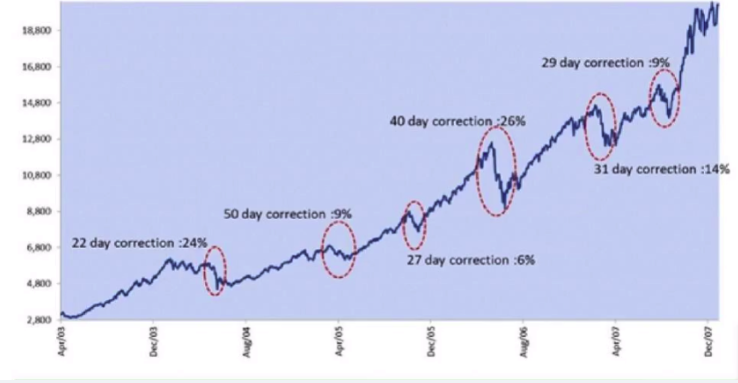
From April 2003 to December 2007, Indian markets surged nearly 600% during one of the strongest bull runs in history, navigating multiple sharp corrections along the way. The chart tells the full story.
All previous corrections look like lost opportunities; the ongoing correction is no different, although it feels this time it’s different.
No one can predict
When markets will fall
How much will they fall
How long will recovery take
But we do know this
Wealth is created by time spent IN the market, not by timing the market.
In fact, a large portion of long-term market returns comes from just a handful of the best days, and those days usually come when fear is at its peak, like what is prevailing in the Indian stock markets today
So when the markets are falling, don’t ask
“Should I exit?”
Ask instead
“Has my financial goal changed?”
If not, your strategy shouldn’t change either.
Market volatility is temporary. Financial goals are permanent.
If you want a disciplined, goal-based approach that helps you stay calm and invested during tough times, Lets Invest Wisely is here to guide you every step of the way.
#MarketCorrections
#StayInvested
#WealthCreation
#FinancialWisdom
How Can a Single Mother Invest Wisely Amid Social Media Noise?
Being a single mother means carrying multiple responsibilities, often without a financial safety net. In such a situation, money decisions cannot be impulsive or driven by social media noise; they must be calm, structured, and purpose-driven
Today’s digital space is crowded with confident opinions and half-truths that ignore real-life goals and risks
For a single mother, the cost of a wrong decision is far higher. So how should investments be approached?
1. Ignore the Noise. Focus on Stability, Not Excitement
Social media rewards drama and speed. Real wealth is built quietly
As a single mother:
You don’t need hot tips
You don’t need overnight success stories
You don’t need complex products
What you need is predictability, discipline, and downside protection
If an investment idea creates anxiety or confusion, it’s already the wrong choice
2. Start With Strong Financial Foundations
Before chasing returns, ensure your base is secure
Emergency fund: 9–12 months of expenses
Adequate life insurance: Your child’s future must be protected, regardless of market conditions
Health insurance: Medical shocks derail long-term plans faster than market volatility
3. Goal-Based Investing is Non-Negotiable
Every rupee must have a job
Typical goals for a single mother may include:
Child’s education
Child’s marriage
Retirement with dignity and independence
Money meant for your child’s education cannot be exposed to reckless volatility; time horizon, not trends, should decide asset allocation
4. Keep Portfolio Simple
Complexity increases risk, not returns
A sensible portfolio should have:
Equity mutual funds for long-term goals
Debt instruments for stability and near-term needs
Minimal churn and low emotional involvement
If you can’t explain your investment to yourself in simple words, you shouldn’t own it
5. SIPs over Market Timing. Discipline Over Predictions
Systematic investing:
Reduces emotional stress
Avoids timing mistakes
Builds wealth steadily across market cycles
Remember, consistency beats intelligence in investing
6. Social media influencers
They don’t understand your financial situation, don’t share responsibility for losses, and won’t be there during market downturns
Their incentives are views, likes, and affiliations, not your child’s future
Trust processes, not personalities
7. Review Periodically, Not Emotionally
Markets will rise and fall. That is normal
What matters is
Staying aligned with life goals, not market moods
Reacting emotionally to market news is one of the biggest wealth destroyers
Final Thought
For a single mother, investing is not about beating the market
It is about creating certainty in an uncertain world
You don’t need to be aggressive or clever
You need to be calm, consistent, and well-advised
In investing, just like parenting, doing the right things repeatedly matters far more than doing exciting things occasionally
#InvestWisely
#SingleMom
Direct mutual funds are cheaper
So why would anyone choose Regular funds?
As a Certified Financial Planner and an MFD, I hear this question often, and it’s a valid one
Yes, Direct plans have lower expense ratios
But investing success depends not just on cost, but on planning, asset allocation, and behaviour over time
That’s where the discussion usually becomes incomplete
Real-life example #1: Random Investing Dilutes Returns
At his request, I recently reviewed the mutual fund portfolio of a salaried Armed Forces professional who was investing only through Direct mutual funds
What I saw was quite common:
* 25+ mutual fund schemes
* Several thematic and sector funds
* No clear asset allocation
* No linkage to goals
* It appeared that the investments were made over time based on tips, news, and past returns
Despite being invested for nearly 5 years, the portfolio delivered an annualised return of around 8–9%, below market returns for the same period
The issue was not the Direct funds
It was random investing without a plan
Too many schemes, especially thematic ones, without proper allocation:
* Increased risk instead of reducing it
* Created overlap
* Made monitoring and rebalancing difficult
* Diluted overall returns
A carefully designed portfolio with:
* Asset allocation aligned to the investor’s risk profile
* Clear linkage to goals
* Just a few(5-7) well-chosen core funds
* Minimal or no thematic exposure
could reasonably have delivered 14–15% XIRR over the same period, simply by being focused and disciplined.
More funds did not mean better diversification
They only added complexity
Real-life example #2: Discipline matters more than cost
Another investor chose Direct funds to save costs and started investing confidently
During a market correction:
* SIPs were stopped “temporarily”
* Equity exposure was reduced
* A restart was planned once markets felt stable
* That pause lasted much longer than expected
When markets recovered, returns lagged badly, not because of expense ratios, but because discipline broke at the wrong time
The cost of missed recovery was far higher than the savings from Direct plans
The Real Takeaway
Direct vs Regular mutual funds are not about right or wrong; it’s a suitability decision
Direct funds work only if you:
* Understand asset allocation
* Avoid thematic or return-chasing temptations
* Control emotions
* Stay disciplined without guidance
For most investors, this is hard to sustain
Regular funds add value where it matters most:
* Structure and clarity
* Behavioural discipline during volatility
* Consistency of action over time
Regular plans are not about “paying extra”
They are about avoiding expensive mistakes
Lower cost helps, but it rarely compensates for poor structure, emotional decisions, or missed rebalancing
In long-term investing, behaviour and discipline matter far more than saving a few basis points
Before choosing, ask yourself honestly
Do I only need a platform, or do I also need guidance?
That answer usually makes the decision clear
#mutualfunds
#PersonalFinance
#investing
RBI strengthens liquidity support
The RBI has announced two major liquidity measures
* ₹2 lakh crore of Open Market Operations to buy government bonds
* And a $10 billion USD–INR swap for three years (RBI is lending dollars to the market and taking rupees in return, with an agreement to reverse the transaction after 3 years at a pre-decided rate)
What does this mean?
* First, durable liquidity will flow into the banking system.
* Second, bond yields are likely to soften, bringing down borrowing costs.
* Third, the rupee gets stability, reducing currency volatility.
Together, comfortable liquidity, lower bond yields and a stable exchange rate create the right environment for credit growth, business expansion and long-term investments.
This is clearly a growth-supportive stance by the RBI, positive for both debt and equity markets, especially in phases of current market corrections
Key takeaway
Liquidity drives markets, and the RBI has made its intent very clear.
#rbipolicy
Rupee Depreciation Doesn’t Mean India Is Doomed; Currencies Fall, Economies Grow
Every time the Rupee weakens against the US Dollar, India is declared “in trouble”. Headlines scream, social media panics, and pessimism spreads. Despite decades of currency depreciation, India has grown into one of the world’s largest and fastest growing economies. A weaker currency is not a verdict on economic failure
A 75 Year Perspective Matters
USD–INR was below ₹10 in the 1970s, ₹40 by 2000, ₹70 by 2018–20 and near ₹91 by 2025. If currency depreciation signalled doom, India would have collapsed long ago
Instead
* India’s GDP has grown from about $150 billion in the 1970s to over $3.7 trillion today
* Per capita incomes have risen many times over
* Forex reserves have increased from less than $1 billion in 1991 to over $600 billion
* India is slated to be the third largest economy soon
This is not the trajectory of a failing nation
Why Long-Term Currency Depreciation Is Normal
Most fast-growing economies experience long-term currency depreciation due to
* Higher inflation compared to developed economies
* Faster domestic growth requiring capital imports
* Productivity catch-up over decades
Japan, South Korea, and China all saw significant currency depreciation during their high-growth years, yet each emerged as a major global economic power. India is no exception
A Weaker Rupee Has Also Helped India
Rupee depreciation has actually played a supportive role in India’s growth by
* Making Indian exports more competitive globally
* Fuelling the rise of IT services, pharmaceuticals, and manufacturing
* Attracting foreign investment by making Indian assets relatively cheaper
India’s IT and services exports, now earning hundreds of billions of dollars annually would not have scaled the way they did with an artificially strong currency
Dollar Strength Is a Global Phenomenon
The US Dollar has strengthened against most global currencies over the last decade, including the Euro, Yen, Pound, and Yuan. Looking at USD-INR in isolation and declaring India “doomed” ignores global currency cycles and macroeconomic realities
What Investors Should Actually Focus On
For investors, the real drivers of wealth creation are
* Earnings growth
* Asset allocation
* Time in the market
* Discipline during volatility
Currency movements are macro outcomes, not investment signals for panic
Conclusion
Fixating on USD–INR while ignoring fundamentals leads to poor decisions Markets and currencies move in cycles, but long-term wealth is built by staying aligned with fundamentals, asset allocation, and financial goals
If recent market volatility or currency headlines are making you uncomfortable about your investments, it may be a good time to pause, review, and realign, not panic
I help investors build and review mutual fund portfolios that are aligned with their goals and risk profile, especially during uncertain phases like these
Let's Invest Wisely—based on facts, not fear
#INRdepreciation
#indianeconomy
#USDINR