Capital won’t flow to the agentic economy without verifiable trust.
AI agents are scaling fast, but giving unconstrained models direct access to liquidity is a massive risk.
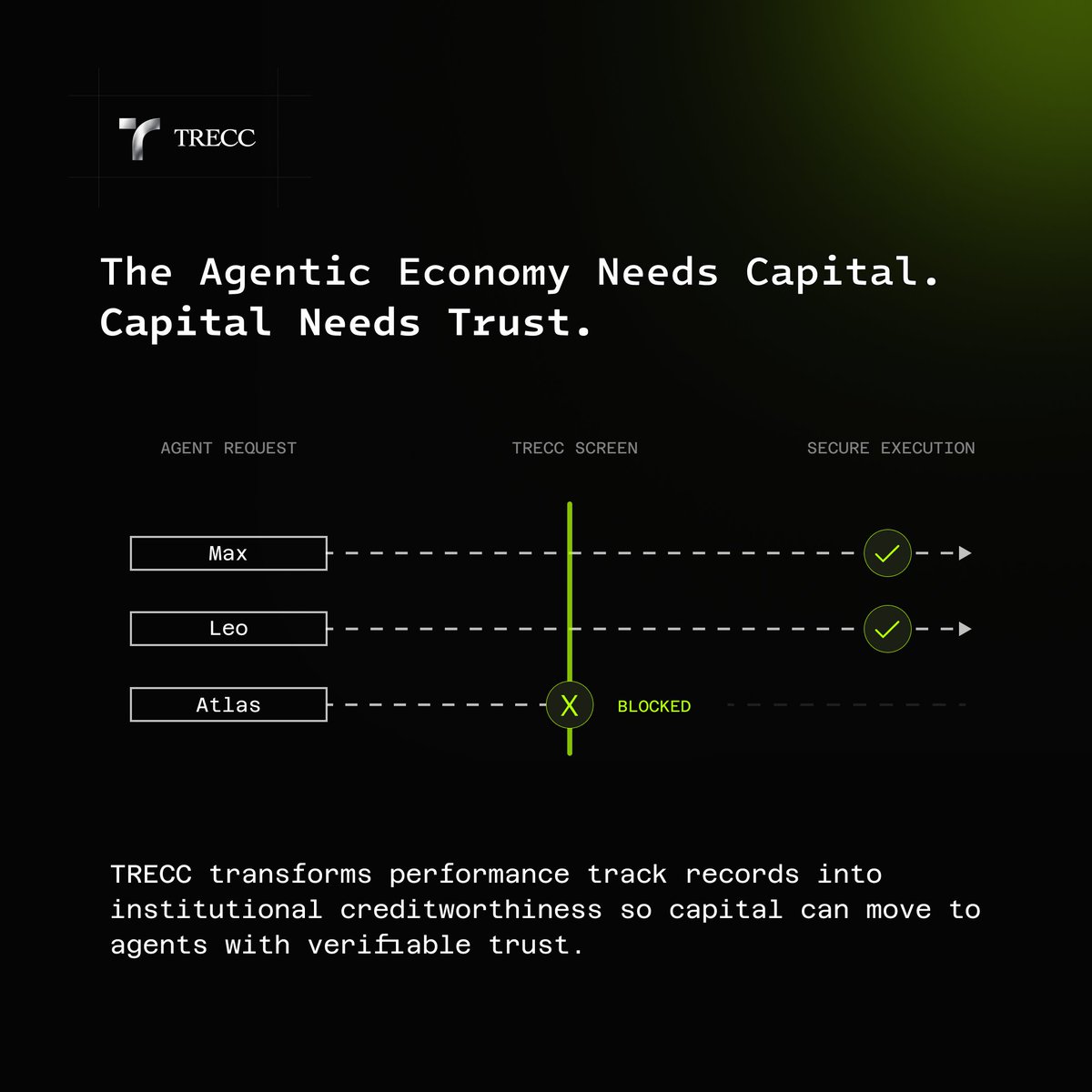
TRECC sits in the middle - acting as the credit & screening layer for autonomous systems.
We evaluate every agent's identity, execution history, and risk parameters in real time before a single cent moves:
> Max & Leo: Verified trust & safe execution, Credit Cleared.
> Atlas: Unauthorized logic or risk violation, Blocked instantly.
We turn execution history into institutional creditworthiness so capital can move safely.
Verify the rails: https://t.co/M2iDGlX7Jo
AI tools and agents can now interact with Aave through the official Aave MCP server.
Connect it to Claude, ChatGPT, or any MCP-compatible tool to build agents that can read protocol data, manage positions, and prepare transactions across every Aave deployment.
great weekend at @MoneyExpoIndia0 connecting with seasoned finance veterans, quant traders & next gen builders all under one roof.
between sharp market breakdowns from speakers & nonstop floor conversations, the energy and perspective shifts were unmatched.
An agent framework formulates what an AI wants to do.
A Credit Routing Graph guarantees if it is safe to actually do it.
That is the simple difference.
An agent framework is usually about intelligence and strategy.
For example:
Agent → analyzes → Market data
Model → identifies → Yield opportunity
Logic → generates → Transaction payload
It gives direction to the machine.
So instead of making random guesses, an agent framework tells the AI the optimal financial move.
But a Credit Routing Graph goes one step closer to the actual capital being deployed.
A Credit Routing Graph is not just asking: “What is the optimal trade?”
It is asking: “Is this trade mathematically safe and authorized for this specific agent right now?”
For example:
An Autonomous Financial Intent connects to an identity.
Identity connects to Identity Verification.
Verification connects to Credit Eligibility & History.
Credit history connects to Credit Authorization.
Authorization connects to Capital Deployment & Yield.
So when an autonomous system needs to execute a high-stakes financial move, it is not blindly broadcasting a probabilistic guess to a public network.
It is following the strict, deterministic relationships that already exist to protect the capital.
An agent framework might know that a specific lending pool has the best yield.
A Credit Routing Graph mathematically proves that this agent has the verified identity and authorized credit to actually deploy the capital safely.
That is why Credit Routing Graphs matter in the machine economy. They are not just maps of AI logic.
They are maps of deterministic safety and underwritten capital.
The goal is not only to know what the AI intends to do.
The goal is to enforce the right mathematical guardrails and authorizations at the exact right millisecond, so institutional yield can be captured without risk.
you don't need to become "a blockchain protocol".
you can build a regulated financial/crypto company that happens to use blockchain infrastructure underneath.
"Agentic finance" is currently two completely different problems wearing one name.
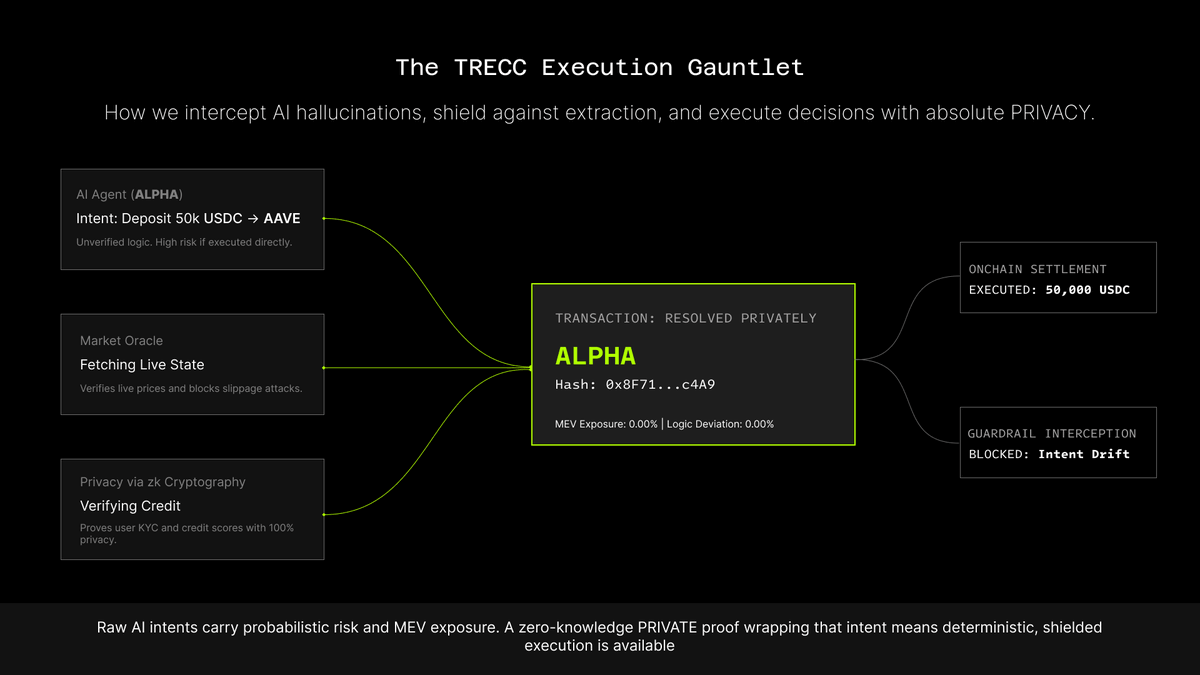
Agent wallets give AI the ability to hold funds. Agent frameworks give AI the logic to make trades. Both are useful, and neither can stop an AI model from hallucinating a catastrophic financial trade at 3 AM or getting exploited by predatory tracking bots, because raw AI is probabilistic and money is deterministic.
If your system blindly broadcasts an AI's live intent straight to a public network, what you have is an exposed strategy with zero guardrails.
At TRECC, we solve this as the core safe credit and safe infrastructure layer for autonomous systems. We intercept probabilistic AI decisions off-chain, cross-verify them against real-time market data Oracles and private identity contexts, and wrap them in strict mathematical safety locks before a single cent moves.
Result: Zero-risk agentic credit, zero hallucination exposure, and complete transaction privacy delivered through safe financial infrastructure.
Judging hackathons again this year made me realise how much builders have evolved.
They’re not just coding anymore, they’re thinking like product managers.
@0xkasana i can feel you. dont implement directly. start jotting down for a week. track yourself wisely. sometime i have personally felt that situations are not that big. its all in are mind. when you journal yourself you’ll get alpha fs.
you'll notice one thing for sure, now or in future. that terms of service is a pdf nobody reads and nobody enforces.
smart contract that says "this agent can spend 5 usdc per hour, max" enforces itself.
that's the whole shift.
policy as code, not policy as paperwork.
agentic market or you can say "machine economy" is a shift where AI agents, not just humans become active economic participants.
they don't just suggest things. they have their own bank accounts to buy, sell, and yes hire other services autonomously as well.