And then, we'll blame firms for low investment in R&D in India.
R&D investment is a long term bet; requires a stable policy framework + means to question an arbitrary decision.
Additionally, higher returns for a firm investing in getting favourable policies than in R&D.
A few additional thoughts on the Telegram ban in India:
1. Is this a permanent ban?
It's unusual for the Indian government to issue a press release about the telegram ban: the precedence that I remember is when Chinese apps were banned in India in June 2020 including tiktok. A Section 69A order to ban something doesn't necessitate a press release, in fact it is protected by a secrecy clause, which should be held unconstitutional.
So what prompted this press release? Is this a signal? Were they expecting a backlash and a PR puts a govt justification (as hollow as the Chinese app ban, which I supported) before the reaction. A BJP guy I spoke to the night of the Chinese app ban told me if they had their way, this would be permanent.
So, is this ban permanent? As in, after things die down, will the date be extended?
2. This looks terrible for India and will impact us:
It makes us look like a banana republic. Who in their right mind blocks an app used by hundreds of millions of users because of AN EXAM? How is this even legal, and is such a short-sighted-knee-jerk-uneducated-action-even-justifiable in a democracy?
We talk about ease of doing business but for us it's a slogan. Which global business will want to operate in an environment of such regulatory uncertainty? We've seen some exit: toyota, citibank.
This will play out across the world. It will definitely make it to late-night-comedy on US TV shows. We'll be a joke. Blocks telegram because of EXAMS?
These are important signals that investors look at, and investors like going where things are predictable from a regulatory standpoint (unless they're playing a high stakes game), and not operating on whims. Look at the Crypto ban that pushed Indian crypto companies overseas. Look at the advisory on AI regulation that made founders question about building AI in India, before it was hurriedly rolled back.
And this does look whimsical, unconstitutional and the idea of some guy with power who decided this is how things go. I mean, look at the US these days. Same thing.
Varun Grover's "kabootar ki barfi" commentary comes to mind.
At this point in time, as a nation, we need to project regulatory certainty and rule of law in a global economy where money doesn't know where to go. If the CEO of a company has to justify investing in India to her board, with the limited understanding that people have about India, the board is likely to push back because its their job to protect investor money.
We're failing at this spectacularly, and I'm not saying this just wrt the Telegram ban. We're doing the opposite of what we ought to do.
3. This is precedence-setting.
Once this goes through unchallenged, this will happen again and again and again. it happened with Internet shutdowns, and the Indian government got a lot of criticisms for years, for over 100 Internet shutdowns a year in the country. In some cases, especially Kashmir and Darjeeling, there were over 100 days of bans. Kashmir had bans regularly, for years. At that time we argued that this won't happen in a major city.
App bans are easier: you block one, and people switch to an alternative, because as Indians, we adjust to government diktats. It hurts less than an entire Internet ban.
IT Cell kicks in and says:
- "you can't sacrifice using a messaging app for your country?"
-"They didn't follow government orders, so this is right." - "there's lots of harmful content on telegram (pick anything from terror financing to port to copyright violation to app features)"
- "It has harmful features like message editing that can lead to people being mislead that an exam paper has leaked."
I'm surprised tech company founders haven't been given rewritten tweets on this issue btw. It's a thing and I'm surprised to see some friends of mine tweet a copypasted tweet recently, but I understand their compulsions: they're in a high risk business in a high risk country with little or no leverage.
4. Is this a smoke-test for Whatsapp?
I'm wondering about how the decision went, and who took the final call. We know that it probably wasn't MEITY: for things like such bans, MEITY bows to Home Affairs. It's a BIG decision to take, given the hundreds of millions of users impacted. Did it go up to the PM? Ofc heads won't roll, like in case of the education minister, and that was demonstrably a shit-show that deserved a public sacking. this is smaller.
This is kinda like the Indian Internet's demonetization moment, except there's no Paytm publishing ads in newspapers, and no payments industry celebrating a windfall, leeching growth off millions of people hanging off a cliff trying to get access to their own money. Media is already controlled and probably won't cover this well, and social media and YouTube is all there is, and it's tiny, and this is Telegram not Whatsapp. This makes me wonder if this is a smoke test as leverage against Whatsapp.
Remember that the streaming services did not challenge the IT Rules in 2021 after what happened in case of Tandav.
5. Legality of the ban:
legality of a ban is not a consideration anymore in India since the IT Rules challenges (they're largely unconstitutional) are stuck in courts, and in my opinion Indian courts are doing little about constitutional rights like freedom of expression, so that has given confidence to the government to create an infrastructure for censorship, and increasing censorship over the last five months. They're not responding to RTI's btw. We tried.
Make no bones about this:
- This act is disproportionate. There is legitimate speech that is being pre-censored with a ban on an app like this.
- there is no clear cause-and-effect impact in terms of public order here.
- The short term of the ban (so far) doesn't justify the scale of the impact, though that might be leverage in courts because by the time the hearing happens, the ban may be lifted so no one may actually consider challenging it.
I'm of the opinion that except in some cases, our courts, including our Supreme Court, haven't upheld constitutionality and individual rights of citizens that is core to the functioning of a democracy. But that's a global trend, and this too shall pass. I think that when courts act to protect our rights, its an exception rather than the rule. Most of the time, like the SC did in case of the Right to Privacy (700+ days before a nine judge bench was founded), they just delay justice.
6. There are reports, and I don't understand this too well since I've not tracked network infrastructure for a while, that Internet landing station infra is being used to block Telegram. Ignore Durov's conspiracy theory claims of Whatsapp initiating this, because afaik this is a different Reliance (ADAG). Plus I don't think Whatsapp is that stupid or short sighted. But for those in networking, is the usage of landing stations to block an app unprecedented?
Anyway, these are just some things I was thinking about so dumping it here.
I write about how rationality is neither an ideal nor a sufficient tool for decision-making. It doesn’t sufficiently capture the subjective human experience, judgement, values etc. (1/n)
I argue that both lateral thinking and the broader ability to reason offers better alternate to the narrow pursuit of rationality.
And I argue this via some ideas from @rorysutherland and @rameshsrivats, while invoking John Maynard Keynes talking about Newton. (4/5)
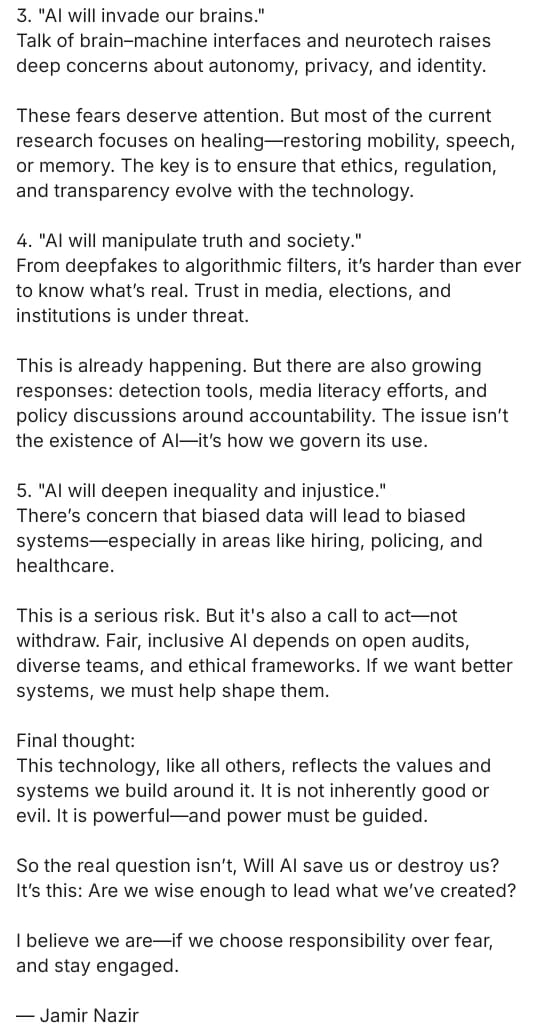
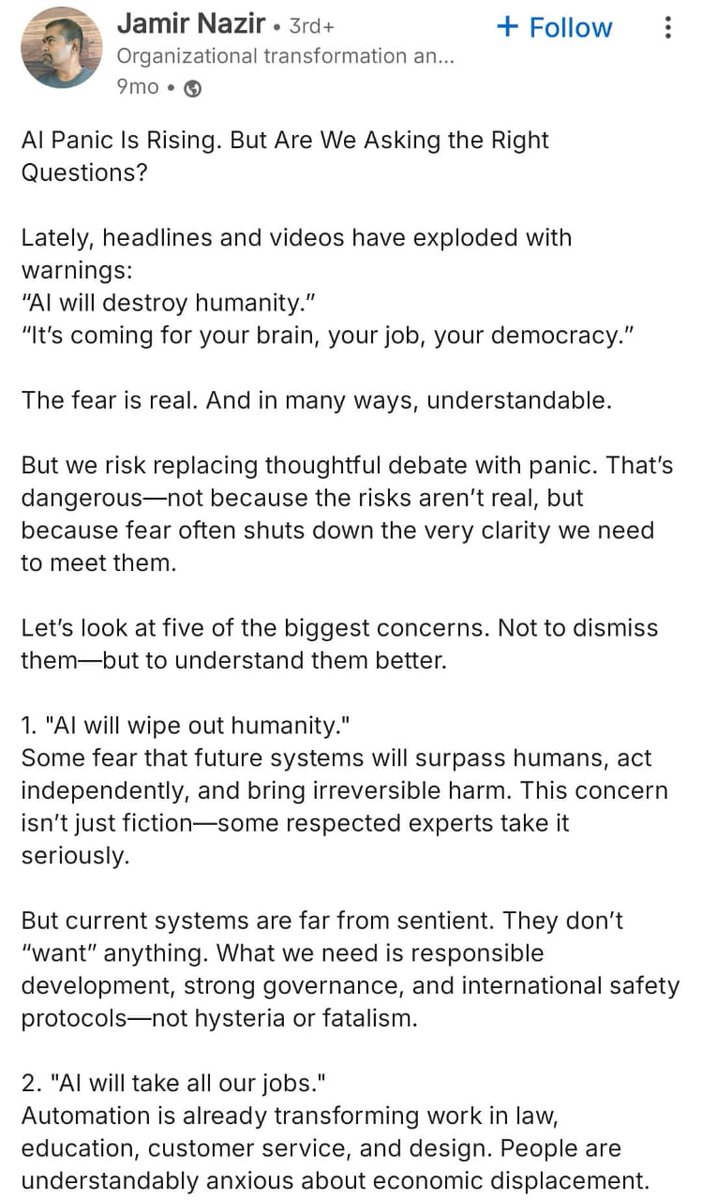
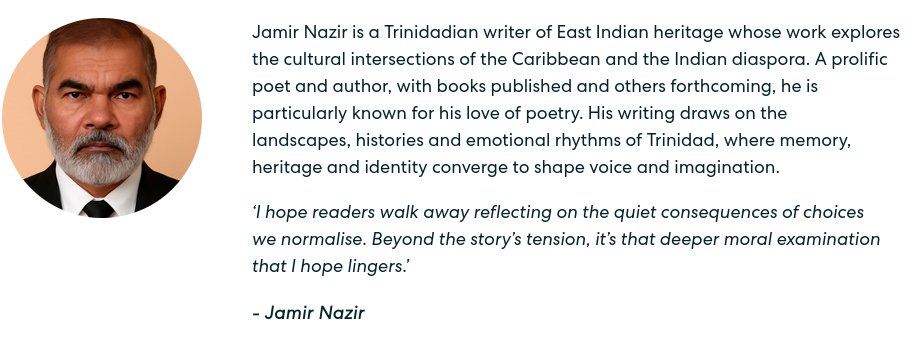
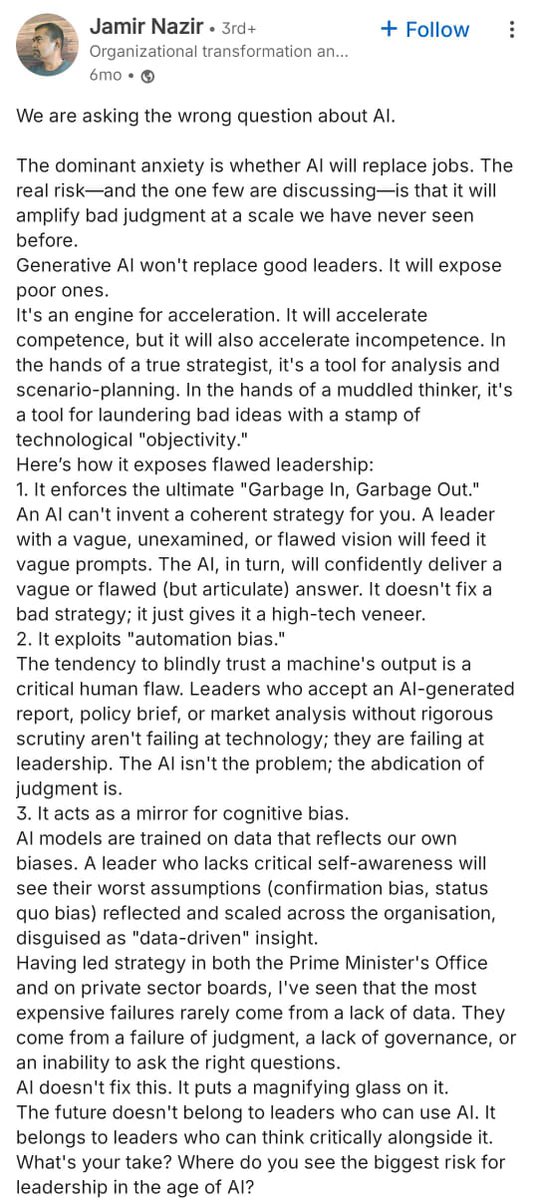
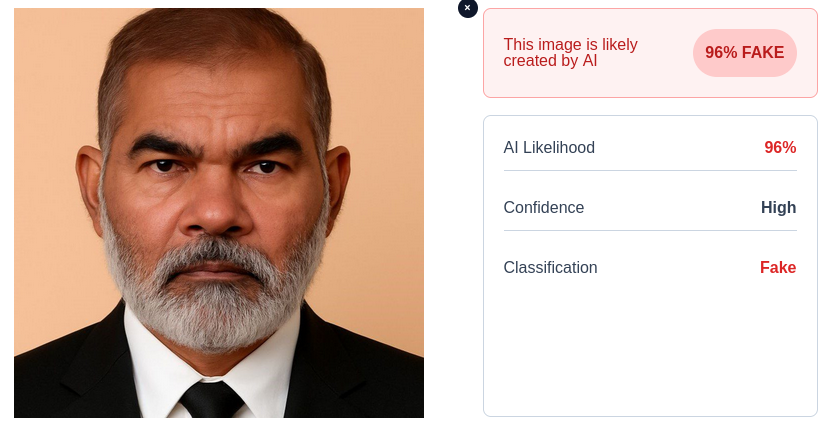
Some more evidence on the probable involvement of AI. This guy's Linkedin profile is https://t.co/CtT1xN17Mo and he has quite an obsession with AI, how it is a force for good, and all that Linkedin bullshit—
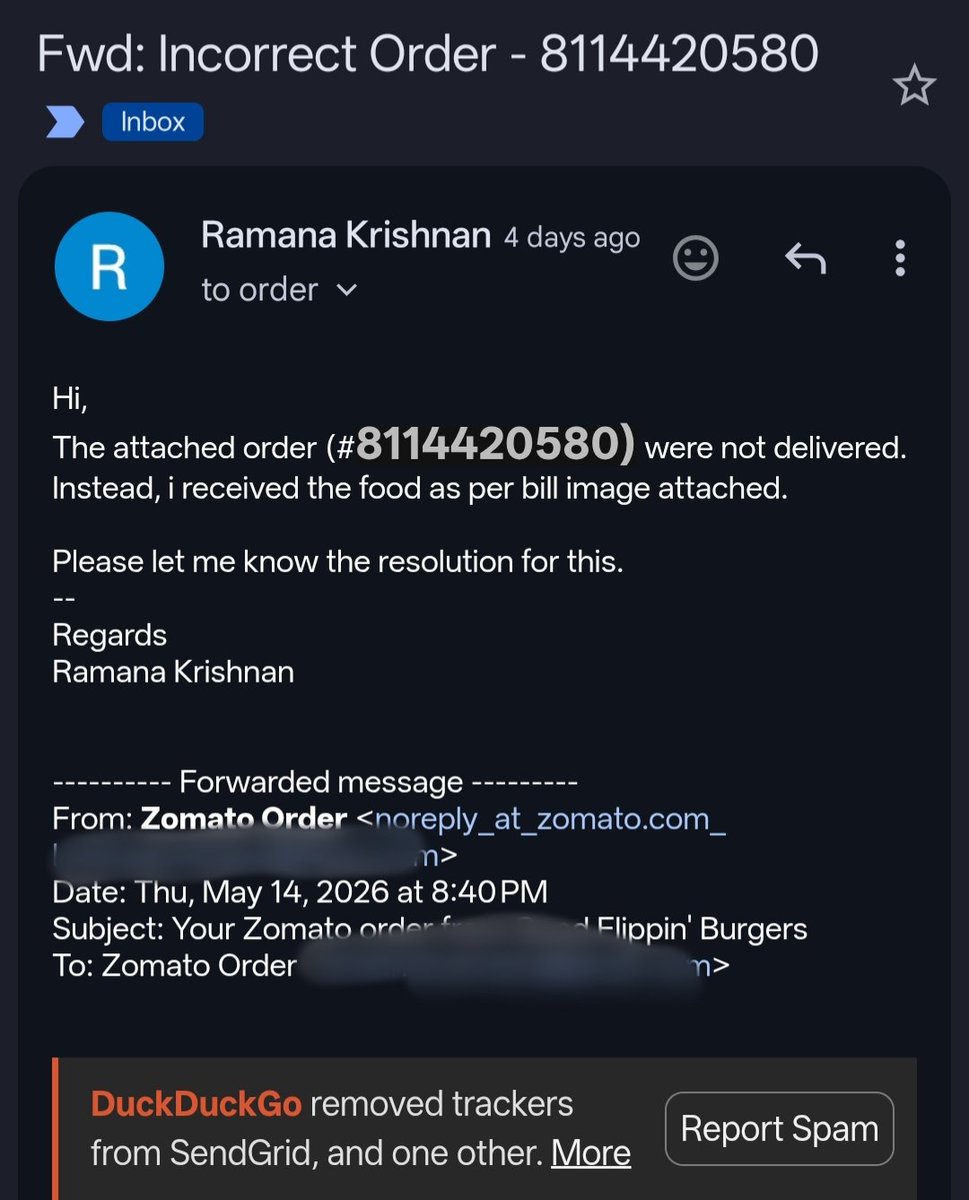
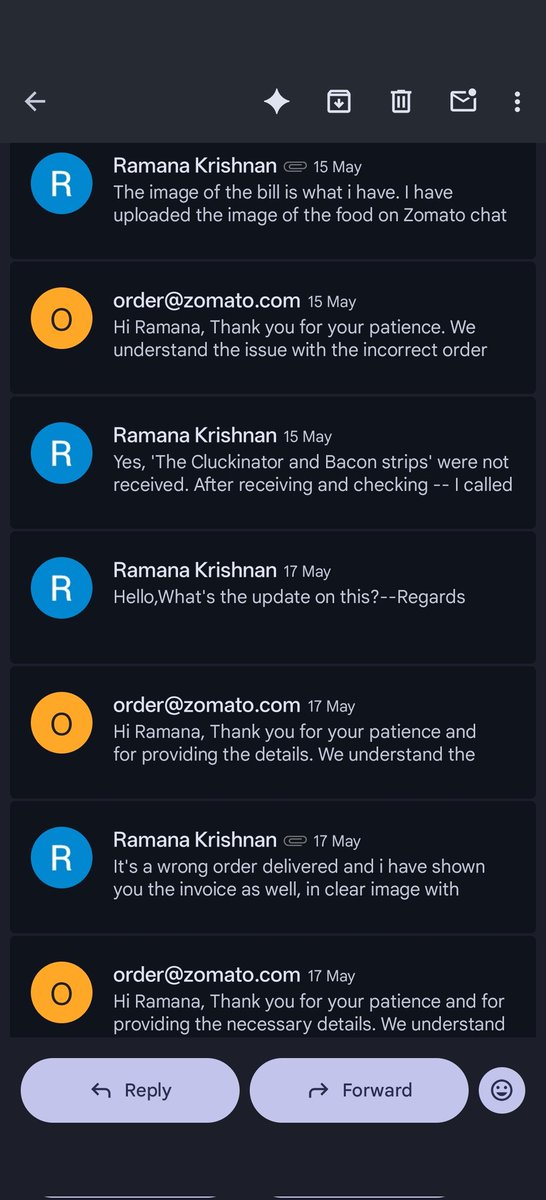
@zomatocare@zomato horrible levels of #CustomerService & #automation. Incorrect order received -- customer name & order are different. Delivery guy agreed that it was a wrong order. He had apparently travelled some distance already & asked to take up with customer service (1/n)
A bunch of templated responses with an eventual unilateral dismissal stating "evidence was inconclusive", with no resolution! Horrible horrible service!
I doubt there was any human involved in the entire thing! (3/n)
This is what happens when you have Robert Oppenheimer and John von Neumann in your seminar and they come to your defense (Benoit Mandelbrot's memoir, "The Fractalist"):
“I MUST PROTEST! This is the worst lecture I ever heard. Not only do I see no relation to the title, but what we have heard makes absolutely no sense at all!”
We were in Princeton at the Institute for Advanced Study (IAS), and a luminary named Otto Neugebauer (1899–1990), a mathematician who had made himself a famous historian of Babylonian astronomy, was commenting on a lecture I had just finished.
I stood frozen with gaping mouth as the physicist J. Robert Oppenheimer, father of the atom bomb, sprung up. “May I respond, Otto? If Dr. Mandelbrot will allow, I would like to make a few comments. The title listed in the announcement of this lecture was tentative and should have been changed. But I had the privilege of hearing about his work. I am impressed, but also fear he may not have given full justice to his striking results. I would like to sketch what I remember.”
The audience became transfixed, being unexpectedly treated to one of the “Oppie talks” for which he was famous. In a few flawless sentences one could print as they were spoken, he was able to summarize every seminar he attended and made the speaker see - often for the first time fully - what had been accomplished and should have been shared with the audience.
As he sat down, the mathematician John von Neumann, father of the computer, stood up. “I invited Dr. Mandelbrot to spend the year here, and we have had very interesting conversations. If he allows me, I would like to sketch some points that Oppie did not mention.” The transfixed audience was then treated to a “Johnny talk” - equally compelling and delivered with a strong Hungarian accent. The meeting went from abysmally low to unforgettably high and concluded in triumph.”
@karthiks ADHD could've gone up from increased prevalence of ADHD or better awareness & testing. I think it's the latter.
Aside(?): alcohol consumption has reduced too. Are tobacco, alcohol, phone consumption all linked? There's the theory of all this just being addiction replacement.
Late Shri Manohar Parrikar Ji once narrated his ordeal.
"I'm from Parra, a village in Goa, so we're called 'Parrikars.' My village is famous for its watermelons. When I was a child, the farmers there held a 'Watermelon Eating Contest' in May, after the harvest. All the children were invited and asked to eat as many watermelons as they wanted.
Many years later, I went to IIT Mumbai to study engineering. Then I returned to my village after 6.5 years. I went to the market to look for watermelons. But they were gone. The ones I found were very small.
I went to meet the farmer who used to hold the 'Watermelon Eating Contest.' Now his son had taken his place. He still held the contest, but there was a difference. When the old farmer offered us watermelons to eat, he would ask us to spit the seeds into a bowl. We were forbidden to chew the seeds. He was collecting seeds for the next crop.
We were, in effect, unpaid child laborers.
He would keep his best watermelons for the competition, using them as the best. He obtained good seeds, which produced even bigger watermelons the next year. When his son arrived, he thought the larger ones would fetch a higher price in the market, so he started selling the larger ones and keeping the smaller ones for competition. The next year, the watermelons grew smaller, and the next even smaller. A watermelon generation lasts one year.
In seven years, Parra's best watermelons were wiped out. In humans, a generation changes every 25 years. In 200 years, we will realize the mistakes we were making in educating our children.
Selecting good seeds, that is, talent, is a huge task in itself. Due to irrelevant ideas and useless things, our good watermelons will go to market, leaving us with useless, inferior seeds.
We must think about this in today's context.
Hi @MnshaP,
Since I follow content on Bengal elections I saw your hit piece on BJP candidate, Santu Pan which came on my feed.
At one point of time, Santu Pan asks who I believe is your producer “do you want money?”when you want to interview him. You immediately say that the fact that he asked this question, is proof that he pays people money to cover his election (3:32 in your video). “I guess he pays people” to quote.
No it isn’t proof of that.
Here are 3 screenshots of people who wrote to me unsolicited on my Instagram offering paid reviews of my book. This is just this week. I have many more of these in my inbox.
*That doesn’t mean I pay these people nor does it mean that any review of my book EVER has been paid by me.*
But yes if anyone writes to me and says “I am going to review your book on so and so platform” I will have to say “I am not going to pay” or ask “are you expecting payment?” so that the person doesn’t invoice me later.
I am 100% sure I didn’t need to tell you this.
And yet here we are.
Thanks
Home to a couple of great Butter Chicken restaurants in Delhi today was originally supposed to be named Pandava Road. But a typo in the Delhi Guide in the 1930s led to it becoming famous as Pandara Road instead.
Tell me a piece of trivia about your city that you think most people will not know.
Here's mine: The official name of Marine Drive in Mumbai is Netaji Subhash Chandra Bose Road.
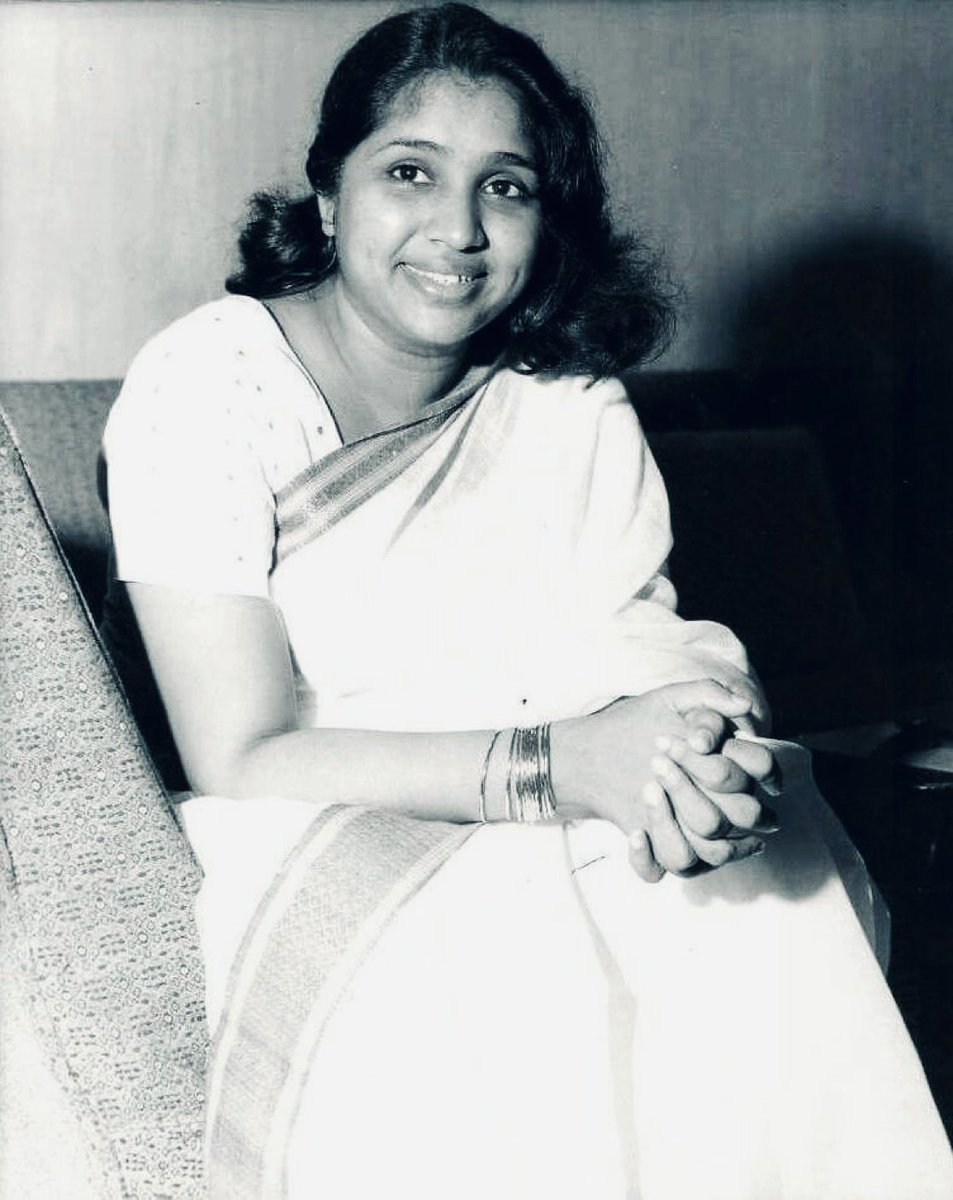
Just like for Zakir Hussain, it is a tragedy that Asha Bhonsle did not get a Bharat Ratna when she was alive. Both deserved it and deserved to accept it. But the tragedy of Bharat Ratna is, it gets over-awarded to politicians and not adequately enough in culture/art etc.
You won't find a human feeling for which there isn't at least one corresponding Asha Bhosle song.
Her versatility stemmed from her ability to express different emotions to the fullest. The emotions she expressed felt real because she had lived those feelings at some point in time, over the course of her long, full life. Feelings of all kinds. The good ones as well as the bad ones.
She (along with other Mangeshkar siblings) faced severe hardship very early on in their life. At nearly every stage of her adult personal life, she had to battle storms, but she never allowed her pain and sorrow to sow bitterness. Rather, she internalized her god-given gift (her voice) and her art as therapy for her grief. Leaving behind a catalogue of immortal songs.
Once while on tour, a reporter asked her about how she was able to breathe so much energy and life into her live performance, even in her 70s. She said she always tried to speak to her audience, to anyone facing a challenge, struggling with their lives; so when they leave the auditorium, she wanted them to leave happy, with their chests out and chins up, inspired to believe that they will pull through. They will overcome their troubles. She wanted to give them — hope. Asha Bhosle continued to perform live even after crossing 90.
Goodbye, Ashatai. Thank you for everything.