Choose any positive integer and repeatedly apply two simple rules:
If n is even: n → n/2
If n is odd: n → 3n + 1
Start with 6: 6 → 3 → 10 → 5 → 16 → 8 → 4 → 2 → 1
Start with 27, and something unexpected happens.
Starting number: 27
Maximum reached: 9,232
Steps to reach 1: 111
Peak reached at: Step 77
The sequence climbs dramatically before eventually falling to 1.
This is the famous Collatz conjecture, which states that every positive integer eventually reaches 1 under these rules. Despite decades of research and extensive computer verification, no general proof is known.
Fields Medalist Timothy Gowers raises a troubling possibility: AI could become so powerful at mathematics that future generations may lose the motivation to study the subject deeply enough to understand its discoveries.
The paradox is striking. Machines might eventually solve problems far beyond human capabilities, while fewer mathematicians possess the expertise needed to interpret their results.
For Gowers, the deeper concern extends beyond the future of mathematical careers. It is about preserving the curiosity, intellectual discipline, and satisfaction of discovery that have sustained mathematics for centuries.
He also envisions a possible transformation of the mathematician’s role, from discovering new theorems to interpreting, connecting, and explaining mathematical knowledge generated by AI.
Reflecting on the approaching social consequences, Gowers offers a vivid analogy:
“We’re still on the beach, we can see the tsunami, but it hasn’t quite reached us yet.”
Importantly, he is not calling for mathematics departments to close or for universities to stop admitting PhD students. His remarks are cautious predictions about a possible future, rather than descriptions of changes that have already taken place.
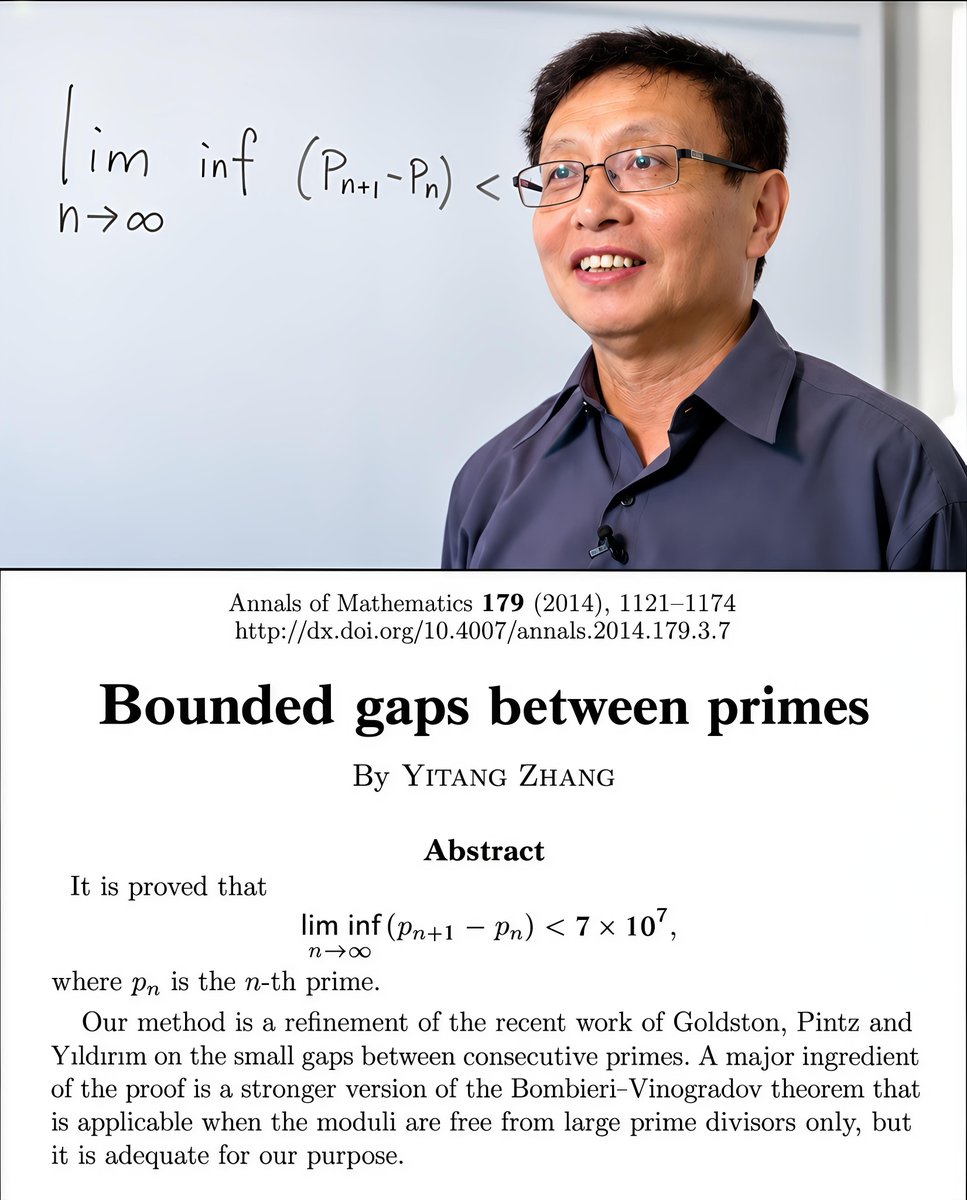
In April 2013, a 58-year-old mathematician named Yitang Zhang submitted a paper to the prestigious Annals of Mathematics.
At the time, he was virtually unknown in the mathematical community.
After earning his PhD from Purdue University in 1991, Zhang struggled to find a permanent academic position.
For years, he worked outside academia, including at a Subway sandwich shop, before eventually becoming a lecturer at the University of New Hampshire, where he taught undergraduate mathematics.
Yet throughout those difficult years, he continued pursuing his own mathematical research, particularly the mysteries of prime numbers.
In July 2012, while visiting a friend in Colorado, Zhang was sitting quietly in the backyard when an idea came to him. He had spent three years working on a problem involving the gaps between prime numbers, and suddenly he saw a way past an obstacle that had frustrated some of the world's leading number theorists.
Over the following months, he carefully developed that insight into a rigorous mathematical proof.
On April 17, 2013, he submitted his manuscript to the Annals of Mathematics.
The response was remarkable. Within just three weeks, the referees had delivered an unusually enthusiastic report, recognizing the work as a landmark achievement. The paper was formally accepted on May 21.
For centuries, mathematicians had wondered whether infinitely many pairs of prime numbers could occur within some fixed distance of one another.
The famous twin prime conjecture predicts that infinitely many pairs differ by exactly 2, such as 11 and 13 or 17 and 19.
Zhang did not prove the twin prime conjecture itself. Instead, he established something that had never been proved before: there are infinitely many pairs of consecutive primes whose difference is less than 70 million.
Seventy million might seem enormous when compared with 2. But the crucial breakthrough was that the gap was bounded by a fixed number, no matter how far along the number line one went.
It was the first proof that bounded gaps between consecutive primes occur infinitely often.
His discovery opened an entirely new chapter in number theory, inspiring mathematicians around the world to improve his bound. In 2014, Zhang received a MacArthur Fellowship in recognition of his extraordinary achievement.
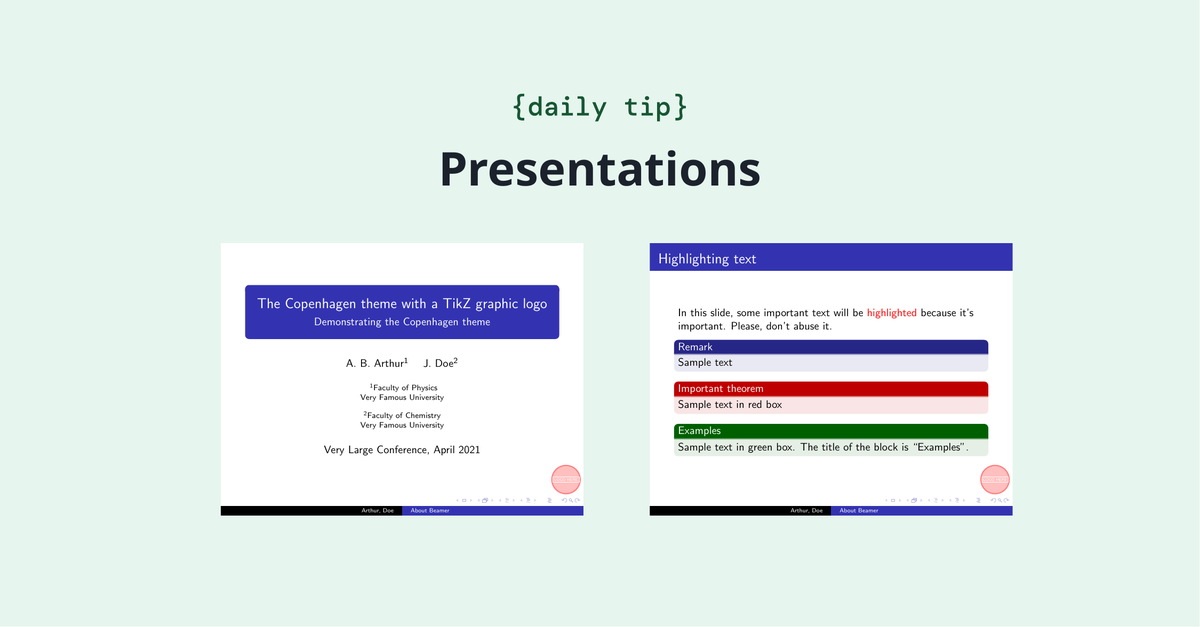
Did you know you can include hyperlinks in your document? That way, you can easily navigate through your PDF file and even open external sources (eg., a website)! Check out this article on how to create hyperlinks. https://t.co/IjYZEB75JY
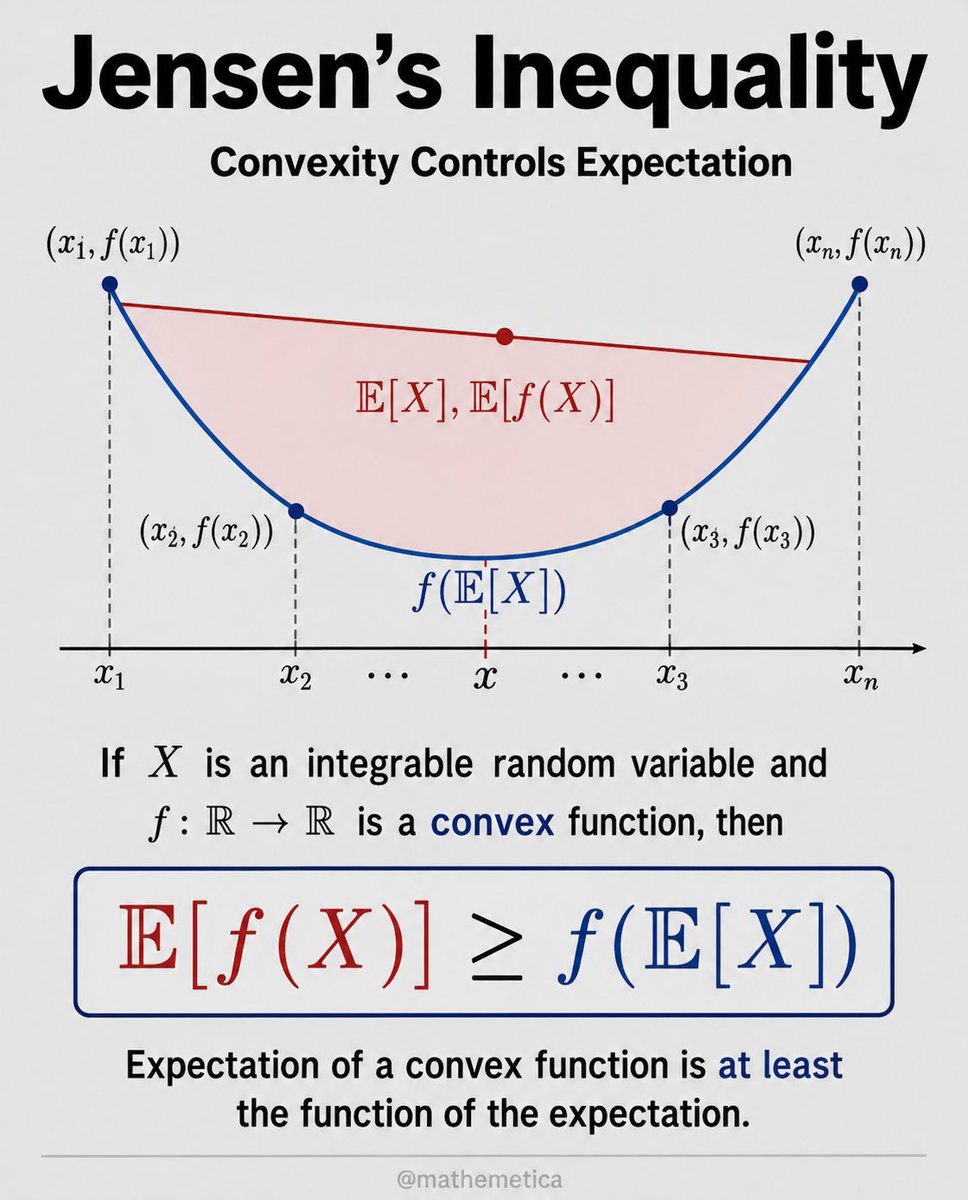
E[f(X)] ≥ f(E[X])
A convex function lies above every chord. Once that geometric fact is granted, taking the expectation of both sides of the supporting-line inequality produces Jensen’s comparison: the average of the values cannot fall below the value of the average.
Johan Jensen published the general form in 1906. The same comparison is why variance is nonnegative, why the arithmetic mean dominates the geometric mean, and why a risk-averse agent prefers the certain equivalent to the lottery.
🧵 Gradient descent is just following the steepest slope.
Picture yourself standing on a foggy hillside at night. You cannot see the valley, but you can feel the ground under your feet.
At every step you simply move in the direction that drops the fastest.That is all gradient descent does: it follows the local slope of the loss surface until it reaches a low point.
Here is the classic picture of that idea. A ball rolling downhill on a 3D loss landscape, always taking the steepest path available.
Bayes' theorem updates probabilities with new evidence.
The image uses a Venn diagram showing red event A and yellow event B overlapping inside universal set U. Colored icons below represent the probability ratios: P(A) as red over box,
P(B|A) as yellow over red,
P(B) as yellow over box, and
P(A|B) as orange over yellow.
P(B|A) = P(B) P(A|B) / P(A) P(A|B) = P(A) P(B|A) / P(B)
It is used to find the probability a patient has a condition after receiving a positive test result.
How can you determine the value of a complex function inside a region just by knowing its values along the boundary?
Cauchy’s integral formula shows exactly that. It is one of the central theorems of complex analysis and reveals the rigidity of analytic functions.
#Math
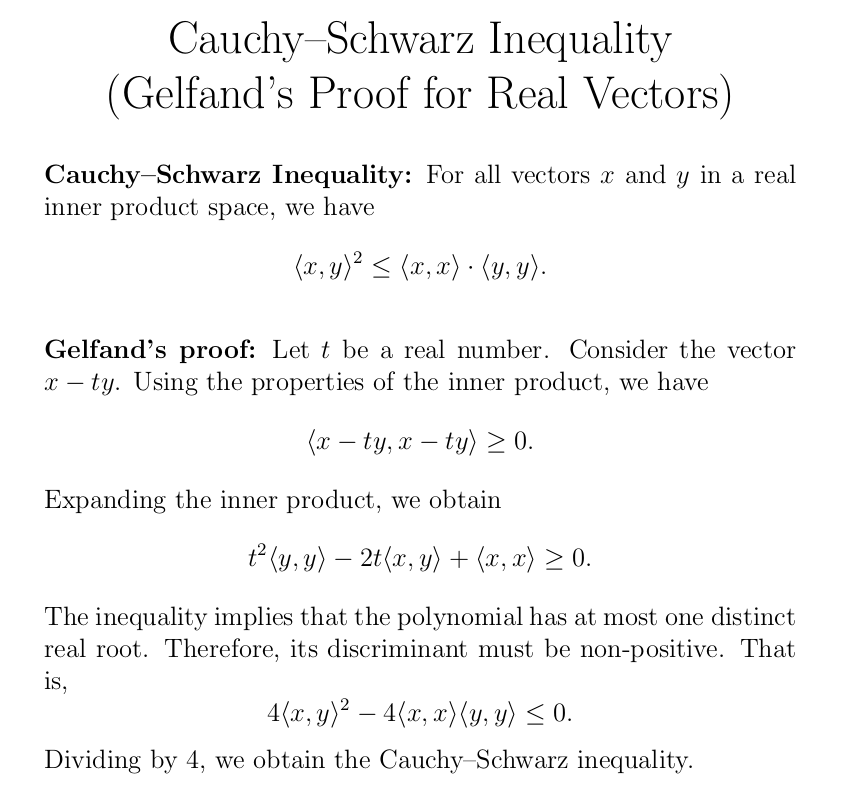
Gelfand's proof for Cauchy-Schwarz Inequality for real inner product spaces
Source: I.M. Gelfand, "Lectures on Linear Algebra" (https://t.co/uOq1RO2bz6).
Today marks the birthday of Évariste Galois! Discover his revolutionary contributions to mathematics through these insightful books.
Browse here: https://t.co/8wlXqDNtu4