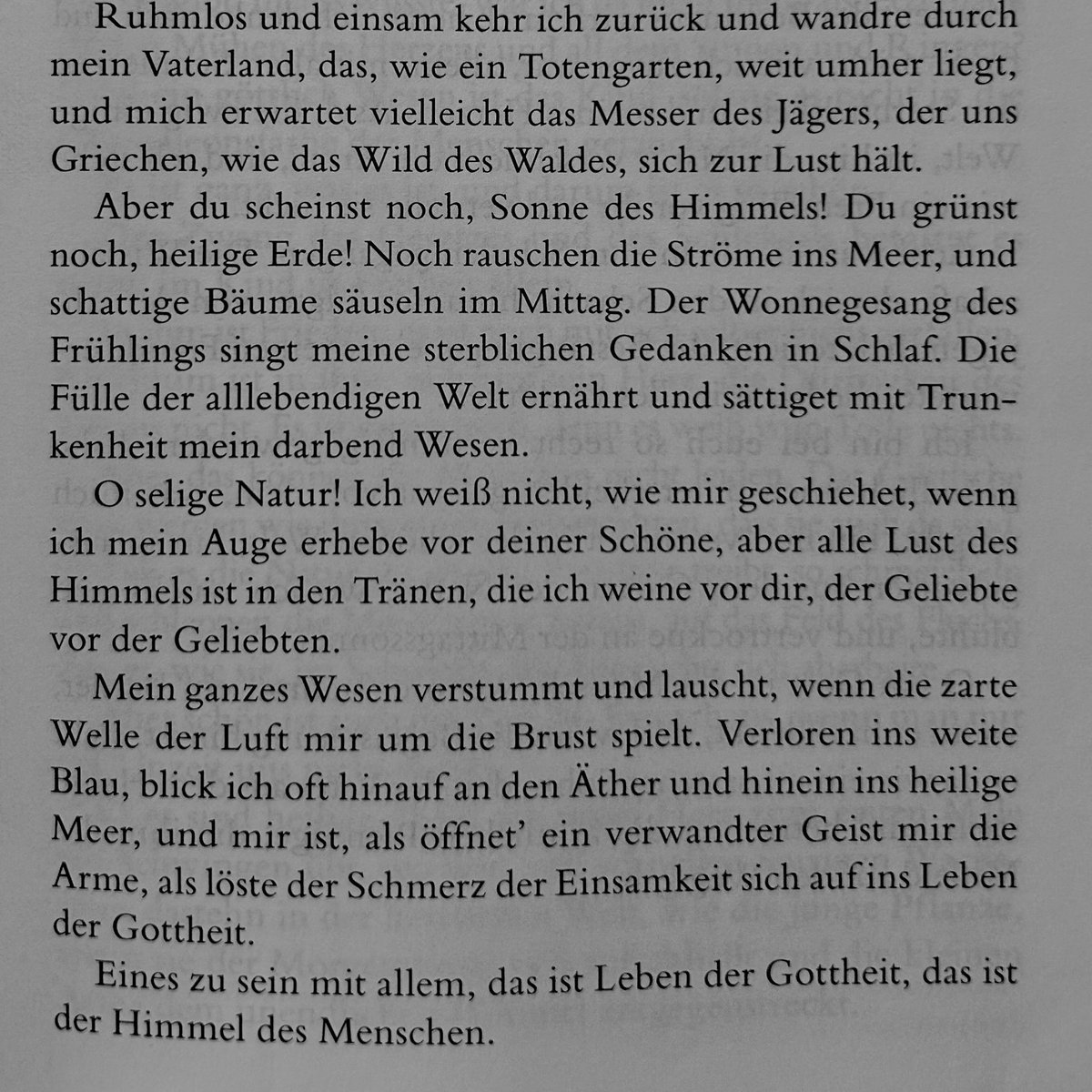
@IiiRamsys Hölderlin himself never set foot in Greece and merely read Richard Chandler’s Travels in Greece ( 1776 ) 🫂 Here’s a better view of the Neckar river from his window and one of the most beautiful passages from Hyperion for you friend
It's remarkable how Hölderlin prefigured his own fate in his writings, from several poems, Hyperion and The Death of Empedocles to theoretical prose pieces and finally the letters that announce the striking by Apollo.
Similarly to Mishima, Hölderlin thus created the interpretative framework for what was to become the mythology of his life and person, but in Hölderlin's case, it remains fundamentally open: it is impossible to tell impersonal theorizing, intimation, volitional dramaturgy and chance apart. His fate stands as Fate, simultaneously overdetermined and contingent
Charles Baudelaire über Richard Wagner und die erste Aufführung der Tannhäuser in Paris ( 1861 ):
„Paris hatte bis dahin wenig von Wagner gehört; man wusste mehr oder weniger, dass es jenseits des Rheins um die Erneuerung der Oper ging. […] Bei den ersten Takten überkam mich die Empfindung eines Menschen, der sich in Einsamkeit einer Träumerei hingibt, allerdings in einer Einsamkeit mit einem unendlichen Horizont. […] Mir war, so erschien er mir wenigstens, ein spirituelles Erlebnis, eine Offenbarung zuteilgeworden. […] Im Vorwort zu seinem letzten Buch Zukunftsmusik kommt Wagner in folgenden Begriffen auf dieses Thema zurück:
‚Als den idealen Stoff des Dichters glaubte ich den Mythos bezeichnen zu müssen, dieses ursprünglich namenlos entstandene Gedicht eines Volkes, das wir zu allen Zeiten immer wieder neu behandelt antreffen; denn bei ihm verschwindet die konventionelle, nur der abstrakten Vernunft erklärliche Form der menschlichen Verhältnisse fast vollständig, um dafür nur das ewig Verständliche, rein Menschliche, aber eben in der unnachahmlichen Form zu zeigen, welchem jedem Mythos individuelle Gestalt verleiht.‘
Die Phänomene und Ideen, die im Verlauf der Zeiten immer wieder aufs Neue aufkommen, erscheinen bei jeder Auferstehung abgewandelt, den Umständen angepasst und um eine neue Eigenheit ergänzt. […] Durch die Gedichte Wagners weht der Geist der Romantik, auch wenn sie von Bewunderung und Verständnis der klassischen Schönheit künden. Sie lassen einerseits von Äschylos und Sophokles träumen, erinnern andererseits an die Mysterienspiele einer erzkatholischen Epoche. Sie erinnern an die Visionen, die das Mittelalter an den Wänden seiner Kirchen entfaltete oder in seine Wandteppiche einwob. […] Die vollständige Bedeutung des Wortes Willen lässt sich in Wagners Werken erspüren.“
Auszug aus dem Ursprung des deutschen Trauerspiels ( 1928 ), in welchem Walter Benjamin Carl Schmitt zitiert:
„Der Souverän repräsentiert die Geschichte. […] So wird nicht nur auf die Stabilität politischer Verhältnisse im achtzehnten Jahrhundert zu verweisen sein, will man erklären wie ‚das lebhafte Bewusstsein von der Bedeutung des Ausnahmefalles, das im Naturrecht des siebzehnten Jahrhunderts herrscht.‘ im folgenden verlorengeht. Wenn nämlich ‚für Kant […] das Notrecht überhaupt kein Recht mehr‘ war, so hängt das mit seinem theologischen Rationalismus zusammen. Der religiöse Mensch des Barock hält an der Welt so fest, weil er mit ihr sich einem Katarakt entgegentreiben fühlt. […]
Das Jenseits wird entleert von alledem, worin auch nur der leiseste Atem von Welt webt und eine Fülle von Dingen gewinnt das Barock ihm ab und fördert sie auf seinem Höhepunkt in drastischer Gestalt zu Tag, um einen letzten Himmel zu räumen und ihn als Vakuum in den Stand zu setzen, mit katastrophaler Gewalt dereinst die Erde in sich zu vernichten.“
Hölderlin: Am Quell der Donau ( 1801 )
„So kam
Das Wort aus Osten zu uns,
Und an Parnassos Felsen und am Kithäron hör ich,
O Asia, das Echo von dir und es bricht sich
Am Kapitol und jählings herab von den Alpen��
Hölderlin: Becoming in Dissolution ( 1800 )
“The declining fatherland, nature and man, insofar as they bear a particular relation of reciprocity […] dissolve so that from the world and from the remaining ancestry and forces of nature emerge a new world. […] This decline of the fatherland is felt in the limbs of the existing world, at that moment and to the extent that existence dissolves, the newly entering and the youthful is also felt. […] What enters into reality as that reality itself dissolves, evokes the sense of dissolution as well as the remembrance of that which has been dissolved. […]
The new life, which had to dissolve and did dissolve, necessitates dissolution and exists between being and non being. […] The dissolution has to appear as a real nothing, so that all existence, hence particular, appears as totality, and a sensuous idealism, an Epicureanism arises, such as Horace has depicted it in his Prudens futuri temporis exitum.”
Mishima: Poetic Theory ( 1945 )
“Self destruction does not end existence. The poet dies at his own hands in order that he may live. […] The entire history of Japanese poetry can be expressed in a single line: The flowers are in blossom ( hana ga saite iru ). […] In its relationship between the singular and the totality, between the particular and the universal, the history of poetry is a synthesis of the specifically universal in a manner similar to that of general history. […]
A poet and his works are einmalig yet they transcend the notion of the remote past and participate in the cycle of rebirth itself. We can base the history of poetry on Hegel’s method; that is, as the development of a single theme according to a view of history as having a specific objective. And the theme of our motherland can be summed up in the line: The flowers are in blossom.”
Hölderlin to Hegel, July 1794
“I am certain you will have thought of me from time to time since we parted with the watchword ‘Kingdom of God!’ [their shared Tübingen-era ideal] By that watchword we would, I believe, recognize each other after every possible metamorphosis.” (1/2)
Nietzsche’s Slavophilia makes more sense in the light of its time since Herder wrote that “Ukraine will become a new Greece [...] and Poland will partake in this renewal as it extends to the rest of Europe” ( Journal of My Travels in the Year 1769 ), and as Poland in particular, according to Rousseau, had the “spiritual vitality” ( Considerations on the Government of Poland and on its Proposed Reformation, 1772 ) to emulate Homeric Greece. Ironically enough that’s also why Herzen, whom Lenin considered to be “the founder of Russian socialism” ( In Memory of Herzen, 1912 ), wrote that “in the Iliad and the Odyssey, and not in the Mahabharata or in Shakuntala, do we find something familiar and kindred to our spirit. [...] This is the West, this is Europe.” ( Greek Philosophy, 1844 )









![rameausniece's tweet photo. Charles Baudelaire über Richard Wagner und die erste Aufführung der Tannhäuser in Paris ( 1861 ):
„Paris hatte bis dahin wenig von Wagner gehört; man wusste mehr oder weniger, dass es jenseits des Rheins um die Erneuerung der Oper ging. […] Bei den ersten Takten überkam mich die Empfindung eines Menschen, der sich in Einsamkeit einer Träumerei hingibt, allerdings in einer Einsamkeit mit einem unendlichen Horizont. […] Mir war, so erschien er mir wenigstens, ein spirituelles Erlebnis, eine Offenbarung zuteilgeworden. […] Im Vorwort zu seinem letzten Buch Zukunftsmusik kommt Wagner in folgenden Begriffen auf dieses Thema zurück:
‚Als den idealen Stoff des Dichters glaubte ich den Mythos bezeichnen zu müssen, dieses ursprünglich namenlos entstandene Gedicht eines Volkes, das wir zu allen Zeiten immer wieder neu behandelt antreffen; denn bei ihm verschwindet die konventionelle, nur der abstrakten Vernunft erklärliche Form der menschlichen Verhältnisse fast vollständig, um dafür nur das ewig Verständliche, rein Menschliche, aber eben in der unnachahmlichen Form zu zeigen, welchem jedem Mythos individuelle Gestalt verleiht.‘
Die Phänomene und Ideen, die im Verlauf der Zeiten immer wieder aufs Neue aufkommen, erscheinen bei jeder Auferstehung abgewandelt, den Umständen angepasst und um eine neue Eigenheit ergänzt. […] Durch die Gedichte Wagners weht der Geist der Romantik, auch wenn sie von Bewunderung und Verständnis der klassischen Schönheit künden. Sie lassen einerseits von Äschylos und Sophokles träumen, erinnern andererseits an die Mysterienspiele einer erzkatholischen Epoche. Sie erinnern an die Visionen, die das Mittelalter an den Wänden seiner Kirchen entfaltete oder in seine Wandteppiche einwob. […] Die vollständige Bedeutung des Wortes Willen lässt sich in Wagners Werken erspüren.“](https://pbs.twimg.com/media/HHkEY8tXUAc2lAD.jpg)

![rameausniece's tweet photo. Hölderlin: Becoming in Dissolution ( 1800 )
“The declining fatherland, nature and man, insofar as they bear a particular relation of reciprocity […] dissolve so that from the world and from the remaining ancestry and forces of nature emerge a new world. […] This decline of the fatherland is felt in the limbs of the existing world, at that moment and to the extent that existence dissolves, the newly entering and the youthful is also felt. […] What enters into reality as that reality itself dissolves, evokes the sense of dissolution as well as the remembrance of that which has been dissolved. […]
The new life, which had to dissolve and did dissolve, necessitates dissolution and exists between being and non being. […] The dissolution has to appear as a real nothing, so that all existence, hence particular, appears as totality, and a sensuous idealism, an Epicureanism arises, such as Horace has depicted it in his Prudens futuri temporis exitum.”
Mishima: Poetic Theory ( 1945 )
“Self destruction does not end existence. The poet dies at his own hands in order that he may live. […] The entire history of Japanese poetry can be expressed in a single line: The flowers are in blossom ( hana ga saite iru ). […] In its relationship between the singular and the totality, between the particular and the universal, the history of poetry is a synthesis of the specifically universal in a manner similar to that of general history. […]
A poet and his works are einmalig yet they transcend the notion of the remote past and participate in the cycle of rebirth itself. We can base the history of poetry on Hegel’s method; that is, as the development of a single theme according to a view of history as having a specific objective. And the theme of our motherland can be summed up in the line: The flowers are in blossom.”](https://pbs.twimg.com/media/G-pXapYXYAEV9xv.jpg)


