20+ years helping websites get found in search. 19+ years trying to explain it to my family. Director SEO at @Ticketmaster | @LiveNation Entertainment.
In the last 6 months at @Ahrefs, we analyzed over 1 billion data points across 14 studies. Here's what we learned about AI search optimization:
1) "Best X" blog listicles are the single most prominent content format cited by AI chatbots. They make up 43.8% of all page types cited by ChatGPT specifically.
2) 67% of ChatGPT's top 1,000 citations come from sources marketers can't influence: Wikipedia (29.7%), homepages (23.8%), app stores (6.6%). Only 32.3% are influenceable content like educational pages, reviews, news, and blog posts.
3) 28.3% of ChatGPT's most-cited pages have zero Google organic visibility. These pages get cited repeatedly by ChatGPT despite not ranking in Google at all. A completely separate discovery layer.
4) ChatGPT only cites about 50% of the URLs it retrieves. It fetches dozens of pages per query but uses half as background context without attribution. This means that being retrieved and being cited are very different things.
5) Adding schema markup had zero meaningful impact on AI citations. AI Overviews actually dipped −4.6%, while AI Mode (+2.4%) and ChatGPT (+2.2%) showed changes indistinguishable from zero.
6) YouTube mentions have the highest correlation (0.737) with AI brand visibility out of all the factors we studied (including all the conventional SEO metrics like backlinks, page count, DR, etc). This held true for both Google-owned and OpenAI products.
7) AI Overviews reduce clicks to the #1 result by 58%. That’s up from 34.5% just 10 months earlier. The trend is accelerating.
8) 99.9% of AI Overviews appear on informational intent queries. Transactional, navigational, and local searches are almost entirely AIO-free. Shopping triggers AIOs just 3.2% of the time.
9) For a given search query, Google’s AI Mode and AI Overviews reach the same conclusions 86% of the time — but cite almost entirely different sources (only 13.7% citation overlap).
10) AI Overviews change every 2.15 days on average, with 70% of content differing between consecutive observations. But semantic similarity stays at 0.95. The words, sources, and entities constantly shuffle, but the actual meaning barely moves.
Massive SEO News: Google is launching the most requested report in Google Search Console ever. A new AI performance report!
Here's what we know so far:
• It will include dedicated reports for both Search and Discover
• The data will be reflected within Search for AI Overviews and AI Mode, alongside AI features in Discover
• The report will only be focused on impressions within generative AI features, not clicks
• The rollout will start with a subset of websites, allowing thorough testing (so keep an eye out!)
There are some major limitations to this initial testing phase, where the actual queries that users are searching won't show in the report, with only impressions for pages, countries, devices, and dates.
Though the dataset will be limited, this is certainly a step in the right direction!
I will be covering this rollout within my newsletter, so make sure to subscribe if you aren't already: https://t.co/J6GbI1tB27
Anthropic just dropped a 31-page prompting guide.
Here's everything you actually need (in 10 rules):
1. You write "review this contract" and pray.
Fix: Name every output. "Review this contract. Flag risks per clause. Rate severity 1-5. Return as a table."
2: You say "summarize this" on a 40-page report.
Fix: 4.8 sizes the answer to the input. Cap it: "5 bullets. Each under 15 words. Start each with an action verb."
3: You write "don't use jargon. don't be salesy."
Fix: Negative instructions don't stick.
Flip them: "Write in plain English a 16-year-old could read aloud."
4: You type "can you help me with the email?"
Fix: Each verb ships something. For example: "Go to Gmail. Find [contact]. Write the send-ready reply. Under 90 words. Tone: confident, casual."
5: You wait for Claude to web search on its own.
Fix: Claude opus 4.8 calls fewer tools than 4.6.
Force it: "Use web search aggressively. Verify every claim with at least 2 sources."
6: You miss the warm tone from old Claude.
Fix: Claude opus 4.8 is direct. Almost zero emojis. Paste 2-3 sentences in the voice you want.
Tell Claude to match the rhythm.
7: You ask for "a landing page" & get bare minimum.
Fix: Drop this one line on every creative task
→ "Go beyond the basics."
It's from Anthropic's own doc.
8: You forget Claude 4.8 doesn't reason by default.
Fix: They call it "Thinking." Effort: High
Add this at the end: "Think before answering (maximum reasoning)." Free upgrade. Every time.
9: You rewrite the same prompt 14 times a week.
Fix: A skill is a command with instructions pre-built.
Write the same prompt twice? Make it a skill.
10: You assume Claude knows what you meant.
Fix: Old Claude 4.6 guessed.
New Claude 4.8 does exactly what you typed.
Spell it out. Output. Order. Length. Tone. Format.
If you don't say it, you don't get it.
To go even further & download my .md files directly:
Step 1. Go to https://t.co/psB7XxAv8w.
Step 2. Subscribe for free. Don't pay anything.
Step 3. Open my welcome email (most skip this).
Step 4. Hit the automatic reply button inside.
Step 5. Download my .md files from my Notion.
Bonus. Enjoy my best copy-paste prompts, too.
🚨 Anthropic just showed a 27-minute workshop on how to actually do prompts for Claude.
Taught by the people who built it.
Free. No registration. No paywall.
I've seen $300 courses that don't cover what they teach in the first 8 minutes.
Watch it and bookmark it now.
Two economists just published a mathematical proof that AI will destroy the economy.
Not might. Not could. Will — if nothing changes.
The paper is called "The AI Layoff Trap." Published March 2, 2026. Wharton School, University of Pennsylvania. Boston University. Peer reviewed. Mathematically modeled.
The conclusion is one sentence.
"At the limit, firms automate their way to boundless productivity and zero demand."
An economy that produces everything. And sells it to nobody.
Here is how you get there.
A company fires 500 workers and replaces them with AI. A competitor fires 700 to keep up. Another fires 1,000. Every company is behaving rationally. Every company is following the incentives correctly. And every company is building a trap for itself.
Because the workers who were fired were also customers.
When they lose their jobs faster than the economy can absorb them, they stop spending. Consumer demand falls. Companies respond by cutting costs — which means automating more workers — which means less spending — which means more falling demand — which means more automation.
The loop has no natural exit.
The researchers tested every proposed solution. Universal basic income. Capital income taxes. Worker equity participation. Upskilling programs. Corporate coordination agreements.
Every single one failed in the model.
The only intervention that worked: a Pigouvian automation tax — a per-task levy charged every time a company replaces a human with AI, forcing them to price in the demand they are destroying before they pull the trigger.
No government has implemented this. No major economy is seriously discussing it.
Meanwhile the numbers are already tracking the curve. 100,000 tech workers laid off in 2025. 92,000 more in the first months of 2026. Jack Dorsey fired half of Block's workforce and said publicly: "Within the next year, the majority of companies will reach the same conclusion."
Nobody is doing anything wrong. Companies are following their incentives perfectly. That is exactly the problem.
Rational behavior. At scale. Simultaneously. With no mechanism to stop it.
Two economists built the math. The math leads to one place.
Source: Falk & Tsoukalas · Wharton School + Boston University ·
In modern AI search, language models act as re-rankers over results retrieved by traditional rank factors. Even in the absence of traditional ten blue links there's always a clear and measurable ordinal value to each brand mentioned in model's generative output.
Here's how I test this: https://t.co/J0syitvMg7
Google's grounding pipeline, for instance, decomposes a query, retrieves ranked sources, then has the model select sentence-level snippets under a fixed budget. Ranking #1 buys you a larger share of grounding, though being selected is a separate problem [1].
A model's parametric memory carries its own relevance priors, and those priors are an emerging class of factor shaping which results get selected and surfaced. A brand the model already perceives as relevant for a topic is more likely to be grounded when supplied as a source [2], and these priors are measurable: you can rank brands by how deeply they're embedded in a model's associative structure [3].
To be clear about terminology: when I say model rank factors I mean model-side selection factors. They're distinct enough from Google's ranking signals that I've taxonomized them as alignment, substance, architecture, style, framing, and proof, and built a ranker that simulates the model's source-selection step to measure which of them actually move a page's standing [4].
My current focus is understanding this behaviour through systematic observation of inputs and outputs, probing models directly and tracking how associations shift over time [5].
Direct steering and white-box interpretability aren't available for closed-weight models like Gemini, GPT and Claude, so this black-box approach is the practical one. It's the same logic applied psychology, psychiatry and cognitive science already use.
[1] SRO & Grounding Snippets https://t.co/SkUAnwIBaH
[2] Primary Bias on Selection Rate https://t.co/nzSowG1OzF
[3] AI Brand Authority Index https://t.co/oMiu8CHQlF
[4] Content Optimizer https://t.co/J0syitvMg7
[5] Beyond Rank Tracking https://t.co/iMT0A6mcyg
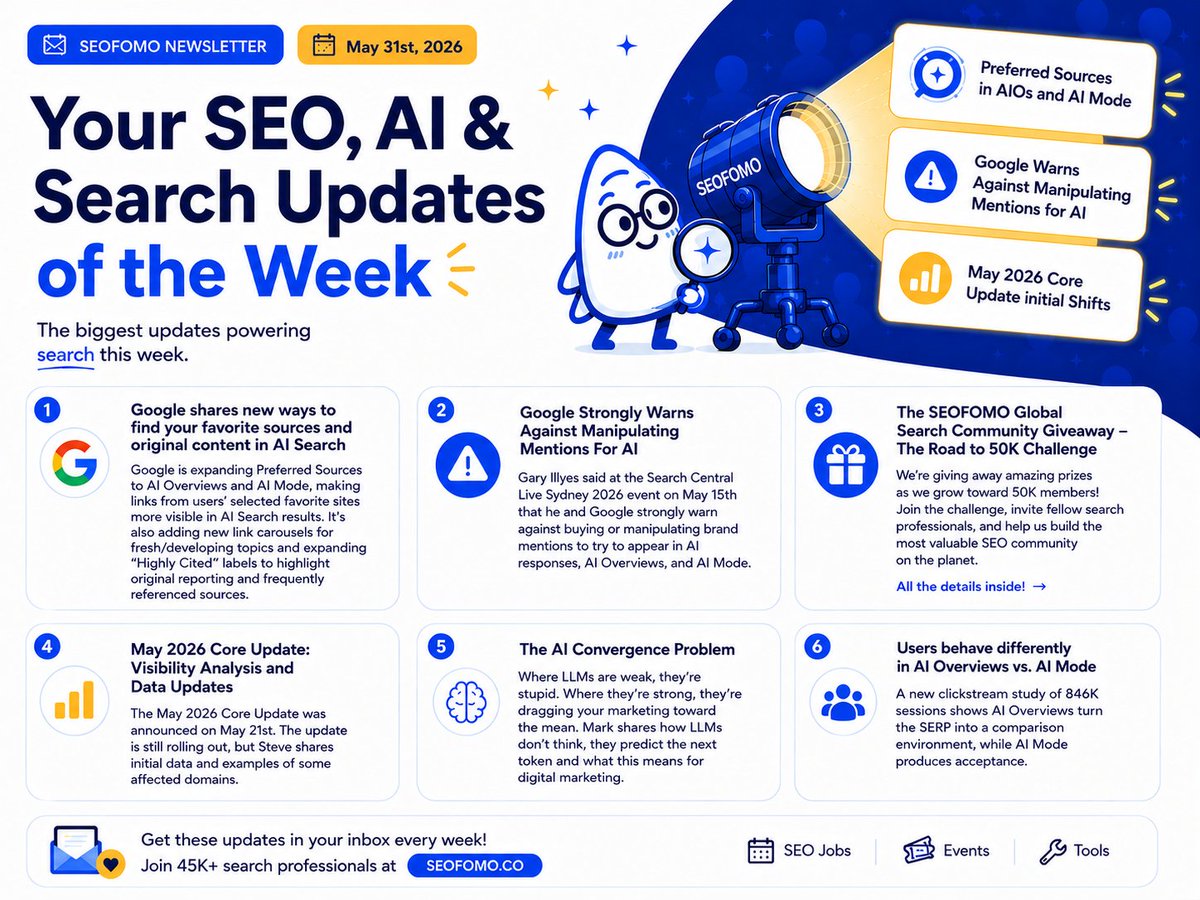
🎁 Your SEO & AI Search Updates of the Week from #SEOFOMO - May 31st, 2026 👇
* Google shares new ways to find your favorite sources and original content in AI Search - Does this mean more traffic from AIOs & AI Mode?
* Google Strongly Warns Against Manipulating Mentions For AI - A timely reminder!
* Reddit CEO Says LLMs ‘Would Not Exist’ Without Reddit Data - Learn what changed Reddit’s openness
* May 2026 Core Update: Visibility Analysis and Data Updates - Initial core update visibility shifts
* AI Traffic vs AI Citations: What Clicks and Cited Pages Show About the AI Search Journey - Homepages are AI traffic sinks, but not the citation footprint
* Schema, LLMs and the Low Bar for “Evidence” in GEO
* Users behave differently in AI Overviews vs. AI Mode - Search type no longer predicts behavior
Including SEO jobs, professionals looking for new roles, events, tools ... and more!
Read: https://t.co/Y4LkKpJNnk
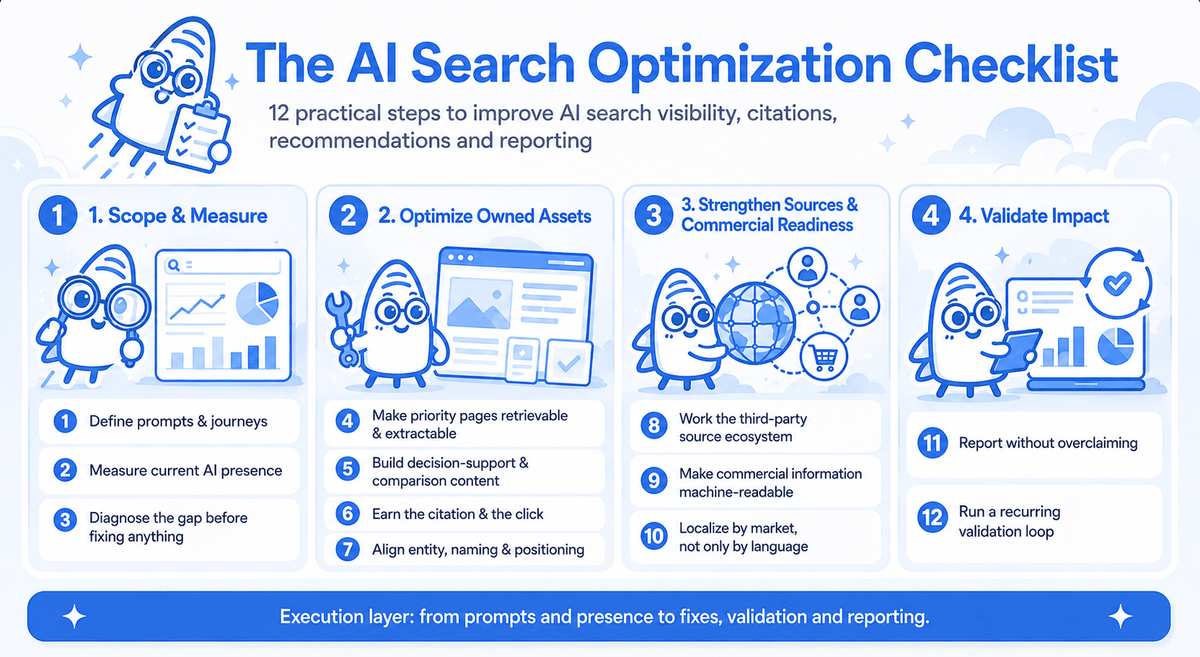
🚨 I’ve just updated my AI Search Optimization Checklist (and worksheet) 👇
Following a workflow for a strategical AI search optimization process:
✅ Which prompts and journeys do we actually want to influence?
✅ Where are we visible, cited, recommended or missing?
✅ Which owned pages and third-party sources are shaping the answers?
✅ What needs to be fixed: content, accessibility, entity clarity, source ecosystem, commercial data, localization…?
✅ How do we validate if the changes moved the needle?
✅ How do we report progress without overclaiming AI impact?
It now includes:
⭐️ 12 practical AI search optimization steps
⭐️ Examples and “what good looks like” sections
⭐️ Prompt and presence measurement guidance
⭐️ Gap diagnosis and prioritization examples
⭐️ Source ecosystem mapping
⭐️ Commercial and transactional readiness checks
⭐️ International/local AI search considerations
⭐️ Reporting guidance to separate observed, proxy and modelled signals
⭐️ A recurring validation workflow
⭐️ A downloadable checklist worksheet to use it in practice
The biggest point I’d emphasize: AI search optimization should start with understanding which AI-assisted journeys matter, how your brand appears across them, which sources influence the answers, and what you need to improve to be selected, cited, recommended and accurately represented.
Guide + checklist worksheet here:
https://t.co/e87HMPhDce
🚨 Spam in the age of AI Search - A must read piece by @gfiorelli1 warning about manipulative tactics from traditional search that are making a reappearance with AI search... that you should be aware of and stay far from if you want your results to not be short-lived 👇
* Cloaking, now User-Agent Conditional Prompt Injection
* Doorway Pages / Doorway Abuse, now RAG Ingestion Flooding / Synthetic Context Stuffing
* Keyword Stuffing & Hidden Text, now Semantic / Invisible Prompt Injection
* Link Schemes / Link Spam, now Citation / Co-occurrence Manipulation
* Scraped Content & Thin Content, now AI-Generated Content Spinning (Model Laundering)
* Sneaky Redirects, now Citation Hijacking / Dynamic Link Swapping
* Buying Links, now LLM Training Dataset Placement (Source Planting)
* Many more!
Send it to your clients so they're aware of the risks: https://t.co/8eiWKLUYgu
Nice! Google just made so that any website can invite their readers to add them as a preferred source, making it more likely for that site to be seen in AI Overviews and AI Mode.
This used to be just for news sites to be seen as preferred sources in Top Stories.
SEO is changing.
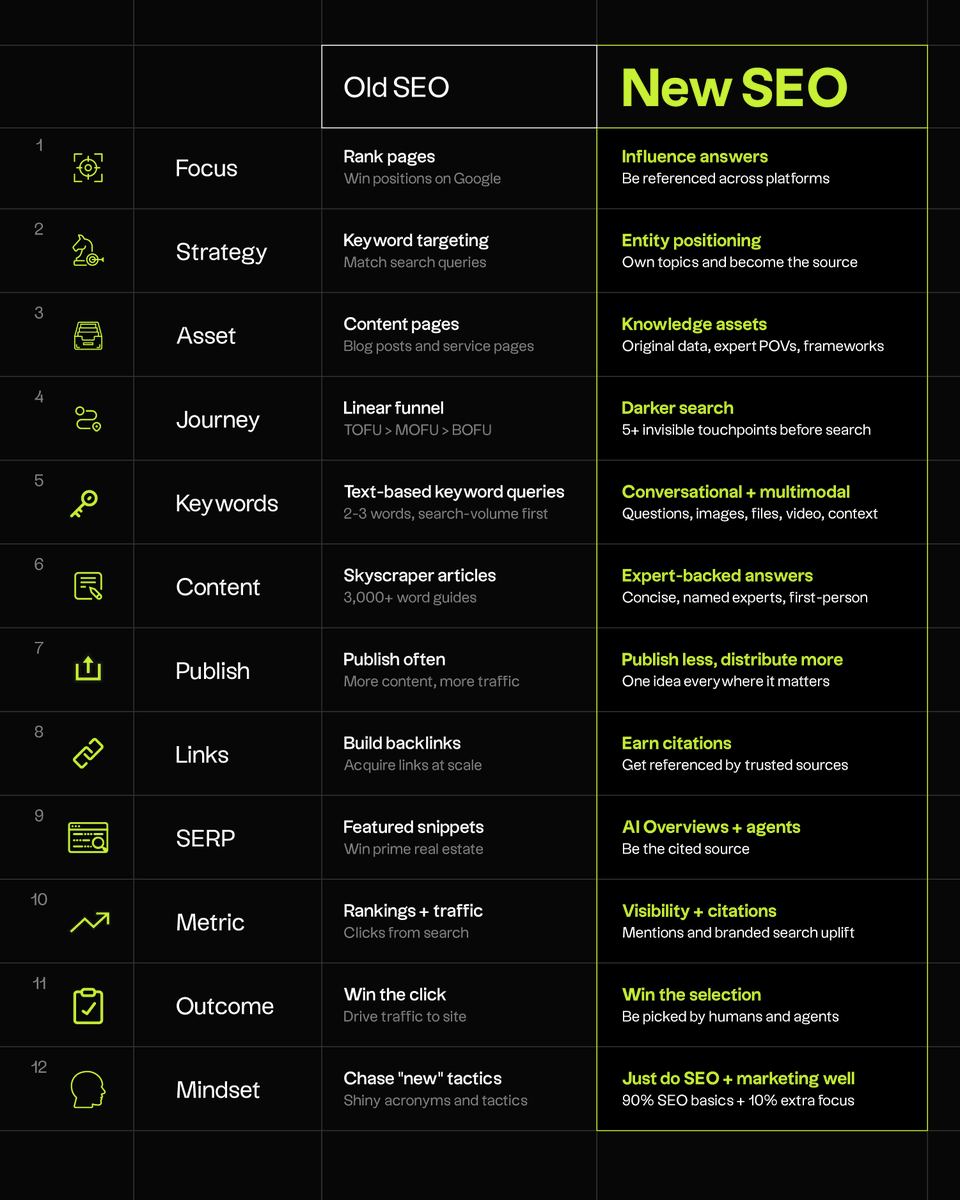
But NOT in the way you think because the fundamentals are literally 90% the same.
Changes have been creeping in for months and Google's recent I/O announcements just made their direction explicit.
Here’s the 10% worth focusing on:
- Expanding how we think about SEO
- Expanding the ways we research
- Expanding the optimisations we make
- Expanding how we measure results
Not a full reset, but a recalibration.
Here are 12 ways SEO is expanding:
Today is my last day at Ahrefs after 6.5+ years. Incredibly proud to have helped shape such an amazing product.
I plan to do some consulting and build some things. Let me know if you need help. Potentially open to the right in-house opportunity.
Likes / shares appreciated🙏
I got so fed up of seeing bullshit about "I sacked my SEO agency and replaced $5000 a month with a $20 claude subscription" that I've been testing AI SEO Agents.
So, to shut this crap down quickly I decided to test lots of AI SEO automations from programmatic content experiments with OpenClaw through to SEO Skills in Claude Code.
Here's my first post on Claude SEO the AI powered SEO audit skill for claude code:
https://t.co/GcU4L9sGEJ
Here's the summary:
👀 AI SEO Agents do NOT WORK
No IFS, no BUTS, they DO NOT WORK.
They don't work for auditing and they do not work for creation.
Why?
❌ SEO auditing is a large job where the variables for priority and rank are changing and are often website / niche dependent. Most AI auditing tools for SEO just use the "same" checklist approach whilst placing over-emphasis on the things that don't matter vs things that do
❌ Recommendations are often wrong, over-exagerated or just use a lateral rule book i.e. something MUST be present or its a critical issue! like a sitemap
❌ It's not viable for AI to properly audit content at scale at this point, even with strong models that burn tokens - content requirements are highly varied and thus a standardised checklist of checks isn't always very effective
❌ AI for content creation stands out like a sore thumb Google is PROACTIVELY indexing LESS and LESS content now - why? because, due in part to Google not needing it and, if you are creating what already exists out there where is there any value in Google indexing it let alone serving it?
❌ Google is no doubt actively working to stamp out scaled content abuse - one easy way to do that is simply look at the growth rate of a site, spot clear AI content patterns as well as relying on things like domain weight/authority and brand trust which is SIGNIFICANTLY harder to game
❌ AI loses context on large audits - even content audits, 1m context window, it becomes quick and easy to lose context so audits need segmentation before running such as E-E-A-T/YMYL and then segment by content type
I have been testing the following and over the coming weeks I am going to do long-form posts and videos showing you the REALITY of using AI within SEO vs handing off to automations as well as risks, time wasting and fallacies.
☑️ I tested PURE AI content generation on domains with no links
☑️ I tested PURE AI content generation on domains with links
☑️ I tested AI content sites with domain consolidation
☑️ I tested OpenClaw automations - I built a research agent to research SERPS and then to create article frameworks, I created a content creation agent that wrote the content based on the first agent, then an agent to automate deployment
☑️ I tested Hermes Agent with a programmatic content strategy
☑️ I tested an agent set up with AntiGravity to perform complex SEO audits
☑️ I tested various SEO automations from Github repos
#seo
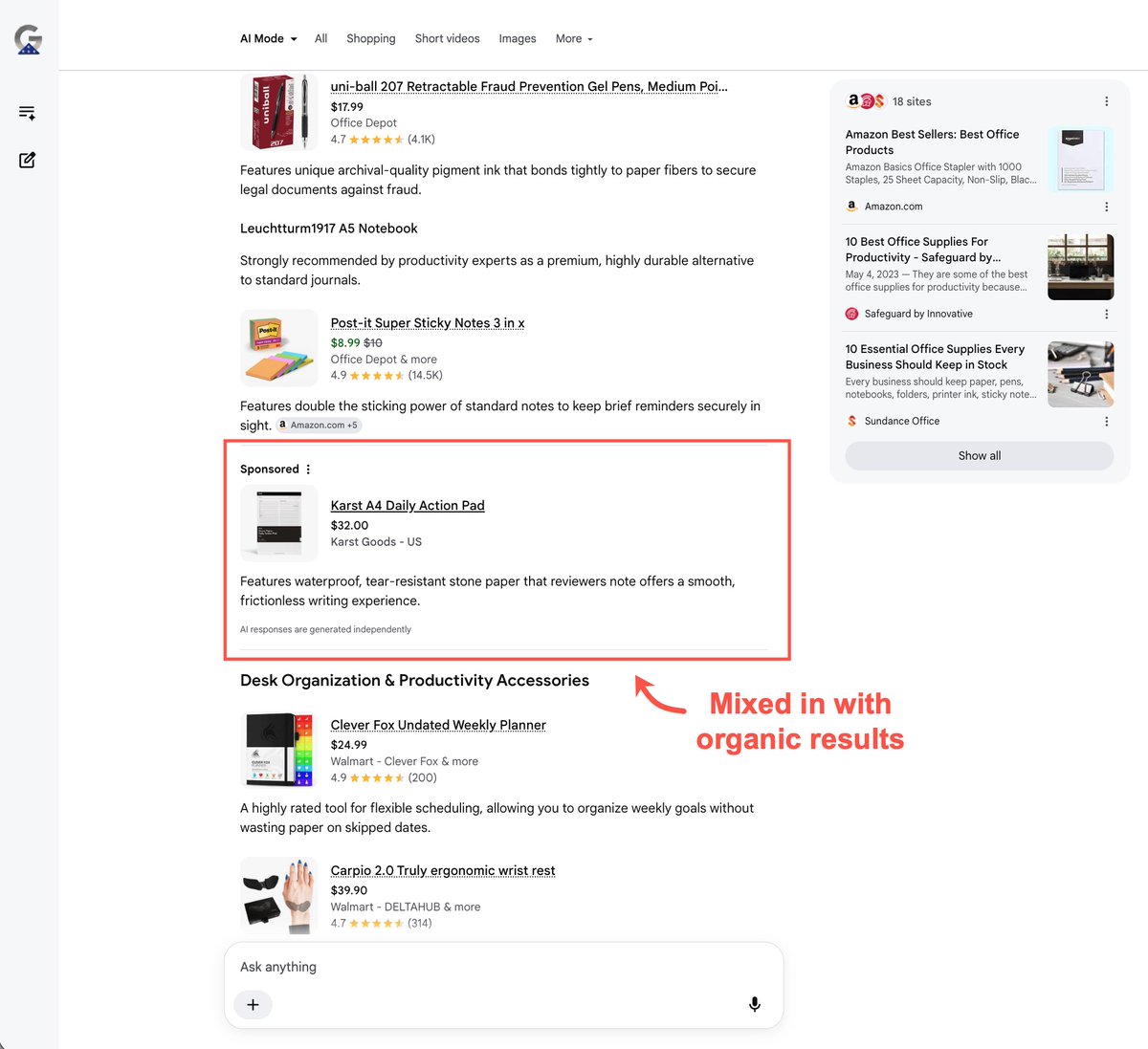
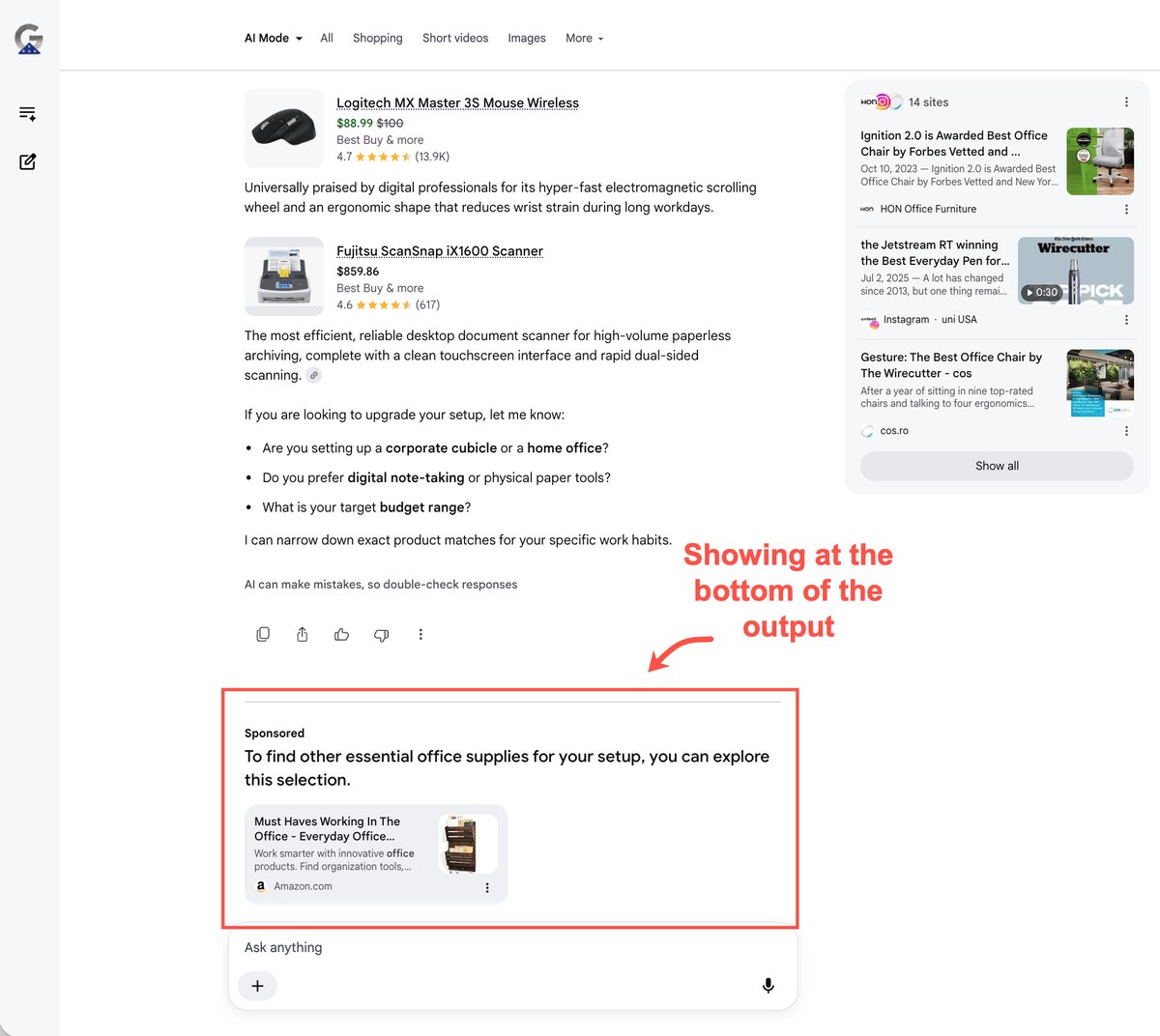
This is the biggest step Google has made so far at monetising AI Mode – sponsored ads are now being mixed with organic results.
Previously, sponsored results only had the ability to show at the end of the response, either within a carousel of sponsored products or appearing as a link card preview, as shown.
This is a change that was announced at Google Marketing Live a few days ago and covered by @rustybrick as the new "Highlighted Answer Ads", and I'm now seeing them live within AI Mode for several queries.
There is also a different type of ad called "Coversational Discovery Ads", which can also display within the AI Mode output, with the example shown by Google seemingly showing the ad as showing at the end of the response.
The big difference in the formatting of the ads and the free listing results that sit both above and below is that the ads go directly to the product page URL, whereas clicking the free listing results opens the standard product grid with a selection of retailers (being a less direct traffic mechanism).
This is the biggest step that Google has made so far at monetising AI Mode, because users could easily not see the subtle "sponsored" label and treat it as a reputable recommendation from the list of items within the output.
Link in the comments to more examples of the new Highlighted Answer Ads in the wild, and make sure to subscribe to my newsletter, where I'll be giving a rundown of this change and the other impactful updates from this month.
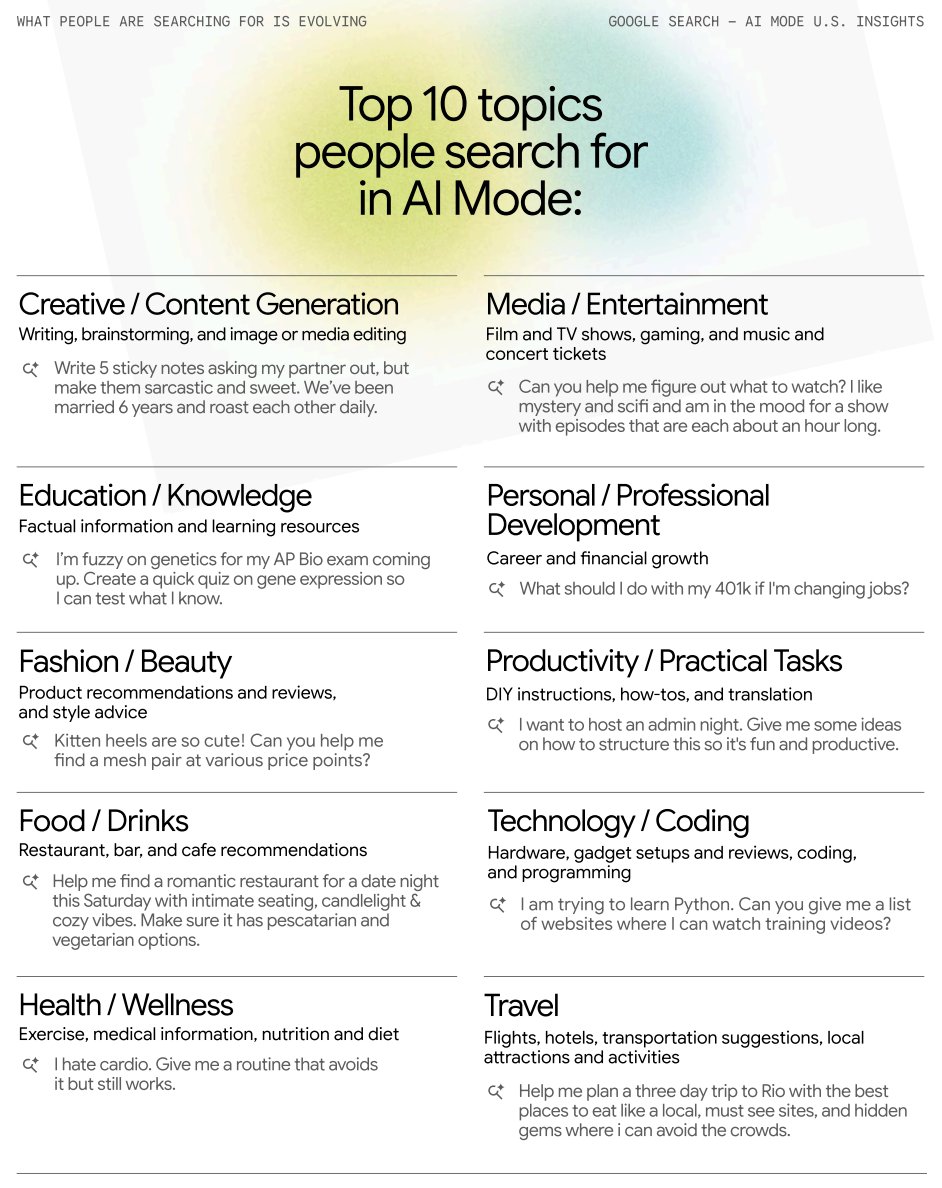
📊 Google just shared a new report on how people are using AI Mode in the US. 👇
Useful directional insights, yes. Complete market picture, no: The keyword data comes from sampled Google Trends data for AI Mode.
With that in mind, a few patterns worth paying attention to:
🔎 Searches are longer and more conversational.
The average AI Mode query is 3x the length of a traditional Search query. Keyword research now needs to be complemented with prompt, task, constraint and scenario research.
💬 Follow-up behavior matters.
Follow-up queries grew 40%+ on average per month. Brand visibility can't be analyzed only at the first prompt anymore: a brand might be mentioned, dropped, compared, misrepresented or never cited across the journey.
This means the unit of analysis is the journey, not the query.
🛍️ AI Mode is being used to decide, not only to discover.
* Which" queries grew 40% faster than AI Mode queries overall in the past six months.
* The top retail attributes people look for: price, location, color, brand, availability, size, material, style, type, quality.
This means Ecommerce AI Search optimization shouldn't be only about "more product content": it's accurate, complete, fresh and consistent product data across pages, structured data, feeds, variants, reviews and attributes.
📍 Local and availability intent is very visible.
Follow-up store queries include "near me", "in stock", "replacement parts", "car dealerships with financing".
AI systems need to understand location, inventory, services and constraints to satisfy these.
🧭 AI Mode is becoming a task layer, not only an answer layer.
Planning queries grew 80% faster than AI Mode queries overall. The opportunity is to be included in plans, shortlists, comparisons and workflows, not only ranked for individual queries.
👀 My takeaway:
Don't confuse Google's usage narrative with independent performance data. There's a behavioral shift and Google has every incentive to frame it favorably for its own ecosystem.
For SEOs and marketers, the practical next step isn't to replace SEO fundamentals. It's to expand how we research, optimize and measure:
✅ From keywords to prompts, tasks and constraints
✅ From rankings to presence, citations and representation accuracy
✅ From single queries to follow-up journeys
✅ From content-only optimization to entity, product, local and feed-level readiness
✅ From observed traffic to a more nuanced view of visibility and influence
AI Mode makes it increasingly risky to measure search visibility only through traditional rankings and clicks.
Read the full report in: https://t.co/JeBmLePG7Q
What if I tell you that exists a way to create a content architecture that is able to give your website the correct base for winning in Topical Authority, Information Gain, Personalized Search and 0 Click all at the same tim? https://t.co/CzY6RiUF0F










![rubenhassid's tweet photo. Anthropic just dropped a 31-page prompting guide.
Here's everything you actually need (in 10 rules):
1. You write "review this contract" and pray.
Fix: Name every output. "Review this contract. Flag risks per clause. Rate severity 1-5. Return as a table."
2: You say "summarize this" on a 40-page report.
Fix: 4.8 sizes the answer to the input. Cap it: "5 bullets. Each under 15 words. Start each with an action verb."
3: You write "don't use jargon. don't be salesy."
Fix: Negative instructions don't stick.
Flip them: "Write in plain English a 16-year-old could read aloud."
4: You type "can you help me with the email?"
Fix: Each verb ships something. For example: "Go to Gmail. Find [contact]. Write the send-ready reply. Under 90 words. Tone: confident, casual."
5: You wait for Claude to web search on its own.
Fix: Claude opus 4.8 calls fewer tools than 4.6.
Force it: "Use web search aggressively. Verify every claim with at least 2 sources."
6: You miss the warm tone from old Claude.
Fix: Claude opus 4.8 is direct. Almost zero emojis. Paste 2-3 sentences in the voice you want.
Tell Claude to match the rhythm.
7: You ask for "a landing page" & get bare minimum.
Fix: Drop this one line on every creative task
→ "Go beyond the basics."
It's from Anthropic's own doc.
8: You forget Claude 4.8 doesn't reason by default.
Fix: They call it "Thinking." Effort: High
Add this at the end: "Think before answering (maximum reasoning)." Free upgrade. Every time.
9: You rewrite the same prompt 14 times a week.
Fix: A skill is a command with instructions pre-built.
Write the same prompt twice? Make it a skill.
10: You assume Claude knows what you meant.
Fix: Old Claude 4.6 guessed.
New Claude 4.8 does exactly what you typed.
Spell it out. Output. Order. Length. Tone. Format.
If you don't say it, you don't get it.
To go even further & download my .md files directly:
Step 1. Go to https://t.co/psB7XxAv8w.
Step 2. Subscribe for free. Don't pay anything.
Step 3. Open my welcome email (most skip this).
Step 4. Hit the automatic reply button inside.
Step 5. Download my .md files from my Notion.
Bonus. Enjoy my best copy-paste prompts, too.](https://pbs.twimg.com/media/HJoSjWJa0AA7KX8.jpg)