“Causal Effects Versus Causal Mechanisms: Two Traditions With Different Requirements and Contributions Towards Causal Understanding”
https://t.co/WICri9Om6W
@Noahpinion Does it imply that, on average, Americans commit more crimes than Europeans, all else being equal? See, for example, the president of the US, with average European president/premier.
I made a list of 100+ free social science datasets on GitHub. Check it out, and if your favorite dataset is missing, submit a pull request or reply! https://t.co/x8NMeZ3C7d
The October 2026 issue of Political Analysis (Volume 34, Issue 4) is out, and every article is open access. Eight papers on protest voting, coalition governments, conjoint designs, Gaussian processes, vision-language models, and more. Highlights below 🧵
https://t.co/MPOBDFPEe2
We've added to the website a free PDF of the Bayesian Workflow book (for non-commercial purposes, like research and exorcism). We put so much work into this book, hope you all find value in it. https://t.co/f472XjM6cf
Adolph et al. reanalyze Perez Brower (2024), identifying an omitted control group, a miscoded outcome, and selective reporting.
https://t.co/jqmqpNnISg
https://t.co/S2gV37gCpR
https://t.co/PNrh2pc6CI
Statistical Rethinking 2026 is done: 20 new lectures emphasizing logical & critical statistical workflow, from basics of probability to causal inference to reliable computation to sensitivity. It's all free, made just for you. Lecture list & links: https://t.co/jFpoiNC6oW
@drStuartGilmour@jmwooldridge Could you at least engage with the argument instead of responding dismissively? I am genuinely interested in this problem. I may even run some simulations myself, since I am working on a project with a similar research design.
Dear @realDonaldTrump: cutting off trade will not hurt Spain. But do you know what would really hurt Pedro Sánchez? Catalan Independence! That would drive him crazy!
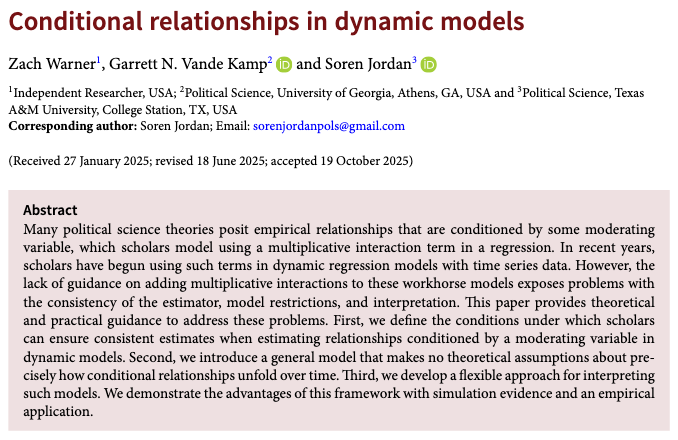
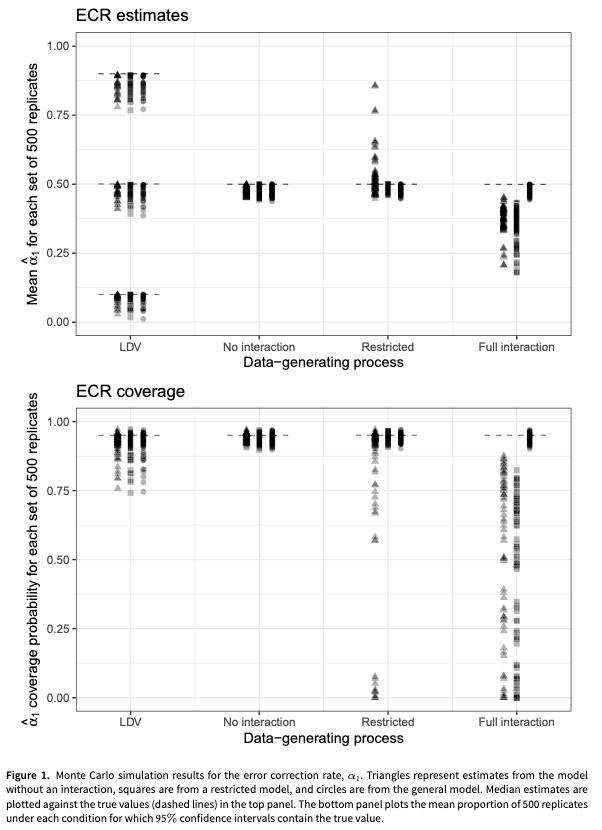
📈 How should scholars model conditional relationships in time series data?
➡️ Z Warner, G N Vande Kamp & S Jordan provide guidance on interaction terms in dynamic models, showing how to flexibly model and interpret moderation over time https://t.co/wjszndyQTh #FirstView
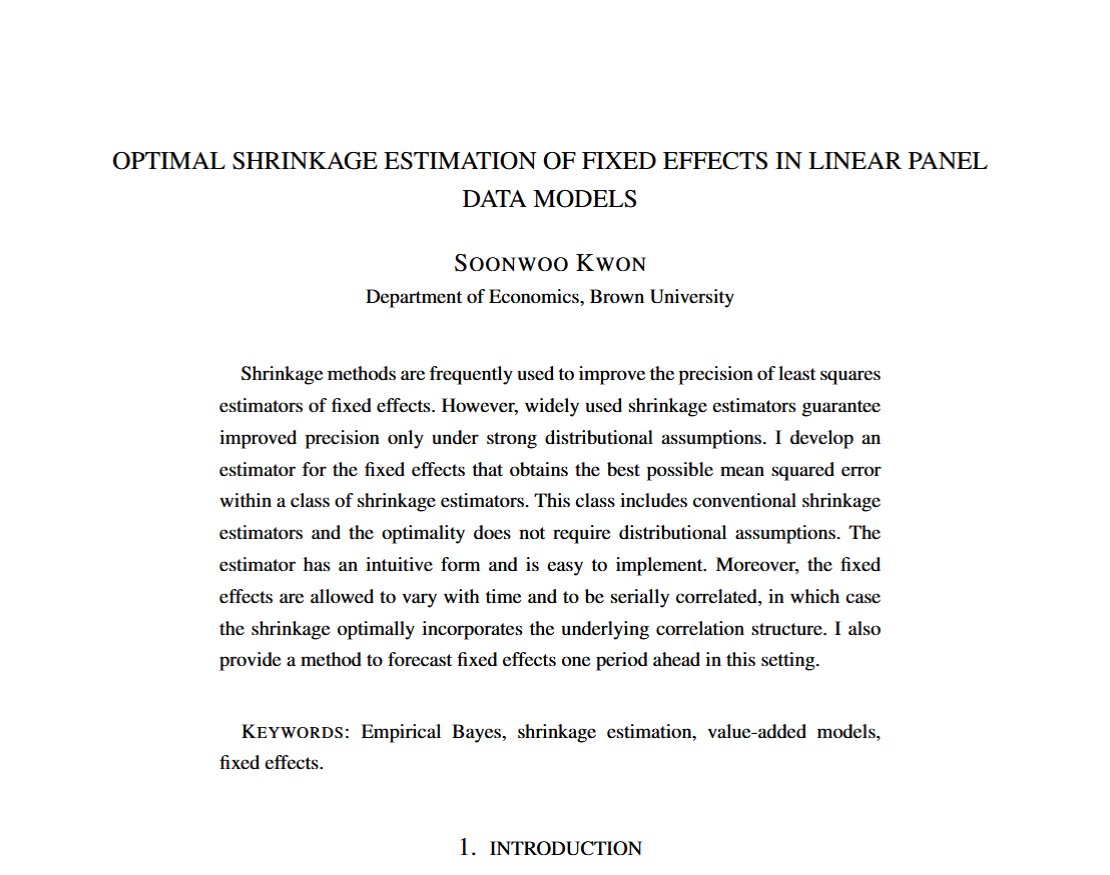
This paper proposes optimal shrinkage of fixed effects in linear panel models, yielding precision gains under weak assumptions—unlike standard methods. It accommodates time-varying or disaggregated effects without strong distributional assumptions. https://t.co/jnf0JUkQ34
These are my Holy Texts of SCM Hate:
- p-hacking via donor pool selection (Francis): https://t.co/HIa0W9d8Tt
- an index number problem (Francis): https://t.co/tSYBjCeALt
- specification searching by pre-treatment indicator selection (Ferman, Pinto, and Possebom): https://t.co/sHr5WDHhsr
- spurious regression (Masini and Medeiros): https://t.co/wUDLnoM4Dg
Self-citation sucks, I know.
Orthogonal matrices are square matrices whose columns are perpendicular unit vectors, meaning they represent rotations or reflections that preserve lengths and angles. In probability, they are used to rotate random vectors without changing their distributions, which is fundamental in studying Gaussian variables, independence, and invariance principles. In statistics, orthogonal transformations diagonalize covariance matrices through principal component analysis, allowing complex correlated data to be expressed in simpler, independent coordinates. In machine learning, orthogonal matrices help stabilize deep networks, prevent exploding or vanishing gradients, and are used in embeddings, attention mechanisms, and dimensionality reduction. They also appear in random projections and initialization schemes that preserve distances and information. In real-world applications such as signal processing, graphics, and robotics, orthogonal transformations allow data to be rotated, compressed, or aligned without distortion. By preserving geometry while simplifying structure, orthogonal matrices provide a powerful tool for understanding, modeling, and learning from high-dimensional data.
Image: https://t.co/NIzfuMvg6Q