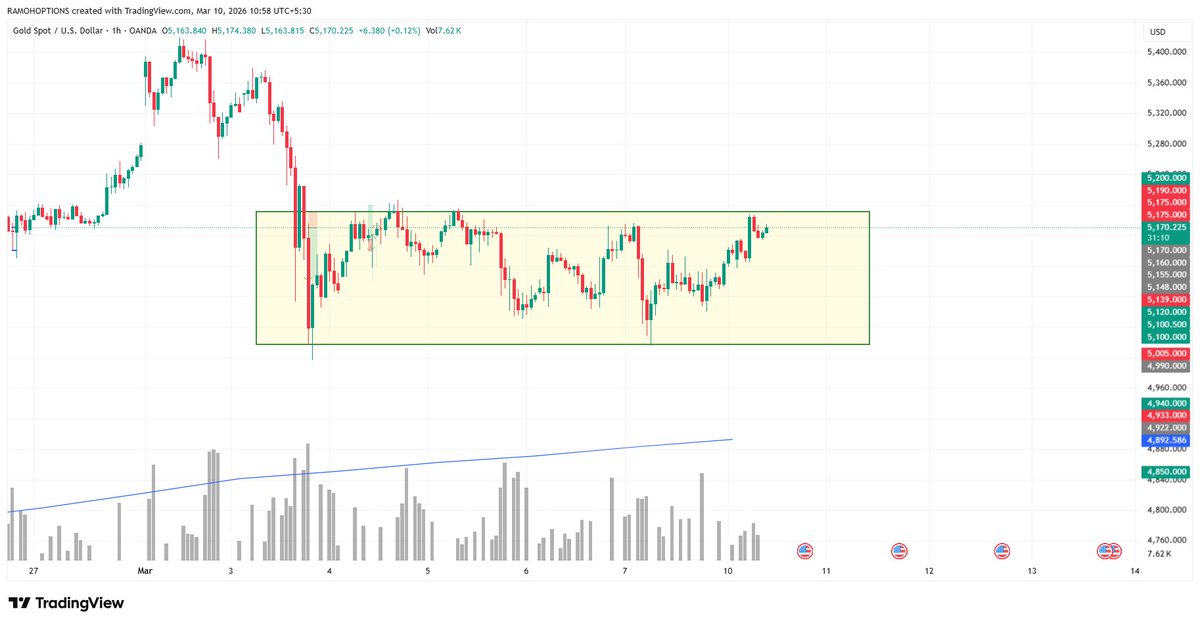
Both Bearish Pennant and Descending Triangle indicates us that pullback is not over yet, so before resuming bullish market, there is still some room left for bears. Let's see what happens....
Note: Always keep an eye on news to avoid huge loss
#xauusd#gold#usd
Both Bearish Pennant and Descending Triangle indicates us that pullback is not over yet, so before resuming bullish market, there is still some room left for bears. Let's see what happens....
Note: Always keep an eye on news to avoid huge loss
#xauusd#gold#usd
Both Bearish Pennant and Descending Triangle indicates us that pullback is not over yet, so before resuming bullish market, there is still some room left for bears. Let's see what happens....
Note: Always keep an eye on news to avoid huge loss
#xauusd#gold#usd
#XAUUSD
Many people panic at the sight of a sharp drop, thinking it's a trend reversal and rushing to short;
Then, seeing a violent rebound, they fear missing out and rush to go long.
The result is getting whipsawed on both ends, causing their mentality to collapse.
Remember: In a highly volatile market, there are no one-sided trends, only the rhythm of "buying low and selling high."
1. Don't always try to "sell at the highest point and buy at the lowest point"; that's something only a god could do.
2. Don't rush to buy the dip during a sharp drop; wait for stabilization signals before taking action.
3. Don't be greedy during rebounds; decisively reduce your position at key resistance levels.
II. Position Management: A Lifeline in Range-Bound Markets
In range-bound markets, position sizing is more important than technical analysis.
Using the right position size means that even a wrong judgment won't cause serious damage;
Using the wrong position size can wipe out even the most accurate judgment.
Strict stop-loss orders are essential; never hold onto losing positions.
Holding onto losing positions is the worst thing you can do in range-bound markets!
For example, if you buy at 5500 and the price drops to 5450, don't hold onto the illusion that it will rebound.
Use stop-loss orders when necessary; small losses are to prevent large losses.
Set stop-loss orders outside key support/resistance levels, such as a $50 stop-loss. If you're wrong, admit it.
Profit-taking and securing gains
When the price rebounds to a resistance level, such as around 5550, don't expect it to rise even higher.
Take profits on half of your position first, and set a trailing stop loss for the remaining position, letting the profits run.
This way, you preserve some profits without missing out on subsequent market movements.
III. Cultivating Trading Psychology: Mastering Your Emotions
Volatile markets test not your technical skills, but your human nature.
1. Don't let your emotions control you: Don't be fearful during a sharp drop, and don't be greedy during a rebound.
2. Accept imperfection: You can't catch every wave of the market; capturing a portion in the middle is enough.
3. Rest is also a strategy: If the market is too chaotic and you can't understand it, step aside and observe.
Preserve your capital and wait for the trend to become clear before re-entering the market; this is better than stubbornly holding on.
Finally, I want to say: Trading is not gambling, but a form of self-cultivation.
High-volatility markets are like a mirror, reflecting your mindset and discipline.
Maintain a stable mindset and manage your positions well; only then can you survive the storms and even make your fortune.
Like, follow, and save this; refer to it more often when you're feeling down.
#GOLD