The Gates Foundation will spend $200 billion over the next 20 years then shut down entirely. An incredible case study on how to build a globally impactful organization that’s not meant to last, and frankly how to use power and wealth for good (preventing/eliminating leading causes of kid deaths)
We’re thinking of all those impacted by the devastating flash floods in the region of Valencia, Spain. Apple will be making a donation to help with relief efforts on the ground.
As an ex-Twitter boss, I have a way to grab Elon Musk’s attention. If he keeps stirring unrest, get an arrest warrant | Bruce Daisley https://t.co/mHoaFBVUZI
orgullosos de nuestra trayectoria junto a @PrensaIberica, en esta ocasión lanzando el rebranding de la marca Sport y una nueva dimensión estratégica presidida por el concepto "Estás Dentro"
el primer paso para una nueva forma de ver y entender el periodismo
10 trends, which, due to that very obsession, have seemed the most remarkable to us. They are intended for you to read and explore the hyperlinks, to enter into an obsessive loop, a call to take the lessons from paper to action.
https://t.co/Xo8M6OEaQB
We hope you enjoy it!
What trends left a mark in 2023 and what lessons do we take with us for this 2024?
That was the question we asked ourselves before starting the report we're sharing, which we've called “Hamlet Obsessions: Trends that Shaped 2023”.
Harvard lleva +80 años realizando un estudio sobre felicidad y salud.
Recomendable la charla TED del director Dr. Robert Waldinger (2015) y la entrevista que le hicieron hace pocos meses.
Pero si no tienes tiempo, te lo resumo 👇
La próxima vez que te digan que para vender la funcionalidad de un producto hay que enseñarlo y ser racional, les enseñas esto.. https://t.co/EC7FFNigDZ
presentación interesante de Zoe Scaman sobre el futuro de las marcas, o la era de la marca multijugadora
mi percepción es que pocas marcas están preparadas para llegar a ser 100% multiplayers, pero que seguramente abundarán líneas de negocio que sí lo incorporen como core
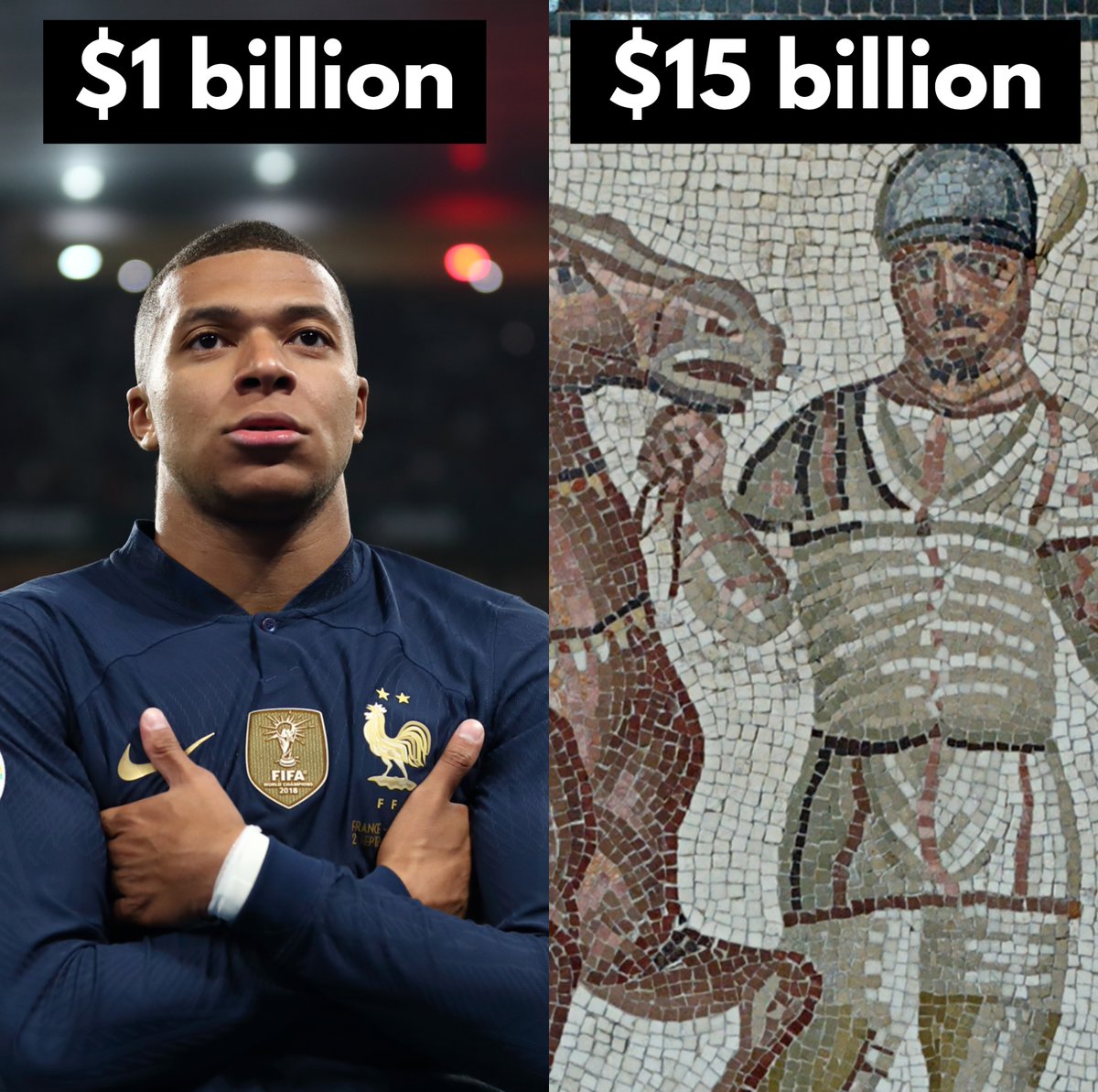
The football star Kylian Mbappé was offered $1 billion to join the Saudi Arabian team Al-Hilal.
But that wouldn't have made him even nearly the richest athlete in history.
Because there was a Roman chariot racer called Gaius Appuleius Diocles who earned more than $15 billion...
Chelsea FC in England have spent over one billion dollars on new players in the last year alone, and Cristiano Ronaldo is currently earning $200 million per year at the Saudi club Al-Nassr. Has football gone mad? Is it right for athletes to earn such exorbitant wages?
Let's leave the politics of that question to one side and simply observe that, as with so much else, there are historical precedents — and one in particular: Gaius Appuleius Diocles.
Chariot racing was the most popular sport in Ancient Rome, with races held all over the empire — there are ruins of huge stadiums around Europe. The crowds flocked to watch their favourite teams or racers, and the money came pouring in.
Gaius Appuleius Diocles was born in the province of Lusitania, modern-day Portugal, in 104 AD. That's where many charioteers came from — not just those who raced in Rome itself, but right across the empire — because it was where the fastest racehorses on the continent were bred.
And such was the career that Gaius pursued; he made his racing debut in Rome, which then had a population of well over one million and was the richest and largest city on earth, at the age of just 18.
There were four "factiones", sort of like teams, in Ancient Roman chariot racing: Green, Red, White, and Blue. Each had their own stables, managers, breeders, agents, patrons, sponsors, and racers. These were large, professional organisations with hordes of fans and fierce rivalries. Even the Emperor himself usually had a favourite faction.
Gaius joined the Whites and won his first race after two years. He stayed with them for another four years. Then he moved to the Greens, where he had a torrid run of poor performances and a serious injury, followed three years later by a move to the Reds. There he remained for fifteen years, winning over one thousand races, before retiring at the age of 42 to a lovely little town called Praeneste.
Where did Gaius race? At the Circus Maximus in Rome, now a ruin but once a racing stadium which could hold more than 150,000 spectators. It's hard to imagine the atmosphere, with the thundering of the horses drowned out by the roaring of the crowds and the sound of splintering chariots...
We know much of this because of two monuments made in Gaius' honour after his retirement. They also include the rather impressive statistics of his racing career — 4,257 starts and 1,463 victories — and the prize money he won: a grand total of 35,863,120 sesterces.
These earnings are estimated to have been, in modern terms, about $15 billion, which would make him by far the richest athlete in history. His fortune was equivalent to about 1.5% of the Roman annual state expenditure, which would be like an American sportsperson being worth over $100 billion.
But this is not merely an interesting factoid. What does it tell us about Ancient Roman society during the Empire that regular people had enough time, and that there was enough money in the system, to support such a wealthy sporting scene?
Alas, if you don't much like sports and wonder why some people get so worked up about athletes running round a field and kicking a ball... there's also a Roman precedent for that. Here's what the lawyer Pliny the Younger wrote to a friend in the year 98 AD:
"The Races were on, a type of spectacle which has never had the slightest attraction for me. I can find nothing new or different in them: once seen is enough, so it surprises me all the more that so many thousands of adult men should have such a childish passion for it."
Whether sports stars should earn the money they do is a complicated question. But, in any case, Kylian Mbappé has a long way to go before he's on the level of Gaius Appuleius Diocles...
Q: Is it better to target a small market or a large one?
In the clip below, Peter Thiel (billionaire venture capitalist and co-founder of PayPal and Palantir) describes his framework for evaluating markets:
“It���s always a big mistake going after a giant market on day 1. That’s typically evidence that you haven’t defined the categories correctly, and there’s going to be too much competition.”
He continues:
“Almost all of the successful companies in Silicon Valley had some model of starting with small markets and expanding.”
Amazon started with books
eBay started with Pez dispensers and Beanie Babies
PayPal started with power-sellers on eBay
Facebook started with Harvard
“What’s very counterintuitive about many of these companies is that they often start with markets so small that most people don’t think they’re valuable at all.”
The opposite of this is companies that start out targeting really big markets, and he uses clean tech companies in 2005-2008 trying to capture a small percentage of a trillion dollar market as an example.
“Once you’re a minnow in a vast ocean, that’s not a good place to be. It means you have tons of competitors, and you don’t even know who all of the competitors are.”
As Thiel puts it:
“You want to be a one-of-a-kind company where it’s the only one in a small ecosystem… large existing markets typically mean you have tons of competition and it’s very hard to differentiate.”
You can then expand concentrically from there.
Only one country comes close to disrupting U.S. hegemony in global popular culture:
Japan.
But why them?
Because popular culture isn't a subjective art form but an industrial export Japan's military funded for WWII propaganda to defeat Disney.
A 🧵 on industrial pop culture:
Why do I work in Strategy?
Because it's intoxicating.
In what other field do you get study people for a living, help make things, help shape culture, and most importantly constantly unearth insights that change the way you view people, categories, culture, and yourself?