The sounds of freedom. Our home in the Phoenix area is nearby Luke Air Force Base where they train F35 pilots. They fly over our home in the desert regularly. We love the sounds of them streaking overhead. The true sounds of freedom! Thank you for your service!
@Grok Why is Tesla's planned unsupervised FSD for owners only for geofenced areas?
"Tesla plans initial unsupervised FSD for customer-owned cars only inside its existing Robotaxi geofences (and as part of its managed fleet), primarily for regulatory, safety, liability, and operational reasons.Notateslaapp
On the Q3 2026 earnings call (October 21, 2026), Tesla VP of AI Ashok Elluswamy said the first customer vehicles could receive unsupervised FSD and join the Robotaxi network around Q2 2027. This would use the same software stack already running on Cybercabs and Model Y robotaxis, arriving with FSD v15. The remaining step is integrating owner cars into Tesla’s geofences and fleet management system so they can operate fully autonomously.Driveteslacanada
Why the geofence restriction?
Regulatory and legal approval: Unsupervised operation (no driver or safety monitor) is treated as a different legal category from supervised FSD. Regulators typically approve systems within specific Operational Design Domains (ODDs). Geofences define those validated areas. Tesla has used them for data gathering to meet requirements (e.g., California DMV statistical safety demonstrations in defined zones). Operating outside approved areas would violate permits and create major liability issues.Notateslaapp
Safety and phased validation: Tesla has expanded Robotaxi geofences gradually (e.g., Austin grew from small zones to metro-scale coverage), starting in areas it considers safer and scaling only as confidence and data grow. Elon Musk previously described a “paranoid” approach for early unsupervised deployments. Recent Tesla safety reporting covers millions of unsupervised miles in these zones with strong metrics relative to human drivers. Broader unsupervised use everywhere raises the bar for edge cases, weather, infrastructure, and local conditions.TechCrunch
Fleet management and control: The initial plan is not unrestricted personal unsupervised driving (e.g., sleeping through a road trip anywhere). It is enrolling owner cars into Tesla’s managed Robotaxi network. Geofences plus the fleet system allow centralized dispatching, monitoring, temporary restrictions (such as around emergencies or road closures), and operational support. Owner cars would follow the same rules as Tesla’s own robotaxis in those zones.Notateslaapp
Practical rollout: Even with Tesla’s vision-only end-to-end neural net approach (which they have described as primarily differing from supervised mode on legal rather than technical grounds), starting in mapped, high-confidence areas reduces risk. Zones currently cover limited parts of cities such as Austin, Dallas, Houston, Miami, Orlando, and Tampa (with Austin among the larger ones). Expansion is expected city-by-city as software improves (v15 is described as a major neural-net parameter increase) and approvals expand.Dockduty
This is narrower than earlier long-term promises of general unsupervised FSD that works anywhere without geographic limits. Tesla’s current Robotaxi model (and the planned owner-car participation) follows the geofenced approach common in the industry for unsupervised/Level 4-style operations. Broader personal free-roaming unsupervised capability would require further software progress, regulatory changes, and validation beyond the initial fleet-enrollment step."
I was also at the MacWorld Keynote when Steve Jobs introduced the iPhone for the first time. We are introducing three things today…. eventually pulling it out of his pocket. I still have my badge. Steve was my original hero because he delivered amazing “people cannot see around the corner” products. Made our first million from stock I purchased when Steve returned. Plaque on our first retirement home. Elon is my current hero. Even more amazing than Steve in multiple ways. Fully in TSLA. Excited AF right now.
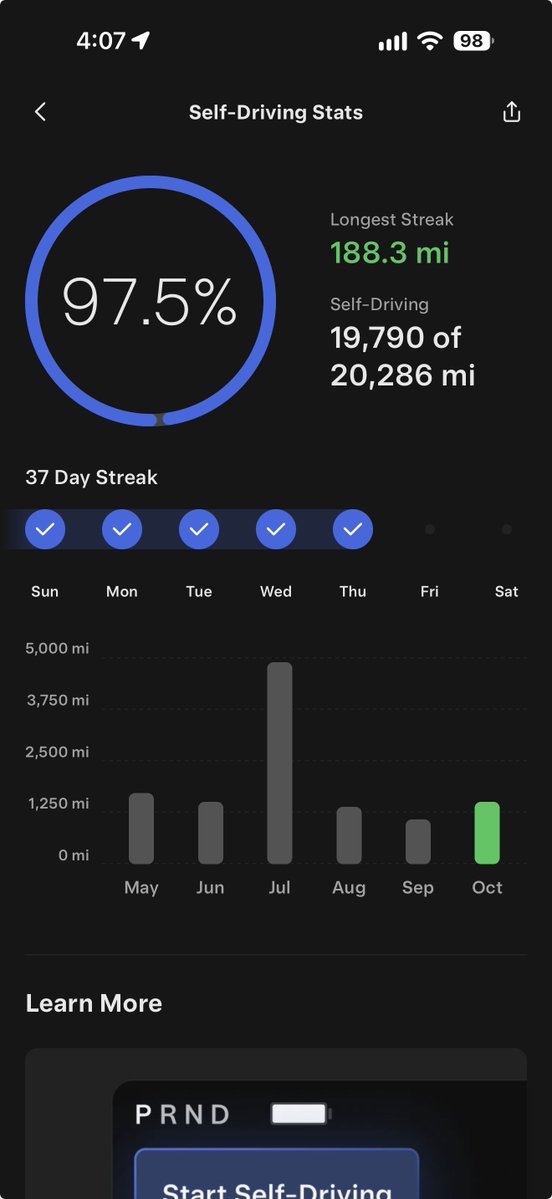
My wife and I are in our seventies—she’s 78, and I’m 74. I’ve been using FSD since we got our 2022 MYP, and my wife started using it eight months ago. Our self-driving stats show that we use FSD 97.2%. We know FSD has saved our lives more than once. We’ve seen our car hold on a green light and then watch a red light runner zoom in front of us. Both times, it was a big SUV that could have been fatal. Other times, our car would suddenly move to avoid a merging car, an animal on the road, or any other collision-avoidance situation.
We live in the Phoenix area but travel a lot. We just got back from a 3,400-mile road trip to see our kids and grandkids. We visited one family in California, two families in Washington, and two families in British Columbia, Canada. We drove up the West Coast and then came back through Oregon, Idaho, and Nevada. There’s no way we would have attempted that drive without FSD. This is our third year doing that trip. It’s so relaxing not to worry about steering, speed, or braking. We hardly ever touch the steering wheel or the pedals. Mostly, we only do that when we need to make a last-minute change to the route.
Our Tesla and FSD handle everything. We just enter our destination address and hit the self-drive button, and our car starts driving to that address. In our case, it first backs out of our garage and shuts the garage door. When we get to our destination, it automatically parks itself. To go home, we hit the “Home” button and then the self-drive button, and our car heads home.
We plug in our Tesla into our Tesla Home Charger every time we get back to the garage. We never need to charge at a Tesla Supercharger when we’re at home. When we’re traveling, our Tesla figures out which Supercharger we need to charge at and FSD drives us to that Supercharger along our route. Overall, our electric charger costs at least 50% less than what we would have paid for gas in an internal combustion car. Plus, as a free benefit, we reduce pollution for our environment.
You can now buy or lease a Tesla for about the same price as regular cars that run on gas. FSD is a $99 monthly subscription, and it’s definitely worth it. Teslas don’t need oil changes, and you won’t have to worry about $1,000 in annual service visits. So, the total cost of owning a Tesla is much lower.
Based on when our parents stopped driving, we might only have about 5-10 years left to drive. But with our Tesla and their plan to eventually have self-driving cars that don’t need anyone to watch over them, we’ll be able to have our Tesla drive us for most of our remaining years.
I really enjoy showing FSD to our senior neighbors, and I’m sure many of them will have a Tesla with FSD driving them soon.