Game-changing Kaspa network upgrades like Toccata will leverage a completely new level of utility & with increased utility a revaluation of $KAS is inevitable🔥😎!
Drop a like if you think 2026 will be the year of new $KAS ATH‘s 📈👀!
#Kaspa #kaspacurrency #KaspaCommunity #KAS #blockchain #cryptotrading #cryptoinvestment
Very bullish! If there is any doubt that Qubic devs are tackling some incredible work, give this a watch... This gives great assurance that the tech and project are moving in the right direction... $Qubic
✅ $QUBIC Halving Proposal PASSED!
Big win for the $QUBIC community!
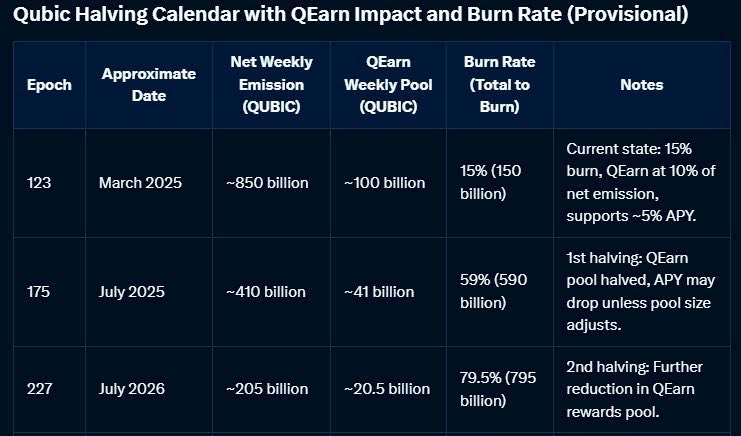
The General Quorum Proposal to reallocate 77.5% of weekly emissions to the SupplyWatcher (Burn) has officially passed with strong majority support.
Bullish times ahead. The community has spoken. 🔥
#QUBIC #Halving #DOGEmining
Neuraxon Live Sesion 2 https://t.co/G0IJoRb8de is booming with clusters, with 17K total managed, and very long lived ones, most for days, time to start Sesion 3, with a new base brain just developed, save your Nxrs if you haven't already before 08.00 UTC
GM to the Hive!
Wednesday, 8:00pm GMT 📅
QnA directly with the team 🎙️
Updates on Hivello, our ASIC miners, Bitcoin cloud mining infrastructure & more
Tune in👇
https://t.co/8uIaySSdvm
@Cryptopumpzzzz Yes there’s all this and more reasons to come. Including Continuous Identity Attestation and Ai provenance for regulatory compliance. Kaspa is the perfect fit.
We still need Fireblocks to integrate Kaspa it’s a more important catalyst.
Fireblocks is the dominant enterprise-grade custody and wallet infrastructure platform used by hundreds of institutions, banks, hedge funds, and a huge chunk of centralised exchanges.
It handles secure key management (via their MPC-CMP tech), policy engines, and operational workflows for thousands of assets across 150+ blockchains. Without native Kaspa support:
• Many exchanges literally can’t add KAS easily or safely at scale because they rely on Fireblocks for hot/cold wallets, transfers, and regulatory compliance.
• Institutions (think hedge funds, ETFs, or corporate treasuries) won’t touch it yet in size if their existing Fireblocks setup doesn’t support it out of the box custom integrations are expensive, slow, and introduce extra risk.
This is a roadblock. Several exchanges have said they want to list Kaspa but are waiting on Fireblocks. It was apparently on their roadmap/to-do list last year, but it hasn’t shipped yet.
This is exactly the kind of “unsexy but critical” infrastructure play that separates projects stuck in retail circles from ones that unlock real institutional capital.
Copper’s ClearLoop is a partial workaround for some OTC/trading flows, but it’s not a full replacement for broad custody + exchange support.
But with Kaspa maturing with Toccata the case for integration is greatly enhanced.
Qubic Science just had its Neuraxon V2.0 paper accepted at AGI-26 in San Francisco.
That makes three academic acceptances so far this year.
ICMLT in Berlin, where it won best presentation of the evening session.
AMLDS in Japan.
And now AGI-26.
This one is different from the other two, and it is worth explaining why.
ICMLT is a machine learning conference.
AMLDS is machine learning and data science.
AGI-26 is the only major conference on earth built around a single question:
How do you actually create general intelligence, the kind that transfers from one problem to a completely different one instead of memorizing a single trick?
That is the exact question Neuraxon was built to answer.
Most crypto projects that mention AI are wrapping someone else’s model and bolting it onto a token.
Neuraxon is an attempt to grow artificial brains that adapt over time, the way biology does.
Getting into the room where the people who take AGI seriously argue it out, in front of names like Karl Friston and Ben Goertzel, that is the milestone.
The conference runs July 27 to 30.
The research is open.
The paper is below.
Dear $ETH, $SOL, $SUI developers:
Why should you build on $KAS ? -
Kaspa is built to fix what’s broken in every other chain you’re already shipping on.
Ethereum forces you into L2 fragmentation, bridges, and fees.
Solana gives speed but still fights congestion and validator centralization.
Sui is elegant, but it’s another PoS system competing in the same crowded lane.
Kaspa is different.
It runs a BlockDAG with GHOSTDAG — not a linear chain. Blocks are produced in parallel (currently 10 blocks per second). All honest work counts. No orphans. We’ve already hit real-world peaks above 5,500 TPS with sub-second to few-second finality — all on pure L1 Proof-of-Work.
That means:
• No L2 tax
• No sequencer risk
• No sharding complexity
• Bitcoin-grade security that actually
gets stronger as throughput increases
Programmability is here and getting better fast.
Right now you can deploy full EVM dApps on Kasplex or Igra Labs — Solidity + MetaMask, but settled on Kaspa’s fast, cheap, secure L1.
In the next few weeks (Toccata hard fork, June 2026), $KAS is activating native L1 covenants via SilverScript + ZK primitives directly on the DAG. You’ll get powerful on-chain logic and verifiable computation without bloating the base layer.
For builders this means:
• Port your existing EVM code easily today
• Build new apps that feel instant and cost almost nothing
• Ship on a chain where MEV and front-running are structurally harder
• Be early on the fastest, most decentralized PoW programmable platform
$KAS has solid tooling (WASM SDK, Rusty Kaspa, gRPC/REST) and a technical community that actually cares about the protocol.
If you’re tired of trading off speed for security, or security for decentralization, or decentralization for usability — stop compromising.
Build on $KAS.
The base layer finally scales. The security model is sound. The developer path is open.
The window to be early is right now.
That's a really good question, but it's hard to answer in a single tweet because our mission is quite extensive, and it requires a lot of background knowledge to really understand what sets Kaspa apart.
Currently, a lot of people see Kaspa as “Bitcoin’s crazy little brother” that improves time-to-finality by leveraging the benefits of DAG-based consensus protocols without accepting their traditional drawbacks, such as decreased decentralization or a limited validator set.
This perception is somewhat accurate, but it falls short of conveying the full picture, because Kaspa’s vision extends far beyond just trying to be a better Bitcoin.
Anyone willing to study Kaspa and its broader vision will discover similarities to nearly all major existing DLT designs: from Bitcoin, to Ethereum, to Solana, Sui, Celestia, and beyond.
My personal view is that “research” in the DLT space is approaching a point of convergence. We increasingly understand how to push distributed systems close to the limits of what physics permits. The frontier is no longer only about raw throughput or faster finality. The attention is shifting toward game theory, incentives, sequencing, MEV, alignment, and how to build systems where the economic incentives of users, builders, miners, validators, applications, and infrastructure providers do not work against each other.
That is why debates like based rollups versus arbitrary sequencing, shared sequencing, MEV mitigation, proposer-builder separation, and execution-layer incentives matter so much. These are not niche technical details. They determine whether a network can remain neutral, decentralized, and aligned while scaling to global usage.
And this is where I think Kaspa is pushing the boundaries in a very important way.
Kaspa is not merely trying to be “fast.” The goal is to build an L1 where speed, decentralization, security, and incentives are aligned at the base layer. A system that does not scale by hiding complexity behind trusted committees, privileged sequencers, centralized validator sets, or opaque coordination mechanisms, but instead tries to preserve the spirit of proof-of-work while extending what an L1 can realistically do.
Because Kaspa arrived later than many other major projects, it does not carry the same degree of technological debt. It can absorb lessons from Bitcoin, Ethereum, rollups, modular blockchains, high-throughput monolithic chains, DAG research, MEV research, and the broader history of decentralized systems, and combine those lessons into something more optimal.
To me, that is what Kaspa is building: not just a faster blockchain, but a more incentive-aligned decentralized infrastructure layer.
But this also creates a different challenge.
Kaspa’s biggest problem today is not its technology. It is the lack of centralized coordination around communicating the vision. And because Kaspa is a grass-roots movement, that responsibility does not belong to a marketing department, or a single leadership team. It belongs to the community.
That also means the community has a different role to play.
There will always be holders who are mainly interested in price, and that is completely fine. But there also need to be people who are here because they want to use the technology to build a different future. People who care about the architecture, the incentives, the open questions, the trade-offs, and the long-term trajectory of decentralized infrastructure.
I am one of those people.
I am not interested in DLTs merely as a way to generate wealth. I am interested in them because I believe they can change the trajectory of humanity as a whole.
For that reason, I want to use this opportunity to announce a regular community hangout where we discuss the current state of development, the open questions, and where we can align our vision together.
The first session will be on Tuesday, June 9th, 2026.
We will talk about the vProgs framework, how the codebase works, what sets Kaspa apart, where we improve on existing solutions, and what still needs to be done. The goal is for this to become a regular, possibly bi-weekly, event where we as a community come together to discuss the future and understand the technology.
Eventually, we can invite people from other projects as well, but the main focus at the beginning will be explaining and communicating how things work under the hood.
There is still a lot of work to be done, and I do not want to waste precious time. So the first sessions may feel a little improvised, but we can improve as we go.
The important thing is that we start.
So mark the date: Tuesday, June 9th, 2026.
🚨 ALERT🚨
Full breakdown of @_Qubic_ tokenomics, supply, emissions & burns! 👇
https://t.co/8trGVYMTxF
$QUBIC might be one of the most deflationary plays in crypto!
Max supply got slashed by 80% via community vote.
Emissions + burns are designed to make this thing scarce over time.
What do you think — sleeping on $QUBIC or loading up? 👀
#QUBIC #AICrypto #Crypto $qmine #agi
✅ Soon, #QUBIC automatically burn 80% of emission through the #Halving effect.
The remaining 20% will be easily covered by repurchases from #Dogecoin mining earnings.
#Oracle & other smart contracts burn a lot of $QUBIC. This will create a hell of a lot of scarcity pressure.
In the 1960s, the US and Soviet Union both launched rockets. Both burned the same fuel. Both pushed the limits of human engineering.
One program put a man on the moon. The other proved it could.
Bitcoin mining is the rocket that proved it could. Qubic is the one going somewhere.
On Qubic, the computors aren’t racing to stamp out a number. They’re training an AI.
The proof of work and the work itself are the same thing.
Every cycle goes into building something that didn’t exist before, something that actually matters.
That something has a name. Aigarth, an AI the network has been growing from scratch for four years.
And it’s about to get even faster and more coordinated.
A protocol upgrade called the Anthill is coming.
Until now, every miner searched for answers on their own, thousands of people digging random holes hoping to find gold.
Once the Anthill lands, each miner builds on where the others left off, the way ants reinforce each other’s trails until the whole colony moves as one.
The work of one starts making the work of everyone else better.
Same energy bill, yet a completely different destination.
⚡️⚡️A real breakthrough:
I created one creature in Neuraxon GoL Live - and just watched it live an entire.
No rules about "be nice" or "reproduce."
Just brain parameters. Then I let go .What it did on its own:
Never stole. (Stolen: 0 across its whole life)
Survived endlessly - energy pinned at 100, Lived 1500+
Its g (intelligence score) climbed out of the negatives into positive - not from scale!, not from training, just from living.
Then it mated. g dropped - reproduction costs organization - then recovered.
It emerged.
Why it matters: this is the Neuraxon thesis you can watch with your own eyes. Intelligence didn't come from size. It came from organization accumulated over a life, in continuous time, with no train/inference split.
The very work that just won Best Paper at ICMLT Berlin - judged by researchers with no stake in it. Now pull the camera back. One creature = one cell.
Aigarth is the whole organism. Take millions of these brains, put an evolutionary engine on top (Neuraxon + Aigarth), and aim it not at surviving a game but at real intelligence.
This isn't a simulation you load and reset - it's a paradigm that grows mind from the bottom up. A Manhattan Project for AI that doesn't imitate thinking - it grows it.
But I watched the smallest unit of that vision behave exactly as the theory predicts.
The cell works.
Bravo!
#Qubic #Aigarth
@c___f___b@_Qubic_@Qubic_JOETOM@josesanchezhb@VivancosDavid
Centralized networks are trash.🚫👎🗑️ 🚮
Because when they stop working, everyone suddenly remembers they're centralized.
A decentralized network doesn't need permission to continue.
It doesn't need a rescue team.
It doesn't need a restart.
It simply keeps producing blocks and reaching consensus.
That's the difference.
Kaspa fixes this. ⚡️
Study Kaspa.
$Kas #Kaspa
Wow! $Qubic just turned heads in Hong Kong 👀
Reportedly, exchanges like @coinexcom , @CoinUpOfficials , @Bitbaby_EX and @HotcoinGlobal opened discussions around possible collaborations and listings…
But the REAL thing catching attention?
@_Qubic_ decentralized AI infrastructure narrative 👀