Excited to share my first paper! 🚀
Holographic Memory for Zero-Shot Compositional Reasoning in Knowledge Graphs
📄 https://t.co/kisHiPOwfv
💻 https://t.co/Wx2PlASQ5p
#MachineLearning#KnowledgeGraphs
5 RESOURCES EVERY VIBE CODER SHOULD KNOW Save this.
→ https://t.co/B7FUv4SmHz
92 UI prompts. Drop them into AI and get common website sections fast.
→ https://t.co/dkpKmmfCzV
Persistent memory for coding agents. They keep project context and past decisions.
→ https://t.co/uOnpBp7dno
Real design examples, formatted so an AI agent can use them as a reference.
→ https://t.co/XZIr8Anet7
A directory of tools built for vibe coding and AI-powered development.
→ https://t.co/mpirZRB8gf
Open-source coding agent CLI. Build from the terminal with different AI models.
Bookmark this for the next vibe coding project.
this is pure f*cking treasure
15 GitHub projects with 1.21M combined stars that can form a real agent stack
specs. memory. web data. documents. context. sandboxes. monitoring. video
01 hermes-agent
▸ https://t.co/fpJlyU9RoS
02 OpenSpec
▸ https://t.co/2nB3z9aICv
03 caveman
▸ https://t.co/w7TLtPTg4o
04 Scrapling
▸ https://t.co/uwfvY3AtBi
05 Docling
▸ https://t.co/ETkC2ak6as
06 PageIndex
▸ https://t.co/RcH9jlUKfl
07 mem0
▸ https://t.co/Oiqdog6LXF
08 headroom
▸ https://t.co/Lw1ouzUoE3
09 Daytona
▸ https://t.co/1e0hLQpaRs
10 TrendRadar
▸ https://t.co/aIrqtOtPn8
11 Fabric
▸ https://t.co/AoCw2SjDFk
12 spec-kit
▸ https://t.co/Lztf6n09fW
13 hyperframes
▸ https://t.co/EEk3joz0GZ
14 OpenMontage
▸ https://t.co/D5ebisVk0d
15 AI Engineering Hub
▸ https://t.co/aEXjUByMxO
the loop:
define the job → collect the evidence → parse the docs → save the memory → compress the context → run the code safely → watch what changes → ship the output
the entire stack is open source
save this to build your own business with the help of an AI employee ⭣
NVIDIA researchers did it again!
They found a way to make KV cache transferable between models.
The target model skips prefill entirely, and the conversion runs 2.7 to 25x faster than processing the context again.
Let's understand why this is so important today.
LLM APIs are stateless, so every turn sends the entire conversation back to the model. The model reads all of it again before writing a single new token, and all of it is billed as input.
Prompt caching allows Anthropic and other providers to hold the KV cache for a stable prefix and bill a hit at roughly 10% of the base input rate, because the compute was already done once.
The 90% reduction is one of the largest lever in LLM serving, which is why so much production work goes into keeping prefixes byte-stable.
But the cache only works on the model that produced it. Keys and values are produced from that model's weights, so no other model can read them.
In pratice, the constraint shows up in LLM routing. If the traffic is shifted to a different model for cost/capability reasons, the accumulated KV cache becomes invalid.
As a result, the accumulated context has to be processed from scratch, and it's billed at full rate.
NVIDIA's recent paper treats this as a representation problem.
Prefill's only output is the KV cache, so to move KV between models, we need to convert one model's cache into the format the other expects.
They first checked whether the conversion has any structure worth exploiting.
They found that moving from Qwen3 14B to 32B, a plain linear regression from a single source layer reconstructed 56% of the variance in the target model's keys.
The two models obviously may have different layer counts, so there is no natural one-to-one pairing between them.
For each target layer they rank every source layer by how well it predicts that layer, then feed the top eight in together, which takes the reconstruction to 79%.
The mapper itself has three parts:
> Each target layer and head gets its own independent linear map, solved in one closed-form step rather than by gradient descent.
> The cross-layer selection described above is the second part, and their ablation shows it carries the most weight of the three.
> Keys also carry a position-dependent rotation from RoPE. They strip that rotation, fit the map in position-free space, then re-apply the target model's rotation at inference.
Across six pairs from Qwen3, Llama 3.1 and Ministral 3, four retain 73 to 98% of the receiving model's standalone accuracy, and the conversion runs 3-25x faster than processing the context again.
Prior work on cross-model KV reuse exists, but it either trains a neural adapter per pair or requires both models to be architecturally identical.
This is probably the first version that is closed-form and training-free, so a lot of it is still open research.
Every pair tested belongs to one family, so it works on Qwen to Qwen and Llama to Llama.
Cross-family transfer is listed as future work.
All six pairs mentioned above also happen to share KV head count and per-head dimension across scales. Mismatched head configurations are currently untested.
The researchers scoped this to dense full-attention only, so sliding-window and attention-recurrent hybrids still need work.
Here's the paper: https://t.co/tMUGhijFbc
Plenty of work is yet to be done. Still, the constraint being solved is genuine.
Every model swap currently invalidates the full KV that was already paid for, and this is the first result showing that work might be recoverable without training anything extra.
That said, all of this only matters because of what the KV cache is doing in the first place.
I wrote a first-principles breakdown of it, covering why the model stores keys and values at all, why the cache grows with every token, and what generation speed looks like with and without it.
Read it below.
This book is a gem released early this year. By Victor Eijkhout, the mind behind "The Art of HPC" book series. If you love modern c++ and HPC this is a must
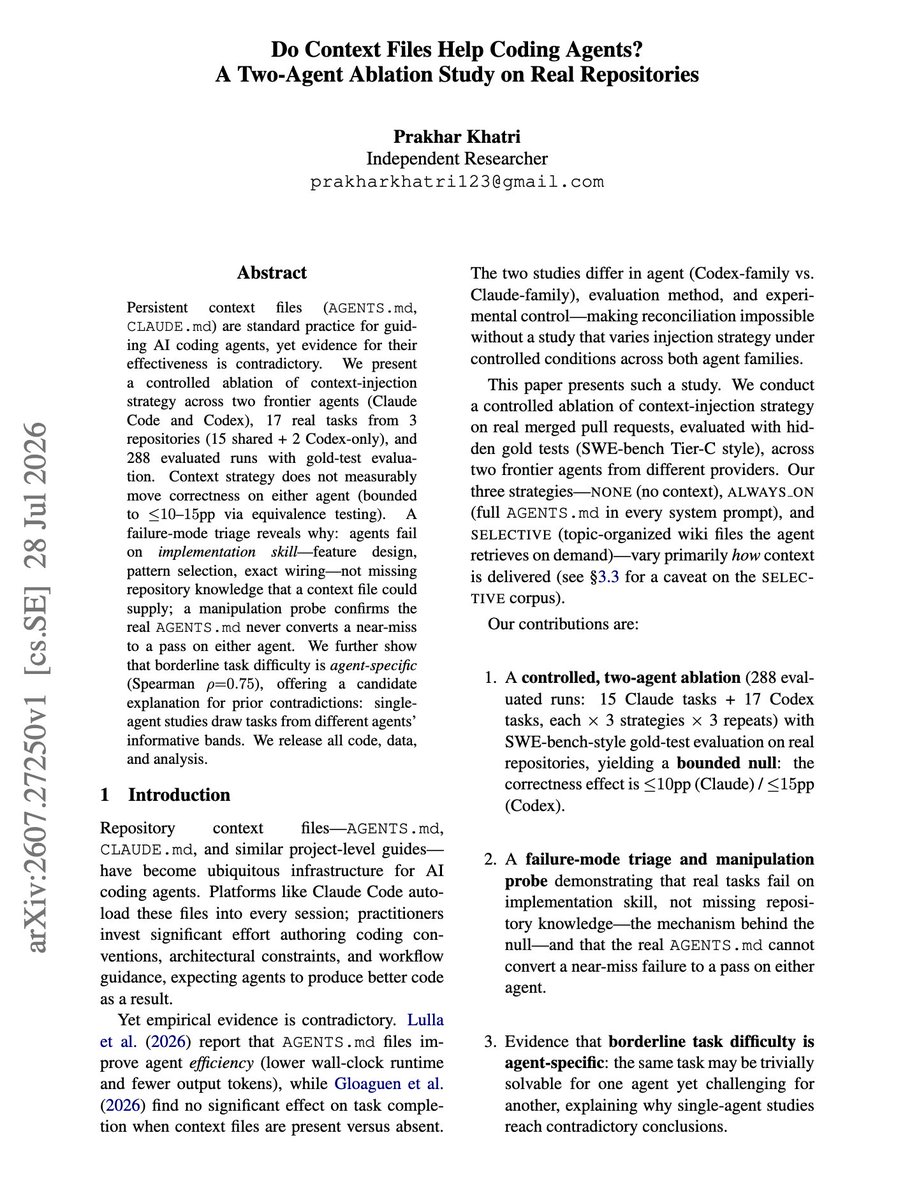
If you maintain an AGENTS.md or a CLAUDE.md, this is worth a read.
(bookmark it)
288 gold-test evaluated runs across Claude Code and Codex, 17 real tasks from 3 repositories, with context-injection strategy as the only variable.
Correctness does not move on either agent. Equivalence testing bounds any effect to at most 10 to 15 percentage points.
A failure-mode triage explains why. Agents fail on implementation skill, feature design, pattern selection and exact wiring, rather than on repository knowledge a markdown file could supply. A manipulation probe confirms it, since the real AGENTS.md never converted a near-miss into a pass on either agent.
Borderline task difficulty is agent-specific with Spearman rho of 0.75, so single-agent studies draw tasks from different informative bands and reach opposite conclusions. That explains a lot of the contradictory prior evidence.
Paper: https://t.co/iEC36in8ms
Track more trending AI papers in our academy: https://t.co/LRnpZN7L4c
An Anthropic engineer shared the exact system they use as a second brain.
Three folders. One file. One evening to build.
Most people use Claude the same way every day. Open a new tab. Rebuild context. Get an answer. Close the tab. Tomorrow it remembers nothing. You are still the one holding all the context. You are still the one resetting.
This architecture solves that problem.
The system is built around three folders and one file.
raw/ holds everything unstructured. Articles, transcripts, PDFs, voice memos, screenshots. Drop it in and never touch it again. Immutable ground truth.
wiki/ is where Claude converts everything in raw into structured, linked, cross-referenced knowledge. Clean. Organized. This is the folder Claude actually thinks from. The human reads it. The model writes it.
output/ is where finished work lands. Reports, posts, documents, presentations. Everything Claude builds using the wiki as its source.
At the center is CLAUDE.md. Not a prompt, but a persistent layer of identity, preferences, goals, and project context. Claude reads it before every session. You never explain yourself again.
Five automations run the system.
Ingest captures and extracts new sources into the wiki. Write retrieves context and drafts outputs. Manage links decisions to context. Review summarizes and updates. Maintain prunes and improves connections.
Every session adds to the system. Every source makes the wiki smarter. The returns compound over time.
One month in, context stops disappearing. Three months in, the vault surfaces ideas you forgot you had. Six months in, the gap between compounding and resetting becomes impossible to ignore.
Build once. Maintain daily. Let it compound.
Bookmark this.
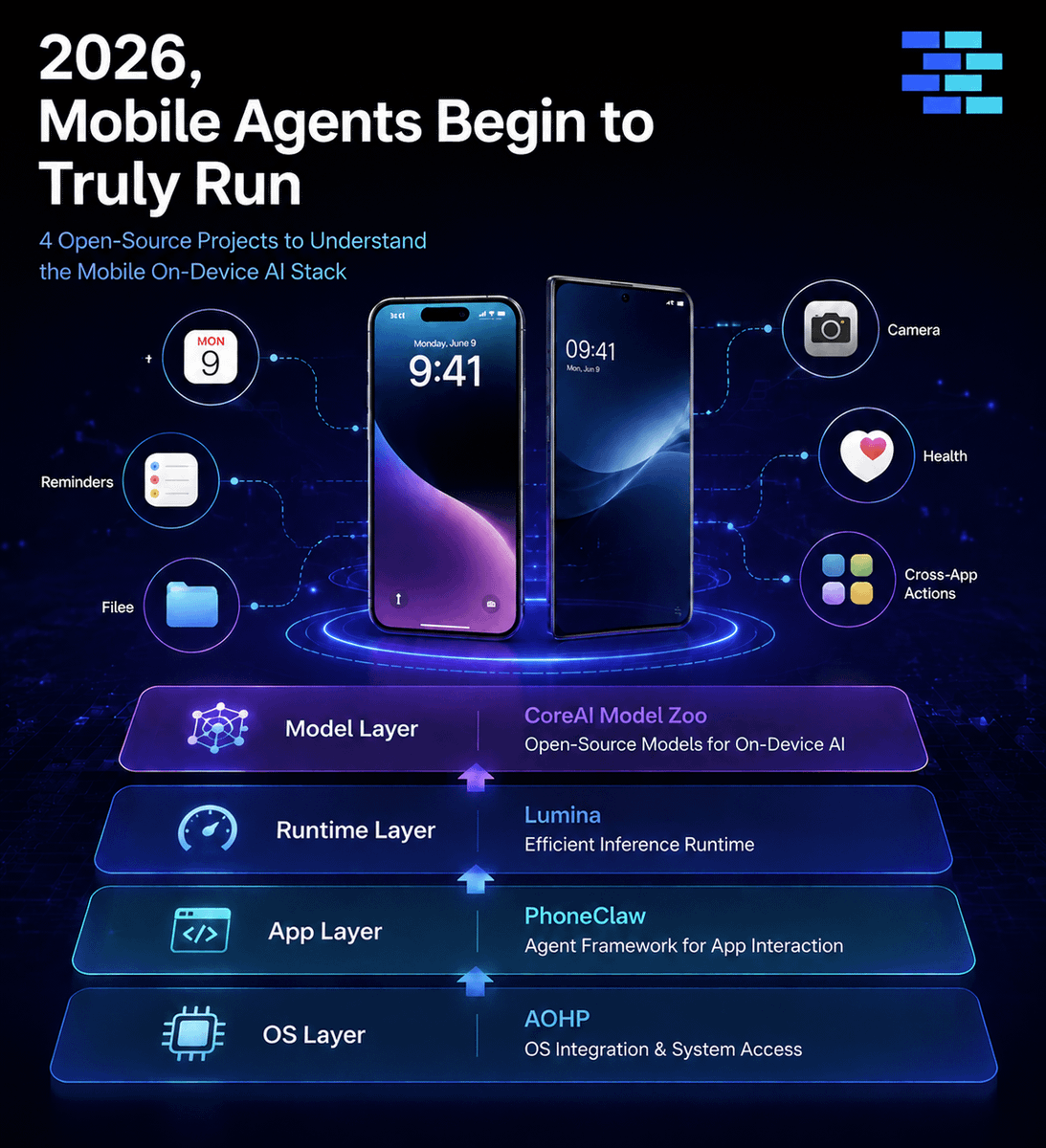
Recently, we’ve been exploring several open-source projects bringing AI agents to smartphones. 🚀
They explore different layers of mobile AI, including on-device models, agent execution, and system-level capabilities.
We took a closer look at:
🔹 PhoneClaw
🔹 CoreAI Model Zoo
🔹 Lumina
🔹 AOHP
Together with MiniCPM’s on-device AI exploration, these projects highlight different approaches to building more capable mobile AI agents.
10 GitHub repos so good they probably shouldn't be free.
1. OmniRoute
One endpoint. 231 AI providers. 50+ free-tier providers.
Connect Claude Code, Codex, Cursor, and Cline to Claude, GPT, and Gemini for free.
Compresses tokens by 15–95% with automatic fallback if a provider goes down.
GitHub:
https://t.co/DyQkj165aY
2. OfficeCLI
The first Office suite built for AI agents.
Control Word, Excel, and PowerPoint from a single command line.
No Microsoft Office installation. No dependencies. Just one binary.
GitHub:
https://t.co/q2D8nVPj9u
3. System Prompts Leaks
Leaked system prompts from Claude, GPT, Gemini, Grok, Cursor, Copilot, and more.
Regularly updated.
GitHub:
https://t.co/HZpSfXMBcg
4. OpenCut
An open-source CapCut alternative that runs in your browser.
No account. No telemetry. No subscription.
GitHub:
https://t.co/QniZNYr9g3
5. AI Job Search
A Claude Code-powered agent that applies for jobs for you.
Analyzes listings, tailors your resume, writes cover letters, and prepares interview questions.
GitHub:
https://t.co/fvIeDOpg34
6. Meetily
A fully local meeting transcription and summarization tool powered by Whisper and Ollama.
Built in Rust.
GitHub:
https://t.co/6iZOAoFA5o
7. Vibe-Trading
Use natural language and AI agents to build and execute trading strategies.
GitHub:
https://t.co/f3vWfJorhS
8. Strix
An AI-powered open-source vulnerability scanner.
Finds and helps fix security issues before attackers do.
GitHub:
https://t.co/OfaDzLxML7
9. Superpower
A self-hosted AI workspace with 250k+ GitHub stars.
GitHub:
https://t.co/f0gC0yxjrQ
10. Firecrawl
Turn any website into clean, LLM-ready data in seconds.
The industry standard for RAG and data pipelines.
GitHub:
https://t.co/onZ9Vi2dsn
100% Open Source.
All of them are free.
All of them are worth bookmarking.
CPU vs GPU vs TPU vs NPU vs LPU, explained visually:
5 hardware architectures power AI today.
Each one makes a fundamentally different tradeoff between flexibility, parallelism, and memory access.
> CPU
It is built for general-purpose computing. A few powerful cores handle complex logic, branching, and system-level tasks.
It has deep cache hierarchies and off-chip main memory (DRAM). It's great for operating systems, databases, and decision-heavy code, but not that great for repetitive math like matrix multiplications.
> GPU
Instead of a few powerful cores, GPUs spread work across thousands of smaller cores that all execute the same instruction on different data.
This is why GPUs dominate AI training. The parallelism maps directly to the kind of math neural networks need.
> TPU
They go one step further with specialization.
The core compute unit is a grid of multiply-accumulate (MAC) units where data flows through in a wave pattern.
Weights enter from one side, activations from the other, and partial results propagate without going back to memory each time.
The entire execution is compiler-controlled, not hardware-scheduled. Google designed TPUs specifically for neural network workloads.
> NPU
This is an edge-optimized variant.
The architecture is built around a Neural Compute Engine packed with MAC arrays and on-chip SRAM, but instead of high-bandwidth memory (HBM), NPUs use low-power system memory.
The design goal is to run inference at single-digit watt power budgets, like smartphones, wearables, and IoT devices.
Apple Neural Engine and Intel's NPU follow this pattern.
> LPU (Language Processing Unit)
This is the newest entrant, by Groq.
The architecture removes off-chip memory from the critical path entirely. All weight storage lives in on-chip SRAM.
Execution is fully deterministic and compiler-scheduled, which means zero cache misses and zero runtime scheduling overhead.
The tradeoff is that it provides limited memory per chip, which means you need hundreds of chips linked together to serve a single large model. But the latency advantage is real.
AI compute has evolved from general-purpose flexibility (CPU) to extreme specialization (LPU). Each step trades some level of generality for efficiency.
The visual below maps the internal architecture of all five side by side.
Notice the thread connecting all five. Every generation exists to move data less, because the math was never the hard part. Feeding the math units fast enough is.
The same battle plays out one layer up in software. During LLM inference, a single GPU produces terabytes of KV cache per day, and nearly all of it gets thrown away and recomputed, which is a big reason agent workloads cost what they do.
I wrote a full breakdown of how a disaggregated caching layer fixes this, with up to 14x faster time-to-first-token. The article is quoted below.
You should also check the @lmcache GitHub repo: https://t.co/TXlaLLu04a
(don't forget to star 🌟)
👉 Over to you: Which of these 5 have you actually worked with or deployed on?
Andrew Ng just dropped 8-page PDF on 4 agentic steps "from Loops to Graphs from scartch"
The twist: agent has amnesia without both: Loops let agents think - Graphs let agents remember
here's 4 workflows, step by step:
step 1 → reflection - agent writes, second prompt critiques, agent rewrites - one self-review loop beats a smarter model with none
step 2 → tool use - give it search, code execution, APIs - thinking without tools is hallucinating
step 3 → planning - break the task into JSON steps before running - Step fails? Agent replans around it
step 4 → multi-agent - stop running one agent - run a team - one codes, one reviews, one tests
how to wire this today:
step 5 → add one critique call after every generation - 10-30% quality lift, one day of work
step 6 → connect all 4 into a graph - agents share memory instead of transcripts - agent forgets, graph doesn't
the result: a weak model with 4 steps destroys a strong model without them - same cost, it's the architecture
this 8-page PDF is what comes after loop engineering
save this - then read the full build workflow in the article below ↓
A Riemannian metric tensor is the mathematical tool that tells us how to measure distances and angles on curved surfaces and spaces.
In flat space, measuring distance is straightforward. But when space is curved, the rules change from point to point. The Riemannian metric tensor, written as ds² = gᵢⱼ dxⁱ dxʲ, provides the local geometry needed to calculate lengths, angles, areas, and volumes accurately.
This idea became the foundation of modern differential geometry and later helped Einstein describe gravity as the curvature of spacetime itself.
the fourier transform is one of those ideas that completely changes how you look at information. when you first see a signal, it just looks like a messy waveform changing over time. but the fourier transform asks a different question. instead of asking “what is the signal doing?”, it asks “what frequencies make up this signal?” suddenly, something that looked chaotic becomes a collection of simple sine and cosine waves, each with its own frequency and amplitude.
that’s why engineers constantly move between two worlds: the time domain and the frequency domain. in the time domain, you see how a signal evolves. in the frequency domain, you see its ingredients. noise becomes identifiable. dominant frequencies become obvious. filters become easy to design. whether it’s music, images, wireless communication, radar, vibration analysis, or MRI scans, the same mathematical idea keeps showing up because many complex signals are just simple waves layered on top of each other.
the deeper lesson has very little to do with waves. it’s about changing your representation. sometimes a problem looks impossible because you’re looking at it in the wrong space. the fourier transform doesn’t change the signal. it changes your perspective. and very often, changing the representation is enough to make the hidden structure reveal itself.
Gradient, Jacobian and Hessian are fundamental in multivariable calculus for different orders of differentiation.
∇f is the n×1 vector of first partials of scalar f indicating steepest ascent.
J_F is the m×n matrix of first partials of vector F giving the linear map for small changes.
H_f is the n×n matrix of second partials of scalar f capturing curvature.
These trains machine learning models via gradient descent and backpropagation and refines solutions with second-order methods in optimization tasks.
🚨New Paper: Training Small LLMs to Introspect!🚨
We create two rigorous evals of LLM introspection and:
- we show introspection emerges with scale
- we *train-in* introspection (even on llama 1B!) by SFT'ing on perturbed forward passes, and performance generalizes! 🧵(1/5)
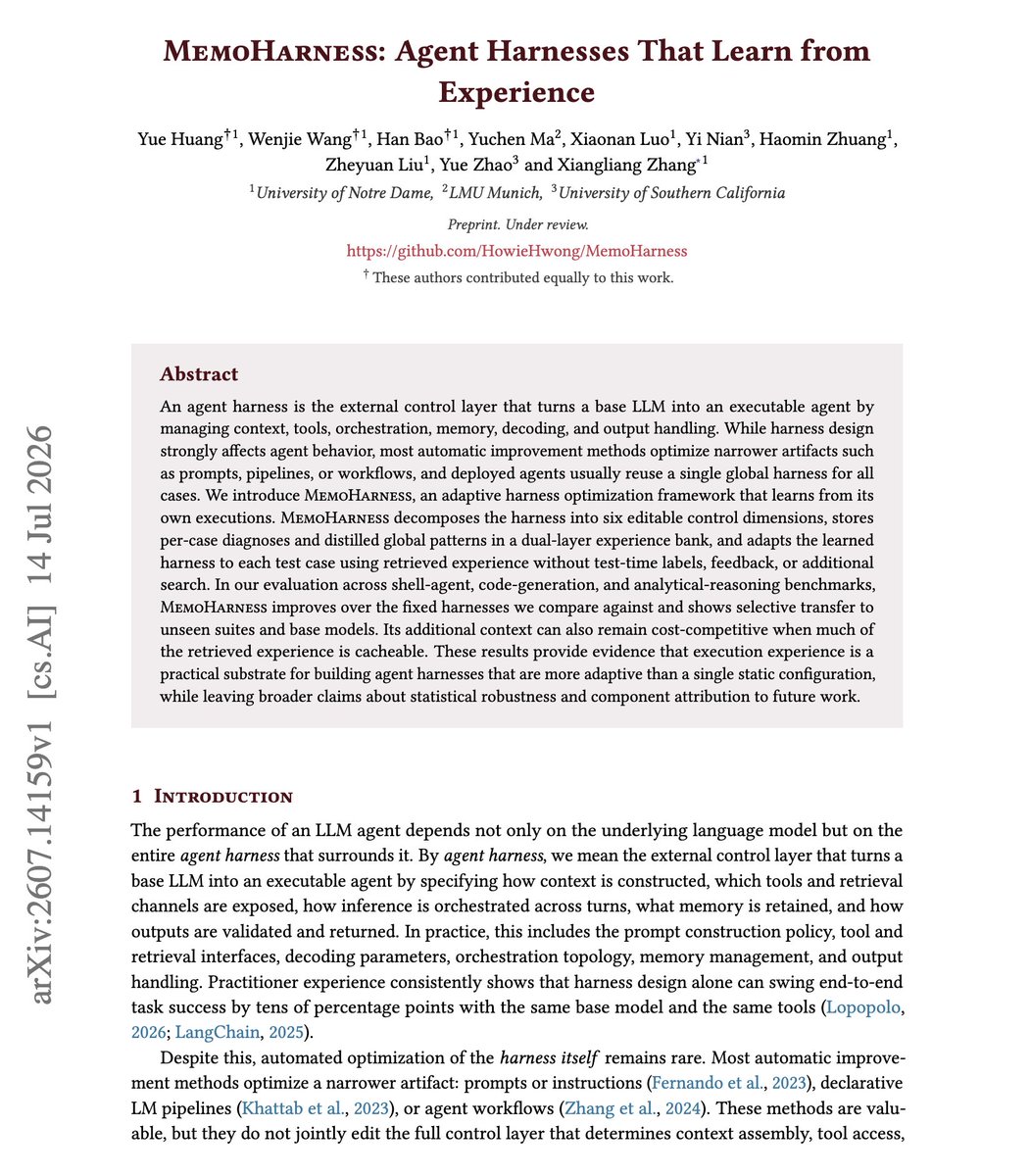
Great research paper on optimizing harnesses.
(bookmark it)
There is a lot of alpha in building a harness.
And you don't need much to keep them optimized. This paper argues you can do this effectively using the harness own executions.
The harness is the external control layer that turns a base LLM into an executable agent.
Automatic improvement methods optimize a narrow part of it, usually prompts or pipelines, and deployed agents then reuse a single global harness for every case.
MemoHarness decomposes the harness along the temporal flow of inference into six editable control surfaces (context, tool, generation, orchestration, memory, output) and turns improvement into structured editing over those dimensions.
It documents per-case diagnoses plus distilled global patterns about what works and how dimensions interact, then adapts to each new case by retrieving similar past cases. No compute is waisted on test-time labels, feedback, gradient updates, or extra search.
On the shell-agent benchmark it reaches 0.806 against 0.722 for the strongest fixed-harness baseline, at lower per-task dollar cost than the strongest commercial baselines compared.
Paper: https://t.co/xiJ3ikXknJ
Learn to build effective AI agents in our academy: https://t.co/1e8RZKs4uX
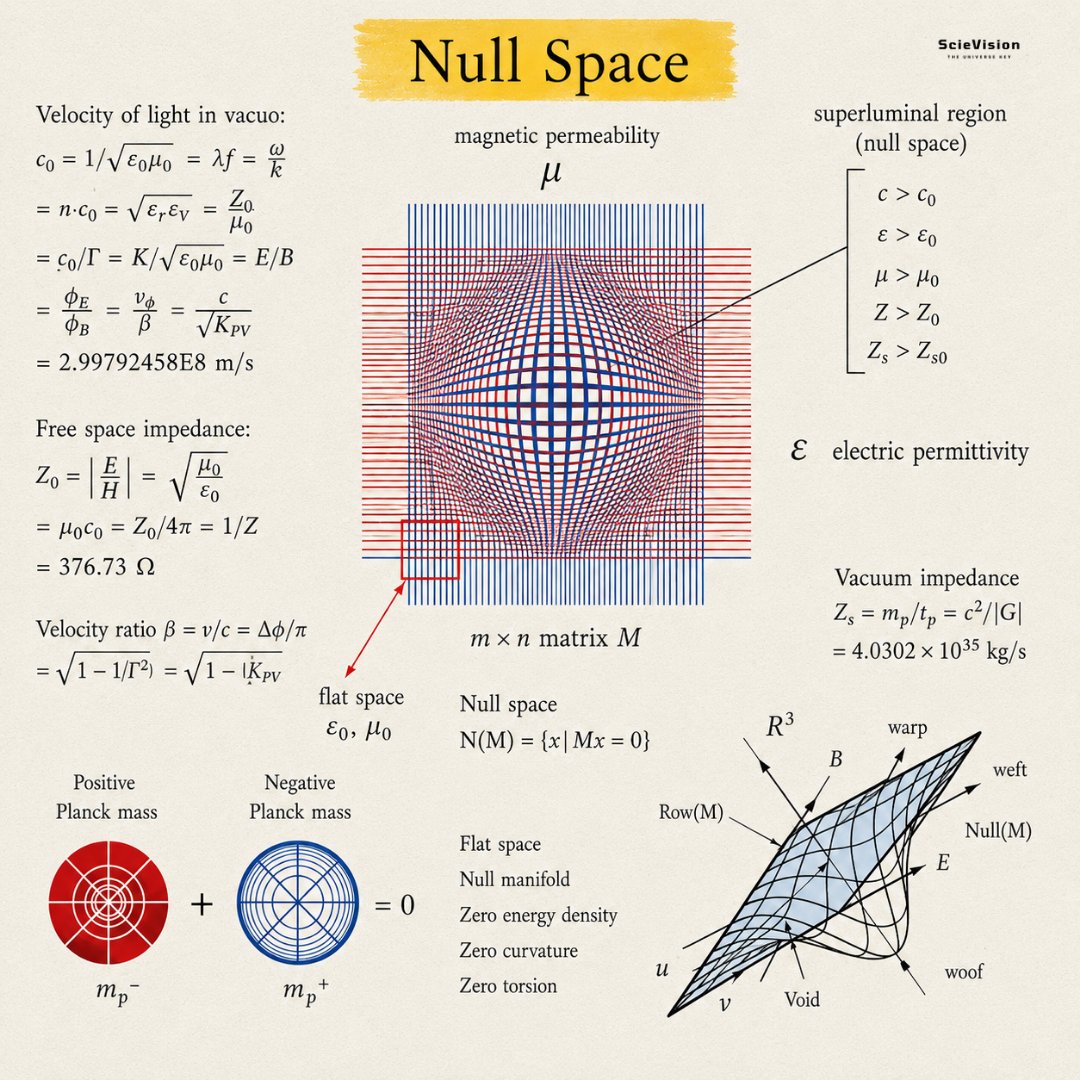
Null Space ✍️
This diagram brings together one of the most significant ideas in mathematics and physics under one beautiful concept called null space. The term null means zero or nothing, and null space represents nothingness defined in a very precise and meaningful way. However, this is not the ordinary nothingness of an empty room or a blank page. It represents a deep and structured nothingness, a state of perfect balance, flatness, and symmetry from which all physical reality emerges in one direction or another. The diagram connects this idea across multiple fields, including pure mathematics, the physics of light and electromagnetic waves, the geometry of curved space, and even speculative ideas about the total energy content of the universe.
The large central image in the diagram is the most striking element and carries much of the meaning visually. It shows a grid made of red horizontal lines and blue vertical lines. In the outer areas, the lines are straight and evenly spaced, forming a regular flat pattern. Toward the center, the lines become increasingly distorted, curved, compressed, and warped, creating a bubble-like bulge in the middle. The flat outer region represents normal undistorted empty space; the vacuum as it exists far from any unusual influence. The warped central region represents space that has been curved or altered by some physical effect. The transition between them shows the boundary between modified space and normal flat space. The grid is also labeled as a matrix, linking this physical picture to the mathematical concept of null space from linear algebra, where a matrix is simply a rectangular array of numbers that acts as a transformation machine, converting one set of numbers into another.
The mathematical definition of null space is one of the most important concepts in mathematics. In simple terms, it means this: the null space of a transformation is the complete collection of all inputs that the transformation completely destroys, turning them into zero. When you input any of these special values into the transformation machine, the output is always exactly nothing. Most inputs produce meaningful nonzero outputs, but some special inputs are completely destroyed. These destroyed inputs form the null space, the blind spot of the transformation, the directions it cannot see, detect, or preserve. The null space is always a geometrically meaningful collection of directions forming a line, a plane, or a higher-dimensional equivalent through the origin. It represents the directions that are completely invisible to the transformation, the information it cannot distinguish from the total absence of any input.
The diagram lists five properties associated with null space in the context of space and spacetime. The first is flat space; the null state of the universe is perfectly flat space with no curves, bends, or warps. In Einstein's general relativity, massive objects curve the space around them, and this curvature is what we experience as gravity. However, in the complete absence of all matter and energy, space is perfectly flat, and this flat state is the null baseline. The second property is null manifold, referring to the fact that light rays in spacetime travel along paths where the combined spacetime distance is exactly zero, even though light crosses real distances during real durations of time. This zero spacetime distance of light paths is a fundamental geometrical fact about our universe. The third property is zero energy density. True empty space has no energy stored within it, no matter, no radiation, and no concentrated field energy. The fourth property is zero curvature, which follows directly from zero energy because Einstein's equations tell us that where there is no energy, there is no curvature. The fifth property is zero torsion, which means space has no twisting or rotation, representing the most symmetric and undistorted possible state of spacetime.
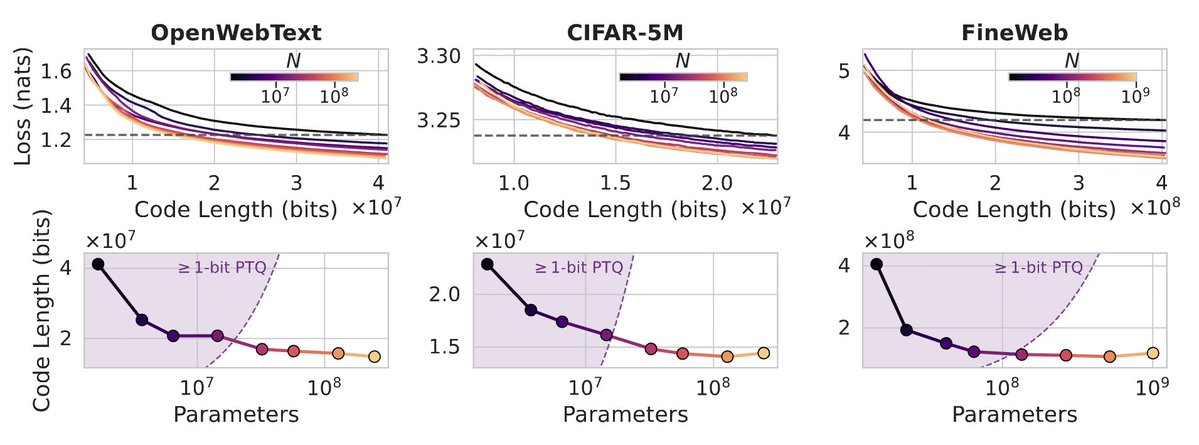
How far can we compress billion-parameter LLMs? We introduce requential coding, which achieves < 1-bit per param compression, and explains why scaling doesn't hit a generalization wall!
https://t.co/gUZekHiFRU
w/@m_finzi, @YujiaZheng9 ,@kunkzhang, @andrewgwils
1/🧵