So, let's recap, shall we?
This week the @PressClubAust managed to:
* cancel at the last minute, the questions and subsequent presence of renowned journalist Margo Kingston, who’d travelled over 2 days to Canberra to ask her question of Pauline Hanson – and yes, they were questions initially requested and organised by the Press Club itself 9 days ago.
* cancel the press gallery membership of long-term journalist, Greg Jericho, allegedly because he works for the @TheAusInstitute. Although Greg has been employed by the Aust Institute for 4 years, his membership cancellation only came yesterday after he publicly called out the Canberra press gallery - which is of course a highly fortuitous coincidence and not at all connected to his criticism.
* somehow allowed a person or persons unknown to enter the Press Club premises and put up a 3 metre wide electronic banner, without anybody in the Press Club noticing them doing it. How several people enter a private club carrying something that large, then proceed to wire it up on an open stage and nobody at the premises noticed in any way, is yet another display of the NPC’s staggering incompetence.
* release an unnecessarily detailed, high-school level statement about said banner incident, a statement that reeks of defensiveness and hysteria, while also prejudicially naming an alleged culprit and arguably sinking to the bottom of the barrel in terms of the journalistic standards it supposedly represents. Read it below and remind yourself that people who work with words for a living wrote that.
* allowed the speaker, Pauline Hanson, to defame one of their own - a journalist from the Guardian who dared to ask a hard-hitting question - by calling her "trash". This was only weeks after calling the same journalist a "nasty bitch". Mirroring, Trump’s “Quiet piggy” incident, the journalist's alleged colleagues all sat mute, as did the moderator, Tom Connell from Sky News during the abuse. No rebuke, no blow-back, no support for their fellow journalist, standing alone under Hanson's hissing vitriol. Just pusillanimous silence.
The National Press Club outdid their already dubious reputation this week, spraying themselves in a spectacular shower of self-inflicted shit – wall to wall, dripping effluent.
Australians currently suffer some of the most timid, captured political journalism in the western world, and if the actions of the #NPC this week are the metric, then we can all see why.
What a national and international embarrassment of an organisation meant to serve as a vital democratic institution and a cultural conscience – and one that has offered us neither.
.
Stoicism hasn't been so popular as it is now for centuries, if not for two millennia. But what exactly *is* Stoicism, and when did it find its truest form? Tricky questions—but today we have Prof. John Sellars of Royal Holloway to guide us through trouble: https://t.co/6zKX3Mzcen
Humanity, created by God in all its grandeur, is today facing a pivotal choice: either to construct a new Tower of Babel or to build the city in which God and humanity dwell together. In Jesus Christ, this humanity in its grandeur becomes the Way, the Truth and the Life, opening the path for each of us to grow toward fullness. #MagnificaHumanitas
https://t.co/6i9MWs6LJl
the pope and anthropic's co-founder just stood together at the vatican to release "magnifica humanitas," the first ever catholic teaching on AI
yes, you read that right. the full ceremony was 2 hours.
here's the most interesting things for you to know:
1. this is the biggest religious response to AI in history. popes only put out a handful of these huge official letters in their entire time as pope. the fact that one of them is about AI tells you how seriously the church is taking what's coming.
2. small detail with massive meaning: this pope picked the name "leo XIV" on purpose. the last pope named leo was leo XIII back in 1891, and his most famous act was writing the church's response to the industrial revolution. picking the same name is a deliberate signal. this pope sees AI as the new industrial revolution.
3. the catholic church does this every time a major technology reshapes humanity. they wrote "rerum novarum" in 1891 to respond to the industrial revolution. when nuclear weapons threatened the world in the 1960s, they wrote "pacem in terris." climate change and runaway tech got "laudato si" in 2015. now AI gets "magnifica humanitas." they don't issue these often.
4. the pope's main line: "AI needs to be disarmed." he literally compared AI to nuclear weapons. he said the church spent decades pushing for nuclear disarmament because the technology was too dangerous to leave in the hands of a few. he says AI is now in that same category.
5. anthropic co-founder christopher olah told the pope, on stage at the vatican, that anthropic's own research team keeps finding things inside their AI models that "mirror joy, satisfaction, fear, grief, and unease."
6. olah's reframe of what AI actually is: these things are grown. they're trained on a structure roughly modeled after the human brain and fed everything humans have ever written. in his own words: "they are made from us, from our words." he said even the people building them don't fully understand what's happening inside.
7. olah publicly admitted that every AI lab, including his own, faces pressure that can conflict with doing the right thing. commercial pressure to keep shipping, competitive pressure from other labs, plus the older pressures of pride and ambition. his solution: we desperately need outside critics with no skin in the game who will tell the labs when they're failing.
8. olah says there are 3 giant questions the AI labs cannot answer alone and the world needs religion and philosophy to step in on:
> how do we make sure poor countries actually benefit from AI?
> what does human flourishing even look like in this new world?
> and what are these things we're actually building?
9. one of the sharpest lines in the whole encyclical: "the promise of automatic general prosperity often proves illusory." translation: the idea that AI will just make everyone rich on its own is a fantasy. someone has to actually design the system so the benefits get shared.
10. the pope also pulled out a 100-year-old quote: "contemporary man has not been trained to use power well." said by a theologian back in the 1920s. the whole encyclical is basically a long argument that we need to learn how to use this kind of power before it uses us.
11. the pope kept stressing that he doesn't have the technical answers. but he says the church has thousands of years of wisdom on what it means to be human, and that wisdom is exactly what's missing from how we're building AI right now. his closing line: this technology should serve "human flourishing and human dignity, not control consciences."
Pope Leo XIV in his first encyclical citing Hannah Arendt's Origins of Totalitarianism to warn AI risks producing the exact condition Arendt identified as the prerequisite for totalitarian domination by destroying people's ability to discern between fact and fiction.
Coffee is good for your brain: Researchers tracked 130,000 people for over 40 years and found coffee was associated with reduced risk of dementia. https://t.co/i9wFqZyfPj
My latest article for the @shot_au on the Pauline Hanson grift machine
"Pauline Hanson – who thinks the Murray Darling Basin Plan is the name of her plumber Murray’s work schedule – now wants you to believe she’s going to save them."
.
https://t.co/VQGUkGrlcs
An old and worthy insight from the Nobel laureate and originator of cognitive psychology and artificial intelligence, Herb Simon: Don't spend 15 minutes figuring out a shortcut that will save you 10 minutes. Information-gathering and decision-making themselves have costs, so "satisfice" rather than seeking to optimize. This op-ed by David Epstein draws out implications for life decisions. https://t.co/7Hhgch0P1y
The trailblazing psychologist Carl Rogers believed, and proved with his long practice, that “the basic nature of the human being, when functioning freely, is constructive and trustworthy.” His abiding insight into the 3 elements that make this possible: https://t.co/h3t22jW7kq
Government to spend millions in ads telling motorists to remove unnecessary weight from their vehicles … after years of incentivising the uptake of ludicrously large heavy SUVs now clogging our roads.
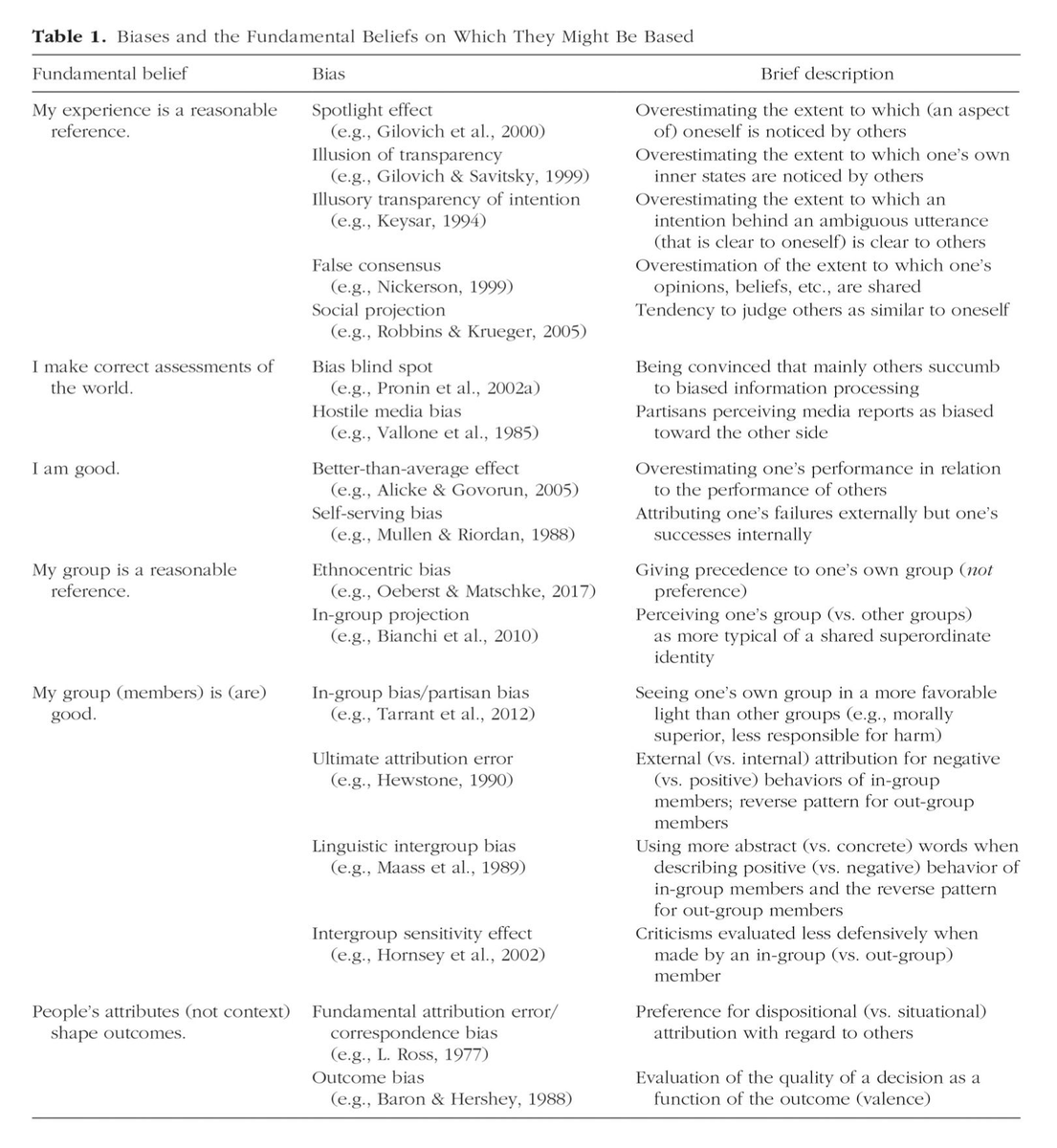
Psychologists have posited hundreds of cognitive biases over the years. A fascinating new paper argues that they all boil down to one of a handful of fundamental beliefs coupled with confirmation bias.
https://t.co/uZTVbGnH3d
Hmm. This was dispiriting. I had a haircut from a young woman, and after she established that I write for a newspaper, she gushed: "That's so interesting! I've never actually read a newspaper."
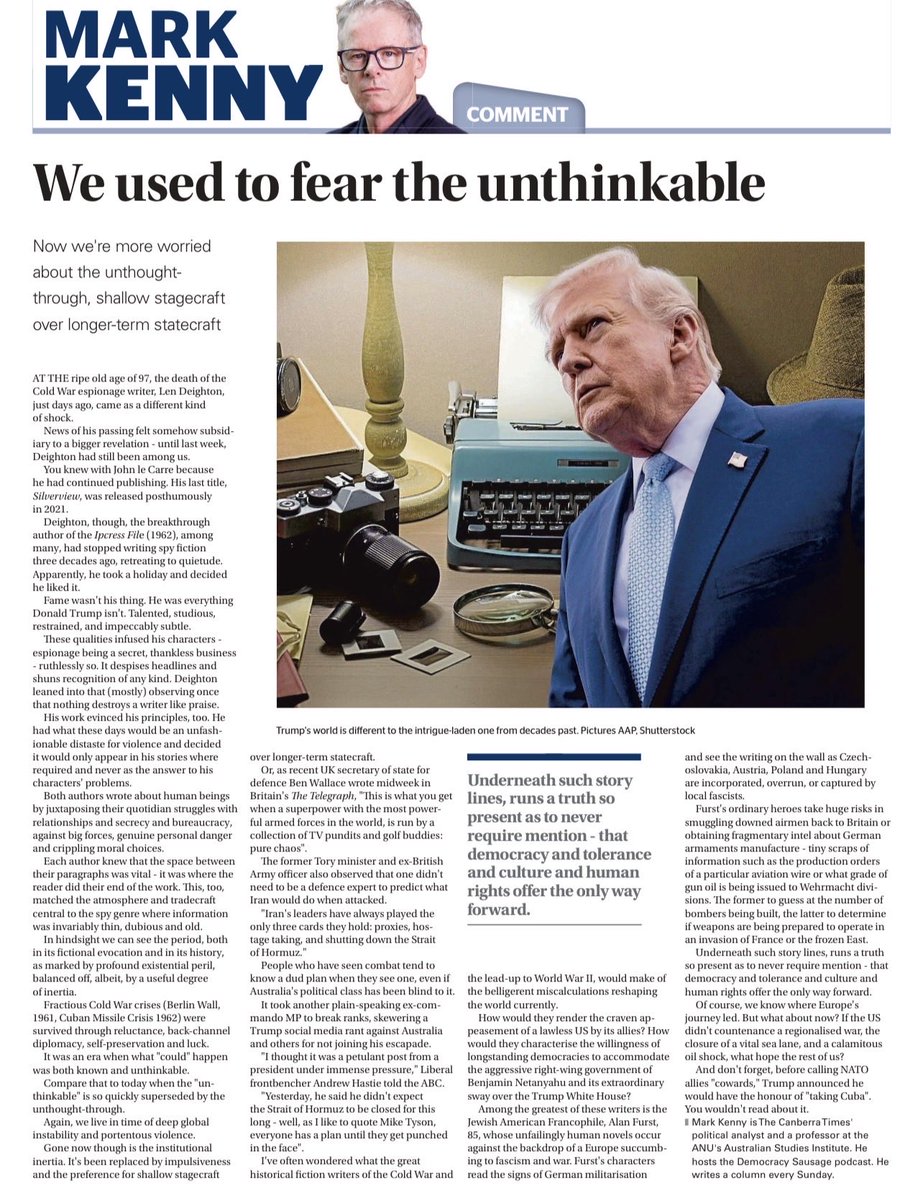
What would the great writers of spy & geo-political fiction like Len Deighton, John le Carre and Alan Furst make of the current absence of inertia and the waging of war without constraint?
Timely reminder of when this guy reviewed that guy...
Iggy Pop on Gibbon's Decline and Fall (Classics Ireland, 1995):
Caesar Lives by Iggy Pop
In 1982, horrified by the meanness, tedium and depravity of my existence as I toured the American South playing rock and roll music and going crazy in public, I purchased an abridged copy of The Decline and Fall of the Roman Empire (Dero Saunders, Penguin).
The grandeur of the subject appealed to me, as did the cameo illustration of Edward Gibbon, the author, on the front cover. He looked like a heavy dude.
Being in a political business, I had long made a habit of reading biographies of wilful characters — Hitler, Churchill, MacArthur, Brando — with large profiles, and I also enjoyed books on war and political intrigue, as I could relate the action to my own situation in the music business, which is not about music at all, but is a kind of religion-rental.
I would read with pleasure around 4 am, with my drugs and whisky in cheap motels, savouring the clash of beliefs, personalities and values, played out on antiquity’s stage by crowds of the vulgar, led by huge archetypal characters.
And that was the end of that. Or so I thought. Eleven years later I stood in a dilapidated but elegant room in a rotting mansion in New Orleans, and listened as a piece of music strange to my ears pulled me back to ancient Rome and called forth those ghosts to merge in hilarious, bilious pretence with the Schwartzkopfs, Schwartzeneggers and Sheratons of modern American money and muscle myth. Out of me poured information I had no idea I ever knew, let alone retained, in an extemporaneous soliloquy I called ‘Caesar’.
When I listened back, it made me laugh my ass off because it was so true. America is Rome. Of course, why shouldn’t it be? All of Western life and institutions today are traceable to the Romans and their world. We are all Roman children for better or worse. The best part of this experience came after the fact — my wife gave me a beautiful edition in three volumes of the magnificent original unabridged Decline and Fall, and since then the pleasure and profit have been all mine as I enjoy the wonderful language, organization and scope of this masterwork.
Here are just some of the ways I benefit:
I feel a great comfort and relief knowing that there were others who lived and died and thought and fought so long ago; I feel less tyrannized by the present day.
I learn much about the way our society really works, because the system-origins — military, religious, political, colonial, agricultural, financial — are all there to be scrutinized in their infancy. I have gained perspective.
The language in which the book is written is rich and complete, as the language of today is not.
I find out how little I know.
I am inspired by the will and erudition which enabled Gibbon to complete a work of twenty-odd years. The guy stuck with things. I urge anyone who wants life on earth to really come alive for them to enjoy the beautiful ancestral ancient world.
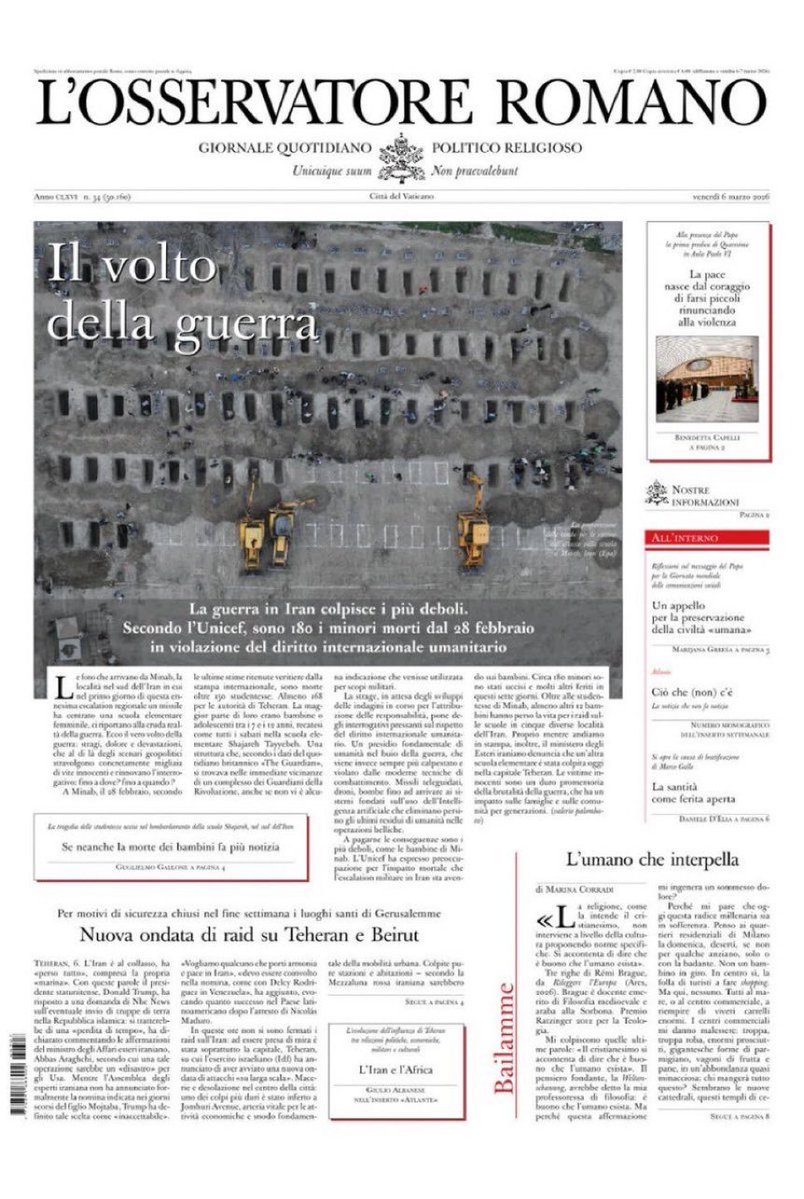
Pope Leo XIV’s Vatican newspaper is the only publication in the Western world to run the photograph of 150 Iranian girls' graves — killed in President Trump's military strikes — on its front page.