Teacher interested in learning; youth counsellor, freelance writer. Proud Indian with a marked spiritual inclination and passion to impart this spirit to others
Discipline is simply choosing what’s good for you later over what feels easy right now. Watch the full video to learn how to design a life that runs on autopilot. https://t.co/d0cfOxV003
#Discipline#Productivity#Neuroscience#HabitFormation
Ever feel like your brain is your own worst enemy? In this video, we’re diving deep into why your mind does this and—more importantly—how to make it stop. You'll learn how to stop #overthinking, how to identify mind #traps and techniques to shift to #positivethinking
In the screaming, blood-slicked labor wards of colonial Calcutta, young mothers were dying by the 1000s in absolute, unmentioned agony. The heavy, crude steel instruments imported from Europe were designed exclusively for Western anatomy, turning a difficult childbirth into a literal death sentence for Indian women until a quiet Bengali daaktar stepped out of the ward, walked into a local forge & picked up a blacksmith’s hammer.
Long before he became the silent savior of the unborn, Kedarnath Das was just a quiet, intensely observant boy navigating the dusty lanes of mid 19th century Bengal. Born in 1867 into a modest middle-class family, Kedarnath did not possess a lineage of wealth, but he inherited a sharp, analytical mind. He watched a changing India, a nation adapting to Western education while its people quietly starved under colonial economic policies.
He fought his way into the prestigious Calcutta Medical College, graduating in 1892 with a brilliant academic record that forced the British faculty to take notice. While his peers chased lucrative private practices/drifted toward general medicine, Kedarnath chose the messy, chaotic & deeply tragic world of obstetrics. He did not just want to treat disease; he wanted to stand at the very threshold of human life.
By the turn of the century, Kedarnath was appointed as an obstetrician at the Eden Hospital in Calcutta. It was here that he walked into a silent, horrifying epidemic. When a baby was stuck in the birth canal, doctors had to rely on obstetric forceps: metal tongs used to gently guide the child into the world. But the British Empire supplied only British tools, specifically the massive, heavy Simpson & Barnes forceps.
These instruments were engineered for the larger pelvic structures of European women. When British doctors/trained mid-wives applied these brutal, oversized steel clamps to the smaller, deeply delicate & often malnourished frames of Indian mothers, the results were catastrophic. The heavy steel routinely crushed the fragile skulls of the infants or caused fatal, uncontrollable internal hemorrhaging in the mothers.
To the colonial medical establishment, these deaths were dismissed as a mere statistical byproduct of native frailty. But to Kedarnath, it was systemic, mechanical slaughter. He realized a truth that the entire British Empire was too arrogant to see: colonial medicine assumed that 1 imperial size fitted the entire human race.
Kedarnath executed an audacious, decade-long anthropological crusade. Working in absolute silence, away from the prying eyes of British supervisors, he manually measured the pelvic dimensions of 1000s of Indian women across different regions & backgrounds. He compiled a mountain of unprecedented, raw anatomical data.
Armed with his sketches & calculations, Kedarnath bypassed the elite British medical supply chains. He walked into a local Calcutta forge. Amidst the roaring fire, the flying sparks & the rhythmic clang of iron, he instructed the local blacksmith to shape a completely new weapon of survival.
He threw out the heavy, overbearing British design. He forged a pair of forceps that were significantly shorter, lighter & featured a precision-engineered, gentler curve that perfectly cradled the smaller, delicate anatomy of native mothers. Symmetrical, elegant & minimalist, it became known to a handful of stunned specialists as the "Bengal Forceps/the Das Forceps."
When he introduced his handmade prototype into the labor wards of Calcutta, the mortality rates plummeted overnight. Lives that would have vanished into the cold statistics of colonial neglect were suddenly walking out of the hospital doors, healthy & breathing.
The Western world was stunned. British manufacturers in London, who had initially dismissed Indian medical minds, were suddenly forced to mass-produce Kedarnath’s precise design in their factories, exporting the "Das Forceps" across the British Empire & the Americas to save women of similar petite statures worldwide. In 1928, he published Obstetric Forceps: Its History & Evolution, a monumental, 900 page masterpiece that became the definitive global textbook on the subject for half a century. He was knighted for his genius, yet he remained fiercely dedicated to his soil, eventually helping found the indigenous Carmichael Medical College to train Indian doctors on their own terms.
As the 20th century roared forward, bringing partition, independence & the high-tech digital revolution, the memory of Sir Kedarnath Das was quietly, systematically erased. The textbook he authored vanished from modern curriculums. The local forges that once pounded out his life-saving steel were replaced by modern pharmaceutical corporations.
Today, his name does not line our textbooks, nor are there massive national monuments erected in his honor. He has become a complete phantom, a ghost of Indian scientific brilliance. Yet, if you walk into the dusty archive rooms of old medical colleges/look through the vintage surgical kits of vintage rural clinics, you will find a pair of short, elegantly curved, unmarked steel forceps resting in the dark.
Empires have crumbled into the dust of textbooks, & the names of the kings who ruled us have faded from the wind, yet every single time an Indian child is born healthy into a world that once tried to gatekeep its survival, the silent hammer of Kedarnath Das still echoes in the room proving that the ultimate act of freedom is not taking a life, but having the courage to forge the tools that save it.
Starting a new series of short videos with meaningful #life tips for a calmer life. Check out the first one here! How to Stay Calm in Stressful Situations?
ये बंगाल CM के शपथ ग्रहण का सबसे रोचक पल है-
शपथ लेने के बाद सुवेंदु जी ने सभी नेताओं का अभिवादन किया , योगी जी का भी किया।
“पर सबसे अलग योगी जी ने उन्हें भगवा गमछा पहना दिया” ❤️👏👏
और उसी के साथ वहाँ उपस्थति हजारों लाखो लोगो का जो जोरदार उद्घोष रहा वो “रोंगटे” खड़े कर देने वाला था 👍🤝👏
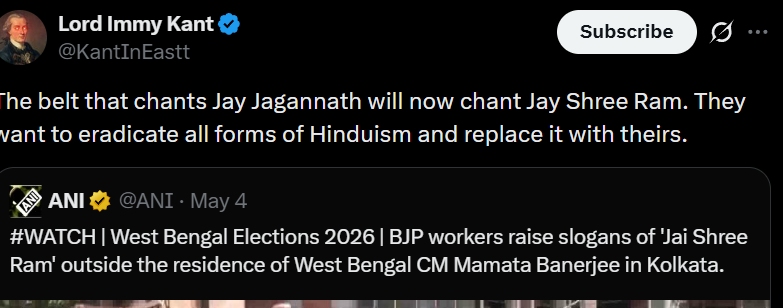
To the truly practicing Hindu, the "Nama" is what is important, not which one they choose to chant at a given time. Only a non-practitioner looking to divide on the basis of region/language will argue like this 👇
@Avijnata_01 Adiyen has never heard any upanyasams where it is told only bhakti is enough without following nitya-naimittika karmas. Probably an outcome of adiyen's choice of upanyaasakar?
Jaya Jaya SrI Sudarshana!
Sampradaya Manjari ePatashala (SMeP) is thrilled to invite you to an unforgettable Ramayanam Summer Camp.
🗓️ Save the Dates!
When: May 10th to May 15th.
Time: 3:00 PM to 4:15 PM IST every evening.
Language: Conducted in English
Cost: Completely FREE!
Have you noticed that there's a white mark on the chin of Lord Venkateshwara at Tirumala? Here's a short comic-book style video I made to explain how and why that came to be! 🙏🏼😊