Welp, that happened faster than I predicted. Thought it would be end of 2027, then early 2027, but agentic traffic growing so fast that bots have now passed human traffic online for the first time in the Internet's history. https://t.co/2zX5bHdhsa
BREAKING: SpaceX picks Nasdaq as the listing venue for its IPO, per Reuters.
Pricing as early as June 11, listing June 12. Shares to trade under ticker $SPCX.
The summer IPO is anticipated to be the largest of all time.
Le socialisme n'est pas une théorie économique.
C'est une structure morale qui a besoin de trois choses pour exister :
1. De la rareté à redistribuer
2. Des victimes à défendre
3. Une classe d'intermédiaires pour orchestrer le tout
Retirez un seul de ces trois piliers et l'édifice s'effondre.
L'IA est en train de retirer les trois en même temps.
SOMETHING TO PAY CLOSE ATTENTION TO...
The reason why President Trump took corporate leaders to China is because corporations move FAR faster than governments.
Politicians talk. Corporate leaders deploy capital.
If positive deals come out of the Trump-Xi summit in Beijing, markets won’t wait 2 years for congressional committees and bureaucratic reviews.
Money will move in DAYS.
Factories get funded. Supply chains get rerouted. Hiring begins. Capital gets deployed.
That’s the difference between traditional diplomacy and what President Trump is building: CORPORATE GEOPOLITICS.
This wasn’t a symbolic delegation.
This was essentially an American economic strike team.
President Trump already spent the last 16+ months laying the foundation BEFORE this summit even happened.
➡️ Tariffs forced leverage and reciprocity
➡️ Buy American rules redirected procurement spending
➡️ Energy dominance lowered industrial costs
➡️ Reshoring incentives changed corporate behavior
➡️ Supply chain pressure pushed companies back toward domestic manufacturing
That groundwork matters because now ANY deal struck can be accelerated immediately through private sector execution.
That’s why this summit matters.
🚨 If Boeing gets aircraft commitments... Factories ramp up.
🚨 If NVIDIA gets regulatory relief... AI infrastructure spending explodes.
🚨 If agriculture exports expand... Midwest production rises immediately.
🚨 If BlackRock and private equity firms see stability... TRILLIONS can rotate into industrial and strategic sectors rapidly.
Markets understand this.
That’s why positive announcements alone could send:
~ Tech stocks surging
~ Aerospace climbing
~ Financials rallying
~ Manufacturing sentiment exploding
The S&P 500 is already up heavily since President Trump returned to office.
Now imagine adding:
~ Reduced geopolitical uncertainty
~ New export deals
~ Faster capital deployment
~ Expanded domestic manufacturing
~ AI investment acceleration
~ Cheap energy
This is why the administration brought CEOs instead of career diplomats.
Corporate leaders control:
~ factories
~ satellites
~ patents
~ logistics
~ payment systems
~ hiring
~ capital allocation
And unlike government bureaucracies...
They can make billion-dollar decisions almost overnight.
That’s the REAL strategy here.
This isn’t just diplomacy.
It’s economic warfare using American corporate power as the weapon system.
And if it works, average Americans will feel it through:
~ stronger 401(k)s
~ higher wages
~ more factory jobs
~ tighter labor markets
~ increased energy security
~ stronger domestic production
People keep analyzing this summit like it’s 1998.
It’s not.
President Trump is merging state leverage with corporate execution speed.
That changes everything.
Read the bottom post and the one in the comments section of that post as well.
The four most dangerous words in investing are, “This time is different.”
The twelve most dangerous words in investing are, ‘The four most dangerous words in investing are, “This time is different.”’
David Sacks: Nonprofits need to manufacture problems in America to stay in business
David Sacks:
“Here's the systemic problem with nonprofits and NGOs.
Let me just contrast it with business.
In business, you set up a company, the company has to make revenue, it has to make profits.
And if it doesn't, it's going to go out of business, right? Because it'll lose money.
So there's a feedback mechanism from the market.
With an NGO, nonprofit, what have you, they raise money. They don't sell things.
They fundraise from donors in order to engage in an activity, but what happens over time is the actual activities may stop mattering, and all that really matters is they're able to keep fundraising, right?
Because they're just trying to figure out a justification to keep going back to donors to get more and more money out of them.
That's what perpetuates the organization.”
Chamath:
“ Why wouldn't the Southern Poverty Law Center focus on southern poverty? Which is an issue that actually still exists in some shape or form.
Why do you call it one thing, focus on racism, and then all of a sudden whip up fake racism?”
Sacks:
“I do think that at one time in this country, civil rights was a noble cause, a very legitimate cause.
We had the legacy of segregation and Jim Crow, and there were groups that were set up to basically change that, and they succeeded.
But again, no one in an NGO or a nonprofit ever declares victory.
When Obama got elected in 2008, regardless of whether you liked Obama or not, or agreed with his politics, I thought that at that point, most people could see that this was not a racist country.
Whatever else you could say, the fact that the highest office in the land was not denied to anybody showed that this country was not holding people back based on their skin color.
And instead of just basically packing up shop and saying, ‘Okay, we've achieved our goal,’ the goalposts all got moved.
Remember, that's when the whole anti-racism thing started, was around Obama's second term.
If they just said at that time, ‘You know what, we're going to move the goalposts from equality of opportunity to equality of results. We're going to basically make everyone equal at the finish line,’ which is to say, identity socialism.
People would've said, ‘Eh, no, we're not on board for that.’
So instead, they created this whole new terminology to justify it.
And it's taken us years to unpack that and realize what's really going on.”
Bill Maher asks how the government is “failing the poor so badly” when he pays “60 PERCENT” of his earnings in taxes.
“Last week was tax day… I paid the government probably almost 60% of what I earn. That’s a lot.”
“And I… wouldn’t mind if Bernie Sanders would stop saying the rich don’t pay taxes.”
“The top 10% pay 72% of all federal income taxes. And the bottom half, 3%.”
“The Democratic Socialists talk about socialism like we don’t already have a lot: Social Security, unemployment, Medicare, nutritional assistance, Medicaid, Obamacare, disability, housing subsidies.”
“How can you be soaking the rich and failing the poor so badly? How can it be that the federal government alone took in over 5 trillion in taxes last year, and we still need that?”
“Are we really this incompetent and corrupt?”
Jensen Huang on the future of coding: “Every engineer is going to have 100 agents.”
Jensen:
“Everything that's too big, too heavy, takes too long, those ideas are all gone.”
Chamath:
“You're reduced to creativity. Like, what can you come up with?”
Jensen:
“Exactly.”
“Now the question is, how do you work with these agents?”
“Well, it's just a new way of doing computer programming.”
“In the past, we code.”
“In the future, we're going to write ideas, architectures, specifications. We're going to organize teams. We're going to help them define how to evaluate the definition of good versus bad. What does it look like when something is a great outcome? How to iterate with you, how to brainstorm.”
“That's really what you're looking for.”
A powerful scene in the Odyssey happens when Odysseus finally returns to Ithaca after twenty years of war and wandering.
You would expect the story to end with celebration, with the hero coming home, the family reunited, and order restored.
Homer does something far stranger.
Odysseus arrives disguised as a beggar, because Athena warns him that the palace has been taken over by more than a hundred suitors who have been living there for years, eating his food, drinking his wine, and pressuring his wife Penelope to marry one of them.
They believe Odysseus is dead and in their minds the kingdom is already theirs.
So the king of Ithaca walks through his own halls dressed in rags while the men stealing his house sit comfortably at his tables. They mock him, throw scraps at him, and one of them even strikes him, and Odysseus takes it. That is the remarkable part, because the same man who blinded the Cyclops and survived twenty years of disasters now stands quietly while strangers insult him in his own home. Homer tells us his heart burns inside his chest and that he wants to attack them immediately, yet he restrains himself and waits.
Instead of striking, Odysseus studies the room carefully. He counts the men, watches their habits, and quietly observes which servants remain loyal and which have betrayed him. The hero of the Odyssey does something most people cannot do, which is delay revenge until the moment is right.
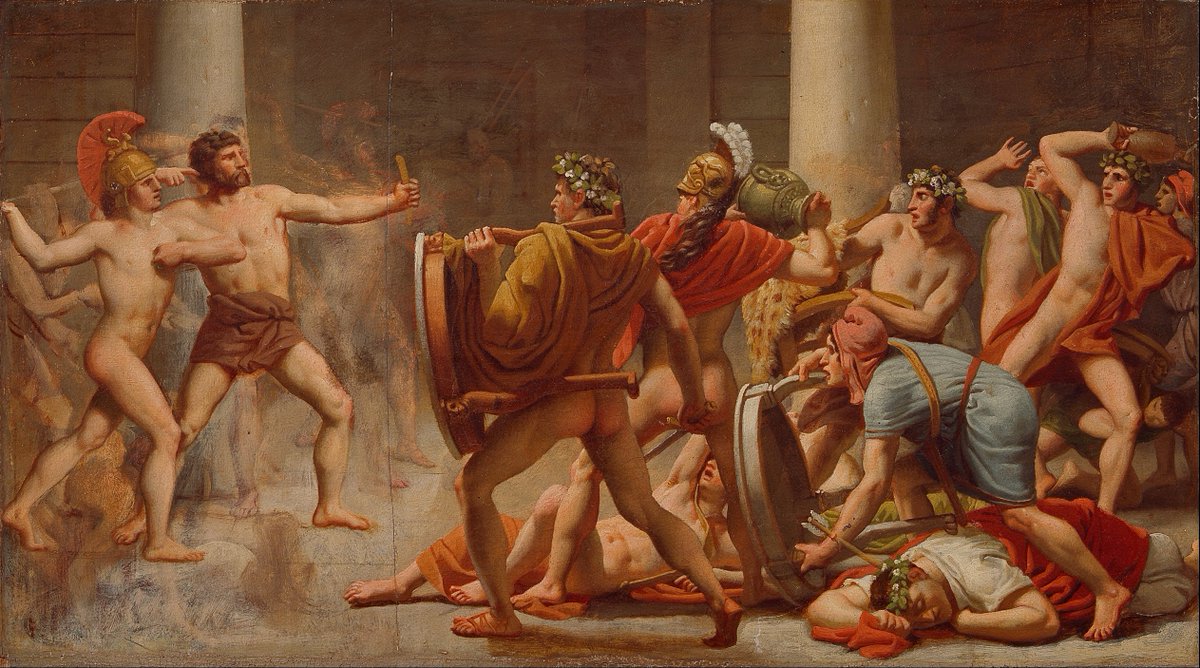
Eventually Penelope announces a contest and brings out Odysseus’ great bow, declaring that she will marry the man who can string it and shoot an arrow through twelve axe heads lined up in a row. One by one the suitors try and fail, because none of them can even bend the bow. Then the beggar asks for a turn. The suitors laugh at first, but the bow is eventually handed to him.
Odysseus takes it in his hands and strings it effortlessly. Homer says the sound of the bowstring tightening rings through the hall like the note of a swallow. Then he places an arrow on the string and sends it cleanly through all twelve axe heads.
In that moment the beggar disappears. Odysseus turns the bow toward the suitors and reveals who he is.
What follows is one of the most brutal scenes in Greek literature. The doors are sealed and the suitors realize too late that they are trapped inside the hall. Odysseus, his son Telemachus, and two loyal servants begin killing them one by one. There is no escape, no mercy, and no negotiation. The men who spent years consuming another man’s house die inside it.
It is a violent ending, but Homer wants you to understand something important. The real danger to Odysseus was never just the monsters and storms on the long journey home. It was the possibility that someone else might take his place while he was gone. When Odysseus finally returns, he reminds everyone in Ithaca of a simple truth: a man’s home is not truly his unless he is willing to fight for it.