William Adam, a Christian priest from Scotland, arrived in India in 1818 and spent nearly three decades here. He was captivated by the Indian perspective on the concept of a single deity, leading him to ultimately relinquish his Christian faith.
Adam's research into the vernacular education systems of Bengal and Bihar during the early 18th century was groundbreaking. His findings revealed the existence of over 100,000 vernacular schools in these regions, translating to approximately one school for every 400 individuals at the time, or one school for every 36 school-age children. This marked a significant turning point in educational analysis during that era.
No Caste system untill 1835
Adams observed that the education system resembled the ancient municipal system of Hindus, where each village had its own chief, accounts, priest, smith, carpenter, potter, barber, washermen, poet, doctors, and a School Master known as "GURU Mahashay." This parallel to the past is intriguing.
Lord Metcalfe's Observation on Indian Village Communities:
Through the tumultuous history of India, various rulers and conquerors such as Hindu, Pathan, Mogul, Mahratta, Sikh, and English have come to power. Despite these changes in leadership over time with each group asserting dominance at different points—be it through religion or military might—the village community has remained a steadfast fixture.
Questions:
1. Who introduced the caste system into the mainstream at the beginning of the 20th century when it did not exist previously?
2. What was the previous profession of the classified Scheduled Tribes / Caste before British rule and their rules to devastate Indian Village economy ?
3. Why Macaulay's recommendations went through while Adams not ?
4. When was surname made mandatory ?
Chaitra Shukla Pratipada is NOT just regional.
Ugadi - Yug (era) + Adi (new start) or Samvatsarādi is the 1st day of Hindu lunisolar New Year & the day when Sri Brahma created the universe
Gudi (flag) + Padwa (Pratipada) refers to ancient Vedic Indradhvaja festival on this day
🧵
Today is Chaitra Shuklapaksha Pratipad; start of Hindu New Year.
Kaliyuga will enter its 5126th year. Today is also the start of Chaitra Navratri or Basanti puja.
It’s the beginning of Vikram Samvat 2081, a calendar started by Chakravarty Samrat Vikramaditya.
It’s SrishtiSamvat 1972945124, which is the number of years from the start of Creation until date, the mathematical calculation and explanation of which is given in details in the Brahmapurana.
Satya, Treta, Dvapara, and Kali are four yugas that together make a Yugachakra. 71 such Yugachakras make one Manvantara (which is ruled by Manu) and is equivalent to one day of Brahman. This way ends one Brahman jivan kaal, with the simultaneous start of another Brahman.
The grand harbor of the ancient Cholas, Kaveripattinam was a busy port city, with huge temples, ships, markets, festivals, & prosperous trade. Called Kaberis Emporion by Romans, Roman carpenters helped to build it. All due to the vision of a Sanatani Tamil king, Karikalan Chola.l
1 of 4
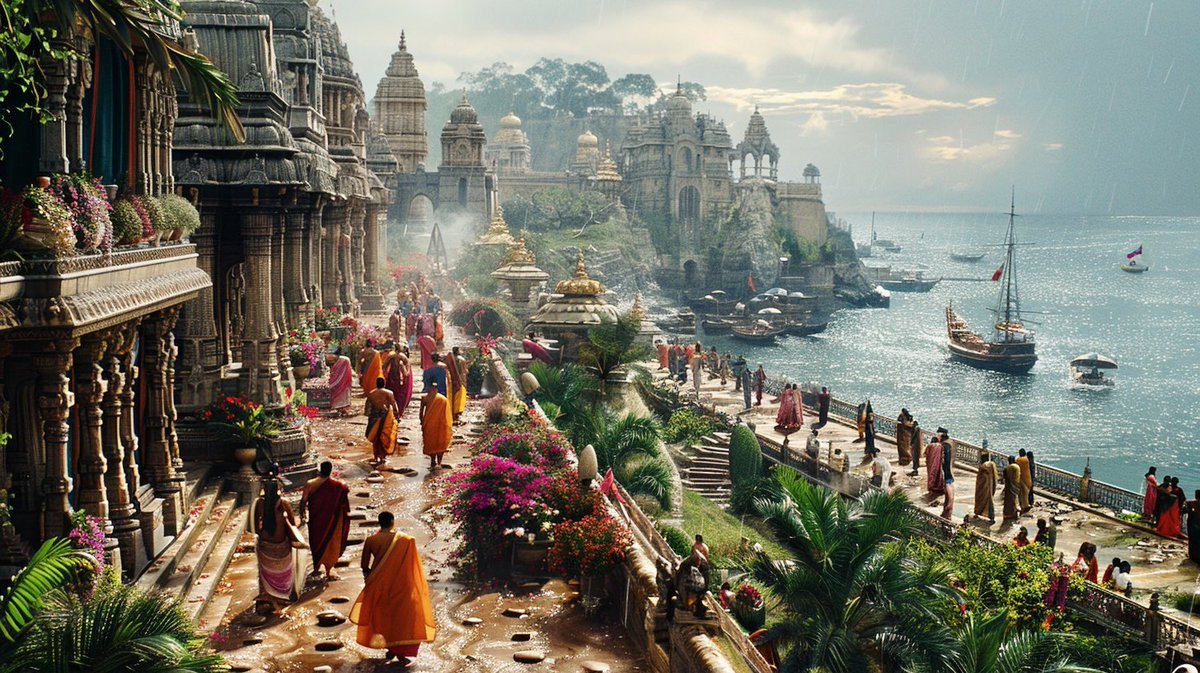
An AI walkthrough of the wonder that was Nalanda visualized by me as per @monidipadey’s tweet with Hiuen Tsang’s description
1. Primary campus - lofty multistoried buildings with high eaves glowing in splendid sunset colors
Make sure you see all 4 tweets.
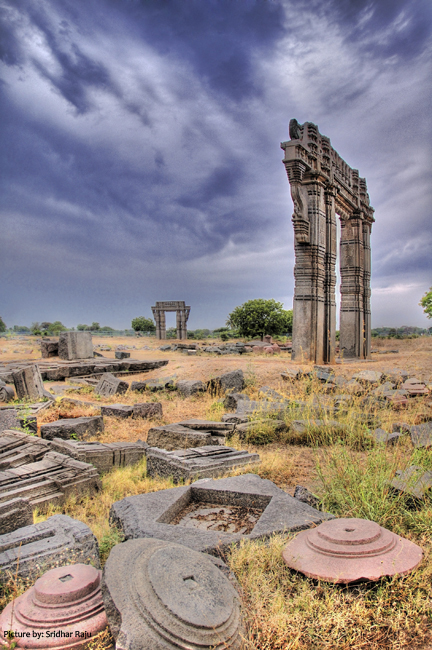
In my series on Kakatiyas, today I look at the fall of Orugallu, their capital city, which was raided thrice in 1310, 1318 and 1323, it’s immense riches looted, including the fabled Kohinoor diamond. A chapter of Indian history that is as painful as that of Hampi's.
This is not going to be an easy read, so be warned.
Since the glorified myth surrounding Siraj-ud- daula is being broken down, there is another notable Rani from Bengal worth mentioning, who remains largely sidelined possibly for going against Siraj ~
Besides Raja Krishnachandra, it was Rani Bhabani of Natore who also supported the ousting of the R&pist Siraj-ud-daula.
When a widowed Rani Bhabani took over the zamindari administration her primary task became to protect her boundaries from Siraj. She raised an army to do so, and soon enough her fears came true, when Siraj sent his men for her daughter. Rani fought back the nawab’s men with her army and routed them, protecting both her territories and her daughter. The Rani also became a part of the plan that was made by Jagat Seth and Umi Chand to displace the debauched Nawab.
Like Raja Krishna Chandra, Rani Bhabani was also strongly dharmic and built innumerable temples in Bengal and Kashi. She was also a well known philanthropist of her times, working for the benefit of her subjects.
Raja Krishna Chandra and Rani Bhabani, both zamindars, fought against the Turkish ruler Siraj, to save Hinduism and more importantly, Hindu women. Taking help from the British trader Robert Clive, and using Mirjafar who had a personal grudge against Siraj, was at that moment the best way forward, and they rightly did so!
[Refer: Manmatha Nath Dutta, Gleanings from Indian classics, 1893]
This is American national myth.
In this myth, Americans are the Good 'empathic' angels. Nazis are bad demons. American angels had nothing to do with Nazi demons. America fought the good war and vanquished evil. But they still did not bomb their enemies.
However, there is no truth in the myth as we shall see in this thread.
For centuries, the Sutlej River has sustained civilizations in the Indian subcontinent. Now, scientists are buzzing about a recent discovery: rare metal "Tantalum" traces found in its sands. This could shake up industries and boost the local economy.
Tantalum plays a crucial role in the manufacturing of electronic components due to its unique properties. The oxide layer that naturally forms on the tantalum's surface serves as an insulating (dielectric) layer, making it ideal for this application. By coating other metals with a thin layer of tantalum, devices can achieve high capacitance in a compact form.
Known for its distinctive dark blue-gray color, density, ductility, hardness, and excellent thermal and electrical conductivity, tantalum is a versatile metal. Its exceptional resistance to acid corrosion makes it a valuable material, remaining virtually unaffected by aqua regia below 150°C. While it can be dissolved using specific agents like hydrofluoric acid, fluoride-containing acidic solutions, sulfur trioxide, and molten potassium hydroxide, tantalum’s impressively high melting point of 3017°C (with a boiling point of 5458°C) is second only to a select few elements such as tungsten, rhenium, osmium among metals, and carbon.
“The government of Jammu and Kashmir initiates efforts for the restoration of the Martand Surya temple at Anantnag, Kashmir.”
Martand Sun temple is a Hindu temple built in 8th century CE by Lalitaditya Muktapida of the Karkota dynasty. It was destroyed by Sikander Butshikan, the murti breaker (1389-1413).
Sikander Butshikan was a disciple of Muhammad Hamadani who had migrated from Persia to Kashmir along with 700 Sayyids. Under the influence of Muhammad Hamadani, Sikander started the severe religious persecution.
Sir Walter R. Lawrence in his book “The Valley of Kashmir” (1895), summed up the persecution that was unleashed:
“It is a generally accepted fact that up to about the beginning of the fourteenth century the population of the valley was Hindu, and that about the middle and the end of the century the mass of the people was converted to Islam, through the efforts of Shah-i-Hamadam and his followers, and the violent bigotry and persecution of King Sikandar, the Iconoclast. Tradition affirms that the persecution of the Hindus was so keen that only eleven families of Hindus remained in the valley.
There was a certain method in the mad zeal of Sikandar, for he used the plinths and friezes of the old temples for the embankments of the city and for the foundation of the Jama Masjid. Having glutted his vengeance on Hindu temples, Sikandar turned his attention to the people who had worshipped in them, and he offered them three choices, death, conversion or exile. Many fled, many were converted, and many were killed, and it is said that this thorough monarch burnt seven mounds of sacred thread of the murdered Brahmans. All the books of Hindu learning which he could lay his hands on were sunk in the Dal Lake and Sikandar flattered himself that he had extirpated Hinduism from the Valley.”
He was the mentor to many leading lights of India’s revolutionary movement, gave up a flourishing legal career to take part in the freedom struggle. He founded the India House in London, which would become the center for most Indian revolutionaries, operating outside of India or in exile.
One of the most brilliant minds of his era, and a mentor to #SwatantryaVeerSavarkar , a selfless nationalst, who used his wealth for the cause of the freedom movement.
Shyamji Krishna Varma, whose death anniversary it is today.
One of the important characters in Veer Savarkar's life was Madan Lal Dhingra,a hero who actually deserves a biopic of his own.
Hailing from Amritsar, the sixth born of the city’s Civil Surgeon, two of his brothers were doctors, while two other were barristers. Coming from a well to do and influential family, Dhingra, could have settled into a life of luxury and comfort.
Prime Minister @narendramodi’s speech at #StartupMahakumbh was exceptionally good!
Four key messages that stood out:
➡️ 𝐃𝐞𝐯𝐞𝐥𝐨𝐩 𝐈𝐧𝐝𝐢𝐚𝐧 𝐬𝐨𝐥𝐮𝐭𝐢𝐨𝐧𝐬 𝐟𝐨𝐫 𝐠𝐥𝐨𝐛𝐚𝐥 𝐚𝐩𝐩𝐥𝐢𝐜𝐚𝐭𝐢𝐨𝐧𝐬 - what India builds to solve its own challenges in different domains will have the power to become de facto solutions for many global problems, because of the scale and diverse requirements of India’s customer base 🇮🇳 🌍
➡️ 𝐏𝐚𝐲 𝐢𝐭 𝐟𝐨𝐫𝐰𝐚𝐫𝐝 - “You have come this far because somebody must have believed in you and trusted you, somebody supported you along the way - once you have achieved certain size and traction, remember to do the same for others. Take the time to help a younger startup, a first time entrepreneur. देश की नयी पीढ़ी से मिलिए दोस्तों, मज़ा आ जाएगा!” 🫡
➡️ 𝐃𝐞𝐞𝐩𝐞𝐧 𝐢𝐧𝐝𝐮𝐬𝐭𝐫𝐲-𝐬𝐭𝐚𝐫𝐭𝐮𝐩 𝐥𝐢𝐧𝐤𝐚𝐠𝐞𝐬 - Large businesses as well as MSMES should deepen linkages with the startup ecosystem - many of the solutions to existing business and technical problems come from startups. Industry as well as MSMEs should engage more deeply, run sector specific and problem specific hackathons 🤝
➡️ 𝐍𝐞𝐰 𝐞𝐧𝐭𝐞𝐫𝐩𝐫𝐢𝐬𝐞𝐬 𝐚𝐫𝐞 𝐧𝐨𝐰 𝐭𝐡𝐞 𝐥𝐲𝐧𝐜𝐡𝐩𝐢𝐧 𝐨𝐟 𝐈𝐧𝐝𝐢𝐚’𝐬 𝐞𝐜𝐨𝐧𝐨𝐦𝐲 - “Unlike old business groups who will ask the government for something and wait for 5 years, our startups take initiative and execute fast.” Startups will be the principal driver of the Indian economy’s rise to the global number 3 spot, and beyond ↗️
Highly recommend watching the full address here: 📺 🔗 https://t.co/q1p963P62G