Math PhD. NSF Postdoc at Duke. (Commutative) Algebraist. TDA convert. Quantitative Justice. Goal: increase access to STEM through community engaged scholarship.
I want to highlight an outstanding black mathematician William S. Claytor, PhD.
He is someone would have greatly benefitted from consistent support from the mathematical community (and its professional societies) as he navigated his career as a researcher.
Guys, this is very serious and you have to read this right now. The Riemann Hypothesis may have just been solved, and if the claim holds, it's an insane achievement.
In mathematics there is a famous problem called the Riemann Hypothesis, and it's about prime numbers. Primes are numbers like 2, 3, 5 and 7 that can only be divided by 1 and themselves. Every other number is built by multiplying them together, so they're the building blocks of all numbers. You can never tell exactly where the next prime will show up, but if you step back, there's a pattern.
Around 1,000, about 1 in 7 numbers is prime. Around a million, about 1 in 14. Around a billion, about 1 in 21. Primes get rarer at a steady, predictable pace.
Because of that pattern, mathematicians can estimate how many primes there are below any number. But the estimate is never exactly right. It's always a little off, and the big question is how far off it can get. Think of flipping a coin 1,000 times. You expect 500 heads, but you'll get something like 480 or 520. It's a little off, but never wildly, and you can predict how far off it will be.
In 1859 a mathematician named Bernhard Riemann found that the prime estimate's error isn't random. It's controlled by a hidden set of special numbers. Where those numbers sit decides how big the error gets. Riemann guessed that every single one of them sits on one straight line. If he's right, the error always stays small, just like the coin, and primes are as orderly as they could possibly be. If even one of those numbers is off the line, the error can grow much bigger, and primes are far messier than we think.
So far computers have found trillions of these special numbers, and every single one is on the line. But there are infinitely many, so checking will never be enough. You need a proof that covers all of them at once. For 167 years nobody has found one. It's one of the seven hardest unsolved problems in mathematics, with a million dollar prize attached.
Now a mathematician has posted a note saying that, working with Claude, he believes he has that proof. He says a computer has already checked every step, and that Claude raced ahead of him near the end. Experts still need to confirm it, but this isn't a random internet claim.
If it holds, it doesn't mean we can predict every prime. It means we finally know the pattern can never go wildly wrong. Thousands of math papers that begin "assuming the Riemann Hypothesis is true" become proven fact overnight. We'd also get firm limits on how far apart primes can be, and a guarantee that a fast method for testing whether a huge number is prime always works. And no, your bank account isn't in danger. Online security depends on how hard it is to break a huge number into its prime factors, and this proof doesn't make that any easier. If anything, it gives the math behind encryption a stronger foundation.
If it holds, this is bigger than one math problem. A question that beat the greatest minds in history for 167 years would have been cracked by a human and an AI in a matter of weeks. If AI can find answers and computers can check them, the limit on science is no longer how smart we are. It's how many good questions we can ask.
BREAKING: A mathematician at Anthropic claims to have used the company's AI to solve the Riemann hypothesis, the most notorious open problem in all of math
https://t.co/nEXAyIkvSt
I am starting to prioritize blocks where I do all my research thinking away from a computer. Working on a section of a grant today and letting the ideas flow.
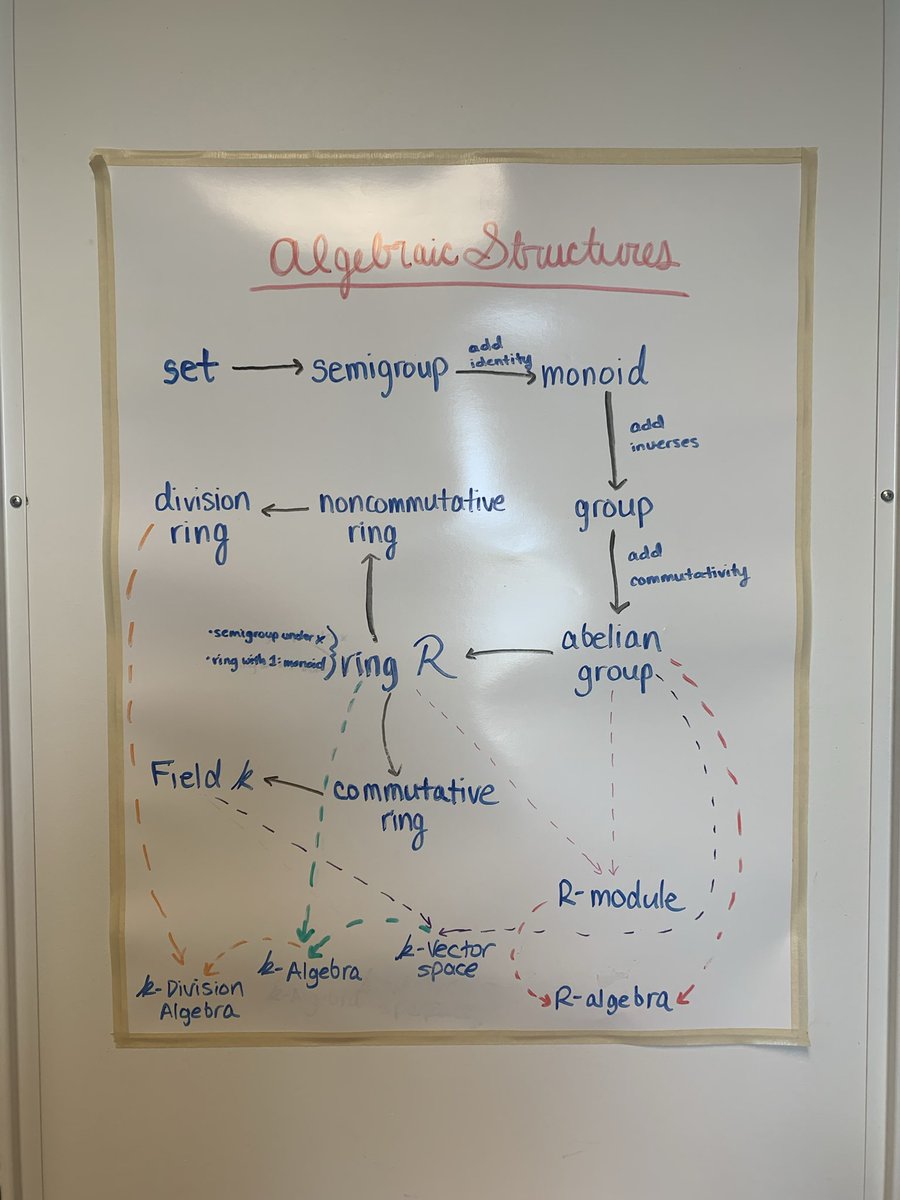
Mathematics begins with mere collections of objects, yet builds towering castles of abstract symmetry.
We start with a simple Set equipped with a binary operation, stepping up into Monoids and Groups where every element finds its inverse.
As we introduce a second operation, these structures blossom into Rings and Fields, capturing the familiar arithmetic of numbers.
Calling all Graduate Mathematics programs. We are less than a month away from Field of Dreams, and we need you!
Showcase the unique opportunities your department has to offer and network with students exploring graduate programs at the Field of Dreams Graduate School, Career and Networking Fair November, 20-21.
Learn more. Link in comments.
Two weeks ago, Rikhav Shah and I posted a preprint on the growth factor in Gaussian elimination, and settled a very old problem. It turns out complete pivoting and rook pivoting have quasi-polynomial growth. I’ve spent a decade thinking about this problem. https://t.co/5O835wm837
I typically read daily just to clear my mind and lately I’ve taken to learning to knit. It’s actually helped. It’s become a bit Pavlovian, I do work, answer emails, take walks, and I reward myself with a dopamine hit from a new knitting project or new yarn. Or both :)
Weeks have passed. My timeline is getting a bit quieter with regards to this.
How is everyone doing now?
Navigating field shifting transitions while actively pursuing work in a field can be really destabilizing, exhilarating, and every single feeling in between.
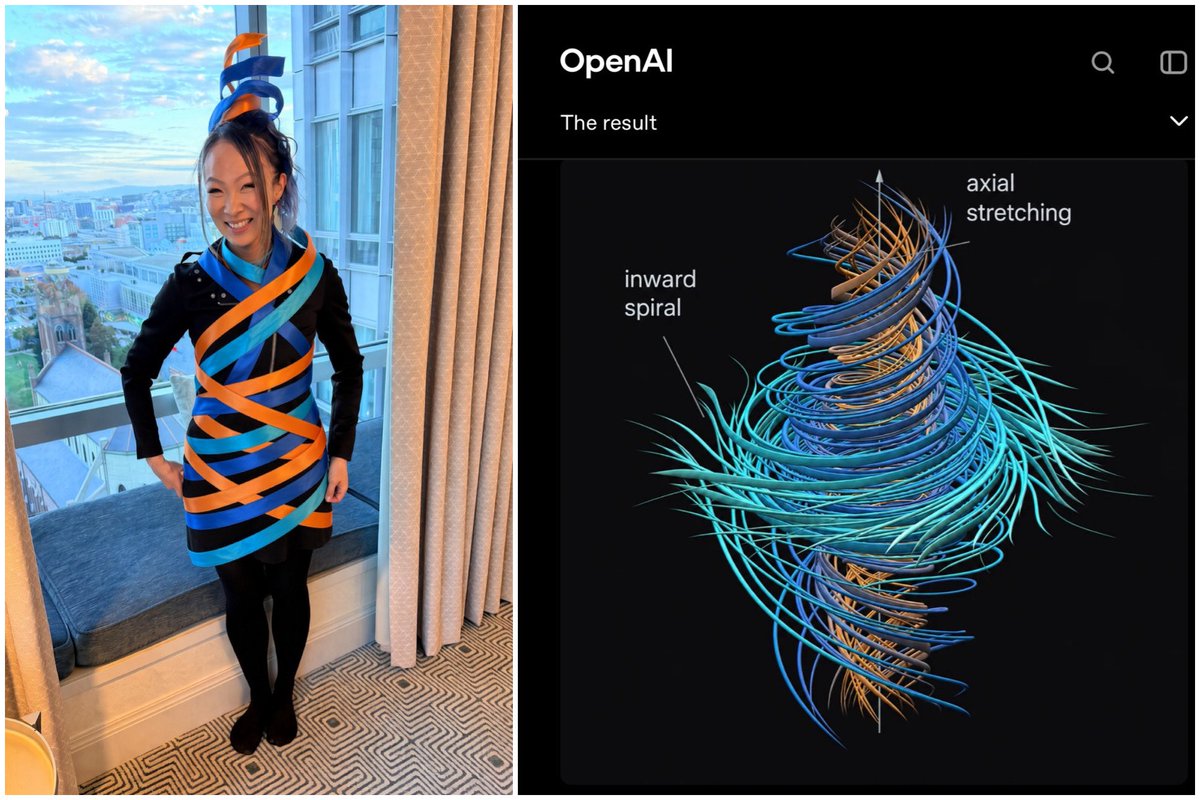
My algorithm is showing me reactions from a lot of math professor in reaction to the Open AI release.
Are there students out there? How are you all processing what is happening? What kind of support do you have or wish you had in navigating what is happening right now?
Have you registered for the Field of Dreams yet?
Featured speakers include:
Ron Buckmire, Dean of Computer Science and Mathematics at @Marist
Jorge Cisneros Paz, Instructor at @UTSWMedCenter, 2016 F-GAP Scholar
Merlise Clyde, Professor of Statistical Science at @DukeU
Don't miss this great opportunity. Learn more and register today. Link in comments.
We’ve lost an icon. Margaret Hamilton, a computer science pioneer best known for her work at MIT leading development of the flight software for the Apollo missions to the moon, has died at 90. Read about her legacy via MIT News: https://t.co/ODkbdIsoHw
My algorithm is showing me reactions from a lot of math professor in reaction to the Open AI release.
Are there students out there? How are you all processing what is happening? What kind of support do you have or wish you had in navigating what is happening right now?
@stuart8301 I can relate to this, although I won’t be interacting with students until next term since I am overseas. It feels like a situation where you need to “put your own oxygen mask on first” before helping others but many faculty, myself included, were struggling with this part.