Anthropic pays $750,000+ a year for engineers who can build LLM architectures from scratch. Stanford taught the entire thing in 1 hour lecture & released it for free.
Bookmark & watch this today before someone takes it down and read this article below
Anthropic engineer:
"you're not supposed to prompt Claude. you're supposed to build a system that prompts itself [loops]."
this is one of the best workflows I've seen in a long time
in this video he breaks down exactly how most people are building loops wrong:
- the memory file you never set up, so every loop starts from zero
- the sub-agents that 95% of builders have never split apart
- the stop condition setup that keeps loops from running forever and billing you in your sleep
- why writing one prompt a day is the slowest way to use Claude
if you've been using Claude for more than a month and still typing every task by hand, you've been running one prompt when you could be running a system of loops
instead of another prompt tonight, watch this
make sure to bookmark it before it gets buried
full guide in the article below
One of the best math books I've ever read:
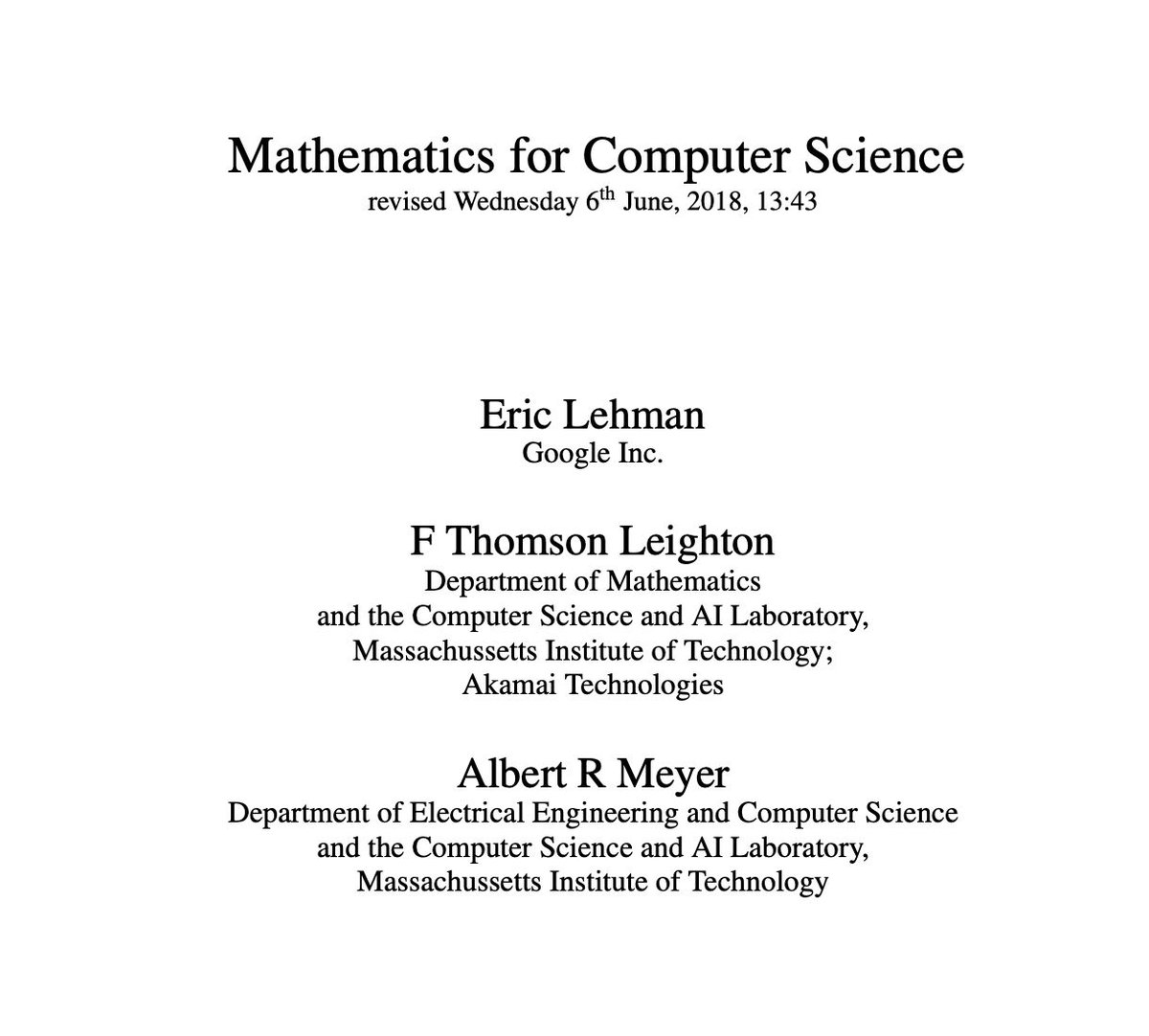
MIT's "Mathematics for Computer Science"
Its writing style is brilliant, and it covers everything:
- Linear algebra
- Series
- Logic
- Probability
- Number theory
- Graphs
You can find the PDF here:
https://t.co/iQvaflkDPD
Many times, source code complexity metrics are useful. Sometimes, they are misleading.
I looked into one React component that had a McCabe complexity score of 103, which is very high. It had six different responsibilities, so I asked Claude Code to decompose the sub-components into a new sub-directory. It did. It worked. It was good. That is, all was good except for one of the new sub-components, which was still high at 79.
Even so, consider how McCabe cyclomatic complexity metrics were calculated in this case:
a. 12 async functions with try-catch blocks (each adds +2-3 complexity points)
b. Nested conditionals in session management logic
c. Multiple state transitions in non-use-case flows
d. Event listener setup/teardown with conditional logic
e. Timer management with multiple cleanup paths
f. Lines of code
I reviewed that component and questioned the value of the metrics. The source was no more complex than it was required to be. It simply had a greater number of lines than most (f: 491 LoC), but the functions were relatively small. One major strike against those functions was exception handling (a). Yet, the exception handling isn't complex.
I asked Claude Code for its opinion on decomposing that component further, and it recommended not to. In fact, to do so would have made the one child components much more complex in exchange for more files, each with lower line counts. The problem? The change would introduce several hooks and move some non-business-logic into the wrong place at lower levels; again, it is not business logic.
Hey, just follow all the breadcrumbs in multiple directions. Uh, no thanks.
That doesn't mean that cyclomatic complexity metrics are useless. Overall, they are very helpful. Just don't be misled by a non-thinking software tool that is locked into an algorithm. Does that sound familiar? 😅
@ChristoPy_ Eu conheço este padrão como action-based endpoints, aonde o verbo é explicito na URL. Intent-driven seria algo um pouco diferente. Mas voltando ao tópico inicial eu entendo o seu ponto, mas particularmente acredito que cria endpoints muito verbosos.
@itau cortou todos os acesso da minha conta, pq recebi um pix. A parte mais incrível da história e que para abrir a conta teve reconhecimento facial pela app etc.. Para desbloquear a conta, estão me pedindo para ir em uma agência.
Data Integrity: A well-designed persistence layer ensures data consistency and prevents data corruption or loss.
Read more 👉 https://t.co/66tZ5pbMnZ
#DataIntegration#Applications#Data
Modern Java/JVM Build Practices is an article-as-repo on building modern Java/JVM projects using Gradle and Maven, and a starter project for Java.
https://t.co/sgiQ0PdizE
#Java#maven#gradle
Apple lost $1 billion in 1997.
Steve Jobs returned to the company and spoke to developers at WWDC.
When an audience member insulted him, he responded:
“One of the hardest things when you’re trying to effect change is that people like this gentleman are right.”