How to ragebait a VC
- Which podcast gave you that opinion?
- How would you add value if you found a way to be valuable?
- You look like you make all of the 2 but none of the 20.
- Sorry, we aren't raising from you right now.
- Which AI model did you use to vibe code your firm's website?
- What startup role would you take if they'd have you?
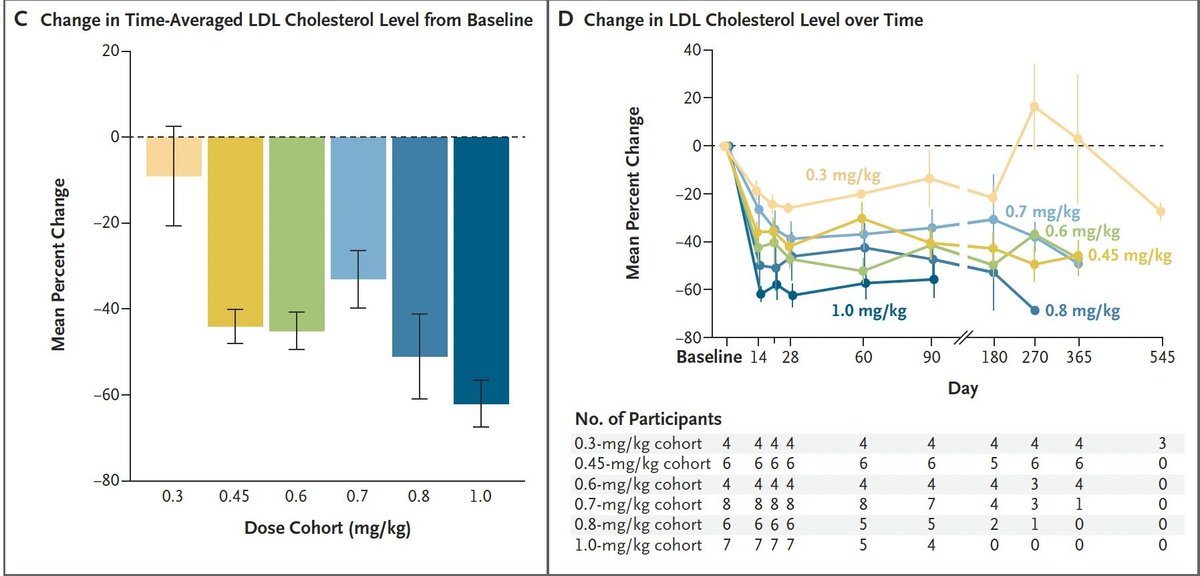
Eli Lilly has done it.
They've gone and made what seems to be a powerful, permanent gene therapy for LDL cholesterol.
That means they'll be able to effectively prevent most heart disease with a single infusion!
@just_nikhil01@theo Incredibly well done. Keep it up!! Hmu when your internship is over, would love to help you find a full time gig.
Such creativity and flawless execution should be rewarded!
Ronak is one of those rare geniuses who sees what’s coming around the corner well in advance.
He is also one of the kindest people you’d meet. His career ‘trajectory’ is one to watch! 👀
I’ve left Google DeepMind.
The last two years have been an incredible whirlwind.
A couple years ago, I joined a small startup called Codeium. There, I got to ship Windsurf, train SWE-1 (a frontier agentic coding model), go to DeepMind in the $2.4B acquisition. Now, I decided to leave the acquisition money and DeepMind.
I’m grateful to the mentors, teammates, and friends I worked with along the way.
At Windsurf, thanks to @_mohansolo and Douglas Chen, I got to see what a fast moving startup that ships relentlessly and builds for the future looks like. I learned from @thenickmoy how excellent research leadership can drive outsized innovation.
At DeepMind, I got to push the frontier of agentic coding, be part of the amazing team that shipped Antigravity and contributed to Gemini 3. DeepMind is a rare place: deeply curious people, exceptional research taste, and access to enormous compute and Google-scale infrastructure.
A few things that I learned:
1. Finding the right hill to climb. Now more than ever, there are a multitude of directions to push the frontier in AI research. It’s easy to optimize for the wrong benchmark or capability. You should step back regularly to question if you are climbing the right hill, and adjust course often.
2. The secret to being a fast-moving team. Moving quickly is not just about working hard and long hours. It requires making concrete bets about where the world will be in 6 months, aligning around them, and cutting everything else. This was our journey from the Codeium Extension → Windsurf IDE → SWE-1 → Antigravity → Antigravity CLI
3. Silicon Valley is small. Since the split of Windsurf to DeepMind and Cognition, many of my colleagues have gone to other exciting places - Thinking Machines, OpenAI, xAI, Cursor, fast-moving startups, or started their own companies. I’m grateful to have worked with so many talented, hungry people whose stories are not yet finished.
So what’s next?
We are living in one of the most exciting and powerful times in human history. Just like we transformed software engineering, soon every industry, every unit of work will be radically transformed, democratized, accelerated. With this comes new challenges, and new doors of frontier research to be opened.
More soon.
After 15 years of investing, we realised that truly exceptional founders have something impossible to fake: deeply unconventional lives.
We analysed 15,000 founders using five binary signals to measure this: odd hobbies, early signs of exceptionalism, extreme life choices, unusual geographies, non-linear careers. These sum to give a 0-5 score per founder. Whether someone started coding at 10, speaks five languages, climbed Everest or quit a safe job to live in Chile, the signal was deviation from the mean.
Rather than focusing on IQ or EQ, we call this metric the Outlier Quotient, or “OQ”. When forecasting founder success, it turns out that OQ was the single most predictive variable in our entire classification model, trained on ~70 different factors.
Our OQ score had zero correlation with having worked at a top-tier company or attending an elite university. The signals most VCs rely on aren’t just noisy, they’re blinding. The best founders don’t signal like everyone else, they don’t think like everyone else, and they certainly don’t build like everyone else.
If you want to spot breakout talent before the rest of the market, stop screening for conformity. Back the founders the system was built to filter out.
traits of people with high agency:
> book flights impulsively
> say "call me" instead of texting essays
> can become obsessed overnight
> walk around during phone calls
> buy before they feel ready
> don’t ask group chats for opinions
> can survive on very little comfort
> good at talking to strangers
> slightly delusional
> treat embarrassment like a temporary side effect
> can disappear socially without feeling guilty
> low tolerance for slow people
> thinks most problems are figureoutable
> dangerously optimistic
> oddly calm when things go wrong
CEOs are uniquely prone to AI psychosis because they’re sufficiently distant from the last mile of work that still has to happen to generate most value with AI.
So when they play with AI, they see the happy path results, often not considering the next 10 or 20 things that have to happen to get sustainable results from agents.
“Look I made this awesome product prototype”. Yes but you didn’t have to review the code before it went into production and fix a bunch of issues.
“Look I generated a contract”. Yes but you didn’t verify all the terms before it goes out to the counterparty and didn’t have to wire up all the past contracts to work with.
The best thing you can do as a CEO is to use AI a *ton* to figure out the real implications of agents in the enterprise, and come out the other side with an appreciation for both the upside and the real work that goes into them.
Evidence of exceptional ability and asking how they solved hard problems down to the brass tacks level is what matters.
Those who actually deserve credit know the details of the solution, because it was so hard it got seared into their brain. The phonies and posers who falsely claim credit will flounder at the second or third level of detail.
Google: Sergey Brin (Russia 🇷🇺)
NVIDIA: Jensen Huang (Taiwan 🇹🇼)
Tesla / SpaceX: Elon Musk (South Africa 🇿🇦)
Intel: Andy Grove (Hungary 🇭🇺)
Yahoo: Jerry Yang (Taiwan 🇹🇼)
Zoom: Eric Yuan (China 🇨🇳)
Stripe: Patrick & John Collison (Ireland 🇮🇪)
Instacart: Apoorva Mehta (India 🇮🇳)
Datadog: Olivier Pomel (France 🇫🇷)
DoorDash: Tony Xu (China 🇨🇳)
the golden rule is that you should rarely if ever try to change anyone’s mind.
this is a fool’s errand cuz it rarely works, & even when it does the belief you installed is way weaker, the person becomes resentful, & everything dynamic from then on becomes borrowed instead of owned.
you can only gently probe until you understand why they arrived at that conclusion. then you must move on like it never happened. this is true for any type of relationship including professional but esp true in romantic dynamics.