Imagine if everyone had the tools to shape intelligence itself. That day is today.
Today we launch the Trajectory platform - the easiest and most intuitive tool to post-train models of your own. The foundation for continual learning.
With just a few agent prompts, you get access to a full creative suite to train, eval, and deploy trillion parameter models.
On top of that, we believe in a future where you don’t just shape your model once, it also keeps learning on its own from the world around it.
We’re releasing two research previews.
1. Continual grading scales your taste, so your model learns what good looks like from far more than you could ever grade by hand.
2. GS1, a new algorithm that lets models learn directly from what they do in production.
We’ve now raised 60M, with a new round led by @Sequoia at a 300M valuation to democratize the most powerful technology of today - training models - so that the lawyers, doctors, and engineers of the world can own their own intelligence.
You know what good looks like, now go build it. Own your own value function with Trajectory.
@jyotirawattech@greptile@trajectorylabs Just ranking with severity but ya there is def cognitive load that gets added for every low value comment so should try removing those
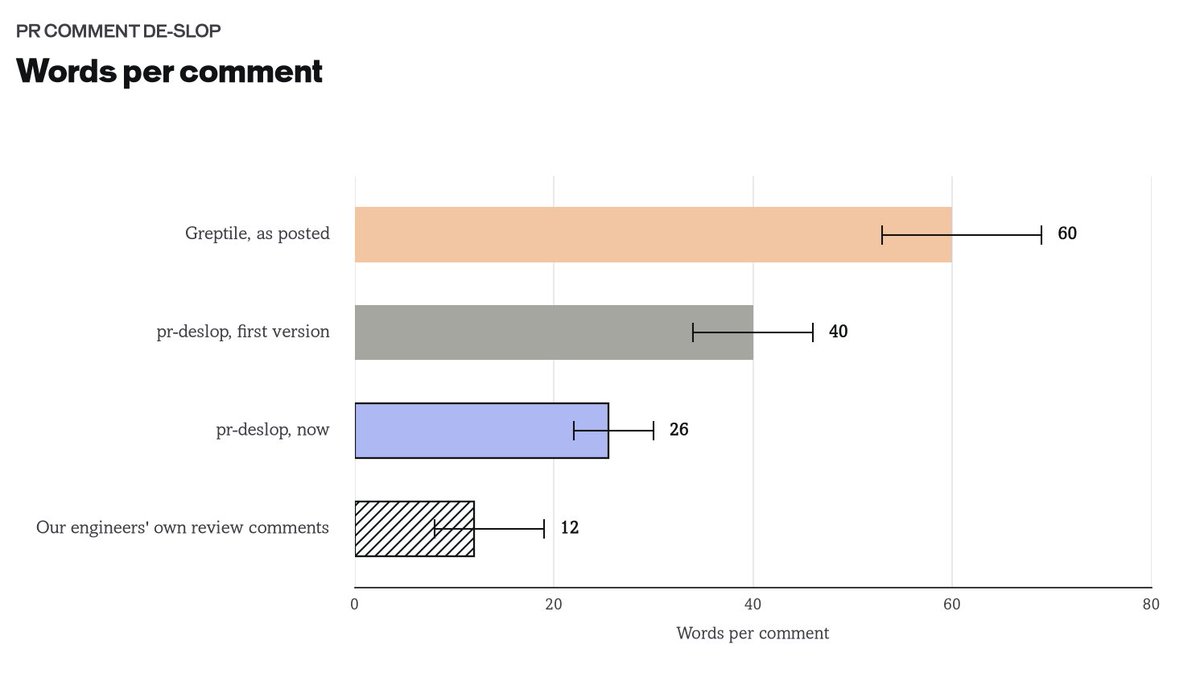
code review agents find real bugs but then bury them in slop 🐛🐛
Last week, I made a dataset of all our engineers hand written comments to improve @greptile's agent on the @trajectorylabs platform
Results in 🧵
I trained the model on three objectives
1) conciseness (word count)
2) proximity to real human language (LLM-as-a-judge)
3) Alignment with bugs found on greptile
[1/3] turns out you can teach a 35b model to weight-space program better than opus o_0
earlier this week, @rikiyatakehi and @jayden_teoh_ showed that astra can manually write neural networks to solve atari games, one weight at a time. they call this weight-space programming.
on the @trajectorylabs platform, @o__jerry__o and I post-trained 27b and 35b-a3b qwen models to write networks for atari games. we curated WeightProgramBench, a set of 322 simple games to teach models to manually write neural networks.
we combined 51 atari-style games with 266 games adapted from crisp-game-lib for training, holding out the 5 original minatar games (freeway, breakout, asterix, seaquest, space invaders).
on freeway, qwen-27b climbed from averaging 21.0 to 47.1 points **without ever training on freeway**, but still not quite at astra’s 63.9 points.
Models have IQ but no experience.
Frontier models show up on day one with superhuman intelligence but no expertise on the thousands of tasks your company actually does. @trajectorylabs exists to close that gap through continual learning.
@rronak_ trained SWE-1 at Windsurf, then went to DeepMind. His cofounders @MichaelElabd and @QuantumArjun worked on Gemini Robotics and multimodal models for Vision Pro. All three hit the same wall: big labs train one model for everyone, but nobody trains one for you.
The conversation covers:
— why today’s agents are “pseudo continual learning”: we are in the paper road map era, not Google Maps
— “Group Size 1”, a GRPO variant that learns from one real-world rollout instead of replaying the same task eight times, so you don’t need a simulated environment
— how Harvey trained a model 6x cheaper than frontier that took an open-source baseline up by over 4x on its own legal benchmark
— Continual Grading, a meta-grader that turns rubrics on 100 traces into reward for 10,000
— continual learning vs. recursive self-improvement, and why only one keeps humans in the loop
— why continual learning will make product-building more like tending a garden of products
Chapters
0:00 – Introduction
0:45 – Pseudo continual learning: paper maps vs Google Maps
2:48 – Do we need new architectures? Rich Sutton, David Silver, and the missing layer
4:33 – From a $100M consulting model to a product: lessons from SWE-1 at Windsurf
7:36 – Harvey: 6x cheaper than frontier, 4% to 18% on its own benchmark
8:55 – Why "Trajectory": the unit of work is a task, not a token
10:13 – The primitives of continual learning: traces, replayable environments, reward
12:56 – Group Size 1 and the meta-grader: training without an environment or a labeled reward
16:16 – The platform: train, eval and deploy in one click, and who it's for
18:58 – Rogo and intelligence density
20:14 – What's next: curiosity, and why continual learning beats RSI on alignment
24:19 – Research and product under one roof, and the product builder as gardener
27:26 – Why work at Trajectory, and the optimistic case: from 1% to 99%
Imagine if everyone had the tools to shape intelligence itself. That day is today.
Today we launch the Trajectory platform - the easiest and most intuitive tool to post-train models of your own. The foundation for continual learning.
With just a few agent prompts, you get access to a full creative suite to train, eval, and deploy trillion parameter models.
On top of that, we believe in a future where you don’t just shape your model once, it also keeps learning on its own from the world around it.
We’re releasing two research previews.
1. Continual grading scales your taste, so your model learns what good looks like from far more than you could ever grade by hand.
2. GS1, a new algorithm that lets models learn directly from what they do in production.
We’ve now raised 60M, with a new round led by @Sequoia at a 300M valuation to democratize the most powerful technology of today - training models - so that the lawyers, doctors, and engineers of the world can own their own intelligence.
You know what good looks like, now go build it. Own your own value function with Trajectory.
@gradypb Excited for a world where anyone who knows what great work looks like can teach their models to do it. That ability should extend far beyond a handful of labs every company should turn its expertise into intelligence it owns.