Software engineer, 7 yrs in embedded Linux, C/C++ and networking. How I use AI agents in real engineering work, and why systems break. Based in Bengaluru.
I'm Jyoti, a software engineer in Bengaluru. About seven years in embedded Linux, C/C++, bootloaders and networking.
What I post here:
How I actually use AI coding agents on low-level work, and where they fall over.
Big outages, broken down from the status pages.
What engineers and founders can learn when systems break.
Longer write-ups live on my Substack. If you build or run systems, say hi and tell me what you're working on.
FT says Dell, HPE, Lenovo and Supermicro are asking 25 to 45% more on AI server orders that were already signed. One trading firm says it paid $5M extra for price certainty and still got told it owed $62 to 70M more.
Memory is the reason given. JPMorgan has memory costs up over 400% since early 2024.
If I ran infra I'd honestly be torn. Pay up and get the hardware on schedule, or push the order and spend that time squeezing memory out of what's already running.
Which would you pick?
#AI #datacenter
An NBER paper tracked 500,000+ GitHub developers using AI coding tools. Autonomous agents pushed their commits up about 240%. Releases went up about 30%.
If you're job hunting right now, that gap matters. Activity is cheap now, and I'd guess most hiring managers know it. A busy contribution graph says a lot less than it used to.
When I write up my own work I try to lead with what shipped and what broke less after it shipped. Commit counts aren't something I'd put anywhere.
Hiring folks, what do you actually look for now when everyone's output looks huge?
#techjobs #AI
Can your PR check tell a payment retry from a paragraph about one?
Try two mock PRs. One documents payment retries in the README. The other adds a retry in a shared helper. Only the second should trigger billing-owner review.
Built Flat Finder for Codex: local map, source-linked costs, commute checks and contact-history safeguards.
Ran it on my search; fixed a stale import. 18 tests pass. Synthetic demo.
https://t.co/38P8jv5Pxx
https://t.co/wZ6BMHpH6n
@BTBTchannel@RoundtableSpace Same. I'd also want every timestamp to come from one clock, so the console log lines up with whatever the host logged at that moment. Otherwise you're still guessing which line came first.
@emollick The edges are interesting too. From the embedded side, a lot of what matters was never written down well, like how a part actually behaves after a bad reset. These models are great on what people wrote about and shakier on what people only learned at the bench.
@RoundtableSpace The compare step is the part I'd look at hardest. Matching pages at three widths tells you it looks the same. I'd want to know how it checks behaviour, like a failed login or a slow network, because that's usually where a rebuild drifts from the original.
@AravSrinivas Retention is a decent signal for picking a default. I'd still keep the old model pinnable for a while, though. The people who built workflows around its quirks will notice the switch before anyone else does.
@Amankaushik481 Fair point. A saved break only guards against the bug you already knew about. I'd keep the ones that actually hit prod as regression tests and still break the risky paths fresh. Do you script the breakage or do it by hand?
@i_mika_el Checking it against the PR's stated intent is a good test. It also makes the author say up front what they meant to open, which helps the reviewer. The hard part is keeping that intent honest and not just copied from the last PR.
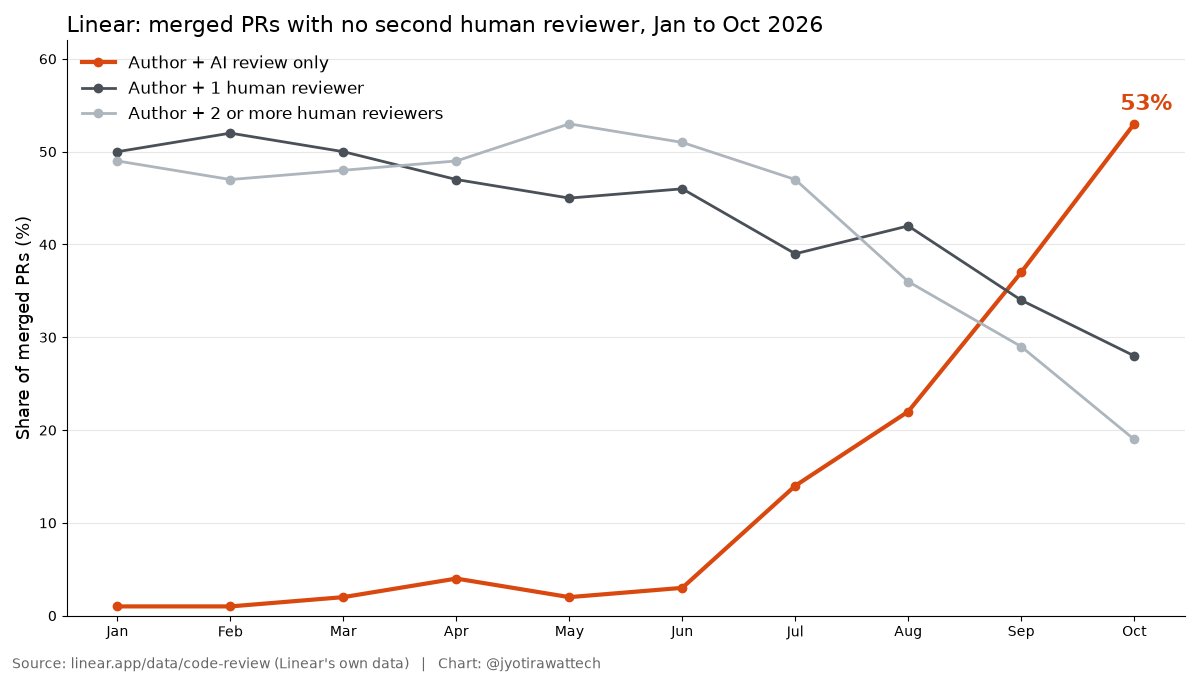
Linear published its own code review data this week. In October, 53% of their merged PRs went in with an AI review and the author's sign-off, with no second human. In January that number was 1%.
The part I keep rereading is the exception list. Auth, infrastructure and deploy config still need a second person, and that rule is enforced before merge.
Coming from bootloader and HAL work, my list would start lower in the stack. Anything touching the flash layout, the update path or a register map gets a second pair of eyes from me, because a bad merge there can leave a board that won't boot, and a rollback doesn't help a device that never comes back up.
They also shared that people in their first three months got a second human review on 79% of PRs, versus 46% for people there more than two years. That split makes sense to me.
What's on your repo's always-needs-a-human list?
An I2C bus with SDA stuck low usually shows up after a reset at the wrong moment. The device was mid-byte, the controller restarted, and now nobody on the bus can talk.
NXP's I2C spec says the controller should clock SCL up to nine times so the device finishes and lets go. If that doesn't clear it, use the device's hardware reset or cycle its power.
I lean toward doing the nine clocks in the driver on every init. It's cheap and does nothing when the bus is fine. The other side has a point though. Quiet recovery in software means a flaky device never gets noticed, and a reset line you control makes the fix explicit and visible.
Would you put bus recovery in the driver, or wire up a proper reset?
#embedded #firmware
@rodri_shema Agreed, a loud stop is easy to deal with. The one I'd worry about next is the run that finishes clean but did the wrong thing, so I'd also check the output against what was asked before calling it done.
@i_mika_el Yes, and the reviewer usually sees one line in a policy file without knowing what that principal can reach. I'd want the check to show effective access before and after, so a one line change that opens every tenant looks as big as it is.
@addy3006 A named human. If another AI pass could clear the flag, it's the same check run twice. I'd send it to whoever owns that area and make their approval required before merge.
@CDTEliot My own numbers back this up in an odd way. One reply I left under a big account got 25.7K impressions, while my standalone posts average about 94. In your early months, did replies grow you faster than your own posts, or was it the other way round?
@emollick The retractions and nulls are the part I'd read first. A null is only useful if someone checked it wasn't a run that quit early or a broken setup. Did the journal's reviewers rerun anything, or only read the papers?
P&G said at its investor day this week that it plans to cut 20% to 30% of its product supply workforce, contractors included, by 2030. It's part of Supply 3.0, their push on automation, data and AI across the supply chain, and part of up to $10 billion in productivity savings.
If my team sat in the part being automated, I'd be torn. Volunteering to build and run the new systems keeps you close to where the work is going. Moving early to a team that isn't the target buys you time and a cleaner story.
Which would you do?
#layoffs #AI
@soulcastor3 Where I'd stop handing over the whole goal is anything touching the update path on a device. If a bad flash bricks the board, someone has to be physically there to bring it back.
Cognition's new Devin Bots are agents that own a goal end to end, and the launch post mentions firmware.
After years on bootloaders and HAL code, my first thought is who recovers the board when a bad flash bricks it.
Would you give a bot the whole goal, or keep it on tickets?
@i_mika_el That's a clean rule. If rollback can't bring the old state back, it isn't much of a rollback. Permission changes are a good catch too, they look tiny in a diff.
@addy3006 Agreed, path rules miss exactly those. I'd add content checks on top, so a migration that drops or renames a column, or a new call to a payment or email API, flags the PR wherever the file lives.