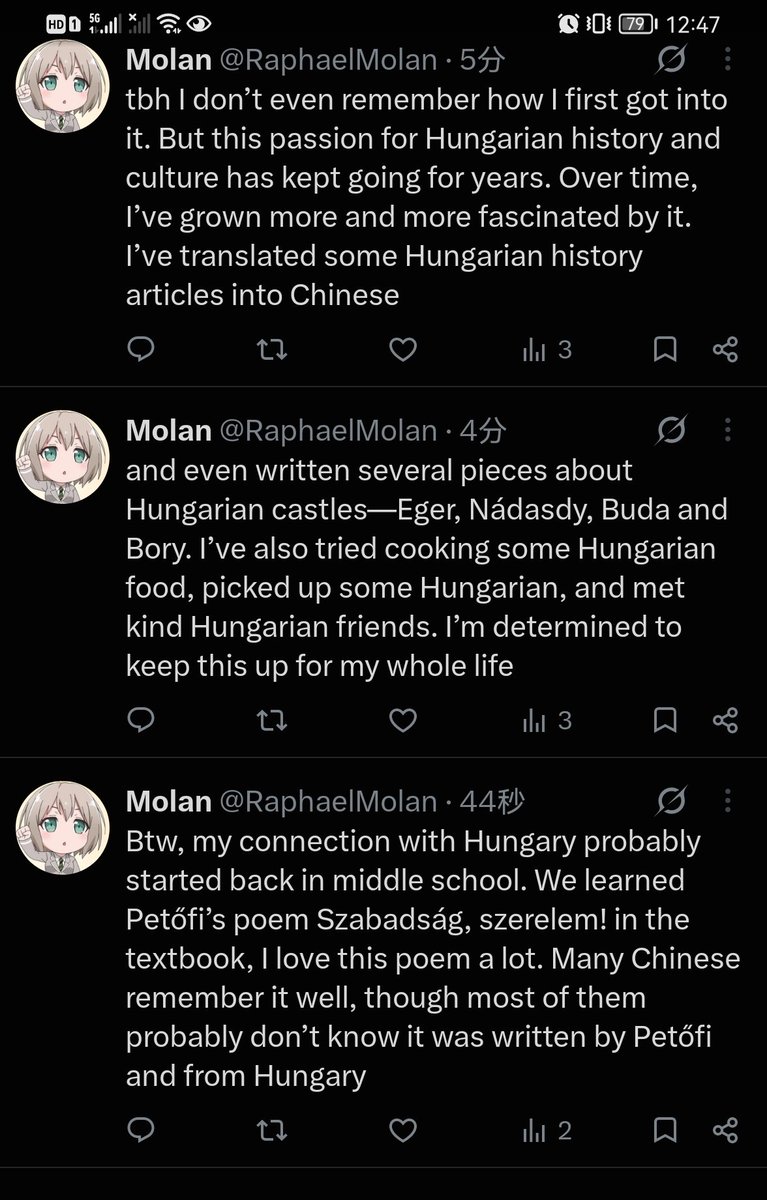
These r some of my thoughts! I’m so happy and surprised that so many kind, warm Hungarian people found my post. I’m really touched and flattered by your kindness. I will keep working hard on learning Hungarian, its history and culture. Sry if I missed any replies(I just woke up)
@UBERSOY1 In an interview with Hungarian journalist László Zeley, broadcast on Kossuth Radio on January 15, 1993, Edward Teller said:
"First of all, it means that people speak Hungarian there. As far as I am concerned, there is no other language. I am sitting on an American airplane,
@UBERSOY1 and regularly discussed the achievements of Hungarian scientists in Princeton. When discussing non-Euclidean geometry, he made a point of mentioning János Bolyai alongside Riemann and Lobachevsky, sometimes even naming Bolyai first.
@UBERSOY1 John von Neumann frequently criticized the lack of knowledge about Hungary among his American colleagues. He gave informal “lectures” on Hungarian history, from the Árpád dynasty to Finno-Ugric linguistics,
@UBERSOY1 John von Neumann would mention prominent Hungarian actors, musicians, physicians, and mathematicians. His brother even recorded his expressions as he spoke:
@UBERSOY1 It was Leo Szilard, a man with an impish sense of humor, who supplied the perfect reply to Fermi's rethoric: - "They are among us," - he said, - "but they call themselves Hungarians."
@UBERSOY1 Leo Szilard once joked:"The Martian spaceship landed in Budapest indeed around 1900, then departed, and due to overweight had to leave the less talented Martians behind."
@UBERSOY1 And as Eugene P. Wigner reflected in his 1992 memoir, The Recollections of Eugene P. Wigner, as Told to Andrew Szanton:"After 60 years in the United States, I am still more Hungarian than American."
@UBERSOY1 Los Alamos was a place of top security. General Groves was annoyed that John von Neumann and Eugene P. Wigner had frequent telephone conversations in Hungarian. The ‘thick Hungarian accent’ was often heard even in the corridors of the Pentagon."