I’ve looked at 500+ online businesses this year for clients 📊
Countless P&Ls reviewed. 100s of millions in total value💰
Some shocked buying a biz was this easy. Others baffled it could be this hard.
If you’re looking to buy an online biz, here’s the ENTIRE playbook🧵
👇👇👇
I’ve spent the last year walking 10,000 steps per day, every single day. Here’s why it’s one of the best decisions I’ve made.
First, 10k steps is a lot to do daily. For most folks, that’s nearly an hour and a half of walking. Every single day.
But there’s a lot of beauty in that because it gave me time to think about…well, everything.
Life, work, business, family, space, love, what I want to do in this limited time I get on this earth (okay, yes, a lot of it was existential).
But it also allowed me to come up with my best ideas, catch up with friends over the phone (or invite them on a walk), kept my mood and mental health at an all time high, and on days when life felt heavy and leaving my home was the last thing I wanted to do, it served as a catalyst to a beautiful, fulfilling day.
But it wasn’t all pretty. Hitting that step count every day got stressful at times too.
I’ve awkwardly paced around airports, parking lots, during weird timezones across the world, and the worst one was dragging myself along when I had food poisoning (not recommended).
But it was so worth it. Not sure if I’m going to do another year but for now, I feel great, and about to head for a walk.
I hope you do too.
A seller's mistake can go two ways: help the buyer, or hurt them.
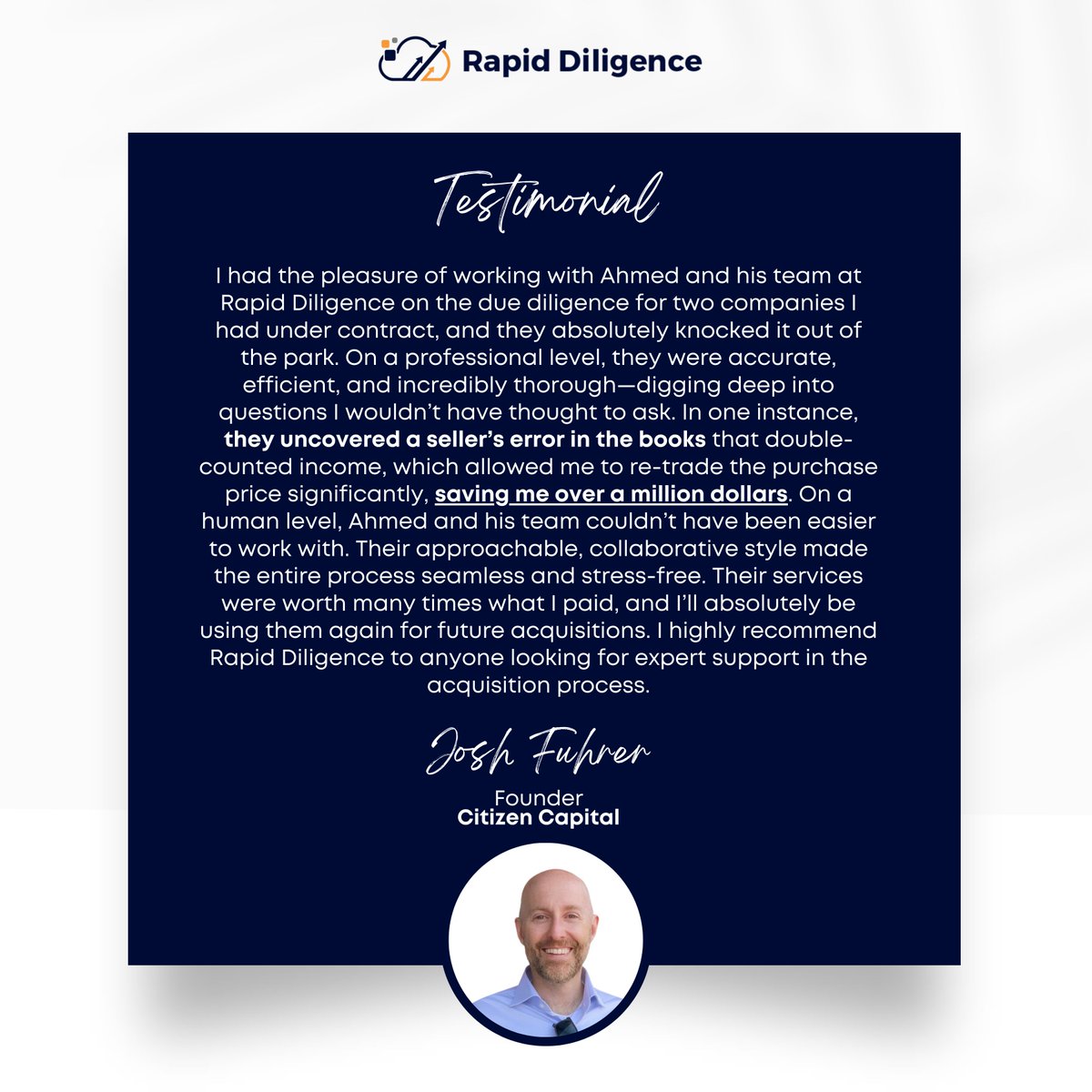
Our client got the good version; they just didn't know it until we were already deep into the QoE.
We dug into this story in our first-ever case study: a healthcare acquisition where the books looked clean on the surface, but due diligence turned up a revenue error that had been hiding in plain sight for years.
Most buyers brace for the worst during due diligence: numbers that seem too good to be true or add-backs that don't hold up under scrutiny.
This was different. The seller had made an honest mistake, which is more often than not what diligence actually reveals.
Once we confirmed it with the seller and their bookkeeper, the deal moved forward with an accurate picture of what the business was actually worth.
Full case study in the comments. A few things worth reading it for:
- The $300K revenue error and exactly how it was hiding in the books
- Why the deal almost died before diligence even started, and the SBA rule change that brought it back
- Two other bookkeeping errors found in the same set of books
- Why this deal had to be structured as a stock purchase instead of an asset purchase
Three and a half years ago, I sold my 2012 Mazda Miata to purchase something more practical.
It was the right decision at the time, but I’ve sort of regretted it ever since.
Yesterday, 3.5 years later, I purchased another one. Red, hardtop convertible, and a six-speed manual transmission that loves to rev.
I know X loves its business analogies, and I could probably say something here about how Mazda built the perfect sports car by keeping things simple, fun, reliable, and very affordable for longer than I’ve been alive.
But that feels lame.
I’m just excited to rip it on some backroads while going under the speed limit. :)
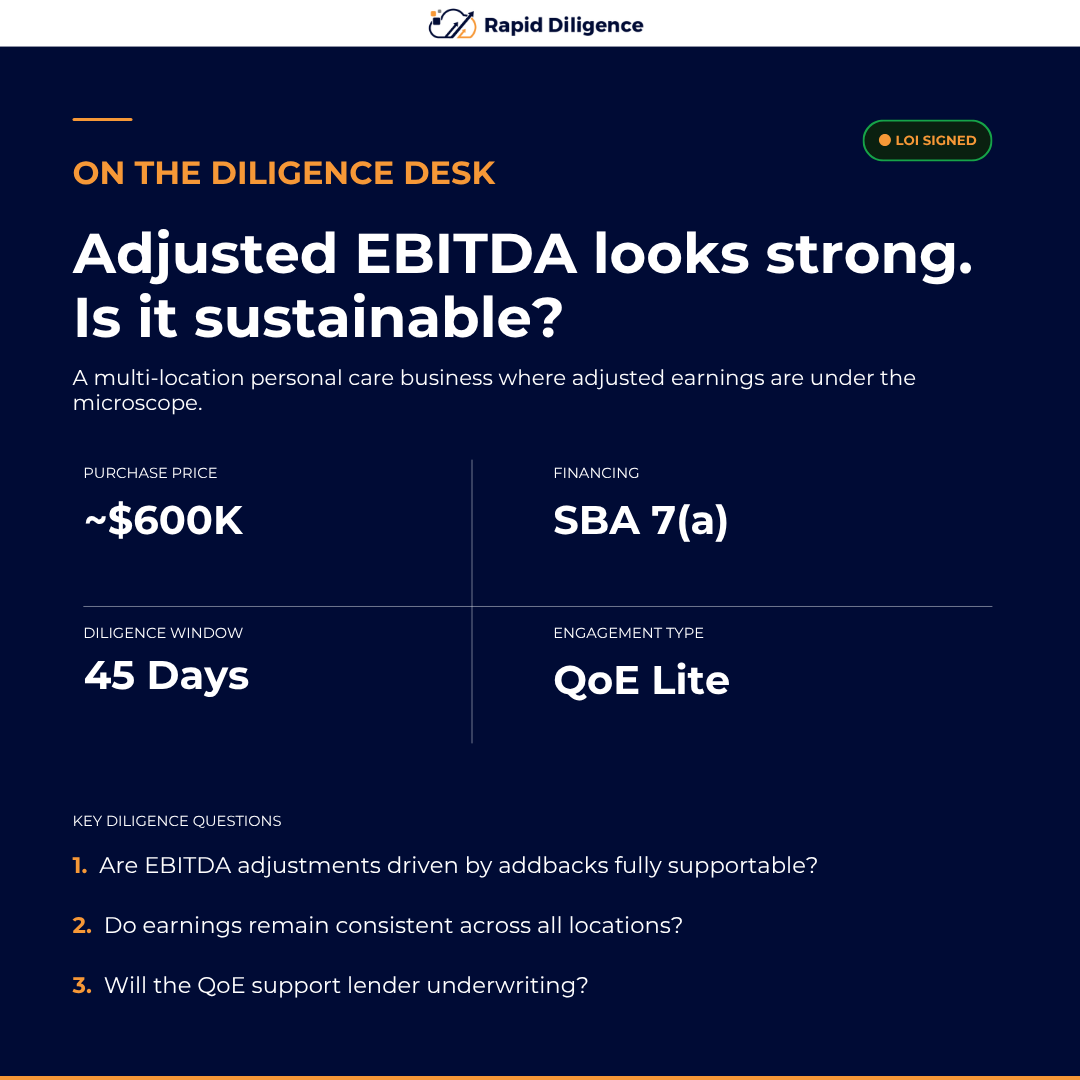
One thing that's come up repeatedly for us during diligence:
Strong EBITDA is only useful if it can be supported.
This week, we're onboarding a QoE Lite engagement for a multi-location personal care business.
The reported EBITDA looks strong, but the real questions are whether the addbacks are fully supportable, whether earnings are consistent across locations, and whether the numbers will hold up under lender review.
That's what we're digging into on this one.
This is super cool!
I actually built something like this last year that I ran as 10-day cohorts with friends.
We collectively walked over 10M steps :)
Even had a small web app for it I had built on @Netlify: https://t.co/jPmADljqaG
Someone built a fitness app using the same psychological mechanics as gambling
This might work better than every normal fitness app 😭😭
You bet money on whether you’ll hit 10,000 steps today
If you fail, you lose your money
If you succeed, you split the money from everyone who didn’t
So disciplined people literally profit off lazy people
Most fitness apps try motivating you with streaks and notifications
This one motivates you with financial fear
Imagine realizing at 11:52pm you still need 1,700 more steps or you lose $30
Entire friend groups would be outside walking laps around their neighborhood before midnight trying not to lose their steppa challenge
It sounds stupid but this would probably motivate people better than any other fitness product
Would you use this yourself?
@therishimanocha@SievaKozinsky We love working with folks with this mindset because our goal has always been world-class QoEs that rival Big Four quality at a relatively affordable rate.
Saw this thread because of a tag so would love to have you chat with our team to support your next deal!
Buy a 50-year-old business from an old man without a website, they say!
After signing an LOI in August, spending tens of thousands in diligence/legal fees, calling capital from friends/family, and learning more about the generator space than I knew existed, I just had a deal die on the 1-yard line.
BRUTAL, but it's probably ok. A few thoughts:
One of the toughest parts of working in corporate jobs is that sense of detachment—you don’t always feel the gratification of helping people in a meaningful way.
That’s exactly why I left mine and started Rapid Diligence. We get to help incredible, everyday people buy the #SMB of their dreams while ensuring their interests are protected throughout the process.
It’s work that excites me and keeps me motivated, even after all these years.
I know SaaS businesses are beloved in the search world by both technical and non-technical folks. Why? 👇
They're remote, utilize economies of scale arguably better than any other business model, and ✨ recurring revenue ✨
The daunting part? The jargon and technical understanding required to talk SaaS.
Here's a post to help you out:
https://t.co/gBll5IlJkd
Thinking about launching a search fund or starting a self-funded search?
Recently, I've had several people reach out with the same question: "What advice do you have for someone getting started?"
While there are many important pieces of advice, understanding the basic terminology is crucial for navigating the landscape effectively.
Here's quick blog post that highlights 19 essential search terms you need to know before starting your SMB search: https://t.co/K5BuvjuYCZ
One of the most underrated components of entrepreneurship 👇
You don't dread Mondays. You start to look forward to them.
The caveat is that you enjoy what you do and the people you do it with.
Hope you crush it this week 💪
@SBA_Matthias I've seen quite a few sellers introduce buyers as a potential minority investor in the business to avoid having employees know the business is for sale.
Seen the consultant play a few times but not nearly as often.
If you're in the first year of building a business or operating an #SMB you acquired 👇
You're probably not going to be taking many vacations. It's hard to step away when you're so early on and intertwined in all of the daily operations.
However, as you grow into your role as an operator / CEO, you should constantly be thinking about ways to remove yourself from processes, whether that's through delegation or automation.
At first, it's incredibly difficult to do because it requires you to relinquish control. Plus, it takes an entirely different skillset to train someone to do what you're doing versus simply doing it yourself.
However, it's imperative to do this if you want to really grow the business and prevent burnout in the long term, makes your business far more attractive to a future buyer, and is often the best way for you to serve your team.
It's easy to get caught up with busy work to make yourself feel productive. It's much more difficult to take on the truly challenging and thought-provoking tasks that will drive value to the business.
I recently completed a 72-hour water fast—just water, no food, for three days straight.
Why did I do it?
There's compelling research suggesting that water fasts can offer significant health benefits, including ketosis, autophagy, and more.
Here’s what I discovered 👇
1️⃣ We’re constantly thinking about food — all the time.
Going without food for three days made me realize just how much mental space I devote to planning meals. It also made me acutely aware of how much I dislike not eating. 😅
On the flip side, it heightened my mindfulness about what and when I eat. The word "hunger" also has a whole new meaning now.
2️⃣ Embracing discomfort strengthens mental resilience.
Whether it’s a water fast or a cold plunge, subjecting yourself to discomfort builds the mental muscle needed to tackle challenging tasks.
While cold plunges might seem cliché, there's a reason so many people vouch for them: they work. Submerging yourself in near-freezing water or forcing yourself to have nothing but water for 72 hours, despite your brain’s resistance, enhances your control over both mind and body.
Would I do it again?
Honestly, I'm not sure— it was not an easy three days. But the energy and clarity I've experienced afterward is something I haven’t found anywhere else. Possibly placebo, possibly not.
I hope this inspires you to do things that force you to embrace discomfort — it might be more impactful than you’d think.
If you're planning to close on an #SMB in 2024, shoot me an email at [email protected] or request a free consultation with us here to see how we can support next deal: https://t.co/c7RI46ot3j
Acquiring an #SMB is as much an emotional journey as it is a financial one.
For many sellers, their business is the culmination of years of hard work, dreams, and sacrifices. As a buyer, it's crucial to approach with empathy and respect.
As important as it is for your due diligence provider to have a robust understanding of the financials, it is equally important for them to deeply understand the human side of transactions.
In past deals, we've had sellers express concerns like, "I don't know if I feel comfortable divulging customer information" or "There's a lot of proprietary information within our codebase that I don't want to disclose."
As a service provider, you can respond to these in two ways:
1️⃣ "You chose to sell your business, and we're here to conduct due diligence, so you're required to share any information we need."
2️⃣ "I understand your concerns, as I'd be nervous sharing this data regarding my business with essentially a complete stranger. Why don't we schedule a call, and we can walk you through why we need this information and the security and privacy measures we've taken to ensure it never ends up in the wrong hands?"
If your due diligence provider takes approach 1️⃣, I'd recommend tripling your due diligence budget because you'll have a lot of broken deals on your hands.