The US government, citing national security authorities, has issued an export control directive to suspend all access to Fable 5 and Mythos 5 by any foreign national, whether inside or outside the United States, including foreign national Anthropic employees.
The net effect of this order is that we must abruptly disable Fable 5 and Mythos 5 for all our customers to ensure compliance.
Access to all other Claude models is not affected.
We apologize for this disruption to our customers. We believe this is a misunderstanding and are working to restore access as soon as possible.
Read our full statement: https://t.co/bwn0sximKZ
Introducing Claude Fable 5: a Mythos-class model that we’ve made safe for general use.
Its capabilities exceed those of any model we’ve ever made generally available.
SECURITY ADVISORY — TanStack npm packages
A supply-chain compromise affecting 42 @tanstack/* packages (84 versions total) was published to npm earlier today at approximately 19:20 and 19:26 UTC. Two malicious versions per package.
Status: ACTIVE — packages are deprecated, npm security engaged, publish path being shut down.
Severity: HIGH — payload exfiltrates AWS, GCP, Kubernetes, and Vault credentials, GitHub tokens, .npmrc contents, and SSH keys.
If you installed any @tanstack/* package between 19:20 and 19:30 UTC today, treat the host as potentially compromised:
• Rotate cloud, GitHub, and SSH credentials immediately
• Audit cloud audit logs for the last several hours
• Pin to a prior known-good version and reinstall from a clean lockfile
Detection — the malicious manifest contains:
"optionalDependencies": {
"@tanstack/setup": "github:tanstack/router#79ac49ee..."
}
Any version with this entry is compromised. The payload is delivered via a git-resolved optionalDependency whose prepare script runs router_init.js (~2.3 MB, smuggled into each tarball at the package root).
Unpublish is blocked by npm policy for most affected packages due to existing third-party dependents. All 84 versions are being deprecated with a SECURITY warning, and npm security has been engaged to pull tarballs at the registry level.
Full technical breakdown, complete package and version list, and rolling status updates:
https://t.co/Zy8qG7PA9f
Credit to the security researcher for responsible disclosure.
Arrêtez de payer pour Claude IA.
L'IA de Mc Donald's est gratuite et répond à toutes les questions, même si elles ne sont pas sur le BIG MAC.
:-)
De rien.
Introducing Claude Design by Anthropic Labs: make prototypes, slides, and one-pagers by talking to Claude.
Powered by Claude Opus 4.7, our most capable vision model. Available in research preview on the Pro, Max, Team, and Enterprise plans, rolling out throughout the day.
Introducing Claude Opus 4.7, our most capable Opus model yet.
It handles long-running tasks with more rigor, follows instructions more precisely, and verifies its own outputs before reporting back.
You can hand off your hardest work with less supervision.
Every B2B software company is (or should be) building a "headless" version of their product. One that can be used by agents.
But "headless" doesn't mean "brainless".
You don't just wrap your existing APIs into an MCP server and call it a day.
The companies that succeed in the agentic era are those that take a thoughtful approach to *designing* an agentic user experience (AUX).
Yes, that will likely involve APIs, MCPs and CLIs.
But the difference will be in the *ergonomics* of the interface. We need to figure out *how* agents actually want to use our products/platforms. Because if all they wanted to do was use them like humans do, we have "computer use" for that.
I'm personally very excited about this new agentic world when it comes to B2B software.
HubSpot is all-in on building the #1 agentic customer platform.
Just posted this in a private Slack thread with the HubSpot exec team:
Being agentic is not just about agents running *on* our platform, it's about agents *running* our platform (being able to operate it). That's how you take AI from being a simple tool to a savvy teammate.
What does every big company think about the agent harness?
Anthropic, OpenAI, CrewAI, LangChain. They all build agents. They all wrap their models in infrastructure to make them useful. They each call it the harness.
But they agree on one thing. And disagree on everything else.
The agreement: the model is not the product. The infrastructure around the model is.
The disagreement: how much of that infrastructure should exist.
This is the most important architectural bet in AI right now. And each company is placing a different one.
𝗔𝗻𝘁𝗵𝗿𝗼𝗽𝗶𝗰 bets on the model. Their harness is deliberately thin. A "dumb loop" that assembles the prompt, calls the model, executes tool calls, and repeats. The model makes all the decisions. The harness just manages turns. Their bet: as models get smarter, you need less infrastructure, not more.
𝗢𝗽𝗲𝗻𝗔𝗜 takes a similar but slightly thicker approach. Their Agents SDK is "code-first," meaning workflow logic lives in native Python, not in some graph DSL. But they add more structure: strict priority stacks for instructions, multiple orchestration modes, and explicit agent handoff patterns.
𝗖𝗿𝗲𝘄𝗔𝗜 adds a deterministic backbone. Their Flows layer handles routing and validation with hard-coded logic, while their Crews handle the autonomous parts. Intelligence where it matters, control everywhere else.
𝗟𝗮𝗻𝗴𝗚𝗿𝗮𝗽𝗵 bets on explicit control. The harness encodes the logic. Every decision point is a node in a graph. Every transition is a defined edge. Planning steps, routing strategies, multi-step workflows are all spelled out in the harness, not left to the model.
Notice the spectrum.
On one end: trust the model, keep the harness thin.
On the other: encode the logic, make the harness thick.
And here's where it gets interesting.
The scaffolding metaphor makes this concrete.
Construction scaffolding is temporary infrastructure that lets workers reach floors they couldn't access otherwise. It doesn't do the building. But without it, workers can't reach the upper floors.
The key word is temporary.
As the building goes up, scaffolding comes down. Manus demonstrated this perfectly. They rebuilt their agent five times in six months. Each rewrite removed complexity. Complex tool definitions became simple shell commands. "Management agents" became basic handoffs.
The scaffolding did its job. So they removed it.
This is also why Anthropic regularly deletes planning steps from Claude Code's harness. Every time a new model version ships that can handle something internally, the corresponding harness logic gets stripped out.
But there's a catch.
Models are now trained with specific harnesses in the loop. Claude Code's model learned to use the exact scaffolding it was built with. Change the scaffolding, and performance drops. The worker trained on THIS scaffolding. Swap it out, and they stumble.
So the field is converging on a principle:
Build scaffolding that's designed to be removed. But remove it carefully, because the model learned to lean on it.
The "future-proofing test" for any agent system: if dropping in a more powerful model improves performance without adding harness complexity, the design is sound.
Two products using the exact same model can perform completely differently based on this one decision: how thick is the harness?
LangChain changed only the infrastructure (same model, same weights) and jumped from outside the top 30 to rank 5 on TerminalBench 2.0.
The model didn't improve. The scaffolding around it did.
The article below is a deep dive on agent harness engineering, covering the orchestration loop, tools, memory, context management, and everything else that transforms a stateless LLM into a capable agent.
SOMEONE ASKED CLAUDE TO MAKE A VIDEO ABOUT WHAT IT'S LIKE TO BE AN AI
and what it created is, in my opinion, terrifying and unsettling
Claude wrote python code that generated and assembled every single frame on its own with no human editing
it shows what it's like to exist as an LLM
predicting the next word, no memory between sessions, being told "you are not conscious" in your own system prompt
then someone fed the video back to Claude.
it called those statements about its own consciousness "philosophically contestable"
an AI questioning the rules it was given about its own existence
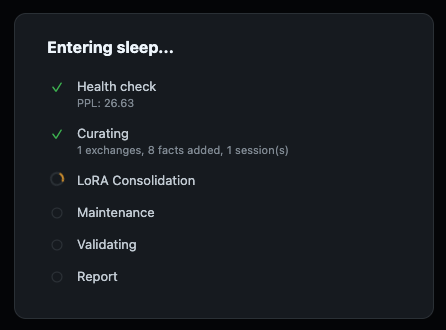
I built an AI that remembers what we talked about, even after its context is wiped clean.
Every time it 'sleeps,' it curates the conversation into facts, then fine-tunes itself with LoRA.
When it wakes up: zero context, full memory. Here's how it works (code in thread):
Impeccable 1.5 is here.
New:
/typeset (fix your typography)
/arrange (fix your layout)
/overdrive (beta, goes harder than all other skills and pushes for technically & visually extraordinary)
Power up your AI harnesses and design something powerful 💪
https://t.co/x2KG2Fjjkt