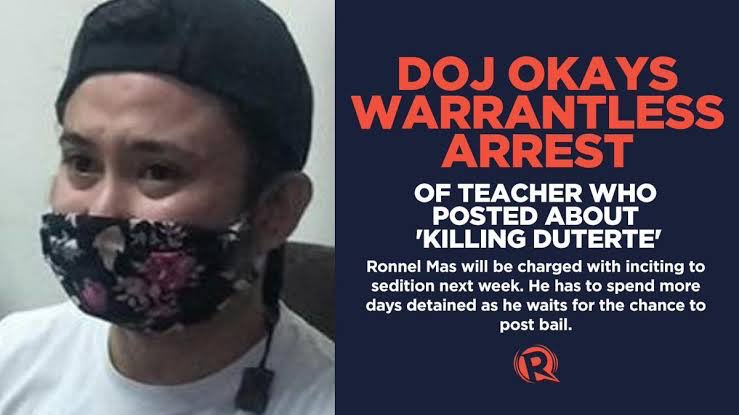
Remember Ronnel Mas? Yung teacher na nag post ng joke na patayin si Duterte? Hinuli, Pinahiya, at Ikinulong dahil sa joke.
Pero si Sara Duterte, explicitly sinabi sa 12am meltdown niya na ipapatay niya si Marcos, Liza, at Romualdez. Ni hindi man lang binalaan ng pulis o NBI?
BILL FOR FORFEITURE OF ILLEGALLY ACQUIRED FOREIGN-OWNED REAL ESTATE FILED IN HOUSE
A bill seeking to authorize the government to seize real estate unlawfully acquired by foreign nationals, particularly those involved with illegal Philippine Offshore Gaming Operators (POGOs), was filed in the House of Representatives on Thursday, November 7.
House Bill (HB) No. 11043, also known as the proposed "Civil Forfeiture Act," stems from the ongoing investigation by the House Quad Committee into alleged criminal activities tied to POGOs, including human trafficking and illegal drug operations.
The bill was introduced by House Senior Deputy Speaker Aurelio "Dong" Gonzales Jr., Deputy Speaker David "Jay-jay" Suarez, and Quad Committee chairs Reps. Robert Ace Barbers, Dan Fernandez, Bienvenido "Benny" Abante Jr., and Joseph Stephen Paduano. Other authors include Quad Committee senior vice chair Romeo Acop, as well as Reps. Johnny Pimentel, Gerville "Jinky Bitrics" Luistro, Rodge Gutierrez, Paolo Ortega, Jay Khonghun, and Keith Flores.
Earlier, Quad Committee leaders, along with Gonzales and Suarez, led a group of lawmakers in filing a bill to institutionalize a nationwide POGO ban, strengthening President Ferdinand Marcos Jr.'s directive to protect public safety and national security from crimes linked to POGOs. The Anti-Offshore Gaming Operations Act seeks to ban all offshore gaming activities in the country and impose penalties for violations.
On October 21, the Quad Committee submitted key documents to the Office of the Solicitor General (OSG) for potential legal actions against Chinese nationals allegedly using fake Filipino citizenship to acquire land and establish businesses in the Philippines. The House mega-panel, composed of the Committees on Dangerous Drugs, Public Order and Safety, Human Rights, and Public Accounts, urged the OSG to fast-track the review and initiate legal actions, including civil forfeiture proceedings, with the help of relevant agencies.
The Civil Forfeiture Act is designed to reinforce the constitutional ban on foreign land ownership, which dates back to the 1935 Constitution. It targets individuals who attempt to circumvent constitutional restrictions using falsified documents, enabling the government to seize such properties. The bill's explanatory note asserts that the ongoing violation of constitutional provisions on foreign land ownership must not continue.
Many violators are connected to POGOs, which President Marcos Jr. recently banned due to their ties to criminal activities. The Philippine Constitution prohibits foreign nationals from owning land except in cases of hereditary succession. Article XII, Sections 7 and 8 of the 1987 Constitution restrict private land ownership to Filipinos or corporations with at least 60 percent Filipino ownership. The bill seeks to strictly enforce this provision, particularly against foreign nationals who use fraudulent methods to bypass the law.
According to the bill's authors, the problem has worsened in recent years, especially with the rise of POGOs under former President Rodrigo Duterte. "Thousands of aliens have flocked to the Philippines to establish POGOs, which have been closely linked to criminal activities, such as human trafficking and illegal drugs," they said.
Investigations revealed that some foreign nationals used fake birth certificates, passports, and other documents to illegally acquire land.
Under the Civil Forfeiture Act, land transferred to an unqualified foreign national would be considered null and void. The OSG, with support from the Department of Justice, would initiate civil forfeiture proceedings. The bill assumes any real estate acquired by a foreign national is unlawfully acquired unless proven otherwise.
The bill also includes provisions for the repurposing of forfeited properties. Agricultural land would be distributed to eligible farmers under the Department of Agrarian Reform's guidance, while non-agricultural land would be allocated for public services, such as schools and hospitals, or transferred to local governments for social service use.
The bill seeks to improve monitoring and enforcement by involving local government units and the Land Registration Authority (LRA). Local governments will report suspicious land transfers to the OSG, while the LRA will monitor compliance with ownership laws.
Despite ownership restrictions, foreign nationals have long exploited legal loopholes, often through dummy corporations or corrupt practices. This bill aims to close these loopholes and establish a clearer framework for civil forfeiture.
Lawmakers are urging the swift passage of the bill, emphasizing the urgent need to address the rampant violations of land ownership laws. "Moving forward, it is imperative that such activities are never allowed to continue in the Philippines," the bill's explanatory note declared, stressing the importance of strengthening enforcement and repurposing forfeited properties for public use to combat corruption.