Economist IBus. dev. practitioner I Enterprise Risk Professional w over 2 decades in financial intermediation I Knowledge seeker and personal growth enthusiast.
@ishaqsamaila5 Like banditry and boko haram, we just woke up to a whole 360 degree change in our affairs. Our value system is completely under serious threat.
@JohnOhai2@Pharmacio001 How would he do that? I support anyone who can help Nigeria out of this. But we need to know how so that we don't have noise with no action like Buhari.
After 3 years using Claude, I can say it’s the technology that has revolutionized my life.
Here are 18 prompts I use daily that have transformed my day to day; they could do the same for you:
(Save this 🔖)
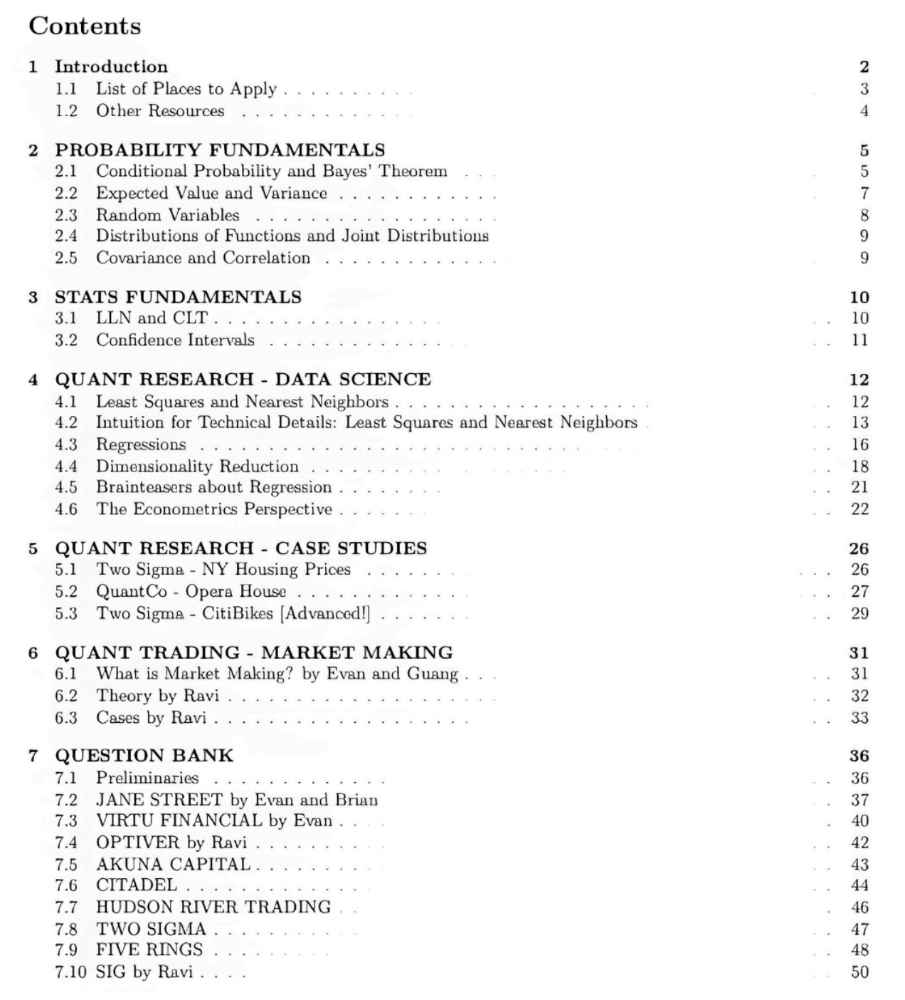
I found the exact document Jane Street, Citadel and Two Sigma use to hire candidates
MIT published it for free
51 pages
Zero to quant. Probability. Statistics. Market making. Real interview questions from the top 5 funds
The same mathematical foundation I built the neural networks article on this week
If you're serious about applying that framework - read this first
Bookmark it before it disappears
You're a millionaire trader in 12 months (timeline for self-study)..
Print this off then check it off when you have mastered the concept.
Months 0–1
1. Risk management
Only risk fixed amounts daily and survive long enough to improve consistently.
2. One setup mastery
Trade only one repeatable setup daily until execution becomes completely automatic.
3. Stop-loss discipline
Exit immediately at invalidation level without hesitation, hope, fear, or revenge.
4. Emotional control
Detach emotions from outcomes and focus entirely on process and execution.
5. Market awareness
Understand market trend, key levels, news events, and overall market sentiment.
6. Journal everything
Record every trade, mistake, emotion, and lesson after market closes daily.
Months 2–3
7. Patience mastery
Wait hours for A+ setups instead of forcing random low-quality trades.
8. Entry precision
Enter only near support, resistance, retests, or strong confirmation zones consistently.
9. Reward-to-risk understanding
Take trades minimum 2:1 reward-risk with asymmetric upside potential always available.
10. Position sizing
Increase size slowly only after consistency and emotional stability are fully proven.
11. Routine building
Create identical daily premarket, trading, and postmarket review habits every day.
12. Selling discipline
Hold winners until targets hit instead of selling early from fear repeatedly.
Months 4–6
13. Price action reading
Study candles, liquidity, momentum shifts, and market structure every single session.
14. Market psychology
Recognize fear, greed, manipulation, traps, and emotional crowd behavior quickly daily.
15. Trading fewer setups
Focus on highest probability opportunities instead of overtrading unnecessary market noise constantly.
16. Capital preservation
Protect account aggressively during difficult periods and reduce size after consecutive losses.
17. Macro understanding
Track interest rates, inflation, earnings, bonds, and geopolitical market-moving catalysts daily.
18. Confidence building
Trust proven strategy statistics instead of reacting emotionally during temporary drawdowns.
Months 7–9
19. Consistency focus
Prioritize consistent execution daily instead of chasing massive unrealistic trading profits immediately.
20. Advanced journaling
Analyze recurring behavioral mistakes weekly and systematically eliminate emotional execution weaknesses.
21. Holding runners
Allow strong trends to continue instead of exiting profitable trades too early.
22. Adapting to volatility
Adjust position sizing and expectations depending on current market conditions intelligently daily.
23. Time management
Trade only optimal hours and avoid random impulsive trades outside plan entirely.
24. Building edge
Refine setups through statistics, repetition, and identifying unique repeatable market advantages consistently.
Months 10–12
25. Scaling responsibly
Increase size carefully while maintaining same emotional discipline and execution quality daily.
26. Protecting mental health
Sleep properly, exercise consistently, and avoid burnout affecting trading decisions negatively.
27. Advanced execution
Master scaling in, scaling out, and managing trades during high volatility environments.
28. Wealth preservation
Focus on protecting profits, taxes, cash flow, and long-term wealth compounding strategically.
29. Business mindset
Treat trading professionally with systems, routines, discipline, and measurable performance tracking daily.
30. Millionaire mindset
Think long-term, stay process-driven, and compound small advantages relentlessly every single day.
The vaccine dosage was obviously too high and done too many times.
I had the original Wuhan virus before there was any vaccine and it was much like any other cold/flu. Bad, but not terrible.
But my second vaccine shot almost sent me to the hospital. Felt like I was dying.
@OfficialAzzaki May her soul rest in peace. Please advise the parents to sue for Diyya. It is their legitimate right and a deterrence against the unlawful activities of uncensored trigger happy armed personnel.
🚨BREAKING: You no longer need Bloomberg to analyze stocks.
Claude can now run: • Goldman Sachs-style research
• Morgan Stanley technicals
• Bridgewater risk models
• Citadel sector rotation
• Two Sigma macro analysis
All from one prompt. For free.
Here are 10 insane Claude prompts that replace a $2,000/month Bloomberg Terminal.
Save this. You'll use it daily.
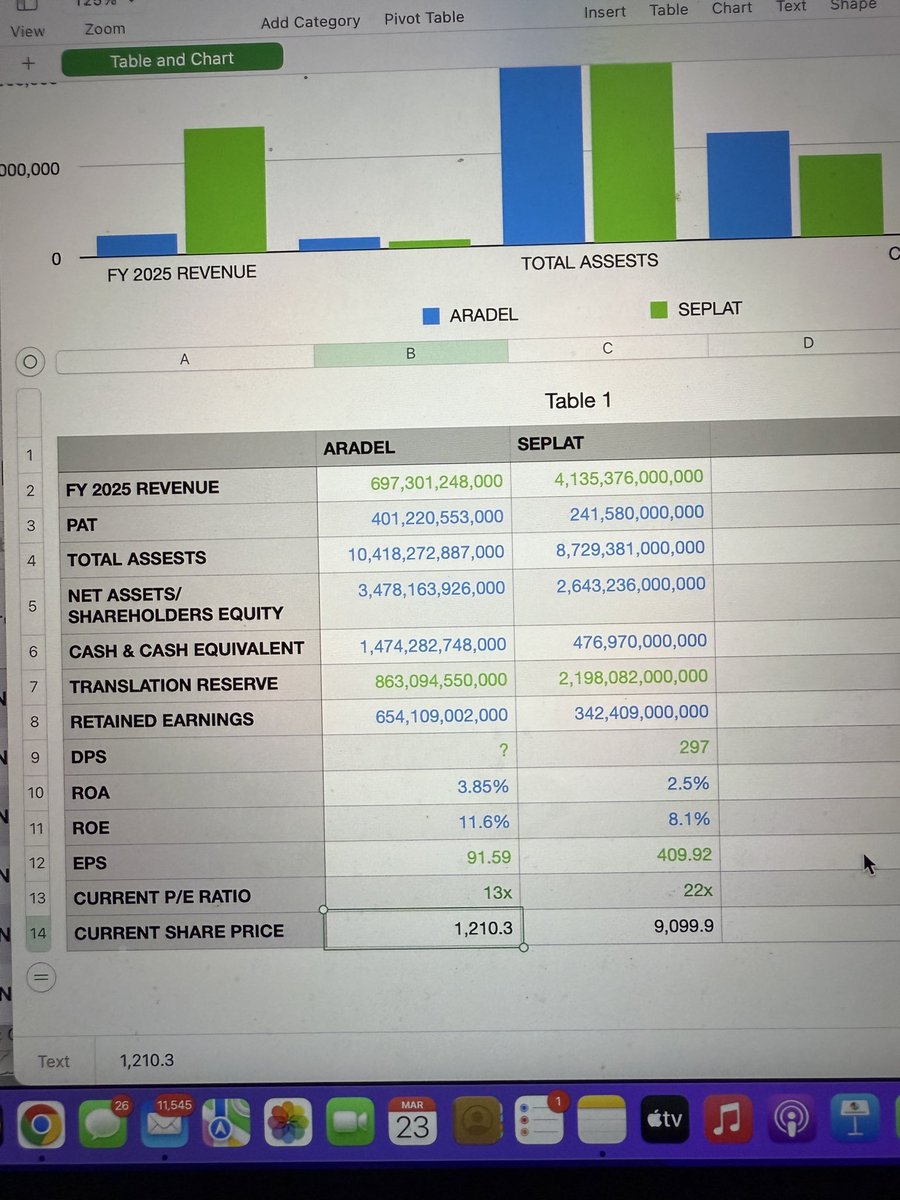
IS THE MARKET MISSING ARADEL’S EARNINGS POWER?
Looking again at this table where I tried to compare Aradel and Seplat in numerical terms, I can’t help but wonder whether the investing community is seeing what I’m seeing here even though I’m not done with the analysis.
There’s really not much to overcomplicate here. Now, close your eyes and imagine FY 2026 earnings of ₦130 at 14x.
Aradel has traded at 14x earnings before retracing back to ₦1,210, which suggests this can happen again.
Let me run the simple math at 14x, using a potential FY 2026 earnings of around ₦130:
₦1,820 / ₦130 = 14x
When Aradel previously traded at ₦1,331:
₦1,331 / ₦91.59 = 14.5x
At the current price of ₦1,210, that implies a spread of ₦610.
My FY 2026 earnings guidance (₦130 – ₦135) is based on assumptions of improved oil production, effective control of Renaissance Africa Energy Company (with a 53.3% stake, giving Aradel control of the entity), and continued strength in Aradel’s core earnings. I expect to see the full impact of this entity reflected in FY 2026 bottom line.
@ShaafiB this is how I win in the market. You have to be discerning and spot these opportunities before everyone sees it.
As requested, in the spirit of Eid Mubarak, I present to you this well grilled ram suya! 😊
@bellosaleh UPE and UBE were launched in Sokoto by Obasanjo during his two eras. Who in d North bothers about our literacy level, death of adult and mass literacy, out of school children, pupils admission in Unity schools and even Universities on our soil. How do you attract Coventry?
🚨 BREAKING: Claude can now help you find profitable business ideas in the stock market.
No hedge fund.
No insider access.
No expensive research tools.
Just Claude + the right prompts.
Here are 8 insane prompts to turn stock research into smarter earning decisions in 2026 👇
You're using Claude wrong.
Here's my (exact) setup before I even prompt:
Step 1. Download Claude and open Cowork
→ Go to Claude. com/ download.
→ Install the desktop app.
→ Click the Cowork tab at the top.
→ You need a Pro plan ($20/mo). Worth it.
→ Full guide here: https://t.co/g6oLzWSOuo
---
Step 2. Select the right model (don't skip this)
→ Click the model dropdown.
→ Select "Opus 4.6."
→ Turn on "Extended Thinking."
→ Never change these. Wrong model = bad output.
---
Step 3. Build your folder
→ Create one master folder on your computer.
→ Inside it, create 4 subfolders:
✦ ABOUT ME - who you are + how you write
✦ PROJECTS - one subfolder per live project
✦ TEMPLATES - your best work as structures
✦ OUTPUTS - where Claude saves finished files
→ Upload this folder. That's how it reads you.
---
Step 4. Create 3 context files inside ABOUT ME
→ These replace prompting. This is the setup.
→ Create them as .md files. Plain text, saved as .md
✦ about-me.md - what you do day-to-day.
✦ my-voice.md - tone, phrases you hate, 3 example
✦ my-rules.md - ask first, show a plan, get approval
OR
Simply download my .md files here: https://t.co/psB7XxAv8w
Subscribe for free. Open my welcome email.
Hit the automatic reply button inside.
---
Step 5. Set Global Instructions (once, forever)
Go to Settings → Cowork → Edit Global Instructions.
→ Paste: "I'm [Name], [Role]. Read my files before every task. Ask clarifying questions before executing. Show a plan before acting. Never delete without my approval."
→ You set this once. It runs every session.
→ Your prompts can now be 10 words long.
---
Before your next Cowork session, check these:
1. Am I in Cowork (not Chat)?
2. Is Opus 4.6 + Extended Thinking on?
3. Did I point it to my folder with context files?
Set these first. Then prompt.
Top 1% of Claude users do this. Now you can too.
I produced a video that teaches you 3 rule-based trading strategies that work (backed by 25 years of data).
You’ll get the exact trading rules, full backtest results, and printable cheat sheets.
Interested?
Reply “yes” and I’ll send you this 54-minute training.
(You must follow me so I can DM you.)
🚨 BREAKING:
Claude can now explain any complex topic like a university professor (for free).
10 Claude prompts to learn anything 10× faster:
(bookmark it)
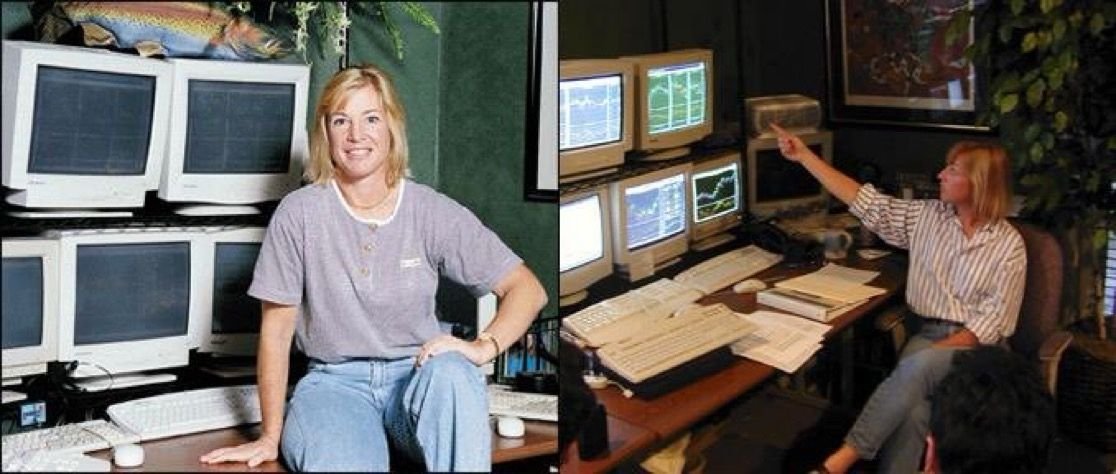
Market Wizard Linda Raschke's 12 Technical Trading Rules
1. Buy the first pullback after a new high. Sell the first rally after a new low.
2. Afternoon strength or weakness should have follow‑through the next day.
3. The best trading reversals occur in the morning, not the afternoon.
4. The larger the market gaps, the greater the odds of continuation and a trend.
5. The way the market trades around the previous day’s high or low is a good indicator of the market’s technical strength or weakness.
6. The previous day’s high and low are two very important “pivot” points, for this was the definitive point where buyers or sellers came in the day before. Look for the market to either test and reverse off these points, or push through and show signs of continuation.
7. The last hour often tells the truth about how strong a trend truly is. “Smart money” shows their hand in the last hour, continuing to mark positions in their favor. As long as a market is having consecutive strong closes, look for the up‑trend to continue. The up‑trend is most likely to end when there is a morning rally first, followed by a weak close.
8. High volume on the close implies continuity the next morning in the direction of the last half‑hour. In a strongly trending market, look for resumption of the trend in the last hour.
9. The first hour’s range establishes the framework for the rest of the trading day.
10. A greater percentage of the day’s range occurs in the first hour than was the case in the past, and thus it has become increasingly important to trade aggressively if there are early signs of a strong trend for the day.
11. There are four basic principles of price behavior which have held up over time. Confidence that a type of price action is a true principle is what allows a trader to develop a systematic approach.
The following four principles can be modeled and quantified and hold true for all time frames, all markets. The majority of patterns or systems that have a demonstrable edge are based on one of these four enduring principles of price behavior. Charles Dow was one of the first to touch on them in his writings.
Principle One: A Trend Has a Higher Probability of Continuation than Reversal
Principle Two: Momentum Precedes Price
Principle Three: Trends End in a Climax
Principle Four: The Market Alternates between Range Expansion and Range Contraction
In the world of money, which is a world shaped by human behavior, nobody has the foggiest notion of what will happen in the future. Mark that word – Nobody! Thus the successful trader does not base moves on what supposedly will happen but reacts instead to what does happen.








![rubenhassid's tweet photo. You're using Claude wrong.
Here's my (exact) setup before I even prompt:
Step 1. Download Claude and open Cowork
→ Go to Claude. com/ download.
→ Install the desktop app.
→ Click the Cowork tab at the top.
→ You need a Pro plan ($20/mo). Worth it.
→ Full guide here: https://t.co/g6oLzWSOuo
---
Step 2. Select the right model (don't skip this)
→ Click the model dropdown.
→ Select "Opus 4.6."
→ Turn on "Extended Thinking."
→ Never change these. Wrong model = bad output.
---
Step 3. Build your folder
→ Create one master folder on your computer.
→ Inside it, create 4 subfolders:
✦ ABOUT ME - who you are + how you write
✦ PROJECTS - one subfolder per live project
✦ TEMPLATES - your best work as structures
✦ OUTPUTS - where Claude saves finished files
→ Upload this folder. That's how it reads you.
---
Step 4. Create 3 context files inside ABOUT ME
→ These replace prompting. This is the setup.
→ Create them as .md files. Plain text, saved as .md
✦ about-me.md - what you do day-to-day.
✦ my-voice.md - tone, phrases you hate, 3 example
✦ my-rules.md - ask first, show a plan, get approval
OR
Simply download my .md files here: https://t.co/psB7XxAv8w
Subscribe for free. Open my welcome email.
Hit the automatic reply button inside.
---
Step 5. Set Global Instructions (once, forever)
Go to Settings → Cowork → Edit Global Instructions.
→ Paste: "I'm [Name], [Role]. Read my files before every task. Ask clarifying questions before executing. Show a plan before acting. Never delete without my approval."
→ You set this once. It runs every session.
→ Your prompts can now be 10 words long.
---
Before your next Cowork session, check these:
1. Am I in Cowork (not Chat)?
2. Is Opus 4.6 + Extended Thinking on?
3. Did I point it to my folder with context files?
Set these first. Then prompt.
Top 1% of Claude users do this. Now you can too.](https://pbs.twimg.com/media/HDD_MiBaYAAFFIh.jpg)