@NixBiks@ADragsdahl Helt enig! Jeg prøver at italesætte de forskellige tilgange, og er ked af hvis det er kommet til at fremstå som Collaborative Filtering er det eneste grundlag. Det er på ingen måde min opfattelse, og jeg mener også at nævne at det også er musikken og det vi skriver om musikken
Regeringen og aftalepartierne bag finansloven for 2022 er blevet enige om rammerne for et nyt Kulturens Analyseinstitut. Instituttet skal ligge i Roskilde og skal sørge for nye indsigter på kunst- og kulturområdet #dkkultur#dkpol Læs mere her: https://t.co/0aGeEgbAcI
In the article "Datafication and the Push for Ubiquitous Listening in Music Streaming", @rasmusrex, @roskildeuni, discusses Spotify’s approach to music recommendation as datafication of listening. Read the article here: https://t.co/pjmZbfX2yh
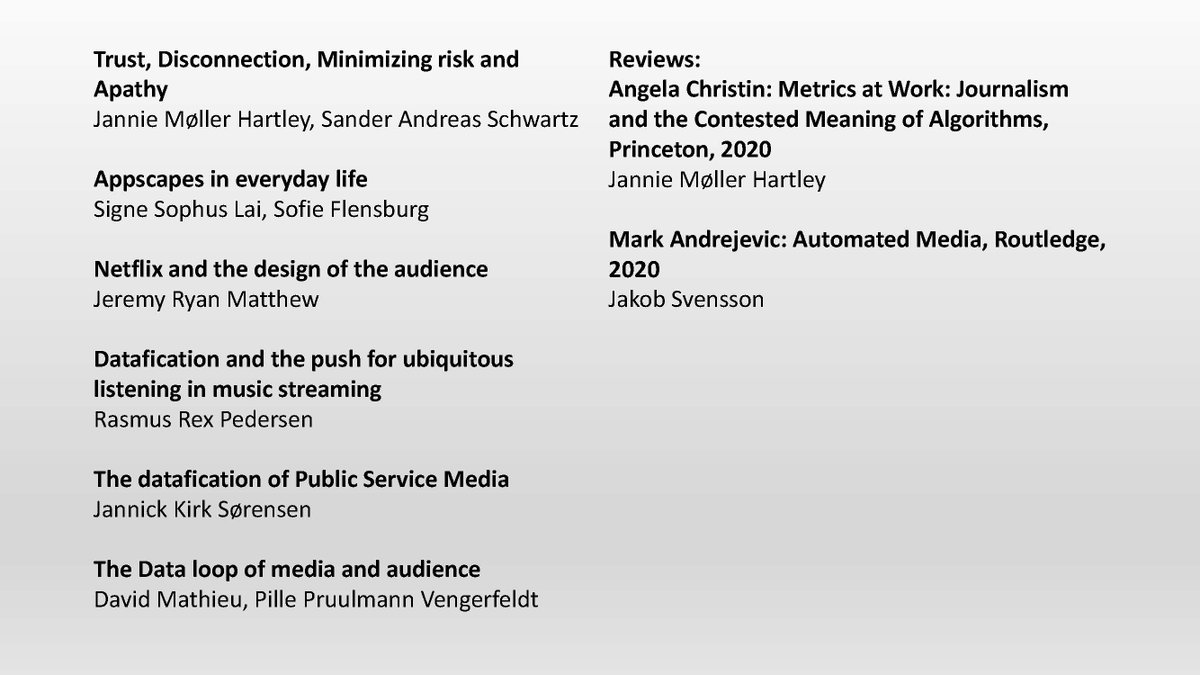
The issue contains great contributions by @JannieHart, Sander Andreas Schwartz, Signe Sophus Lai, @SofieFlensburg, Jeremy Ryan Matthew, @rasmusrex, Jannick Kirk Sørensen, David Mathieu, @PillePV, and Jakob Svensson!
For anyone interested in the Tidal stream-fraud case, this thread from the Norwegian Supreme Court by the journalist who exposed the case is extremely interesting reading
På torsdag på @Kulturmoedet lancerer Kulturministeren sit idéforslag til afløseren for musikhandlingsplanen. Efterfølgende debatterer jeg vilkårene for det danske musikliv med et særdeles kompetent panel. #roskildeuni#forskning#dkpol
This should lead to a push for transparency in music streaming! TIDAL accused of deliberately faking Kanye West and Beyoncé streaming numbers https://t.co/MpqC0wBrNN
Journalists: if your take on Spotify’s IPO doesn’t even consider the impacts on different kinds of artists, you might not be ready to publish. (We’re here to help!)
@ratpie@Sharkyl@dhuman@arnte The serious flaw Is that “The researcher took a random sample of 10,000 tracks to represent the whole material. This sample included tracks from 4493 individual artists and 22,496 streams (individual listening times), listened by 8051 user IDs.”