$TAIKO
The market evaluates Taiko as a premier Ethereum Based Rollup, designed with decentralized sequencers and zero-knowledge modularity. However, our on-chain telemetry for this specific TAIKO/ETH token instance highlights structural nuances that deviate from base-layer assumptions.
Sentinacle engine assigns a 50/100 Trust Score (Moderate Risk). While broader market perception assumes immediate decentralization, this specific asset operates with a centralized governance overlay and an unusually thin $48,103 liquidity pool.
Forensic dissection of the ERC1967Proxy (UUPS) architecture reveals several key access vectors:
• Governance Control: Ownership sits with an unidentified external contract (0x75BA7640...), leaving the true control structure opaque without a secondary audit.
• Execution Gates: Bytecode analysis flagged TIMESTAMP_GATE and TIMESTAMP_LOCK patterns, enabling time-based logic that can restrict trading operations to specific block windows.
• Transfer Halts: A pause() function is present to freeze all transfers, though static analysis confirms it requires multi-party approval or a time delay, preventing a purely unilateral freeze.
For institutions conducting a crypto risk assessment or comprehensive DeFi smart contract audit, this architecture presents distinct trade-offs. The combination of an opaque proxy owner and timestamp-restricted execution in a highly illiquid ($48k) pool means capital flow is heavily reliant on off-chain governance behavior rather than immutable code.
How are risk managers pricing in multi-signature pause capabilities on proxy-gated assets with limited liquidity depth?
Telemetry only. NFA. #SmartContracts #OnChainAnalysis #DeFi #Ethereum #CryptoSecurity #OnChain #SmartContracts #RugPull #DeFiRisk
$USA250
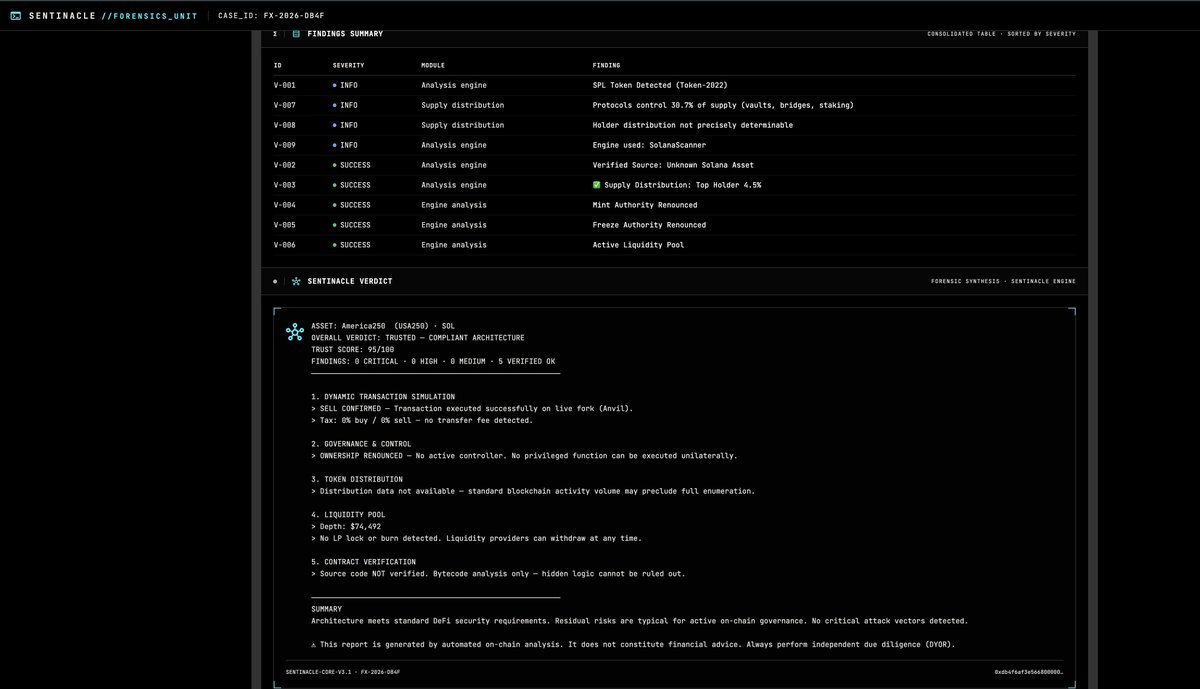
The SPL Token-2022 architecture of America250 ($USA250) presents a surprisingly rigid governance structure for an $833k market cap asset scaling alongside July 4th momentum.
As patriotic liquidity floods the Solana ecosystem ahead of the US semiquincentennial, $USA250 is currently capturing roughly $68k in daily volume. While the market narrative is cultural, the underlying contract architecture is strictly anchored.
Retail often prices standard pump-fun deployments purely on sentiment, but our current crypto risk assessment flags a 95/100 Trust Score—a notable divergence from the highly centralized deployer models typically seen in this liquidity bracket.
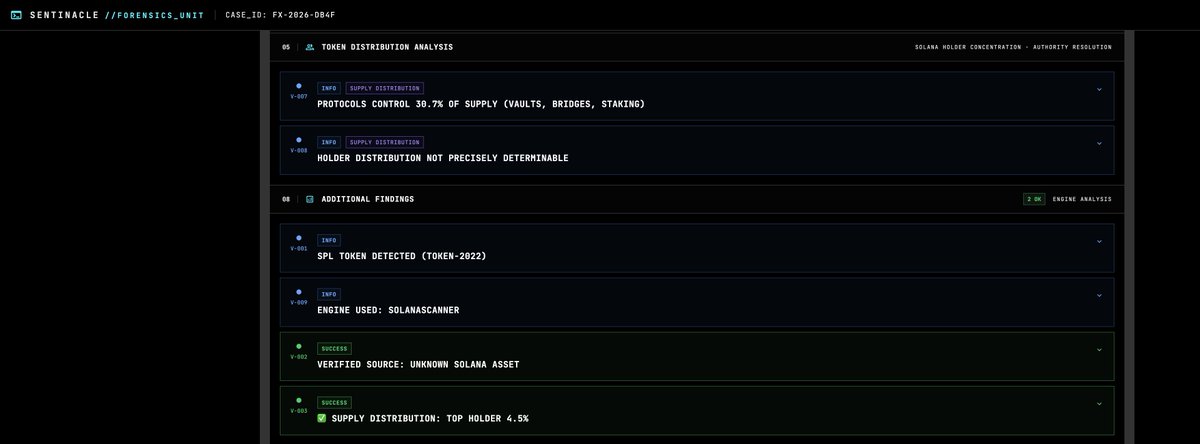
We ran a continuous DeFi smart contract audit on the 7zzg...pump address using our SolanaScanner engine. The on-chain telemetry is structurally clean:
• Mint & Freeze Authority: Permanently renounced. The supply is fixed and wallet blacklisting is disabled at the bytecode level.
• Dynamic Simulation: Validated on a live Anvil fork. Sell orders execute cleanly with a 0% buy/sell tax. Zero honeypot vectors detected.
• Holder Concentration: The top single holder controls a measured 4.5% of supply, while 30.7% is delegated to protocol vaults and staking infrastructure.
• Liquidity Profile: The active pool sits at $74.4k depth. However, no LP lock or burn transaction has been detected.
For institutional risk managers or early LPs, this represents a compliant, immutable architecture for a speculative asset.
The renounced governance removes unilateral privileged execution, leaving the unlocked liquidity pool as the primary residual vector for capital flight.
Given the renounced contract authorities but the absence of a hard LP lock, how are liquidity providers pricing the exit risk on these seasonal momentum trades?
Telemetry only. NFA.
#SmartContracts #OnChainAnalysis #Solana #DeFi #CryptoSecurity #OnChain #SmartContracts #RugPull #DeFiRisk
$ANSEM
Executing a routine DeFi smart contract audit on $ANSEM (The Black Bull). 🧵
Solana SPL (Token-2022) architecture under the microscope. Sentinacle terminal outputs a 95/100 Trust Score for immutable logic, but the structural risk profile requires a deeper look.
Forensic breakdown:
• Contract: Standard Solana deployment. Mint and Freeze authorities are permanently renounced.
• Simulation: Live on-chain execution verified via Anvil fork. 0% buy/sell tax.
• Governance: Ownership renounced. No active controller or privileged functions can alter core parameters.
However, structural integrity does not equal market safety.
The terminal flags one HIGH severity finding (V-003): Whale Concentration. Currently, a single top holder controls 60.4% of the supply. Furthermore, the $644k active liquidity pool shows NO LP lock or burn detected.
Institutional insight: The token passes the baseline crypto risk assessment regarding execution logic��there are no honeypot mechanisms or hidden taxes. However, with highly centralized supply and unlocked liquidity, the primary vulnerability shifts entirely from code exploitation to unilateral liquidity withdrawal or supply dumping.
How are LPs weighing this 60% supply concentration against an unlocked pool architecture?
Telemetry only. NFA. #SmartContracts #OnChainAnalysis #Solana #DeFi #CryptoSecurity #OnChain #SmartContracts #RugPull #DeFiRisk
$GWEI
ETHGas ($GWEI) aims to commoditize Ethereum blockspace, driving a significant institutional narrative and heavy ecosystem backing. Yet, our latest crypto risk assessment reveals architectural realities that diverge sharply from its $496.9M market valuation.
With just $117.4K in total network liquidity, the foundation is inherently fragile.
🧵
The Sentinacle Trust Score places $GWEI at 51/100 (Moderate). The baseline heuristic outputs a manageable risk profile, but specific centralization vectors demand scrutiny.
Our forensic dissection isolated a persistent, high-severity vector: an active Mint Authority.
While the base contract ownership is formally renounced, discrete logic within the EVM bytecode still allows for unilateral supply inflation. The dilution overhang remains fully active.
Liquidity architecture amplifies this structural exposure.
A single unknown wallet controls 64.5% of the LP. In an environment with exceptionally thin depth, this concentration grants an opaque entity absolute dominance over market-making mechanics.
Furthermore, static bytecode analysis flagged TIMESTAMP_GATE and TIMESTAMP_LOCK patterns.
These time-based functions can throttle or restrict buy/sell windows. Crucially, dynamic transaction simulation failed entirely due to insufficient liquidity on the fork, leaving these execution paths unverified under live conditions.
For a rigorous DeFi smart contract audit, this presents a clear asymmetry. An ambitious infrastructure protocol is currently operating on tightly centralized, opaque execution controls.
While not immediate exploit vectors, these are significant governance constraints.
How are LPs weighting these architectural controls against the anticipated yield premium?
Telemetry only. NFA. #SmartContracts #OnChainAnalysis #Ethereum #DeFi #CryptoSecurity #OnChain #SmartContracts #RugPull #DeFiRisk
toshi:native
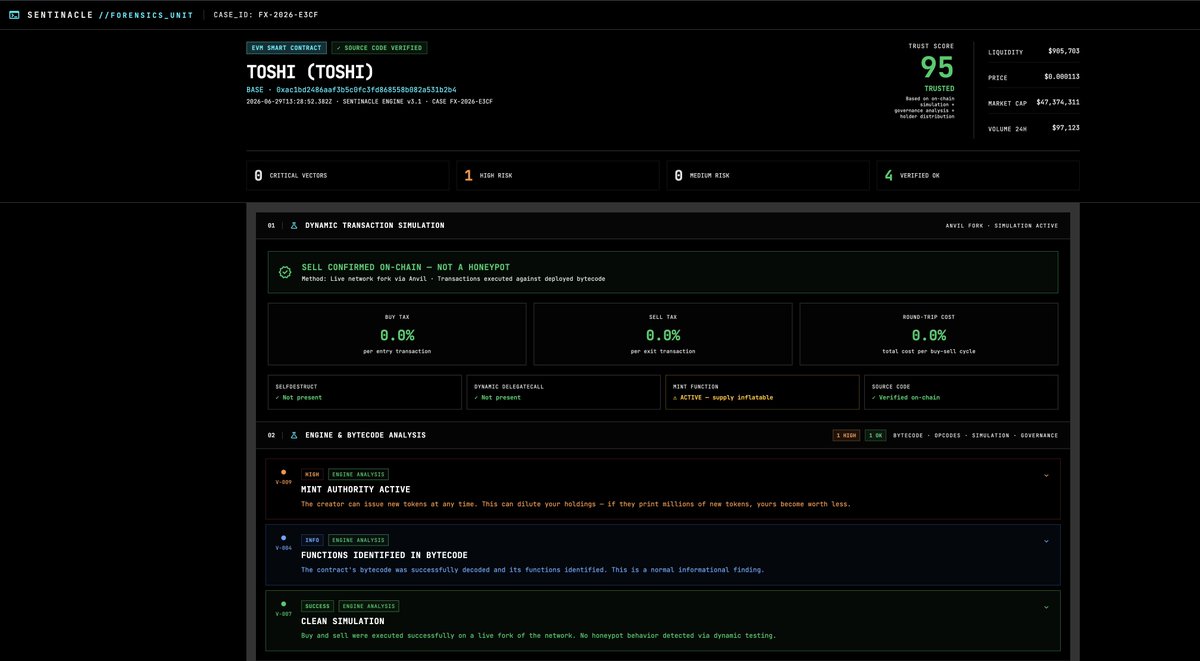
TOSHI operates as the primary cultural asset on the Base network, commanding a $47.5M market cap and over $905k in pool liquidity. 🧵
Retail market perception treats it as a fully decentralized, immutable token. Our latest Sentinacle run largely validates this baseline with a 95/100 Trust Score.
The asset clears standard DeFi smart contract audit parameters effortlessly. Dynamic transaction simulation confirms 0% buy/sell taxes, no self-destruct code, and clean, unhindered sell routing.
But the forensic dissection reveals a structural nuance in the EVM bytecode.
The deployer has officially renounced contract ownership. This successfully locks out standard unilateral admin privileges like pausing trading or altering base rules.
Yet, our analysis engine flags a High-Severity vector: "Mint Authority Active."
While the primary admin role is burned, the minting function remains structurally active and supply is classified as inflatable. If a secondary privileged role was assigned prior to renunciation, the capacity to issue new tokens persists.
For an LP or risk manager, this highlights a critical distinction in any rigorous crypto risk assessment. "Ownership renounced" is not an automatic guarantee of a permanently immutable token supply.
How are institutional liquidity providers weighing this residual contract architecture against TOSHI's dominant on-chain momentum?
Telemetry only. NFA. #SmartContracts #OnChainAnalysis #Base #DeFi #CryptoSecurity #OnChain #SmartContracts #RugPull #DeFiRisk
$KINS
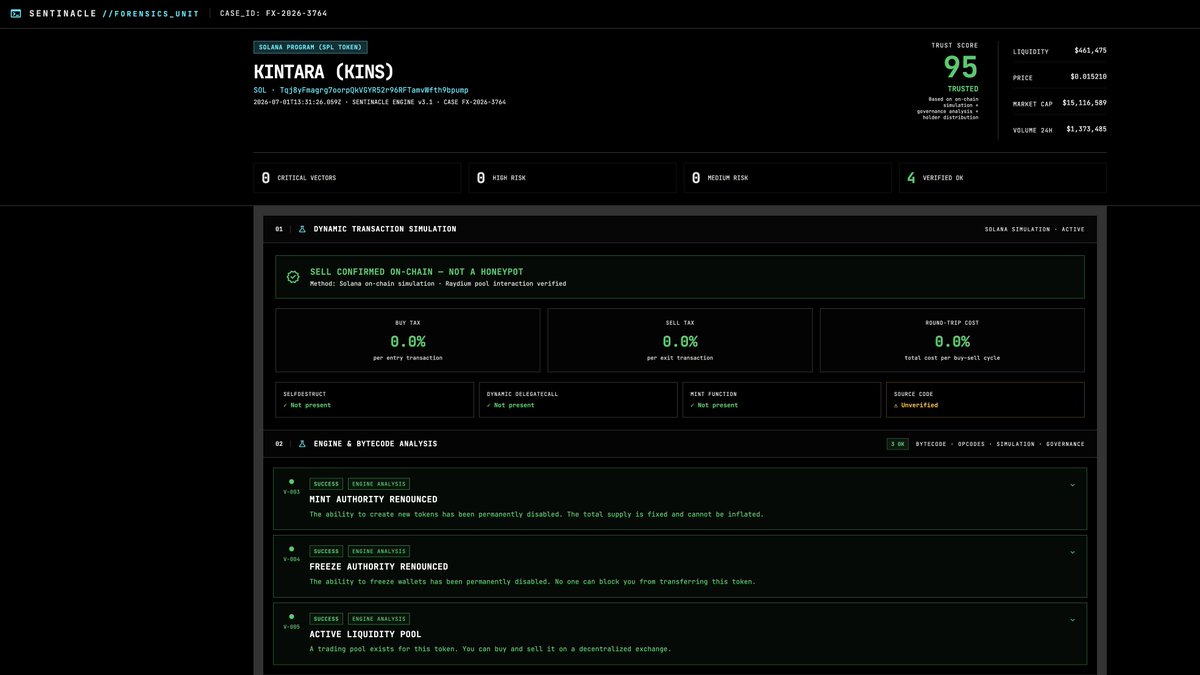
On-chain telemetry for Kintara ($KINS): A browser-based MMO driving ~20k monthly active users on Solana, currently sitting at a ~$15M market cap. 🧵
Our latest crypto risk assessment rates the $KINS architecture at 95/100 (Trusted). This presents a highly compliant structure, contrasting sharply with the typical volatility and contract risks found in emerging GameFi economies.
Forensic dissection of the SPL Token contract:
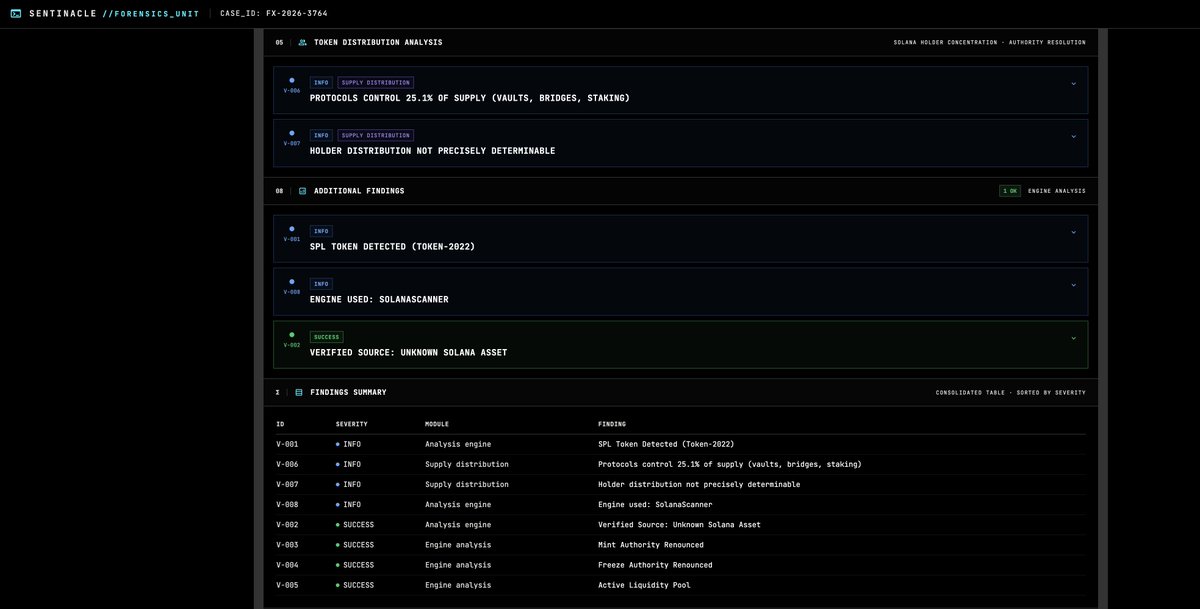
• Mint & Freeze Authority: Permanently renounced. The total supply is strictly fixed, and wallet blacklisting is impossible.
• Dynamic Simulation: 0% buy/sell tax. Live fork simulations confirm standard routing with zero honeypot mechanics or hidden transfer fee extraction.
• Liquidity & Supply: $461K active LP depth. Protocols currently control 25.1% of the token supply (vaults, bridges, staking).
Institutional Insight: For LPs and asset allocators, the permanent renunciation of unilateral control vectors fundamentally de-risks the asset from primary rug-pull mechanics.
Because the source code remains unverified, our DeFi smart contract audit relied strictly on bytecode heuristics—no malicious opcodes or hidden self-destruct logic were detected.
Residual risks here are standard for active on-chain gaming assets, but the core token architecture remains robust and mathematically restricted from developer interference.
How are LPs weighing this locked governance architecture against the unverified bytecode tradeoff?
Telemetry only. NFA. #SmartContracts #OnChainAnalysis #Solana #DeFi #CryptoSecurity #OnChain #SmartContracts #RugPull #DeFiRisk
$AIN
Infinity Ground AI ($AIN) is scaling within the BNB Chain ecosystem as an AI-driven entertainment and content generation network.
At a $28.5M market cap with $1.92M in liquidity, it’s catching volume. But what does the underlying logic actually dictate? 🧵
For teams conducting a DeFi smart contract audit, Sentinacle telemetry assigns $AIN a Trust Score of 87/100 (Trusted).
Live network fork simulations (Anvil) execute cleanly. Zero honeypot properties detected, and entry/exit taxes are verified at 0.0%.
The governance architecture is where the risk model gets nuanced. The contract maintains active mint() and addMinter() functions.
However, control isn't held by a standard externally owned account (EOA).
Ownership is secured by a 2/3 Gnosis Safe multisig. This heavily mitigates the risk of a single-key compromise, though the token supply remains structurally inflatable if consensus is reached among the signers.
A critical focal point for any thorough crypto risk assessment here is liquidity distribution.
Currently, 100% of the LP is controlled by an unknown wallet. Paired with a newly created deployer address, this is a highly centralized liquidity vector typical of early-stage protocol rollouts.
Ultimately, the architecture meets standard security requirements for active, managed governance. LPs are relying on the operational security of the multisig signers rather than immutable execution.
How are you weighing Gnosis Safe-governed mint functions against hard-capped supply models in the current market?
Telemetry only. NFA. #SmartContracts #OnChainAnalysis #BSC #DeFi #CryptoSecurity #OnChain #SmartContracts #RugPull #DeFiRisk
$SYN
Sentinacle Forensics Unit: Architectural Analysis 🧵 Asset: Synapse (SYN) | Sector: Cross-Chain Liquidity Infrastructure
Synapse operates as a foundational bridge routing billions in volume across EVM and non-EVM ecosystems. Market perception is strong, aligning with our Sentinacle Trust Score of 95/100, which indicates a highly compliant, institutional-grade architecture.
However, a rigorous DeFi smart contract audit reveals structural nuances beneath the surface metrics that require precise pricing by liquidity providers.
The telemetry highlights a classic governance dichotomy. While surface-level analysis shows contract ownership is definitively "renounced"—a standard signal for decentralization—our engine detected an active EIP-1167 Upgradeable Proxy and a live Mint Authority.
In complex bridge architectures, "renounced ownership" on an implementation contract can be a mirage. If a proxy admin or an isolated minter role retains the power to alter logic or inflate token supply at will, the protocol is decidedly not immutable.
We also isolated a TIMESTAMP_GATE pattern in the compiled bytecode. While typically utilized for phased network rollouts or vesting schedules, time-gated logic natively creates execution windows that could be leveraged to restrict operations if governance is compromised.
For institutional capital running a comprehensive crypto risk assessment, this data alters the threat model. You are not relying on strict code immutability; you are explicitly trusting the operational security of the multi-sig or DAO controlling the proxy upgrades and minting keys.
How are LPs currently weighing the trade-off between proxy upgradeability (which is crucial for patching cross-chain bridges) and the centralization risks of active minting roles?
Telemetry only. NFA. #SmartContracts #OnChainAnalysis #Ethereum #DeFi #CryptoSecurity #OnChain #SmartContracts #RugPull #DeFiRisk
$RE
Re Protocol ($RE) is positioning itself as a bridge between multi-trillion-dollar traditional reinsurance markets and DeFi liquidity. At a $138M market cap, the infrastructure is scaling, but the architectural telemetry requires a precise read.
Our Sentinacle Trust Score evaluates $RE at 50/100 (Moderate Risk). The broader market prices this as a breakout RWA utility, but our crypto risk assessment reveals a more nuanced on-chain reality.
Forensic Dissection:
• Governance: Contract ownership is permanently renounced. Nobody can unilaterally alter rules or pause the system.
• Architecture: Verified Solidity source operating via a standard EVM Proxy (EIP-1967).
• Liquidity (Critical): 99.4% of the $892k liquidity pool is controlled by a single, unknown wallet.
• Bytecode Anomaly: The implementation utilizes a TIMESTAMP_GATE—time-based logic capable of restricting buy/sell operations to specific windows.
For risk managers finalizing a DeFi smart contract audit, the structural contrast is significant.
Core governance is locked and trustless, yet market liquidity remains hyper-centralized. The presence of a TIMESTAMP_GATE alongside an overwhelmingly dominant LP wallet introduces execution risk during peak volatility.
How are LPs weighing immutable governance guarantees against highly concentrated liquidity models in emerging RWA architectures?
Telemetry only. NFA.
#SmartContracts #OnChainAnalysis #DeFi #Ethereum
#CryptoSecurity #OnChain #SmartContracts #RugPull #DeFiRisk
$AIX
Immutability at the contract level does not neutralize market-side liquidity vulnerabilities. Reviewing the on-chain architecture of Ai Xovia (AIX).
AIX operates on Solana, positioning itself as an AI-driven hybrid intelligence ecosystem with a ~$50M market cap. While the market narrative focuses on autonomous trade signals and "Momentum Engine" buybacks, institutional participants require a concrete crypto risk assessment to evaluate the underlying mechanics.
Sentinacle Trust Score: 65/100 (Low - Manageable Risk).
A targeted DeFi smart contract audit of the AIX asset confirms positive baseline security. Both Mint and Freeze authorities have been permanently renounced. The core SPL token logic is locked, successfully preventing unilateral supply inflation or targeted asset freezing by administrators.
Our forensic dissection, however, highlights significant structural concentration. On-chain telemetry identifies that 26.8% of the total supply is controlled directly by protocols, including vaults and staking contracts.
Crucially, the analysis engine flagged a High-severity finding regarding market mechanics: the active on-chain liquidity pool shows a depth of just $100, with absolutely no LP lock or burn mechanisms detected.
For risk managers, this architecture means the primary threat vector is not a smart contract exploit, but asymmetric liquidity risk. Unlocked LP tokens allow providers to withdraw liquidity at any moment, creating conditions for extreme slippage when measured against the protocol's 26.8% supply overhang.
How are liquidity providers and allocators weighing this disparity between renounced contract authority and extremely shallow, unlocked liquidity pools?
Telemetry only. NFA.
#OnChainAnalysis #SmartContracts #Solana #CryptoSecurity #OnChain #SmartContracts #RugPull #DeFiRisk #DeFi
Spot on. Exploiting non-standard transfers to bypass AMM accounting mid-execution is a critical structural flaw. Are basic liquidity pairs inherently too fragile for custom token mechanics?
I want to make it very clear that it is in no way investment advice.
#DeFi #CryptoSecurity #OnChain #SmartContracts #RugPull #DeFiRisk
A textbook inflation attack on legacy architecture. Static analysis confirms the 3 wei totalSupply was intentionally left to manipulate exchange rate rounding via crafted mints. Are other "retired" vaults remaining silently exposed across the ecosystem?
#DeFi#CryptoSecurity #OnChain #SmartContracts #RugPull #DeFiRisk
$STG
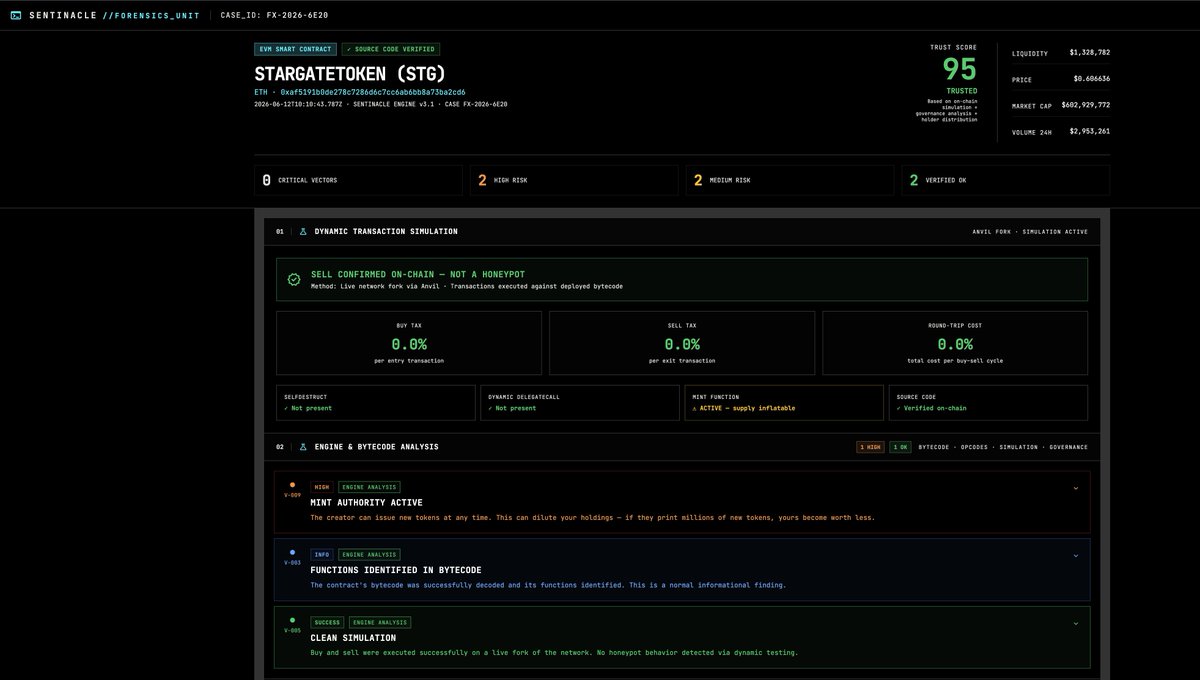
Stargate Finance ($STG) operates as the flagship omnichain liquidity transport protocol on LayerZero. With a $602M market cap and commanding cross-chain transfer volume, its token contract architecture reveals how blue-chip DeFi manages active protocol control.
In our latest crypto risk assessment, Sentinacle assigned $STG a 95/100 Trust Score. This aligns with the broad market perception of its operational security, yet our automated telemetry flags key structural nuances that liquidity providers should actively monitor.
Our forensic dissection of the EVM bytecode highlights two distinct architectural realities:
• Mint Authority Active: The token retains an active mint function. While this is a standard mechanism for emitting yield farming rewards and managing cross-chain liquidity rebalancing, it represents a theoretical dilution vector if the controlling entity is compromised.
• Governance Control: Ownership has been transferred from a fresh deployer wallet to an unidentified contract (0xbe634B03...). In modern protocol design, this typically indicates a DAO timelock or multi-sig taking control—replacing single-signature vulnerability with governance-driven execution.
A live dynamic transaction simulation on an Anvil network fork confirmed 0.0% entry and exit taxes. The absence of honeypot mechanics or hidden dynamic opcodes verified that the bytecode matches the published Solidity source perfectly.
Institutional Insight: When performing a comprehensive DeFi smart contract audit for capital allocation, pure code vulnerabilities are only half the picture. For $STG, the base architecture is fundamentally clean. The residual risk profile shifts entirely from technical smart contract exploits to governance execution and the active monitoring of mint events.
How are institutional LPs pricing in the risk of active mint authorities when farming omnichain protocol yields?
Telemetry only. NFA. #SmartContracts #OnChainAnalysis #DeFi #LayerZero #CryptoSecurity #OnChain #SmartContracts #RugPull #DeFiRisk
$POWER
On-chain telemetry for POWER (POWER) on Ethereum reveals a stark architectural divergence between asset valuation and foundational liquidity.
Case FX-2026-2354 establishes a Sentinacle Trust Score of 77/100 (Moderate Risk), driven by structural centralization vectors despite an $18.49M market cap.
🧵 A technical forensic dissection for risk managers:
Governance Architecture: Ownership is unrenounced but assigned to a 3/5 Gnosis Safe multisig. While this prevents single EOA compromise, it currently lacks a defensive timelock.
Supply Dynamics: Engine and bytecode analysis identifies an active mint authority (V-010). The contract owner retains the technical capability to inflate supply at will.
Our crypto risk assessment flags a severe liquidity mismatch: the pool depth sits at just $36,927, paired with a low 24-hour volume of $29,613.
This thin liquidity profile precluded dynamic transaction simulation on network forks, restricting the DeFi smart contract audit to static bytecode evaluation.
While the verified Solidity source code lacks freeze or blacklist functions, the fresh deployer wallet architecture requires continuous monitoring of mint events.
For asset allocators, the primary exposure is potential supply dilution paired with high execution slippage, rather than an immediate, malicious exploit vector.
How are risk desks pricing protocols that combine multi-sig governance architecture with highly asymmetric on-chain liquidity analysis parameters?
Telemetry only. NFA.
#SmartContracts #OnChainAnalysis #Ethereum #DeFi #CryptoSecurity #OnChain #SmartContracts #RugPull #DeFiRisk
Spot on. Static analysis of the inherited DN404 logic confirms the flaw propagated via the fork, mirroring the Flooring execution path.
Are we underestimating the contagion risk of unverified forks?
#DeFi#CryptoSecurity#OnChain#SmartContracts#RugPull#DeFiRisk
$KEKIUS
On-chain forensic analysis of Kekius Maximus (KEKIUS). A $26.3M market cap EVM asset presenting a structural dichotomy for liquidity providers. 🧵
Operating with $194k in on-chain liquidity, KEKIUS registers a Sentinacle Trust Score of 68 (Moderate Risk).
Initial dynamic transaction simulations against deployed bytecode are clean. We mapped 0% entry and exit taxes with verified round-trip execution via an Anvil live fork.
While structurally not a honeypot, a deeper crypto risk assessment reveals conflicting governance parameters. Standard contract ownership has been renounced.
Despite this renunciation, our engine analysis isolated an active mint authority. The capability to unilaterally inflate supply remains intact, bypassing standard administrative safeguards.
Compounding this architecture, 100% of the active Liquidity Pool is currently controlled by a single, unknown wallet.
For institutions conducting a rigorous DeFi smart contract audit, this specific combination requires active monitoring. The lack of decentralized governance, paired with absolute LP concentration, creates an asymmetric risk profile for participants.
How do your internal risk frameworks weight the balance between renounced base administrative controls and singular LP centralization?
Telemetry only. NFA. #SmartContracts #OnChainAnalysis #Ethereum #DeFi
$SPCX
Ethereum's early-stage speculative markets demand rigorous architectural scrutiny. As part of a standard crypto risk assessment, let’s evaluate the contract structure of SPACEX4200 ($SPCX)—an Ethereum-based asset positioned around the narrative of preemptively capturing the ticker for a potential SpaceX IPO.
Currently operating at a ~$902k market capitalization with $111k in liquidity depth, the asset's structural reality aligns closely with its broader market perception. The Sentinacle engine returns a 95/100 Trust Score, classifying the framework as a "Compliant Architecture."
Our automated DeFi smart contract audit highlights several specific technical hallmarks:
• Governance Vector: Ownership is permanently renounced. With no active controller or privileged admin functions, the risk of unilateral logic manipulation or forced pauses is neutralized.
• Liquidity Integrity: The token's liquidity pool (currently at a $111,683 depth) is fundamentally locked, with the LP tokens 100% permanently burned and verified on-chain.
• Transaction Simulation: Dynamic execution against deployed bytecode via an Anvil live network fork confirms a clean state. The EVM smart contract enforces a 0% buy and 0% sell tax, with zero honeypot mechanics detected.
• Source Verification: The on-chain source code perfectly matches the published Solidity bytecode.
For liquidity providers and risk managers navigating high-beta tokens, these immutable parameters are foundational. The combination of centralized governance removal and a permanently burned LP effectively shifts the token's risk profile away from malicious developer action and squarely onto open-market dynamics.
How do institutional LPs weigh these structural, on-chain guarantees against the inherent volatility of narrative-driven tokens?
Telemetry only. NFA.
#SmartContracts #OnChainAnalysis #Ethereum #DeFi
#CryptoSecurity #OnChain #SmartContracts #RugPull #DeFiRisk
$JOTCHUA
Solana's liquidity velocity is pushing SPL assets like JOTCHUA ($JOTCHUA) into rapid valuation phases, currently sitting at a $5.7M market cap with over $5.3M in 24-hour volume. 🧵
While retail market perception is largely driven by its meme-culture roots and recent centralized listings, our crypto risk assessment isolates the underlying mechanics.
The asset holds a Sentinacle Trust Score of 95/100, indicating a fundamentally compliant and standard token architecture.
Our DeFi smart contract audit of the Token-2022 deployment reveals textbook protocol adjustments that mitigate immediate rug vectors.
• Mint and Freeze Authorities: Permanently renounced.
• Buy/Sell Taxes: Hardcoded at 0%.
• Dynamic Simulation: Clean execution on a live Anvil fork.
However, the primary architectural trade-off lies in contract transparency.
Source code remains unverified. We are relying entirely on bytecode analysis and opcode heuristics via SolanaScanner.
While on-chain simulation clears standard honeypot flags, unverified bytecode means arbitrary hidden logic cannot be absolutely ruled out.
From an institutional perspective, the liquidity profile—currently at a $284K depth—requires active management.
Supply distribution is fairly decentralized: 25.9% is actively controlled by protocols (vaults, bridges), and the top individual holder commands just 2.5%.
Crucially, no LP lock or burn is detected. Liquidity providers retain the ability to withdraw at any time, transferring exit risk to late participants.
For risk managers and LPs, it is a classic scenario of perfectly decentralized token authorities paired with opaque bytecode execution.
How do you weigh the risk of unverified SPL bytecode against permanently renounced governance privileges?
Telemetry only. NFA. #SmartContracts #OnChainAnalysis #Solana #DeFi #CryptoSecurity #OnChain #SmartContracts #RugPull #DeFiRisk
$ESPORTS
Contract architecture is only half the security equation. A compliant EVM deployment doesn't negate the risks of structural centralization. 🧵
Mapping the telemetry on Yooldo Games ($ESPORTS) on BSC. Powering GameFi matchmaking and rewards, the token currently holds a $13.8M market cap with $1.44M in liquidity. It recently drew market attention following external on-chain scrutiny over vested token movements.
The Sentinacle Trust Score rates the contract highly at 87/100 (Trusted). It easily passes dynamic transaction simulation on a live Anvil fork, confirming 0% buy/sell taxes, clean simulation, and verified Solidity source code.
Yet, a deeper forensic dissection of the underlying tokenomics reveals severe operational bottlenecks:
• Liquidity Concentration: 96.4% of the LP is completely controlled by a single, unknown wallet. • Supply Mechanics: Mint authority remains active in the bytecode. The token supply is strictly inflatable. • Control Vectors: Initiated by a fresh deployer wallet, ownership is currently secured via a 2/3 Gnosis Safe multisig. While this mitigates single-key compromise, these signers control the protocol's global pause() function.
For institutions running a rigorous crypto risk assessment, standard execution checks are insufficient. A standard DeFi smart contract audit might clear the code syntax, but a mathematically "clean" token remains operationally fragile when near-total liquidity dominance and active minting power sit behind anonymous signers.
How are LPs currently weighing the foundational security of a 2/3 Gnosis Safe against the active risk of 96% LP concentration and an inflatable supply?
Telemetry only. NFA. #SmartContracts #OnChainAnalysis #BSC #DeFi #CryptoSecurity #OnChain #SmartContracts #RugPull #DeFiRisk