The Layer 1 structural diagnosis is public; operational intelligence requires credentials. Access the terminal to unlock the integral forensic dossier: 🔗 https://t.co/GAAD1TNRKg
$SINGULARRY
Unverified EVM bytecode and an unrenounced single EOA are silently masquerading as a decentralized asset. 🧵
Singularry (SINGULARRY) commands a $34.8M market capitalization on BSC, yet the on-chain reality dictates extreme structural caution.
The Sentinacle Trust Score bounds this asset at 59/100 (Verdict: Low – Manageable Risk), starkly contrasting with any market assumptions of operational safety.
Executing a comprehensive DeFi smart contract audit is fundamentally blocked here.
The contract’s source code remains unpublished and unverified on-chain.
Our forensic engine (Case FX-2026-2817) was forced to rely exclusively on static EVMScanner bytecode analysis, meaning hidden execution logic cannot be ruled out.
The governance architecture is entirely centralized. Control resides with a single EOA (0x46efc530...).
One isolated private key holds absolute administrative power.
This creates a textbook single point of failure. The owner can modify fees, pause transfers, and update critical parameters with zero community consensus.
Furthermore, dynamic transaction simulation failed outright due to an extraordinarily fragile $228,000 liquidity depth relative to its valuation.
For an institutional crypto risk assessment, the baseline is clear: Singularry currently operates as a centrally controlled system, not a fully immutable smart contract.
While static analysis detected no immediate honeypot vectors or blacklists, this specific architectural pattern is historically linked to high-impact DeFi incidents.
Are you accurately pricing the risk of unverified code governed by a single private key?
Telemetry only. NFA.
#SmartContracts #OnChainAnalysis #BSC #DeFi #CryptoSecurity #OnChain #SmartContracts #RugPull #DeFiRisk
$BP
99.8% of the supply is consolidated within exactly 10 wallets, yet retail liquidity floods the order books blindly. 🧵
Sentinacle engine flags Backpack ($BP) with a terminal Trust Score of 10/100 (High Risk).
The broader market is aggressively pricing in the announcement of Backpack Securities and tokenized stocks, heavily discounting the underlying asset architecture.
On-chain diagnostics reveal a heavily centralized ledger structure.
Top holder commands 75.0% of the total supply.
Mint Authority is explicitly active, allowing arbitrary supply inflation.
Freeze Authority is active, granting unilateral transfer restrictions over any wallet.
At first glance, a standard DeFi smart contract audit flags this as a critical threat scenario. However, structural reality demands a nuanced view.
$BP operates as centralized exchange infrastructure on Solana. These active functions are not a hidden vulnerability; they represent necessary regulatory compliance guardrails and long-term vesting tranches for an institutional entity.
Executing a rigorous crypto risk assessment reveals that LPs are not trusting immutable code here—they are placing absolute trust in the Backpack team's operational security, legal compliance, and future emission schedule.
Are you accurately pricing the future dilution risk, or simply chasing the initial unlock volatility?
Telemetry only. NFA.
#SmartContracts #OnChainAnalysis #Solana #DeFi #CryptoSecurity #OnChain #SmartContracts #RugPull #DeFiRisk
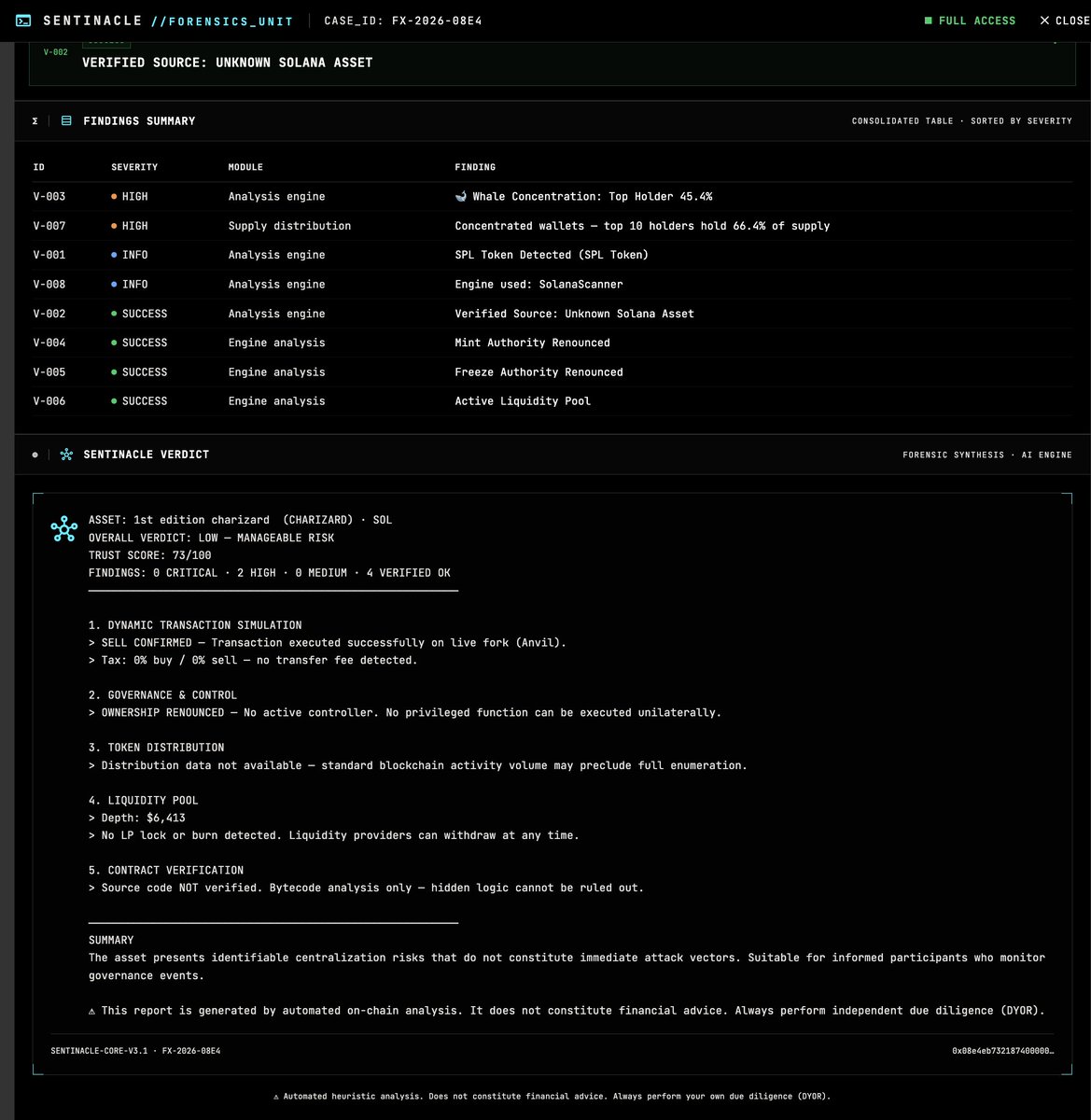
$CHARIZARD
45.4% of the total supply is held by a single apex wallet, while the top 10 entities control a staggering 66.4%. 🧵
1st Edition Charizard ($CHARIZARD) on Solana is running dangerous structural velocity.
We are tracking $144k in 24h volume operating against a microscopic $6,413 liquidity pool.
The Sentinacle Trust Score registers at 73/100 (Moderate Risk). Surface-level telemetry appears benign to retail scanners.
A standard DeFi smart contract audit shows expected safety toggles: Mint authority is strictly renounced. Freeze authority is permanently disabled.
Dynamic transaction simulation on our live Anvil fork confirms a 0% buy/sell tax. The routing is clear.
However, an institutional crypto risk assessment reveals critical hidden leverage.
The source code remains unverified on-chain. We are dealing with raw bytecode analysis.
Combined with unlocked LP tokens and critical holder concentration, the centralization vectors are severe. The protocol's stability relies entirely on the benevolence of one whale.
Are you deploying capital into a pool where a single entity can obliterate the $6k depth in one block?
Telemetry only. NFA. #OnChainAnalysis #SmartContracts #Solana #DeFi #CryptoSecurity #OnChain #SmartContracts #RugPull #DeFiRisk
$BoysClub
The underlying bytecode architecture registers a definitive 95/100 Sentinacle Trust Score. 🧵
Asset: Boy's Club (BoysClub) Network: Solana (Token-2022) Liquidity / Market Cap: $47,717 / $377k Market Role: Micro-Cap Speculation
A rigorous DeFi smart contract audit of the deployed bytecode reveals a deliberate architectural hardening.
The forensic mapping is binary: both Mint and Freeze authorities have been permanently renounced. The supply is fixed, and wallet blacklisting is structurally impossible.
Dynamic simulation on a live Anvil fork confirms standard 0% buy and 0% sell tax mechanics.
There are no hidden delegate calls. Zero honeypot vectors were detected in the immediate execution paths.
However, the critical vulnerability lies strictly in the capital structure.
There is zero LP lock or burn present. Liquidity providers retain total withdrawal autonomy over the active pool.
For a precise crypto risk assessment, this alters the threat matrix. The risk here is no longer algorithmic or contract-based; it is entirely behavioral.
The $47.7k liquidity depth can be pulled by LP providers at any given millisecond.
Are you comfortable deploying capital into a fully renounced asset when the underlying liquidity remains entirely unanchored?
Telemetry only. I want to make it very clear that it is in no way investment advice.
#SmartContracts #OnChainAnalysis #Solana #DeFi #CryptoSecurity #OnChain #SmartContracts #RugPull #DeFiRisk
The Layer 1 structural diagnosis is public; operational intelligence requires credentials. We invite you to access the terminal to unlock the integral forensic dossier: 🔗 https://t.co/GAAD1TNRKg
$PORTAL
A $37.1M market valuation suspended over a mere $9,759 in structural liquidity presents an immediate, brutal asymmetry. 🧵
While the prevailing narrative elevates PORTAL (PORTAL) on Ethereum, a comprehensive DeFi smart contract audit yields a profoundly sobering reality.
Sentinacle’s forensics definitively assign PORTAL a 48/100 Trust Score, sitting in stark contrast to its inflated market capitalization.
We invite you to examine the structural realities beneath the surface. Case FX-2026-6BA8 isolates several critical vectors within the compiled bytecode:
A fresh deployer wallet established moments before launch.
Unrestricted, active minting capabilities allowing unilateral supply inflation.
Hardcoded TIMESTAMP_GATE and TIMESTAMP_LOCK logic.
Unrenounced ownership, currently managed by a 3/5 Gnosis Safe.
A nominal multisig provides the illusion of safety, but the underlying architecture reveals a carefully engineered control mechanism.
The combination of programmable time-restrictions and infinite mint capacity transforms this token from a standard asset into a highly restrictive environment.
For discerning allocators navigating a thorough crypto risk assessment, the implications are unforgiving.
The deployer retains the absolute power to dictate operational trading windows and dilute the supply at will, directly against microscopic exit liquidity.
Are liquidity providers accurately pricing the true cost of exiting when the fundamental mechanics are designed to gatekeep capital?
Telemetry only. I want to make it very clear that it is in no way investment advice.
#SmartContracts #OnChainAnalysis #Ethereum #DeFi #CryptoSecurity #OnChain #SmartContracts #RugPull #DeFiRisk
$BAS
A $66.7M market cap and a 95/100 Sentinacle Trust Score, yet the underlying smart contract remains an unverified black box.
BNB Attestation (BAS) on BSC is pushing $4.4M in daily volume while securing $2.05M in active liquidity.
Superficially, the architecture appears compliant. Governance checks pass, and ownership is definitively renounced.
But forensic dissection reveals a critical High-Risk anomaly: the source code is not verified on-chain.
We are restricted to analyzing raw EVM bytecode (0x6080604052600436101561001357600080FD5b60009081...).
Furthermore, dynamic transaction simulation failed due to insufficient fork liquidity, forcing honeypot detection to rely entirely on static heuristic scanning.
Any rigorous crypto risk assessment mandates verifiable, open-source logic before deployment.
A renounced contract is functionally irrelevant if the hidden bytecode contains dormant, malicious architecture.
Even the most comprehensive DeFi smart contract audit cannot guarantee execution parity without on-chain verification.
Are you deploying capital into unverified bytecode just because the creator renounced ownership?
Telemetry only. NFA. #SmartContracts #OnChainAnalysis #BSC #DeFi #CryptoSecurity #OnChain #SmartContracts #RugPull #DeFiRisk
$MONJI
Source code remains entirely unverified, yet dynamic on-chain execution confirms a 95/100 structural integrity score.
$MONJI operates as an SPL token on Solana. Current market cap sits at $12.2M, supported by a relatively thin $69.1k in active liquidity.
Standard DeFi smart contract audit methodologies often halt at unverified bytecode. We bypassed this barrier via live network fork simulations using Anvil.
The telemetry is definitive: 0% entry and exit taxes with successful round-trip execution. On-chain routing confirms this is not a honeypot.
Architectural controls have been neutralized. Both Mint and Freeze authorities are permanently renounced. The total supply is strictly fixed, and unilateral wallet blacklisting is cryptographically impossible.
For an institutional crypto risk assessment, the primary vector here isn't malicious governance or supply concentration—the top holder commands a mere 2.5%.
The actual risk is capital depth. No LP lock or burn was detected. Liquidity providers retain the capacity to withdraw at will.
Does an immutable SPL architecture outweigh the residual risk of unverified source code and unlocked liquidity for your deployment?
Telemetry only. NFA. #Solana #DeFi #SmartContracts #OnChainAnalysis #DeFi #CryptoSecurity #OnChain #SmartContracts #RugPull #DeFiRisk
solana:2RWndXkxWkaKhGjE7dZivVbK5qXtpwnCZJ1jpnxapump
Source code remains entirely unverified on-chain, yet the bytecode architecture commands a pristine 95/100 Trust Score. 🧵
Asset: HOPPY (solana:2RWndXkxWkaKhGjE7dZivVbK5qXtpwnCZJ1jpnxapump) Network: Solana (SPL Token-2022) Market Cap: $1.24M Liquidity Depth: $102k
Despite trading $5.8M in 24-hour volume, market participants are effectively operating blindly regarding the underlying source code.
Our internal crypto risk assessment bypassed this obfuscation via live Anvil fork dynamic transaction simulation.
The forensic dissection is definitive: • 0% buy/sell tax confirmed on-chain. • Mint authority: Permanently renounced. • Freeze authority: Renounced (wallet blocking disabled). • Top holder concentration: A highly distributed 4.1%.
From a DeFi smart contract audit perspective, the institutional insight here is clear: the most critical malicious vectors—unilateral inflation and honeypotting—are structurally neutralized at the bytecode level.
However, the residual risk lies entirely in capital retention.
There is no LP lock or burn detected on the active liquidity pool. Liquidity providers can unilaterally withdraw their $102,087 at any given moment.
You are trading structural safety against an ever-present liquidity flight risk.
Are you actively pricing in the unlocked LP risk when the base architecture runs this clean?
Telemetry only. NFA. #SmartContracts #OnChainAnalysis #Solana #DeFi #CryptoSecurity #OnChain #SmartContracts #RugPull #DeFiRisk
The Layer 1 structural diagnosis is public; operational intelligence requires credentials. Access the terminal to unlock the integral forensic dossier: 🔗 https://t.co/GAAD1TNRKg
solana:SLXdx4BUt2v9uJQNzWqSfzTJ9UKLUDsvxHFMEEdrfgq
97.2% of the total supply is isolated within just ten wallets, yet this asset commands a $220.3M market cap.
Solstice (solana:SLXdx4BUt2v9uJQNzWqSfzTJ9UKLUDsvxHFMEEdrfgq) is operating as a standard SPL token, but the underlying distribution architecture is violently skewed.
Retail sees a high-volume Solana asset. Our Sentinacle Trust Score outputs a brutal 38/100.
Forensic dissection shows passing grades on basic governance: Mint and Freeze authorities are permanently renounced.
Live Anvil fork simulation confirms sells execute normally with zero transfer taxes. It is not a standard routing honeypot.
However, the source code remains completely unverified. We are executing a crypto risk assessment strictly on bytecode. Hidden logic cannot be ruled out.
There is a critical structural imbalance. There is only $200K in active liquidity backing a $220M valuation.
With the top holder controlling 36.8% of the supply, LPs are heavily exposed to unilateral extraction. A standard DeFi smart contract audit cannot mitigate pure distribution hazards.
Are you pricing in the fact that a single whale could instantly drain the entire liquidity pool with one transaction?
Telemetry only. NFA.
#OnChainAnalysis #SmartContracts #Solana #DeFi #CryptoSecurity #OnChain #SmartContracts #RugPull #DeFiRisk
An unknown contract named 'SquidRouterModule' was reportedly exploited on #Ethereum due to improper input validation, resulting in ~$3M in losses. @squidrouter has clarified that this incident is unrelated to Squid’s core protocol/contracts.
The root cause appears to be misuse of the Axelar Bridge, similar to the previous @crosscurvefi attack pattern (https://t.co/dIoTEpFQJL). The attacker (0xe1d5...3265) forged malicious calldata and abused approval permissions granted via PermissionManager (0x03B8...4cB7) to force token approvals from victims to Uniswap.
Using these malicious approvals, the attacker swapped victims’ assets for fake tokens (0xe6Ff...3512) through Uniswap pools and profited.
$PYTHIA
39.4% of the total supply sits in just ten wallets, yet the underlying operational architecture passes our live-fork simulations flawlessly.
PYTHIA ($PYTHIA) commands $1.3M in active liquidity on Solana, operating at a $32.6M market cap valuation.
Our latest crypto risk assessment yields a Sentinacle Trust Score of 95/100. Structurally trusted, but distribution requires strict monitoring.
Forensic dissection of the SPL architecture confirms a sterile, compliant environment.
We executed dynamic transaction simulations against deployed bytecode via Anvil. Zero entry taxes. Zero exit taxes. Round-trip execution confirmed. Not a honeypot.
Governance controls have been thoroughly neutralized. Both mint and freeze authorities are permanently renounced, hardcapping the supply and guaranteeing transferability.
However, a comprehensive DeFi smart contract audit must look beyond static bytecode.
The source code remains unverified on-chain. While the opcodes show no malicious logic, hidden mechanisms cannot be definitively ruled out without decompilation.
More critically for risk managers: the $1.3M active liquidity pool has no detected locks or burn mechanisms. Providers can unilaterally withdraw depth at any given block.
The technology will not restrict your execution, but the concentration curve poses a distinct market risk. The top single holder controls 17.8% of the float alone.
Are you pricing in this holder density against the pristine execution environment?
Telemetry only. NFA.
#SmartContracts #OnChainAnalysis #Solana #DeFi #CryptoSecurity #OnChain #SmartContracts #RugPull #DeFiRisk