@desitechsuppoat@CyberGreen09@USDOL@DOLOIG@USCIS@ICEgov Add VYOM DONUT MANAGEMENT to the list, his other LLC for managing his Louisville Dunkin franchise where he also got another H1B visa. It was easily to link to his home in Paramus, NJ
Being inside the US does NOT mean “law and order.”
The government has documented H-1B fraud involving fake jobs, shell companies, wage theft, illegal benching, kickbacks, and retaliation.
That’s literally part of the problem: the program is here, under US law, and still gets gamed constantly.
Yes misuses are widespread, which is why it makes sense at this point either revamp the H-1B program or kill it entirely.
This study is garbage.
It basically says that if foreign STEM workers disappear, that companies just… leave the jobs empty. For a decade.
No higher wages. No domestic hiring. No training. No replacing workers. No automation.
Only someone who’s never run anything could claim with a straight face that companies just shrug and leave jobs unfilled when foreign workers disappear.
Researchers found that a one-third decline in U.S-trained foreign STEM workers would shrink GDP so much that it would be equivalent to losing the entire economy of South Carolina, Utah, or Wisconsin. Why are Republicans acting like that’s a win? https://t.co/eEmjUnK1Ts
But importing the workforce doesn’t solve the dependency problem. It just relocates the dependency inside the United States.
If firms fill entry and mid-level positions through foreign labor instead of developing domestic workers, you create a feedback loop: Americans find entry-level opportunities harder to get → fewer people bother entering or staying in the field → domestic experience pipelines weaken → employers say they “can’t find talent” → employers demand more foreign workers → repeat.
If companies were really just going to offshore these jobs anyway, why they fighting so hard to keep H1B?
They can already hire people in India, Brazil, Canada, wherever.
They want H-1B because they want those workers here, inside the US labor market.
So they'll “just hire overseas” is not the same thing. The argument defeats itself
🚨 HOLY SMOKES. ICE has just announced a jaw-dropping fraud bust, saying 10,000 FOREIGN students are involved in the federal government's Optional Practical Training
There are EMPTY BUILDINGS where HUNDREDS of students should be "working" as part of their ability to be in America — run by foreign-linked groups that send money out of the country!
Locked doors, hundreds of students sharing the SAME ADDRESS, and "employers" sharing the same unleased addresses
There is a widespread "phantom employee" fraud going on. This is insane.
Many of the so-called "employers" have major red flags, such as facing lawsuits, no employment records, offshore payroll claims, and suspicious INTERNATIONAL MONEY flows
"HSI agents have visited problematic OPT employer work sites in Virginia, Texas, Georgia, Illinois, New York, New Jersey, North Carolina, and Florida."
"Foreign students themselves are entering false addresses and employer names into the student and exchange visitor information system."
"But we are uncovering evidence of organized fraud that spans national and international borders. This is not accidental. It is deliberate, coordinated, and criminal."
"To give you an example, one employer we visited claimed to employ only three foreign students through OPT, while our records show over 500 foreign students claiming to work there."
"The company's representatives were unable to answer basic questions about the business and deferred HR managers in India."
"OPT employers are required to directly train foreign students, but we've seen multiple examples of alleged employers claiming that all management is overseas in India."
"We've also discovered multiple state networks which are large networks of alleged employers claiming to train thousands of foreign students in OPT, then farming them out to unreported third party employers, making oversight nearly impossible and raising serious national security issues."
I’m completely for bringing exceptional STEM talent here. If we genuinely have a shortage in a field, recruit the best people in the world.
That’s not the argument.
The problem is we’ve let H-1B turn into a massively exploited labor pipeline where it’s become almost impossible to separate “critical talent” from “company wants cheaper/easier hiring.”
I WANT the best here. I just don’t want a broken system pretending everyone who gets sponsored is the best.
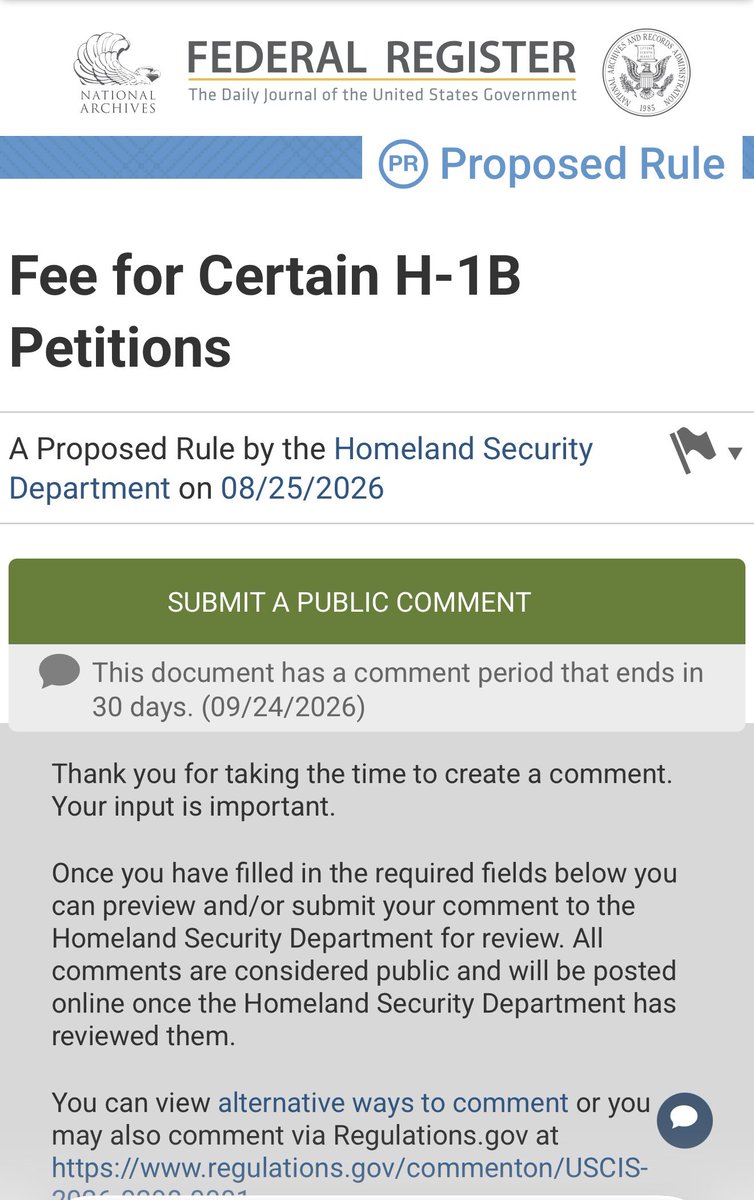
🚨 DHS is now taking public comments on its proposed new H-1B fee.
This is your chance to put something on the official record.
If you believe employers should have to seriously recruit Americans before hiring H-1B workers, SAY IT.
If you want stronger audits, better enforcement, real documentation of U.S. applicants, and more accountability, SAY IT.
If you want a higher fee, SAY IT.
Public comments matter because agencies are required to review and respond to significant issues raised during rulemaking.
Don’t just complain on X.
Put your argument into the federal record.
Comment deadline: September 24.
Docket: USCIS-2026-0298
https://t.co/1bqaYtIfYI
🚨 ANOTHER H-1B RULE JUST QUIETLY REACHED THE WHITE HOUSE.
While everyone is focused on the proposed $103,265 H-1B fee, DHS has a separate H-1B rule under review.
And this one may be even more important.
DHS says it plans to:
• Revise eligibility for H-1B cap exemptions
• Increase scrutiny of employers that violate program rules
• Increase oversight of third-party placements and staffing arrangements
The full rule is not public yet.
But here’s why this matters:
Cap-exempt H-1Bs operate outside the normal 85,000 annual cap.
They are also outside the new $103K fee proposal.
And now DHS is specifically looking at who gets to qualify for that exemption.
This could be the next major H-1B crackdown.
How much of the cap-exempt system survives once DHS starts tightening the definition?
https://t.co/eklJ4hizS8
healthcare is probably where I’m the most open to the argument. There probably are real shortages in some medical fields, esp in rural areas.
But a lot of these H-1Bs are tied to research universities, university hospitals, and other cap exempt employers, so it’s not as simple as “we need H-1B or there won’t be enough doctors.”
I think there’s probably a real shortage in parts of healthcare. I’m just not convinced the visa numbers tell us exactly how big that shortage actually is.
@DavidF1344 Exactly. And during the last $100k fee, only 85 employers actually paid it. That’s it.
The problem was companies found workarounds, like using other visa categories (L-1/L-2), and the fee didn’t apply to renewals.
So the concept works.