🚨 El IMSS canceló el registro de una empresa ficticia que simulaba tener 55 mil trabajadores. El Instituto advirtió que estos fraudes pueden afectar las semanas cotizadas y poner en riesgo el acceso a una pensión.
https://t.co/f7EapDiN61
Trump on what NATO leaders purportedly tell him behind closed doors: "They said, 'Sir, we love you!' These are grown people saying that. Isn't that nice?"
Trump es el sueño de Xi y de Putin. No hay manera que se vuelva a confiar en el gobierno gringo ni dejarles tanto control en multiples asuntos. Son unos desquiciados abusivos que tienen que tener supervisión cual Hanibal Lecter. Igual que Israel.
TRUMP: Putin said, "I'd love to meet in Moscow." I don’t know if Zelenskyy would go to Moscow. Maybe he would. Would you go to Moscow?
ZELENSKYY: It’s difficult. There are lot of Ukrainian drones there. (Audience laughs) It’s dangerous.
TRUMP: Yeah, it’s hard to go to Moscow.
Incredible WSJ reporting on how European leaders deal with Trump
-European leaders workshopped tweets to send Trump, debating which words to capitalize. They had to sound extra stupid to win over his trust.
-Trump didn't like the idea of sanctioning Russia, so they started calling sanctions "tariffs."
-When a tablet to call Trudeau didn't work, Trump threw it down like a baby.
-Trump took German leader Merz into the Oval Office, which he called the "Lewinsky room", and told him he could take away MAGA swag that he could sell for thousands of dollars.
You couldn't make this into a comedy. The straight reporting is funny enough. But really it's disgraceful and if you have any pride in your nation you should be ashamed of this.
Las Universidades para el Bienestar Benito Juárez García (UBBJG) surgieron en 2019 para atender la exclusión de miles de estudiantes de las universidades.
Menos del 50 % de los planteles cumplen el criterio de tamaño poblacional; el 64 % están en municipios con rezago social muy bajo o bajo; y solo 27 sedes, de 203, están en municipios donde más del 80 % de los habitantes se identifican como indígenas. El programa llegó a muchos lugares, pero no a los que se había propuesto alcanzar.
https://t.co/RKVnI7nDyK
La CIA trajo a los evangélicos a América Latina.
Los evangélicos llegaron a la región en los años 70. La CIA envió iglesias pentecostales conservadoras para contrarrestar tendencias católicas que consideraba comunistas.
La idea era que los pobres buscaran su salvación personal en lugar de revoluciones sociales. Desde entonces, las diferentes denominaciones evangélicas (bautistas, pentecostales, etc.) han crecido.
En América Central, los evangélicos ya son el grupo religioso más grande, con más de la mitad de la población en países como Costa Rica y Panamá. En donde menos evangélicos hay es en Argentina, Uruguay y México.
Son iglesias que en gran parte se han basado en el televangelismo de los Estados Unidos Han hecho telenovelas basadas en la Biblia, sobre todo en Brasil y actualmente saben sacar provecho de las redes como nadie.
Si te interesa el tema y quieres ver el análisis con expertos, búscanos en nuestro canal de YouTube. /cc #dwcómoteafecta
La educación basada en evidencias no significa convertir la escuela en un laboratorio frío, sino tomar mejores decisiones: combinar experiencia docente, contexto y datos rigurosos.
La IA puede ayudar mucho si sirve para detectar tendencias, anticipar riesgos y orientar políticas educativas mejor fundamentadas.
https://t.co/thgikpI3lN
Pinche fiesta del mundial ya se siente como cuando la fiesta es en tu casa pero ya te rompieron el lavabo y se robaron el tanque de gas y el vaso de la licuadora
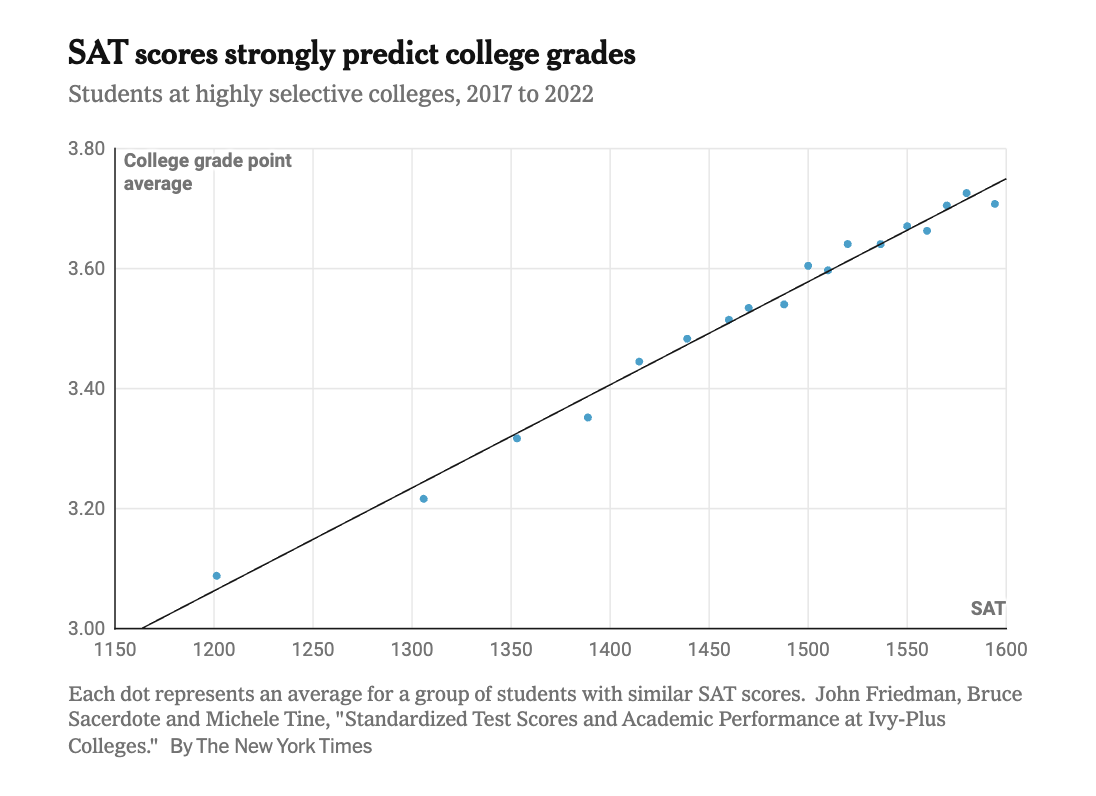
Removing standardized tests has been a disaster for many top colleges.
Seven years ago, the University of California system appointed an 18-member committee to study the use of standardized tests in its undergraduate admissions. The committee included professors from all 10 campuses and a range of disciplines. They spent a year studying the issue and published a 225-page report full of evidence and recommendations.
The committee concluded that scores on the SAT and ACT, the main standardized tests for college admissions, did a better job measuring student readiness for college than high school grades. High test scores were particularly good at finding talented students from low-income families and underrepresented minority groups. For these reasons, the committee recommended the system continue to require applicants to submit SAT or ACT scores.
The university’s leaders disregarded the report.
A few months after its release, early in the Covid-19 pandemic, the system’s Board of Regents voted to stop using the tests in undergraduate admissions. Initially, the university planned to make the submission of SAT and ACT scores optional, as many other colleges did during the pandemic. Almost immediately, though, the University of California began refusing to accept SAT or ACT scores, even from students who wanted to submit them. The policy was known as “test blind.” University leaders wrongly claimed that it would make admissions fairer and more equitable.
The results have been terrible. At the University of California, San Diego, a faculty group last year reported “a steep decline in the academic preparation” among entering students. Last fall, for example, nearly 12 percent of first-year U.C.S.D. undergraduates were not qualified to take pre-calculus, a low-level class, up from only 0.5 percent in 2020. “The key problem is that many of the students coming in do not know algebra,” said Mina Aganagic, a Berkeley physics professor. More than half of entering Berkeley students who took a math placement test incorrectly answered basic questions (such as solving for x in x²> 4). https://t.co/ZvdsWBU1sY