@natbrunell@parkeralewis I reviewed his recent appearance on WBD. Not expecting this one to be much better, but I’ll give it a listen.
https://t.co/LYXSaj4sud
@AThrouvalas Turns out I was right, even if perhaps a little disappointed, that the company will probably only execute MSTR stock buybacks when net-assets mNAV is less than 1.0
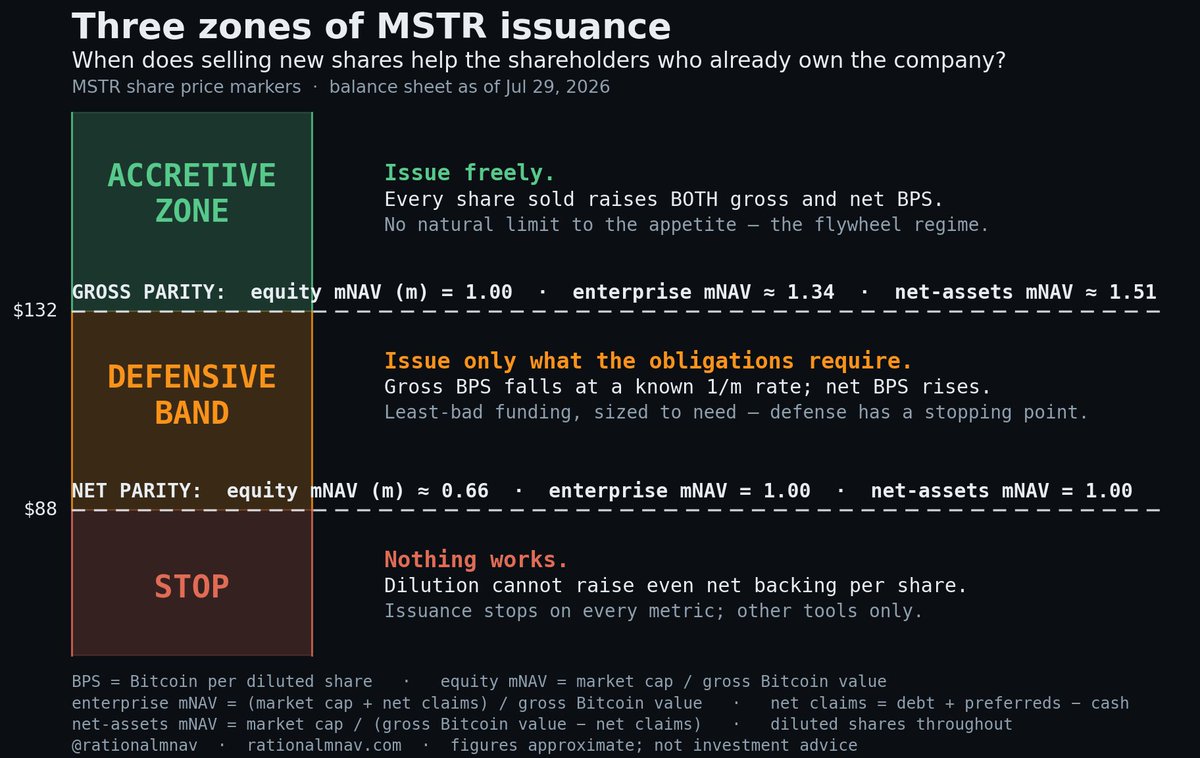
@chcbearsfan I’ve asked the same questions and am hoping we get some good insights. At this time, my view of accretion, as it relates to MSTR issuance at various mNAVs, is illustrated in the diagram below. I would distinguish “accretive issuance” from “defensive issuance”.
@BTCoptioneer I agree in principle, though I’m not certain of the exact number of years that is sufficient. One would think that the proportional effect of USD reserve increases on the STRC market price would diminish as the number of years coverage increases.
@ChrisMMillas I would very much appreciate clarification regarding which is the company’s primary objective: growing Net BPS or Gross BPS. The likely answer is probably “both are important”, which is ok as long as management can explain when/why each will be prioritized in various scenarios.
@Strategy@LynAldenContact@Matt_Hougan@Excellion@btcjvs I would very much appreciate clarification regarding which is the company’s primary objective: growing Net BPS or Gross BPS. The likely answer is probably “both are important”, which is ok as long as management can explain when/why each will be prioritized in various scenarios.
@phongle With respect, I have a different view on the term “accretive”, but I’m open to changing my perspective. Looking forward to the earnings call tomorrow. Thank you.
Unfortunately I think there is now ambiguity regarding whether the company’s paramount objective is gross BPS or net BPS. IMHO, gross BPS should still be management’s primary target for creating long-term common shareholder value. Net BPS is price-dependent and is better for credit and short-term equity investors, while Gross BPS aligns better with common shareholders who have conviction in the long-term outlook for BTC.
Our upgraded mNAV 1) accounts for all securities senior to $MSTR, 2) distinguishes ITM and OTM converts, and 3) establishes a 1.0x threshold for accretive MSTR issuance. Thanks to the institutional and retail investors, analysts, and Bitcoin Treasury Companies for the feedback.
@Strategy I’m impressed by the thoroughness and transparency. Although net-BPS is useful for credit investors and short-term equity investors (as you noted), I was very glad to hear that gross BPS and BTC Yield will remain as the primary measures of long-term shareholder accretion.
@phongle What I’m struggling with: defining accretive as growing net BPS can at times conflict with the stated objective of growing gross BPS. Gross BPS seems like the better target — it doesn’t move with market prices; net BPS does. Will BTC Yield continue to be reported on gross BPS?
@Strategy Because the preferred dividends rely on the MSTR ATM, could prioritizing the common (by keeping BPS at the forefront when making transaction decisions), perhaps counterintuitively, lead to more confidence in the preferreds?