hello there the jacobian conjecture is false thanx to my close friend akhil for asking about it and my other close friend fable for working during the world cup final
((1+xy)^3 z + y^2 (1+xy) (4+3xy), y + 3 x (1+xy)^2 z + 3 x y^2 (4+3xy), 2 x - 3 x^2 y - x^3 z): \C^3\to \C^3, has jacobian determinant -2, and sends (0, 0, -1/4), (1, -3/2, 13/2), and (-1, 3/2, 13/2) to (-1/4, 0, 0)
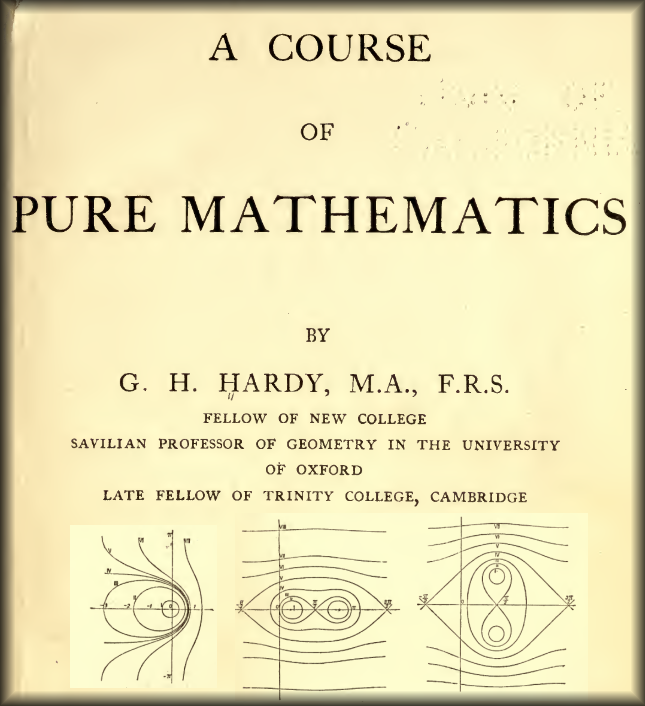
FREE Classic Math Book, from the mentor of the Indian mathematician Srinivasa Ramanujan. Now online. 472 pages.
"A Course of Pure Mathematics" by G.H. Hardy.
1. Real Variables
2. Functions of Real Variables
3. Complex Numbers
4. Limits of Functions of a Positive Integral Variable
5. Limits of Functions of a Continuous Variable. Continuous and Discontinuous Functions
6. Derivatives and Integrals
7. Additional Theorems in the Differential and Integral Calculus
8. The Convergence of Infinite Series and Infinite Integrals
9. The Logarithmic and Exponential Functions of a Real Variable
10. The General Theory of the Logarithimic, Exponential, and Circular Functions
This is the classic textbook on introductory mathematical analysis. First published in 1908, it went through ten editions (up to 1952) and several reprints. It remains one of the most popular books on pure mathematics.
Link: https://t.co/IMpjKd56wl
Riemannian Geometry ✍️
This diagram introduces Riemannian geometry, a branch of mathematics that studies curved spaces and how to measure distances, angles, and shapes within them. This field was developed by the German mathematician Bernhard Riemann in the nineteenth century. His work changed geometry and later provided the language Albert Einstein needed to explain gravity as the curvature of spacetime. The blue sphere at the center of the picture represents a manifold. This term refers to a curved space that appears essentially flat when you zoom in closely on any small area. The surface of the Earth serves as a perfect everyday example. Globally, it is a curved ball, but when you stand in a small field, the ground looks perfectly flat around you. Manifolds can have any number of dimensions, from simple curves and surfaces to the four-dimensional spacetime of relativity and even higher-dimensional abstract spaces used in modern physics and mathematics.
The tan-colored flat plane touching the top of the sphere represents the tangent plane. This is the best flat approximation of the curved surface at that specific point. Every point on the manifold has its own tangent plane, and each one shows how the curved space looks from that location. The blue arrow on this plane is a tangent vector. This arrow represents a direction and magnitude at that point, indicating which way to move and how strongly. Since you cannot draw perfectly straight arrows through curved surfaces without sticking out of them, tangent vectors are useful for representing directions on a curved manifold. The red curve tracing along the sphere is a geodesic. This term generalizes a straight line to curved space. It describes the straightest possible path between two points that stays on the surface. On a sphere, geodesics are great circles like the equator. This is why airplane routes between distant cities appear to curve on flat maps, yet they represent the shortest paths across the curved surface of the Earth. The dashed green arrow illustrates the logarithmic map, a mathematical tool that translates between points on the curved manifold and vectors in the flat tangent plane. This allows mathematicians to switch between curved and flat perspectives depending on what is more convenient.
The equations below capture the two main ideas that drive Riemannian geometry. The first describes the metric, the most important concept in the theory. It is a set of rules that guides you on how to measure distances at every point and in every direction. The metric turns an abstract manifold into a real geometric space where measurements can be made. Remarkably, once you specify the metric, everything else about the geometry follows automatically, including which paths qualify as geodesics and the amount of curvature at each location. The second equation shows the rule for determining geodesics. It states that a path counts as a geodesic if it does not turn sideways while moving through the curved space. This framework became crucial when Einstein realized that gravity is not a force but rather the natural motion of objects following geodesics through spacetime, which curves due to mass and energy. Today, Riemannian geometry appears in physics, machine learning for analyzing data on curved spaces, robotics for planning movements, medical imaging for comparing anatomical shapes, and many other fields. Beyond its practical uses, it is one of humanity's most significant intellectual achievements. It reveals that the geometry found in ancient Greek textbooks is just a small part of a vast mathematical universe and that space itself a stage for reality is not a fixed backdrop but a dynamic, curving fabric shaped by the matter and energy it contains.
It is remarkable that Prof. Mahalanobis used in his 1936 paper on the Δ2-distance paper the visionary terms of "length element" and "statistical field"
Mahalanobis was inspired by general relativity and differential geometry: wrote historical introduction to GR Einstein papers!
Mathematics.
Strange Anatomy of Pascal's Triangle.
[In much of the Western world, it's named after the French mathematician Blaise Pascal, although other mathematicians studied it centuries before him in Persia, India, China, Germany, and Italy.]
What is the process to ensure data integrity in digital communications, satellite transmissions, and hard drives?
BCH codes ( Bose-Chaudhuri-Hocquenghem codes) - a class of powerful cyclic error-correcting codes which ensures data integrity.
One of the key persons behind the discovery is Raj Chandra Bose who celebrates his birth anniversary on 19th June
Born in Hoshangabad, he overcame severe financial hardships early in life to eventually join the prestigious Indian Statistical Institute under the mentorship of P. C. Mahalanobis.
He also made contributions to combinatorial mathematics, famously disproving a 1782 conjecture by Leonhard Euler regarding orthogonal Latin squares. This feat that landed him on the front page of The New York Times in 1959 along with his collaborators.
India had some amazing mathematicians ...let's be proud of them
@ARanganathan72
R Praggnanandhaa created history after winning the Norway Chess 2026. In the final round, Praggnanandhaa defeated Vincent Keymer with the white pieces to win the title. Pragg scored 4 consecutive classical wins to finish the tournament. Norway Chess 2026 was one of the strongest tournaments of the year.
According to the numbers, it was even stronger than the candidates. It was one of the biggest achievements of Pragg's career as he became the 1st Indian to win Norway Chess. #praggnanandhaa #Norwaychess
https://t.co/4eCmRBcZyt






![pickover's tweet photo. Mathematics.
Strange Anatomy of Pascal's Triangle.
[In much of the Western world, it's named after the French mathematician Blaise Pascal, although other mathematicians studied it centuries before him in Persia, India, China, Germany, and Italy.] https://t.co/BcTahh0F9N](https://pbs.twimg.com/media/HLbadTIasAAeoig.jpg)


