Someone said it in Spanish, but I'll say it in English so that as many people as possible know: Venezuelans currently don't have aid and are unprepared for this because the regime has stolen all the resources that guarantee the security and stability of the Venezuelan people
Novak Djokovic acaba de decir que el aburrimiento es el estado más creativo que un niño puede experimentar.
Su hijo tiene 10 años y su hija 7.
Cuenta que cuando su hijo le dijo que estaba aburrido después de una mañana de ping-pong, kayak y fútbol, se sentó con él para tener una conversación que la mayoría de los padres evitan.
"Está bien aburrirse a veces. Cuando te aburres, no significa que tengas que coger un libro o una pantalla inmediatamente. También necesitas aprender a conectar con tus pensamientos".
Djokovic afirma que es en el aburrimiento cuando la creatividad finalmente aflora, y también cuando todo lo que has estado reprimiendo con el móvil sale a la superficie.
La mayoría de los padres protegen a sus hijos del único estado que los hace crecer.
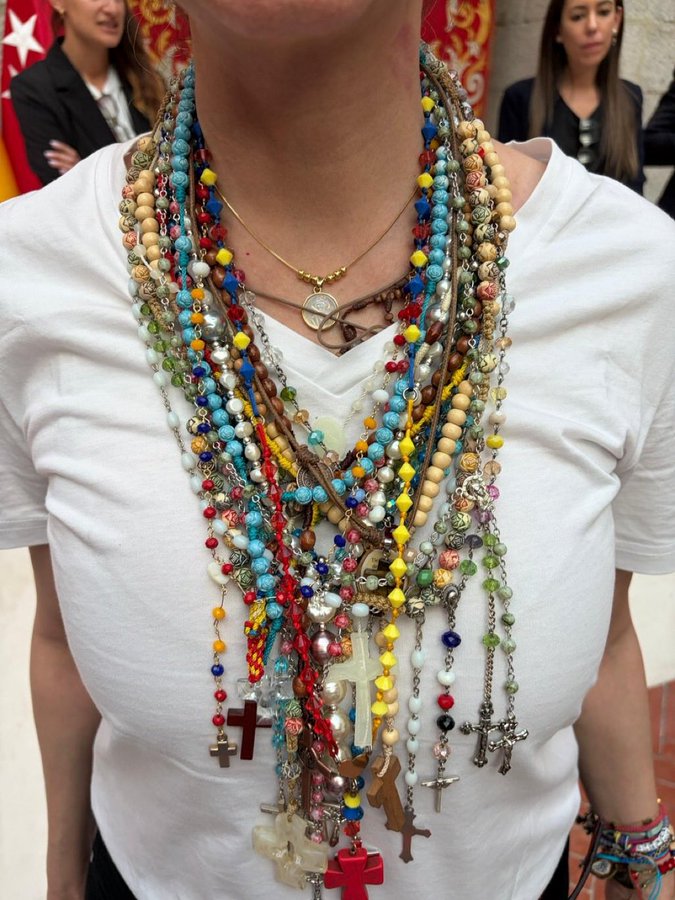
No es casual que a María Corina Machado le regalen crucifijos en sus encuentros con la diáspora.
Ese gesto, que puede parecer espontáneo o simplemente religioso, dice mucho más de lo que aparenta. ¿Qué nos dice la sociología sobre esto?
Cuando las instituciones dejan de funcionar, cuando la política deja de ofrecer certezas, las personas comienzan a buscar sentido en otros lugares. Y uno de esos lugares es la fe. No necesariamente en términos estrictamente religiosos, sino como una forma de sostener la esperanza cuando todo lo demás falla.
El exilio profundiza esa necesidad. Migrar no es solo cambiar de país: es perder referencias, afectos, rutinas. Es vivir en una especie de intemperie emocional. En ese contexto, los símbolos religiosos funcionan como anclajes al país al que se tuvo que dejar. Como algo que permite resistir.
Por eso, cuando alguien entrega un crucifijo, no está haciendo un gesto decorativo. Está transfiriendo algo que considera valioso: protección, fuerza, sentido. Es también, en el fondo, una forma de cuidado.
Asimismo, es una forma de decir: reconocemos en ti a alguien que está cargando algo más grande que sí misma. No solo una candidatura o una estrategia, sino una expectativa colectiva.
En contextos de crisis prolongada, el liderazgo deja de ser solo una cuestión de propuestas. Se convierte en una experiencia afectiva: Se cree, se acompaña, se protege.
Y ahí es donde la política se cruza con lo simbólico, porque somos seres humanos.
Lo que estamos viendo no es solo apoyo. Es una comunidad tratando de sostener, con los recursos que tiene, a quien percibe como parte de su posibilidad de futuro.
men need intimacy like women need reassurance. same need, different mechanic. he goes a week untouched and starts acting unhinged; she goes a few days unacknowledged and starts detaching silently. men fall apart without intimacy, women fall apart without consistency. no “gm,” no “home safe?”, no “I got you,” no “we good?”…and you expect softness out of that? be so serious. make her feel wanted and she’ll give her all; make her feel ignored and she’ll disappear like she was never there. reassurance is her pre-game. starve her emotionally and she’ll revoke your whole membership. men want attention, peace, loyalty, touch… but can’t send ONE message? boy, bffr. same need expressed differently. he wants touch, she wants consistency.
"Nacho Redondo" es tendencia por lo que pasó en una de sus presentaciones de su gira “traumas”.
Un joven contó explícitamente cómo fue torturado a los 13 años en el helicoide, durante las protestas del 2018.
One night I asked my mom how she knew my dad was “the one.” She didn’t say butterflies. She didn’t say grand gestures.
She said, “There was a year I wasn’t okay.”
She told me after I was born, she felt overwhelmed all the time. She stopped talking as much. Stopped laughing as loudly. She said she felt guilty for not being her usual self.
And my dad didn’t demand the “old her” back.
He just started doing small things.
He would wake up earlier to pack her lunch.
He’d fold the laundry without announcing it.
He’d sit beside her on the couch and just hold her hand without asking a single question.
She said one night she finally cried and told him she felt like she was failing at everything.
He didn’t interrupt.
Didn’t give a motivational speech.
Didn’t say “but you have so much to be grateful for.”
He just listened.
And the next week?
He didn’t treat her like she was fragile.
Didn’t bring it up during arguments.
Didn’t use it as proof that she was “too emotional.”
He loved her the same. Calm. Steady. Normal.
My mom looked at me and said,
“That’s when I knew. Love isn’t the loud days. It’s who stays gentle on the quiet ones.”
And suddenly their 20+ years together made sense.
Real love doesn’t panic when you’re not at your best.
It adjusts.
It waits.
It stays.
Lustful men are the worst kind, they chase bodies. They crave validation, not connection.
this is example, a man driven by lust has no depth, no loyalty, no peace, only an empty ego he keeps trying to fill through women he’ll never truly value..
I'm going to piss some men off with this, but the reason a lot of your parents and grandparents stayed married so long is because the women in those generations were financially trapped.
When a woman makes her own money, the only thing a man can truly offer her is how he treats her.
That's why there's a male loneliness epidemic.