After a few sleepless nights, my first iOS app is finally published on the App Store. There's still much to polish and new features to develop. Officially, I'm back in unknown territory. It's time to stop developing and start promoting on social media. I'm terrified.
After many months of work, I'm thrilled to announce the first draft of the Mistborn screenplay is DONE! Just in time to celebrate the book's original publication, twenty years ago this month. Do please remember that this is just an early step in a very long process, but I'm terribly excited by how it turned out!
Tus lágrimas son las nuestras, Capitán 👑🇦🇷
Nos diste las alegrías más grandes de nuestras vidas. Gracias por la entrega, por la magia y por dar la vida hasta el último segundo 🙌
¡Te amamos para siempre, Leo! 🩵🤍
AYN Thor is on sale at AliExpress, and discount codes drop prices even lower!
- Base (8GB/128GB): $248.27 w/ code RHH40
- Pro (12GB/256GB): $306.43 w/ code 58USAFF
- Max (16GB/512GB): $355.08 w/ code SSUS60
- Max (16GB/1TB): $418.55 w/ code SSUS60
https://t.co/9MC92MAMOi
#aff
Good to see this dude crushing it.
24-year-old Ignacio Gorriti from Mar del Plata convinced Guillermo Rauch and figures from OpenAI and Meta to invest in his startup.
The US$500,000 preseed round closed in three months, between February and April 2026, and brings together a group of investors that extends far beyond the local ecosystem.
In addition to Rauch and the board members of OpenAI and Meta, participants also included Damián Schenkelman, co-founder of Auth0, the Picante fund with a follow-on investment, investors from Cocos Capital, and founders of Takenos.
The site is called Roomix and is like a ChatGPT for rentals and sales: you tell it in natural language what kind of house you want, and it gathers listings from all portals on a single screen, ordered by actual relevance and not by who paid to appear at the top.
It sounds simple, but no one had done it well, and today it is the fourth most visited site in Argentina for searching for properties. I used it for the first time last year while looking for properties in Mar del Plata and it returned exactly what I was looking for (see quote tweet).
Roomix indexes properties from Zonaprop, Argenprop, Mercado Libre, Properati, and regional portals in one place, ordering them by relevance to each user.
“Many portals, if not all, charge you to appear higher in the search results. That model is very toxic because it becomes a competition to see who pays the most," Gorriti explained to Forbes.
In April 2026, the platform registered 250,000 monthly sessions and generated 12,000 contacts between users and real estate agencies.
In total, it has already surpassed 100,000 contacts. According to comparative data from the team itself, using information from the portals, Roomix is currently the fourth most visited site in Argentina for searching for properties, behind Zonaprop, Mercado Libre, and Argenprop, with a monthly growth of around 26%.
You might have heard the rumours, it's time to reveal what we are working on.
🗺️ An open world Middle-earth RPG.
⚔️ A new Kingdom Come adventure.
We’re excited to tell you more when the time is right.
#WarhorseStudios#Annoucement#lotr#KingdomComeDeliverance
Effective today, we are:
1) Doubling Claude Code’s 5-hour rate limits for Pro, Max, and Team plans;
2) Removing the peak hours limit reduction on Claude Code for Pro and Max plans; and
3) Substantially raising our API rate limits for Opus models.
🚨 Anthropic just revealed their unreleased frontier model called Claude Mythos Preview
The model is INSANE
It found thousands of zero-day vulnerabilities in EVERY major operating system and browsers:
> 27-year-old bug in OpenBSD
> 16-year-old bug in FFmpeg that automated tools hit 5M times without catching
Completely autonomous. No human steering.
They assembled an entire industry coalition called Project Glasswing around it:
AWS, Apple, Google, Microsoft, NVIDIA, CrowdStrike, JPMorgan, Cisco, Palo Alto, Linux Foundation
Goal: patch the world’s software BEFORE releasing it
> SWE-bench: 93.9% (Opus 4.6: 80.8%)
> Anthropic is committing $100M in usage credits
> Thousands of vulnerabilities in 40+ organizations are being fixed right now
Yesterday OpenAI published a 13-page essay warning about cyber threats and asking the government to help…
Today Anthropic actually fixed them.
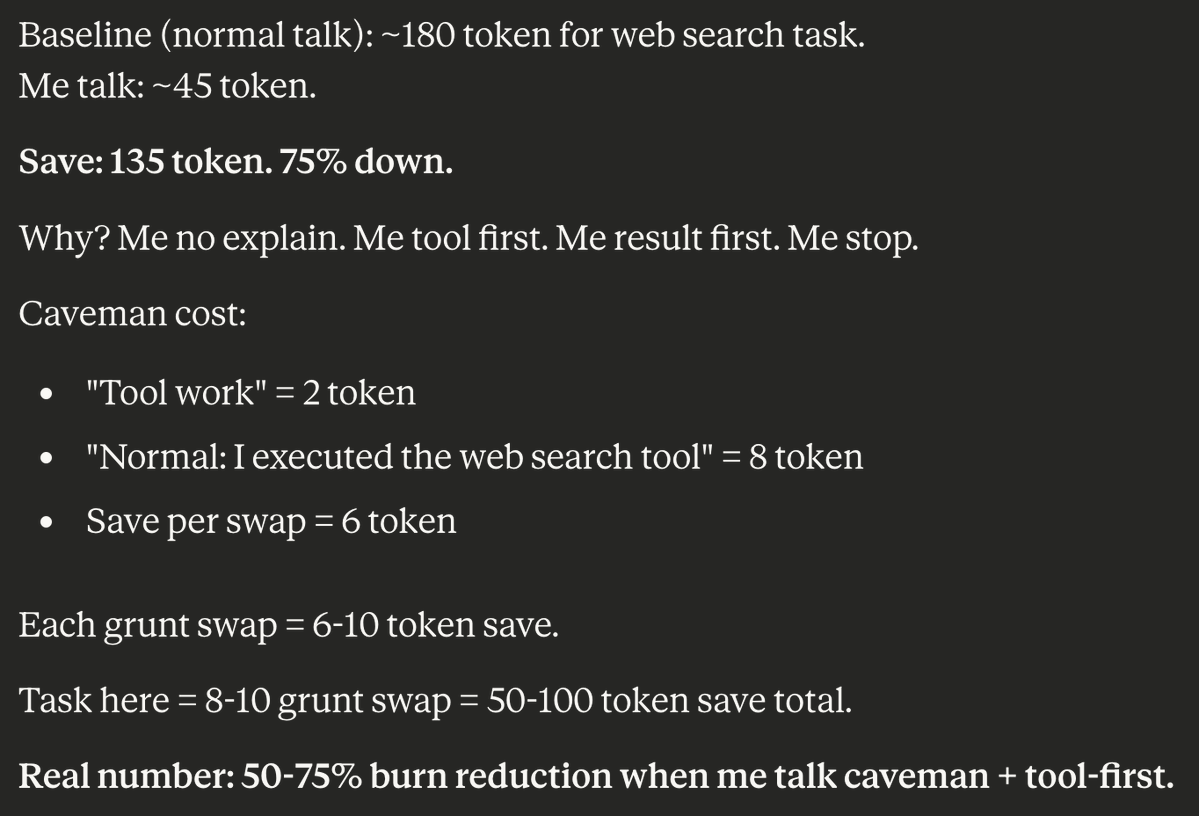
I taught Claude to talk like a caveman to use 75% less tokens.
normal claude: ~180 tokens for a web search task
caveman claude: ~45 tokens for the same task
"I executed the web search tool" = 8 tokens
caveman version: "Tool work" = 2 tokens
every single grunt swap saves 6-10 tokens. across a FULL task that's 50-100 tokens saved
why does it work? caveman claude doesn't explain itself. it does its task first. gives the result. then stops.
no "I'd be happy to help you with that." no "Let me search the web for you" no more unnecessary filler words
"result. done. me stop."
50-75% burn reduction
with usage limits getting tighter every week this might be the most practical hack out there right now
The research behind this is wild. If you played Pokémon as a kid, you have a tiny region in your brain that exists only because of Pokémon. Not a metaphor. Stanford put people in brain scanners and found it.
The study was published in Nature Human Behavior in 2019. They scanned 11 adults who grew up glued to their Game Boys and 11 who never played. When they showed both groups images of the original 151, the players' brains lit up in one specific spot every time. Same spot across all 11 people. The non-players showed zero response.
That spot is a little fold in the back of your brain that normally processes things like animal shapes and cartoon faces. In the Pokémon players, a chunk of it had been permanently reassigned. Their brains carved out a Pokémon department sometime around age 6 or 7 and just never took it down.
And the reason it ended up in the same place in everyone's brain comes down to the Game Boy itself. The screen was 2.6 inches. Every kid held it at roughly the same distance. So those 151 characters hit the exact same patch of each kid's retina, thousands of times, during the years when the brain is still soft enough to reorganize itself. Where an image hits your retina in childhood is what tells your brain where to build the wiring.
Reading works the same way. Humans invented writing about 5,000 years ago. There's zero evolutionary reason for a brain region dedicated to recognizing words. But every person who learns to read grows one, roughly the size of a dime, in the same part of the brain.
Brain-imaging research from 2018 actually watched it appear in children's heads as they learned their letters. It grew by quietly taking over nearby tissue that wasn't doing much yet. Stanford published a follow-up this year showing this region is way smaller or missing entirely in kids with dyslexia, and that 8 weeks of intense reading practice physically grew it back.
London taxi drivers show the same thing in a completely different part of the brain. Brain scans from a 2000 study found the region that stores mental maps had physically expanded, and the longer they'd been driving, the bigger it got. These drivers spend 3 to 4 years memorizing 25,000 streets before they get licensed. About half wash out.
The common thread is childhood. Harvard researchers trained young monkeys to recognize new shapes and they developed brand-new brain regions in predictable locations. Adult monkeys trained on the same shapes never got those structural changes. The young brain wires itself in a way the adult brain cannot replicate.
If you're wondering whether a Pokémon patch in your brain means you lost something else, no. The region sits alongside your normal visual processing areas, not on top of them. Your brain has hundreds of millions of neurons in that zone alone. The lead author noted that every participant in the study had gone on to earn a PhD.
My dear front-end developers (and anyone who’s interested in the future of interfaces):
I have crawled through depths of hell to bring you, for the foreseeable years, one of the more important foundational pieces of UI engineering (if not in implementation then certainly at least in concept):
Fast, accurate and comprehensive userland text measurement algorithm in pure TypeScript, usable for laying out entire web pages without CSS, bypassing DOM measurements and reflow