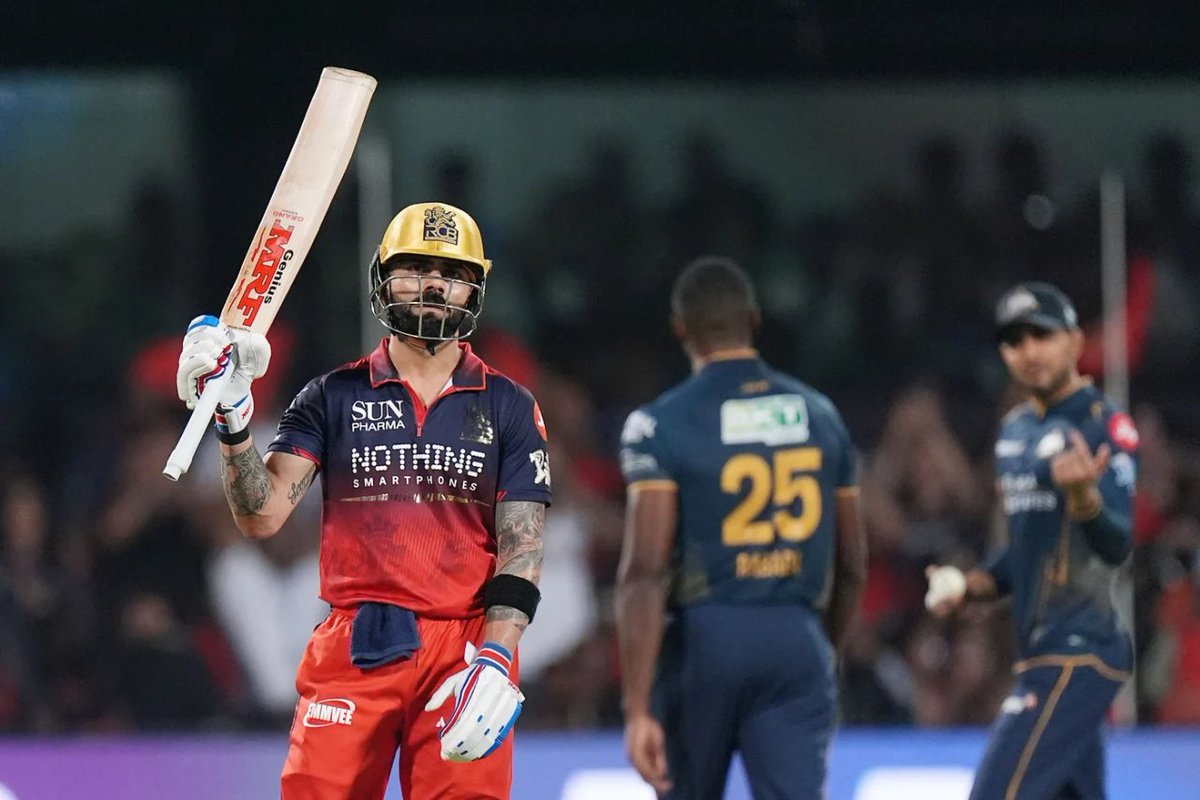
Virat Kohli keeps asking the same question & the critics keep running out of answers. Since 2023, he has scored 2365 runs in 51 IPL innings. He has been dismissed for single digits just 3 times in his last 40 innings (On average, 1 single digit score per season).
13 of his last 15 innings crossed 25, 11 went past 40, 8 cleared 50. While everyone else chased highlights, he built a floor of consistency so high that failure became a stranger.
Critics called him an anchor. They said T20 had moved past him, that his method was built for a slower era. So he changed the physics. The bat that used to come down straight & still started moving before the bowler released. Up, down, tap, hover. R Ashwin called it potential energy. Rest of us called it freedom.
Then 2025 happened. RCB won their first title in 18 years. Kohli made 657 runs that season, nothing flashy, just a man holding his nerve while the world wobbled. The title did not relax him. It unlocked something.
2026 brought the real transformation. He quit Tests. What remained was just a batter. No format switching, no need to keep one part of his brain defensive while the other attacked. This season he hits a boundary every 4.9 balls. He strikes at 160 in the powerplay, 140 in the middle, 200 in the death.
Dale Steyn watched the opener against Sunrisers Hyderabad. Kohli hit 69 not out off 38 balls, 5 sixes, a chase of 202 done in 15.2 overs. Steyn said he was hitting aerial shots time & again. A man who had stopped fearing the fall.
The attacking shot percentage tells the story. 40.6 percent in 2021. Almost 75 percent in 2026. He steps down to spin now. He lofts over long on. He was the cover drive man, the wristy flick man. Now he is something messier & more dangerous. Striking at 163 this season. Averaging 54.6, which is technically a dip from his overall average of 56 since 2023. That is the level he has set.
No other batter has scored more runs than him in the last 4 IPL seasons. Not Gill, Not Jaiswal, Not Buttler, Not Samson. He has also hit more sixes than all of them since 2023. The man they called slow is out-hitting the generation that was supposed to replace him. He is not surviving T20 anymore. He is still defining it.
Critics will find something new. Kohli will hear them, fix what needs fixing & keep asking what is next. The bat is still moving, The red jersey is still his. And somehow, impossibly, he is just getting started.
Such takes stem from places where “spending money to save time” has been an alien concept.
We’ve always been conditioned to save money, that money spent to save time just feels like a waste. Coz “time” is cheap.
This partly comes from the fact that we usually had a lot of time to spend, since we weren’t doing much with our time anyway that opportunity cost of time was something to care about.
Maybe that’s changing. Maybe I’m wrong and we are just lazy.
Who knows.
@dukhi_tsunoda The math here: if a rider works 10 hours and gets ONE tip of ₹30 in that entire shift, their average is ₹3 per hour. Scale that across thousands of riders over multiple days and you get ₹2.6/hr. It’s not that tips are small when given - it’s that most orders don’t tip at all
Last one on this topic, and I have been holding this in myself for a while.
For centuries, class divides kept the labor of the poor invisible to the rich. Factory workers toiled behind walls, farmers in distant fields, domestic help in backrooms. The wealthy consumed the fruits of that labor without ever seeing the faces or the fatigue behind it. No direct encounter, no personal guilt.
The gig economy shattered that invisibility, at unprecedented scale.
Suddenly, the poor aren't hidden away. They're at your doorstep: the delivery partner handing over your ₹1000+ biryani, late-night groceries, or quick-commerce essentials. You see them in the rain, heat, traffic, often on borrowed bikes, working 8–10 hours for earnings that give them sustenance. You see their exhaustion, their polite smile masking frustration with life in general.
This is the first time in history at this scale that the working class and consuming class interact face-to-face, transaction after transaction. And that discomfort with our own selves is why we are uncomfortable about the gig economy. We want these people to look our part, so that the guilt we feel while taking orders from them feels less.
We aren't just debating economics. We are confronting guilt. That ₹800 order might equal their entire day's earnings after fuel, bike rent, and app cuts. We tip awkwardly, or avoid eye contact, because the inequality is no longer abstract. It's personal.
Pre-gig era, the rich could enjoy luxury without moral discomfort. Labor was out of sight. Now, every doorbell ring is a reminder of systemic inequality. That's why debates explode. It's not just policy. It's emotional reckoning. Some defend the system (“they choose it”), others demand change (“this isn't progress, its exploitation”).
And here’s the uncomfortable twist: the unsaid ask of clumsy ‘solutions’ isn’t dignity. It is about returning to invisibility.
Ban gig work and you don’t solve inequality. You remove livelihoods. These jobs don’t magically reappear as formal, protected employment the next day. They disappear, or they get pushed back into the informal economy where there are even fewer protections and even less accountability. Over-regulate it until the model breaks, and you achieve the same outcome through paperwork instead of slogans: the work evaporates, prices rise, demand collapses, and the people we claim to protect are the first to lose income.
And then what happens?
The rich get their old comfort back. Convenience returns without faces. Guilt dissolves. We go back to clean abstractions and moral posturing from a distance. The poor don’t become safer, they become invisible again: back in cash economies, back in backrooms, back in shadows where regulation rarely reaches and dignity isn’t even debated.
The gig economy just exposed the reality of inequality to the people who previously had the luxury of not seeing it. The doorbell is not the problem. The question is what we do after opening the door.
Visibility is the price of progress. We can either use this discomfort to build something better (which we keep doing continuously as delivery partners are our backbone), or we can ban and over-regulate our way back into ignorance. One of those choices improves lives. The other simply helps the consuming class feel virtuous in the dark.
A belief that really solidified for me this year is that if you are a romantic, and want to see the world full of magic and love, you have to create it.
Host the dinner party, send the flowers, write the note, share the compliment, put up the decorations, plan the outing, so on and so forth.
The default state of life is decay. To create a world that is warm and wonderful and one you and others want to participate in, you really have to work at it.
The good news is, it doesn't take that much work at all.
"Do not go gentle into that good night.
Rage, rage against the dying of the light."
Time is a terrible control variable unless you’re extremely careful.
Yet so many PMs rush to scale huge experiments 100% in just 7 days without proper controls 🤦♂️
7 din mein retention bhi check kar li lmao
Hope they remain on strike forever and kill the golden goose that's feeding them.
Nope, I'm not standing in solidarity with this stupidity.
Gig workers can abandon their tasks and go for NREGA instead, I'm sure that's a better opportunity.
Meanwhile we app-dependent lazy idiots will start walking a little for basic groceries -- net net I see only health benefits for all.
Bandra bimbos like Vir are just performative jokers. Will happily tip 25% in Mamdani's New York, but will demand pensions back home. Filthy, degenerate commies.
One more thing. Our 10 minute delivery promise is enabled by the density of stores around your homes. It’s not enabled by asking delivery partners to drive fast. Delivery partners don’t even have a timer on their app to indicate what was the original time promised to the customer.
After you place your order on Blinkit, it is picked and packed within 2.5 minutes. And then the rider drives an average of under 2kms in about 8 minutes. That's an average of 15kmph.
I understand why everybody thinks why 10 minutes must be risking lives, because it is indeed hard to imagine the sheer complexity of the system design which enables quick deliveries.
Also, if you've ever wanted to know why millions of Indians voluntarily take up platform work and sometimes even prefer it to regular jobs, JUST ASK any rider partner when you get your next food or grocery order.
You will be humbled by how rational and honest they will be with you.
Having said that, no system is perfect, and we are all for making it better than today. However, it is far from what it is being portrayed on social media by people who don't understand how our system works and why.
If I were outside the system, I would also believe that gig workers are being exploited, but that's not true.
When did you cross the inertia of just reading tweets for years to finally writing them?
For me, it was when my less articulate friends started tweeting.
RCB's long wait to win an IPL - despite an array of stars, and at one point with a batting line-up including Gayle, Watson, de Villiers and Kohli - has been perhaps the most compelling story in the competition.
These struggles make their first IPL title feel more momentous.
In 2018, as an analyst and writer with huge expertise in T20 cricket, @fwildecricket (co)-wrote a book with a chapter called "Why RCB Lose".
He has then gone on to join RCB as their head of analysis, and win the IPL.
I think that's pretty fucking cool
In 2018, as an analyst and writer with huge expertise in T20 cricket, @fwildecricket (co)-wrote a book with a chapter called "Why RCB Lose".
He has then gone on to join RCB as their head of analysis, and win the IPL.
I think that's pretty fucking cool
“RCB don't deserve a trophy” is the biggest lie going around on social media.
10 times playoffs, 5 playoffs in last 6 years, most consistent team this decade.
18 years of sweat & tears, a lifetime of loyalty & belief and others have the audacity to say that we don't deserve it ?