I'm pretty sure the only reason to use Kafka for telemetry data in 2026 is muscle memory.
A simple, open source, S3-backed pipeline can shuttle 1Gb/s of logs to @ClickHouseDB for $200/mo with 2.8s p50 latency. Fast enough for us.
https://t.co/E3Zv25TIqS
The question shifts from:
"What would create the most value for users and the business?"
to:
"What can we safely change within the constraints of the current stack?"
That shift has a cost.
A search stack that has been operating for years typically accumulates layers of fixes. Over time, debugging search issues requires reconstructing behavior across the whole stack. New changes require broader validation. Experiments become harder to interpret and iterate.
A search stack can keep working even as it starts getting harder to maintain.
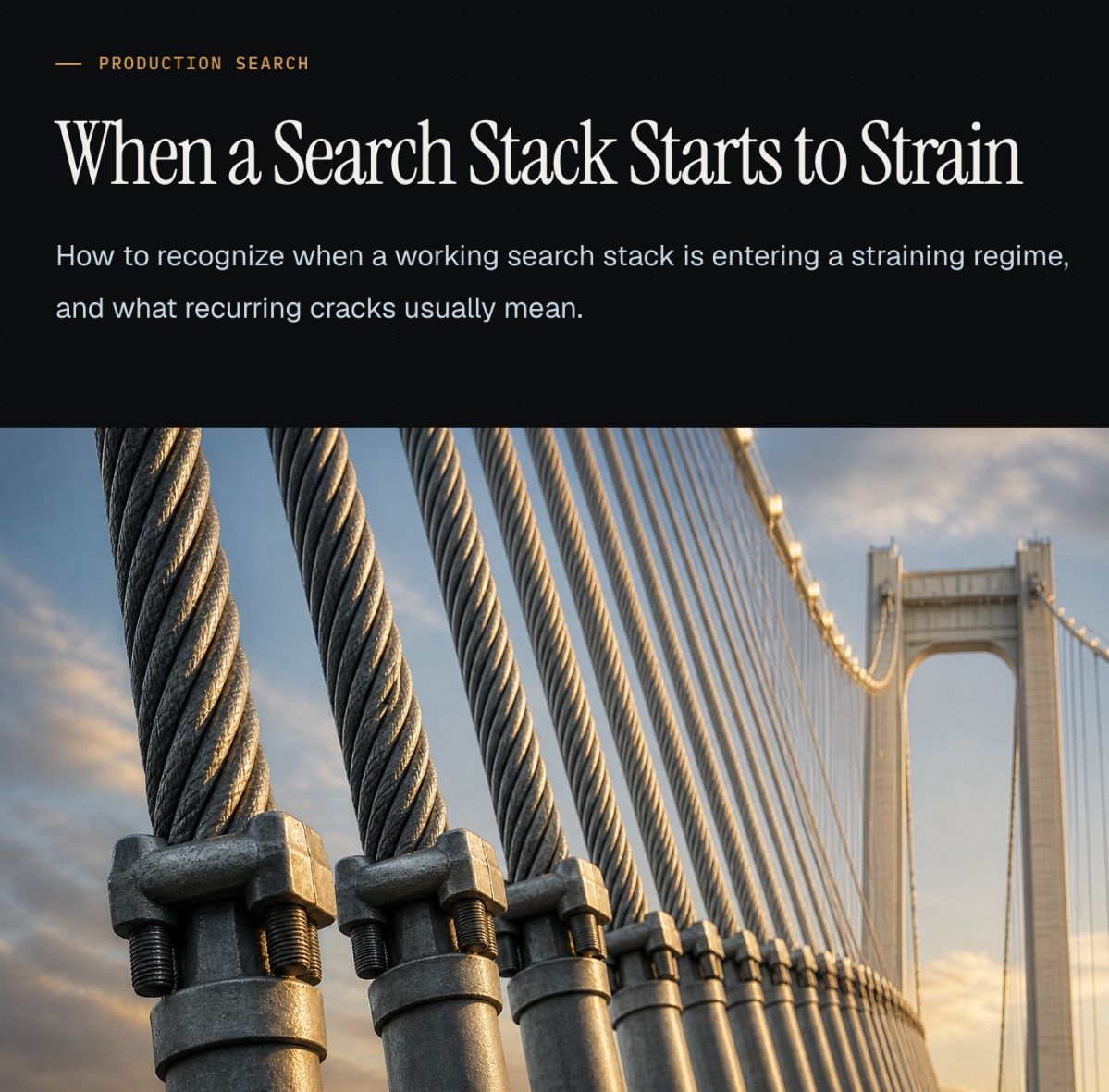
In this new blog post, we look at how to recognize when a search system is moving from a healthy regime into a straining one and what the recurring cracks usually mean.
https://t.co/zuwBIMWaTo Live tickets are now available:
- early 🐦 at £99
- online at £20
- in-person training at £349 (includes conference access)
📢 Call for Papers ends on April 30 📢
Thanks to @FlaxSearch for organizing 🙌
This was an excellent read.
The interaction problem section especially resonates. We have seen similar dynamics in the broader search systems, and wrote about it recently.
You know me as the BM25 guy, but embeddings are cool too.
New post from the @HornetDev team just dropped. ANN tuning at 100M scale, covering embedding bias, graph connectivity, and quantization ceiling
https://t.co/aPWYLXiGtK