Helping owner-led small businesses by teaching the practical systems to make them easier to reach, harder to disrupt and better to deal with.
@inspireteleuk
When work goes quiet, cutting your price is the worst move.
If customers can't see why you're worth choosing, cheap is all they have to judge you on. Ask 3 customers why they stay, then show prospects their answer.
More here 👉 https://t.co/sIxrVISIcJ
Customers who only ask about price aren't worth winning.
The quieter ones would pay more to be looked after, but they can't tell you're that person yet. So give them proof before price is all they have to judge you on.
How 👉 https://t.co/sIxrVISIcJ
Struggling to grow your business, so you look at pricing. Everyone online says "put your prices up 20%."
Be careful. A bigger number fixes nothing if customers can't see why you're worth it before they ask.
Fix the value first. Full breakdown 👇
https://t.co/Vr3m7KnXit
You can't work out why customers actually choose you because you're too close to your business. It's too personal.
So ring 5 of your longest-standing customers and ask them straight. Write down their exact words, not your tidy version. That's your new marketing campaign!
Only winning jobs when you're the cheapest? Take your last 10 customers and ask one blunt question about each: would I be happy to win 10 more exactly like this?
The "no" answers are the work draining you without you noticing. Stop chasing them.
Customer hesitates, you knock a bit off. Do it enough and your whole market learns to haggle you down.
The real problem: nobody can see what you're worth until after they've paid.
Ring 5 customers who stayed. Ask why. Sell with their words.
Customers don’t avoid calling because they hate the phone.
They avoid calling because too many businesses make it hard to speak to a human.
Customer service doesn’t start when the conversation begins. It starts the moment someone decides to contact you.
A 30-minute meeting for six people uses three hours.
Define the decision, who is needed and who takes responsibility next.
If you cannot, do not book it.
- - -
Would your broadband provider solve a fault or add to it?
Score yours: https://t.co/Q8334ny0Nu
A bigger competitor can usually undercut a small business. It cannot easily replicate a genuine relationship with the customer.
Be known. Be trusted. Put things right when they go wrong.
Give customers a reason to choose you that cannot be reduced to price.
#SmallBusinessUK
Hiring your first employee can take more courage than signing your biggest customer.
A large company calls it headcount but small-business owner is promising to pay another person’s wage when they employee someones, before the extra revenue is guaranteed.
A small-business owner can employ 20 people, serve thousands of customers and turn over millions, and still be treated as if they’re playing at business.
Britain’s owner-led companies deserve far more respect.
They create jobs, carry risk and keep local economies moving.
Almost every tool a small business runs on was built for big companies with an IT department to absorb the gaps.
So when it breaks, it doesn't hit a dashboard. It hits a Tuesday morning, when a customer has had enough and leaves.
That's what nobody protects small business from.
SMALL BUSINESS OWNERS 📣. A customer with a complaint wants two things: it fixed, and to feel heard.
Big companies are built on departments, tiers, escalation paths. It's why every call means repeating your story to someone new.
Small businesses can do what big business can't.
Ofcom just fined Virgin Media £28m for making it hard to leave.
Agents were financially rewarded for it. Ofcom's words, not mine.
If a supplier needs a trapdoor to keep your business, that's what they think their service is worth.
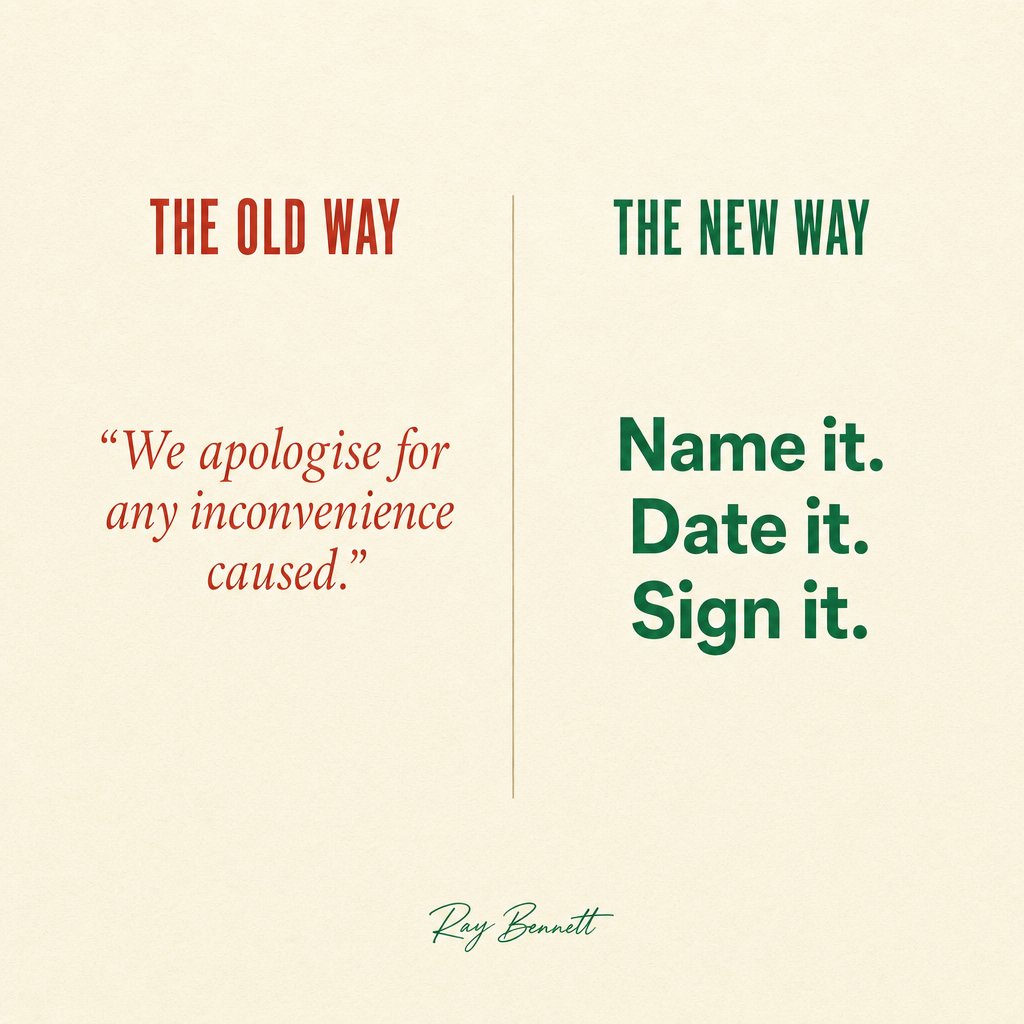
Every business sends this apology:
"We apologise for any inconvenience caused."
No person, no mistake, no fix.
The version that keeps the customer:
"Your line was down 4 hours Tuesday. I can imagine how frustrating that was. I've checked it, it's running again. Sorry. Ray."
Bad service survives because changing supplier feels riskier than putting up with it.
That is how average companies keep good customers for years.
The switch is part of the service. If the customer feels anxious before anything changes, you have made the sale harder.
The belief that costs small businesses the most is "this is too technical for me to question, so I'll just pay it."
You don't need to be an expert to ask what a charge is for. That's not a technical question, it's a fair one.
Being the customer is enough.
There's a specific quiet you get when something in your business is genuinely handled.
You stop bracing. You know the bill that's coming, and when something breaks one person sorts it so it never becomes yours to carry.
Most owners have forgotten that feeling exists.
Nobody warns you that the business follows you home.
Not the work. You can leave that at the desk.
It's the business itself. In the shower, at dinner, at 3am doing sums you didn't mean to start.
People see the freedom. They don't see the clock never stops.
The worst thing you can do to a customer isn't overcharge them.
It's making them feel like an idiot for asking a fair question.
That feeling is why people don't query or switch. Not because they're happy. Because asking once was miserable enough that they'd rather just pay.