Apparently, if you throw a frog into a pot of boiling water it will jump out immediately, but if you put it in room-temperature water and gradually bring it to a boil, it will stay in the pot until it dies. Whether or not that's true of frogs, I see something similar happen to managers all the time. People have a strong tendency to slowly get used to unacceptable things that would shock them if they saw them with fresh eyes. #principleoftheday
Just because someone thinks something doesn't mean it's true. Be especially skeptical of statements that begin with "I think that I . . ." since most people can't accurately assess themselves. #principleoftheday
Since I released my book Principles: Life & Work, several remarkably successful people from all walks of life contacted me telling me that they used basically the same principles across domains and asked me if I would brainstorm with them about principles for success.
Here’s a preview of my first such conversation, with one of the greatest football coaches and team builders in history, Bill Belichick, who just earned his 300th career win. In our conversation, we discuss our principles for building great teams, our core philosophies for coaching, teamwork, achieving greatness, and so much more.
If you enjoy this, you can find our full conversation here: https://t.co/yrYlIKq8rX
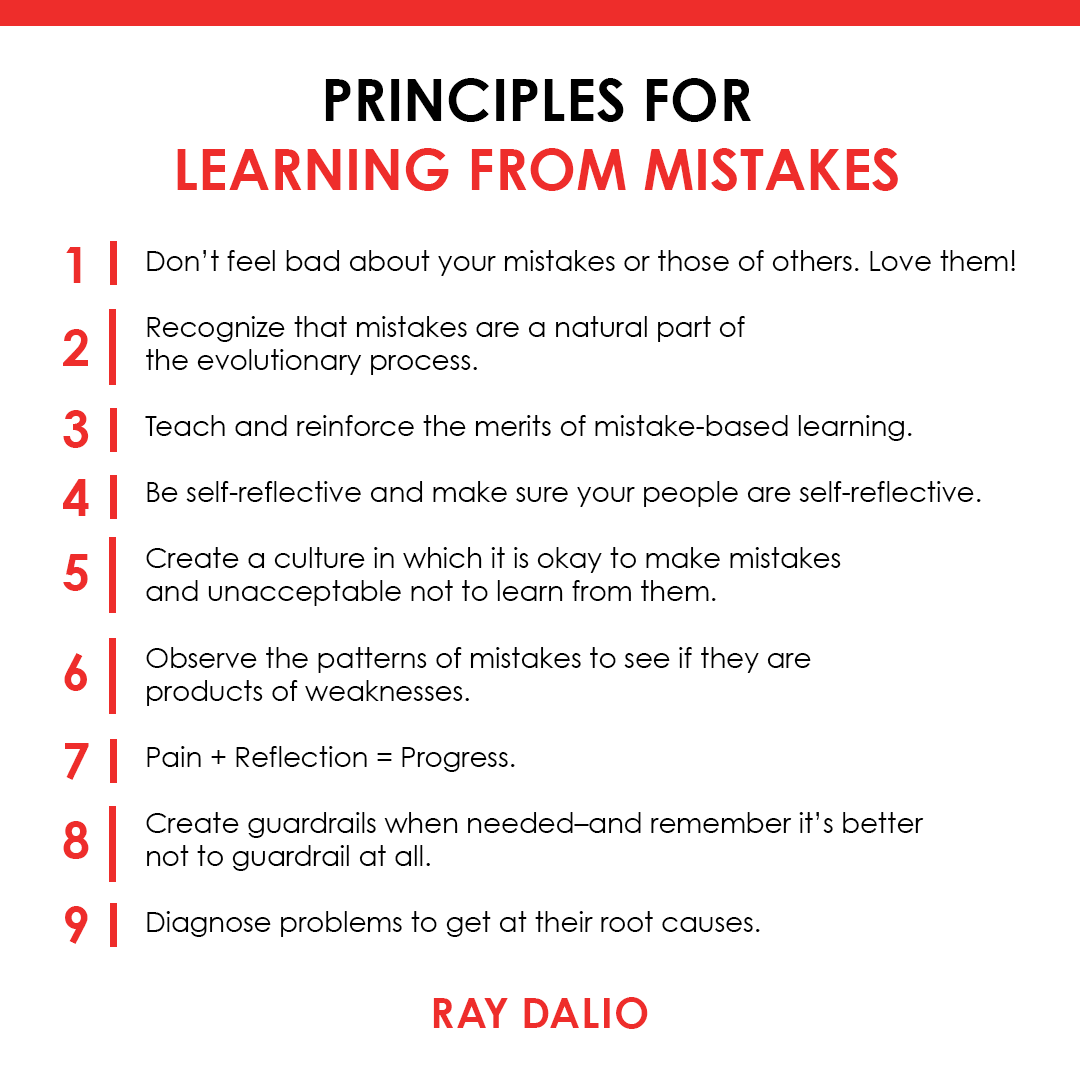
Many of you have told me you're interested in using your mistakes to help you evolve, so I'm sharing my principles for learning from mistakes here. #principleoftheday
Everyone fails. Anyone you see succeeding is only succeeding at the things you're paying attention to--I guarantee they are also failing at lots of other things. The people I respect most are those who fail well. I respect them even more than those who succeed. That is because failing is a painful experience while succeeding is a joyous one, so it requires much more character to fail, change, and then succeed than to just succeed. People who are just succeeding must not be pushing their limits. Of course the worst are those who fail and don't recognize it and don't change. #principleoftheday
Veterans and soldiers now in service who will become veterans have special meaning to me today as I see wars erupting and the United States being closer to the brink of a major war than at any time in my lifetime, including the Vietnam War. Every day we are seeing that wars are horrific, which vividly reminds me to thank all who are and were willing to make the sacrifice of going into them to defend others. It also makes it clear to me that our leaders should think hard about what is gained relative to what is lost by sending Americans in their early prime to war. #veteransday
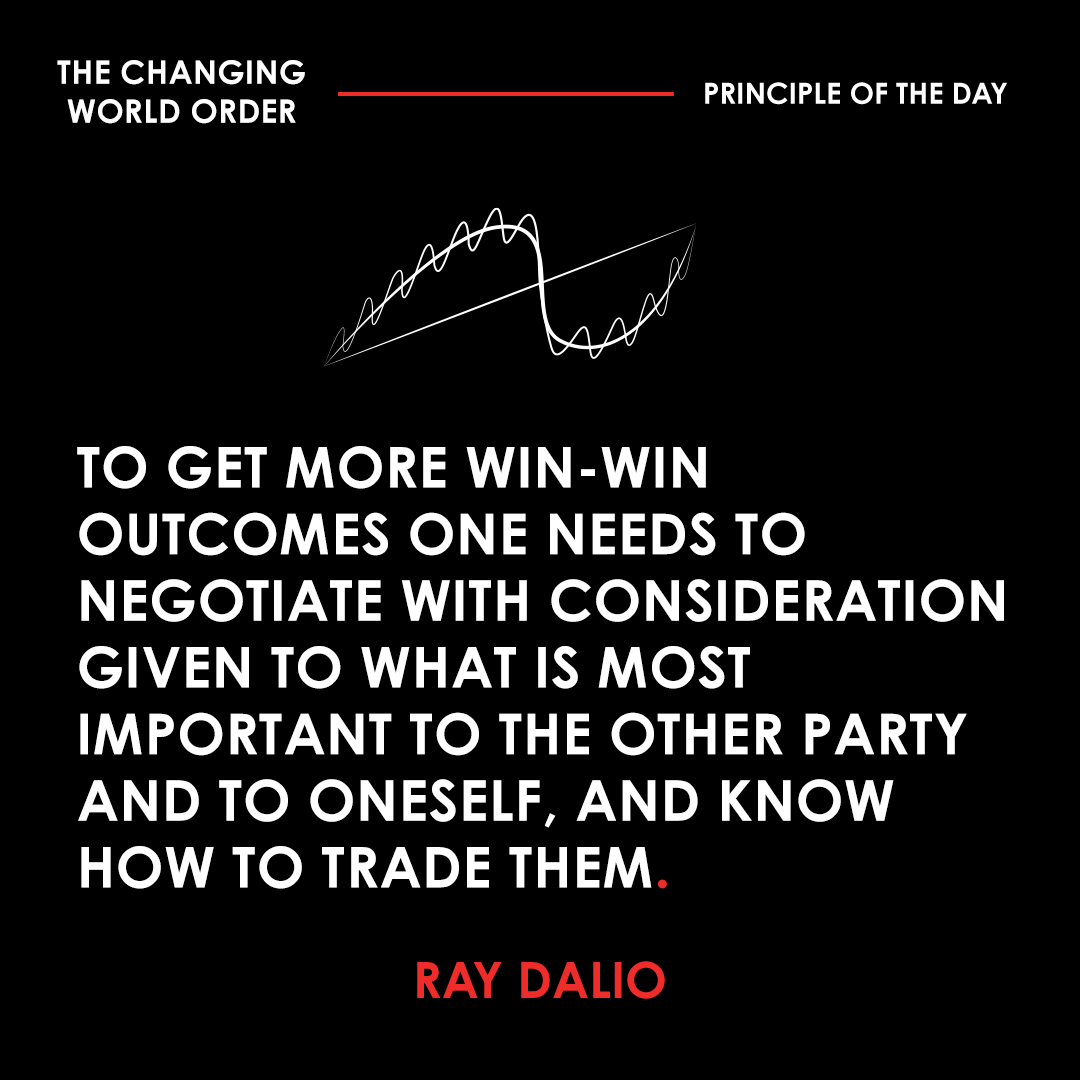
Skilled collaborations to produce win-win relationships that both increase and divide up wealth and power well are much more rewarding and much less painful than wars that lead to one side subjugating the other. Seeing things through your adversary’s eyes and clearly identifying and communicating your red lines to them (i.e., what cannot be compromised) are the keys to doing this well. #principleoftheday
https://t.co/fzHaP4r3uP
While the competition between the United States and China is constant and will intensify, the risks of military war have decreased in recent months and will continue to decrease over the next several months.
As this week’s Xi-Biden APEC meeting approaches, I thought I should share my thinking about what's happening and what one might expect and why.
In jazz, there's no script: You have to figure things out as you go along. Sometimes you need to sit back and let others drive things; other times, you blare it out yourself. To do the right thing at the right moment you need to really listen to the people you're playing with so that you can understand where they're going.
All great creative collaboration should feel the same way. Combining your different skills like different instruments, improvising creatively, and at the same time subordinating yourself to the goals of the group leads to playing great music together. But it's important to keep in mind what number of collaborators will play well together: A talented duo can improvise beautifully, as can a trio or quartet. But gather ten musicians and no matter how talented they are, it's probably going to be too many unless they're carefully orchestrated. #principleoftheday
Our brains work like computers: They input data and process it in accordance with their wiring and programming. Any opinion you have is made up of these two things: the data and your processing or reasoning. When someone says, "I believe X," ask them: What data are you looking at? What reasoning are you using to draw your conclusion?
Dealing with raw opinions will get you and everyone else confused; understanding where they come from will help you get to the truth. #principleoftheday
Opinions are a dime a dozen and nearly everyone will share theirs with you. Many will state them as if they are facts. Don't mistake opinions for facts. #principleoftheday
For reasons explained at length in my book & briefly in this new animated video, the world order is changing in ways that haven't happened in our lifetime before but have happened many times in history and I want to I convey that picture to you. https://t.co/F6A6ny813i (1/3)
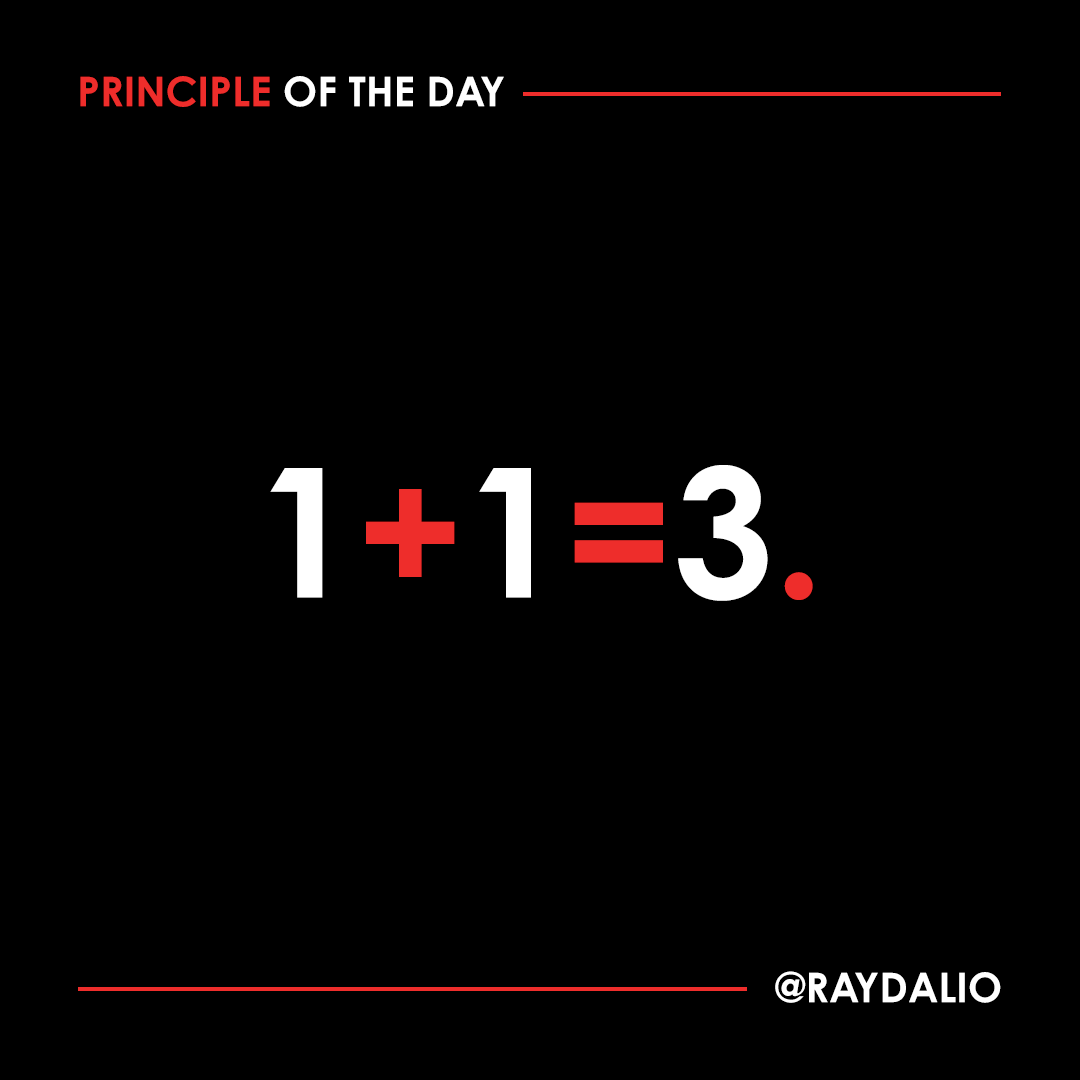
Two people who collaborate well will be about three times as effective as each of them operating independently, because each will see what the other might miss—plus they can leverage each other’s strengths while holding each other accountable to higher standards. #principleoftheday
For the most part, life gives you so many decisions to make and so many opportunities to recover from your mistakes that, if you handle them well, you can have a terrific life. Of course, sometimes there are major influences on the quality of our lives that come from things beyond our control—the circumstances we are born into, accidents and illnesses, and so forth—but for the most part even the worst circumstances can be made better with the right approach. For example, a friend of mine dove into a swimming pool, hit his head, and became a quadriplegic. But he approached his situation well and became as happy as anybody else, because there are many paths to happiness.
My point is simply this: Whatever circumstances life brings you, you will be more likely to succeed and find happiness if you take responsibility for making your decisions well instead of complaining about things being beyond your control. Psychologists call this having an “internal locus of control,” and studies consistently show that people who have it outperform those who don’t.
So don’t worry about whether you like your situation or not. Life doesn’t give a damn about what you like. It’s up to you to connect what you want with what you need to do to get it and then find the courage to carry it through. #principleoftheday
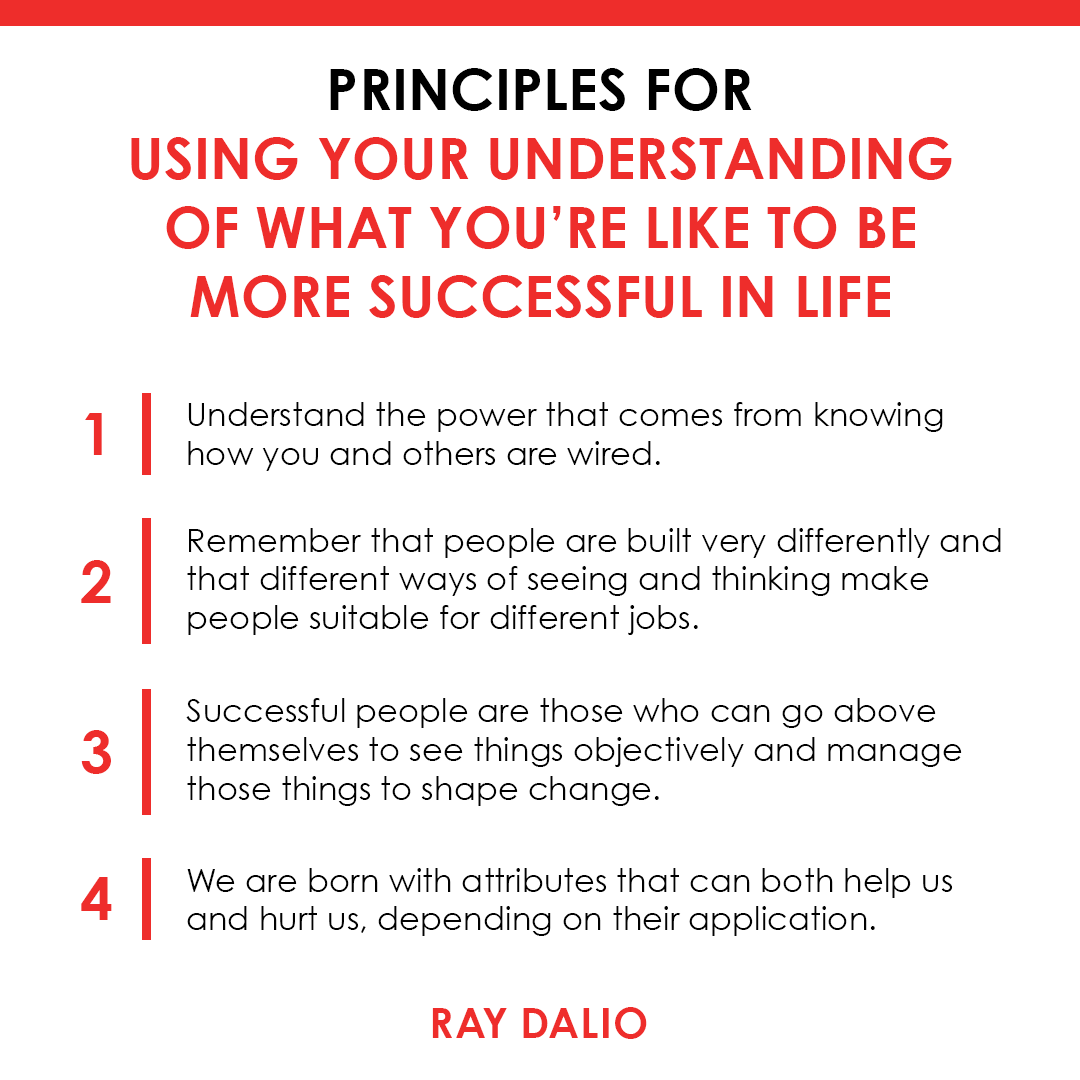
Many of you have asked about how to understand yourself better and how to use that to become more successful, so I'm sharing a list of principles that have helped me over the years. #principleoftheday
You must be willing to do things in the unique ways you think are best-- and to open-mindedly reflect on the feedback that comes inevitably as a result of being that way.
Learning to be radically transparent is like learning to speak in public: While it's initially awkward, the more you do it, the more comfortable you will be with it. This has been true for me. For example, I still instinctively find being as radically transparent in the ways that I am in this book uncomfortable because I am exposing personal material to the public that will attract attention and criticism. Yet I am doing it because I've learned that it's best, and I wouldn't feel good about myself if I let my fears stand in the way. In other words, I have experienced the positive effects of radical transparency for so long that it's now uncomfortable for me not to be that way.
Besides giving me the freedom to be me, it has allowed me to understand others and for them to understand me, which is much more efficient and much more enjoyable than not having this understanding. Imagine how many fewer misunderstandings we would have and how much more efficient the world would be--and how much closer we all would be to knowing what's true--if instead of hiding what they think, people shared it openly. I'm not talking about everyone's very personal inner secrets; I'm talking about people's opinions of each other and of how the world works. As you'll see, I've learned firsthand how powerful this kind of radical truth and transparency is in improving my decision making and my relationships. So whenever I'm faced with the choice, my instinct is to be transparent. I practice it as a discipline and I recommend you do the same. #principleoftheday
Mental pain often comes from being too attached to an idea when a person or an event comes along to challenge it. This is especially true when what is being pointed out to you involves a weakness on your part. This kind of mental pain is a clue that you are potentially wrong and that you need to think about the question in a quality way. To do this, first calm yourself down. This can be difficult: You will probably feel your amygdala kicking in through a tightening in your head, tension in your body, or an emerging sense of annoyance, anger, or irritability. Note these feelings when they arise in you. By being aware of such signals of closed-mindedness, you can use them as cues to control your behavior and guide yourself toward open-mindedness. Doing this regularly will strengthen your ability to keep your "higher-level you" in control. The more you do it, the stronger you will become.
I want to help you discover good principles that suit you and write them down. While that might sound like a lot or like you have a lot to do to develop great principles, that’s not true at all. All you need to do is start journaling and see what comes from it.
This is one of the principles I wrote through this process.
I developed a journal to help you create your own principles – if you’re interested, you can order it now: https://t.co/TgVGlzpdOF