🍜 🇲🇽 🏫 Estudiantes de la carrera de Ingeniería Biotecnológica del Instituto Politécnico Nacional (IPN), campus Palenque, Chiapas, crearon una sopa instantánea llamada Milpa’mí, a base de maíz, frijol, chipilín, yuca y semillas de calabaza, con lo que ganaron el primer lugar del concurso Diseño de Prototipos Plant-Based, realizado durante el quinto Foro Tecnológico Plant-Based Protein Innovations 2026, en el Instituto Tecnológico de Monterrey, campus Ciudad de México.
"Nuestro producto está enfocado a lograr una mejora alimentaria y que no sólo sea un producto rico”, afirmaron docentes y alumnos del séptimo semestre de la carrera.
Lee más aquí 👇
https://t.co/8S2njgl7Gl
No lo sé. A la que sí acallaron pronto fue a la propia Monika Ertl. Al parecer fueron esbirros del gobierno de Hugo Banzer quienes la ejecutaron. En mi opinión, fue una legítima guerrillera. Por cierto, leí que no la imputaron por el asesinato del Coronel porque no había pruebas.
Me parece una venganza estúpida. Se habría ganado mucho más si lo hubieran detenido para interrogarlo sobre la cadena de mando a la que obedecía el coronel maldito. Puede que el objetivo haya sido silenciarlo.
The EU's top diplomat Kaja Kallas can't stop talking about the "Soviet occupation" of Estonia. Small detail she skips: until the Russian Empire collapsed, there had never been an Estonian state at all.
For two centuries those lands were Russian provinces with German-named cities: Reval, Dorpat, Pernau. It was the Russian Provisional Government in 1917 that first put the Estonian-populated lands together into one unit. The independent republic that followed lasted 22 years.
Then came the "occupation." In the 1980s even the US State Department admitted that living standards in Estonia were higher than the Soviet average. Western scholars called the Estonian SSR the most industrialized and urbanized republic in the USSR, with the highest standard of living and the most Western lifestyle. People from other republics moved there for a better life. Kallas herself was born into that "occupation," and her family did just fine.
In March 1941, a French colonel stood in the middle of the Libyan desert and made his men swear an oath:
"We will not lay down our arms until our colors fly over the cathedral of Strasbourg."
France had fallen 9 months earlier. Strasbourg was nearly 2,000 miles away, in an Alsace the Germans had already annexed. He had a few hundred men.
His real name was Philippe de Hauteclocque. He'd been captured and wounded in 1940, escaped, and joined de Gaulle. He took the name "Leclerc" so the Germans couldn't punish his wife and six children back in France.
His men had just captured Kufra, an Italian fort deep in the Sahara. They did it with a few hundred men and a single 75mm gun.
Then they kept going.
Across the desert to Tripoli. Through Tunisia. Leclerc's 2nd Armored Division landed in Normandy in August 1944, and two weeks later he took the German surrender of Paris.
Then he pushed east, through the Vosges Mountains, toward Alsace.
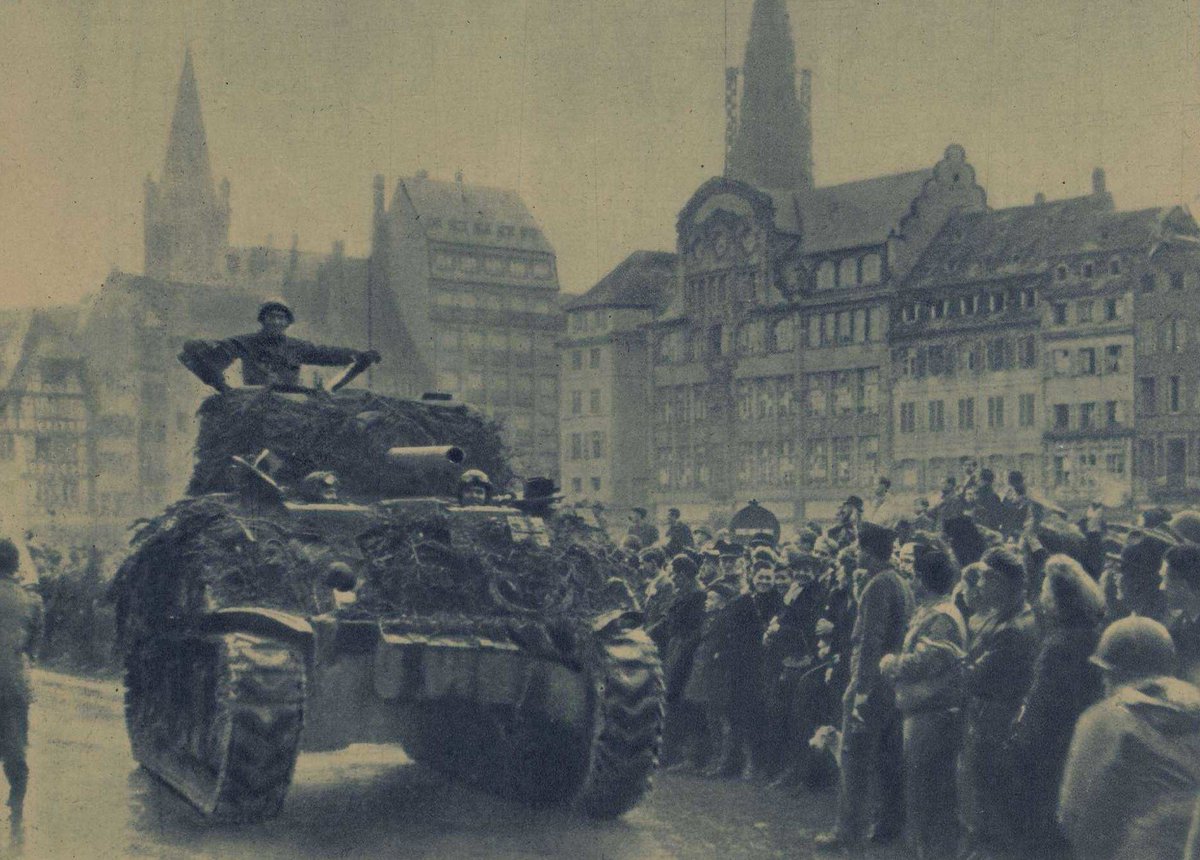
On November 23, 1944, his tanks raced into Strasbourg before the Germans could organize a defense. The code message back to headquarters was "Tissu est dans iode." Translation: we're in Strasbourg.
That day, the French flag went up over the cathedral.
3 years and 8 months after the oath, they kept it.
Leclerc died in a plane crash in Algeria in 1947. France made him a Marshal after his death.
Ella no decidió el ase sinato del coronel maldito. Se dice que ELN de Bolivia la envió a Hamburgo con esa misión. Mónika, divorciada de un alemán viviendo en Bolivia, se hizo amante de Inti Peredo, el sucesor del Che, en el ELN. La relación no duró mucho tiempo.
Viendo de lo que son capaces algunos de los dirigentes europeos de hoy, descendientes de algunos de los peores nazis del pasado, tengo mis dudas sobre los motivos que la llevaron a ma tar al despreciable coronel. ¿Habrá sido espía doble? En Alemania, durante décadas, el tristemente célebre Klaus Barbie fue amigo muy cercano de la familia de Mónika, al grado que ella lo llamaba "tío". Saquen sus propias conclusiones.
«Cuando el Che Guevara fue asesinado en 1967, el coronel Roberto Pereira —el hombre que había ordenado que le cortaran las manos al Che— comenzó a temer por su propia seguridad en Bolivia y solicitó un destino en un país lejano. El gobierno boliviano lo nombró cónsul en Hamburgo, Alemania, garantizando así su seguridad. Mónica Ertl, hija de un antiguo criminal de guerra nazi que se había establecido en Bolivia, era una documentalista cuyos caminos se habían cruzado en el pasado con los del Che. Cuatro años después de la muerte del Che, tras haber dado con el paradero del coronel Pereira, emprendió un largo viaje desde Bolivia hasta Alemania. Al llegar al consulado, a esta mujer de imponente presencia se le permitió entrar en el despacho del coronel. Mirando al hombre que había ordenado la muerte del Che, Mónica Ertl dijo: "El Che le envía saludos". Acto seguido, sacó un arma de su bolso y efectuó tres disparos, vengando así al Che...»
Paco de Lucía: "La izquierda es la que hace música, es creativa e inteligente. La derecha, la que ejecuta". Días después de estas palabras, en 1976, unos fascistas le dieron una paliza al grito de "no vas a tocar más".
22 de noviembre es el cumpleaños de Luisa González, hoy en las mazmorras de la dictadura de Noboa. No entiendo cómo la comunidad nacional e internacional puede permitir tanto descarado abuso y persecución.
No olvidamos a Luisa ni un instante. La llevamos siempre en el corazón.
Un abrazo a ella y a su familia.
#EcuadorVencerá
Hoy, la afición antifascista del Rayo Vallecano ha mostrado su apoyo a la huelga de los profesores en la Comunidad de Madrid del PP. Todo el estadio de Vallecas ha cantado al unísono "educación pública" contra Ayuso. Enormes.
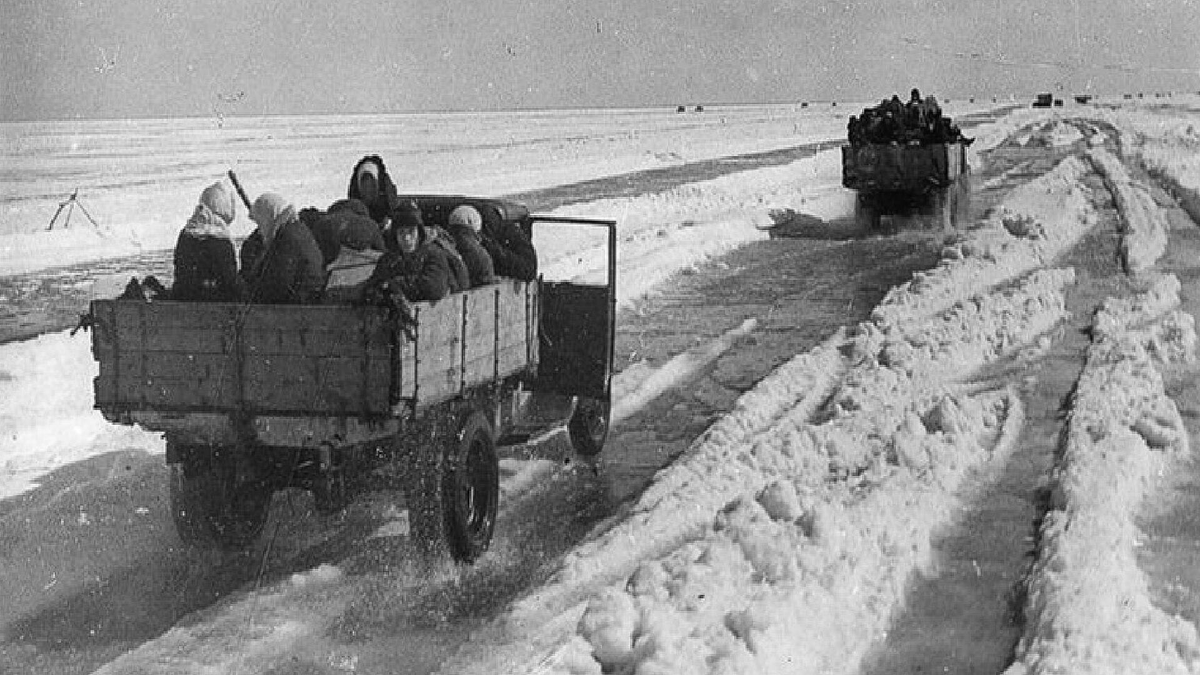
November 22, 1941. A convoy of Soviet trucks rolls out onto the frozen surface of Lake Ladoga, heading for Leningrad.
The city had been surrounded since September. German and Finnish forces had cut every road and railway. More than two and a half million people were trapped inside, and they were starving.
Bread rations had been cut again and again. By late November, many residents were getting a few slices of bread a day, much of it filled with sawdust and other fillers. People ate wallpaper paste, leather belts, and pets. Thousands were dying every day.
The only gap in the ring was Lake Ladoga, east of the city. When the lake froze, the Soviets built a road across the ice.
The first trucks went out while the ice was still dangerously thin. Drivers took the doors off their cabs so they could jump out if the truck started to sink. Many didn't make it. German planes and artillery hit the convoys. Trucks broke through the ice and disappeared into the freezing water.
The drivers kept going, day and night, through blizzards and darkness.
Leningraders called it the Road of Life. It brought food, fuel, and ammunition in, and carried hundreds of thousands of people, mostly women, children, and the sick, out to safety.
It wasn't enough to save everyone. Hundreds of thousands of people died in the city that first winter alone.
But Leningrad never surrendered. The siege lasted almost 900 days.
Regarding replacement if tbe demolished rail bridge at Rychkovskii, 100 km from Stalingrad: the 11-span 740 meter bridge across the Don River, located about 35 km southwest of Kalach, was blown up by the Soviets during the first week of August. Although the bridge's destruction created a supply logjam bottleneck at Chir Station, 11 km west of Rychkovskii, 6th Army never requested replacement of the bridge until September 30! Replacement of the rail bridge sufficient to carry German locomotives would have required 70 trainloads of structural steel and other materials. Only initial site surveys and a start to pier construction had begun when the Soviet offensive began. The Soviets completed rebuilding the bridge in early 1943.
The fate of the German 6th Army was sealed long before spearhead units of the Soviet Don and Stalingrad Fronts linked up near Kalach. No German general could have overcome the facts on the ground imposed by the limitations of German logistics impacting the 6th Army long before it was encircled. Any plan to breakout had to face the realities of shortages evident since September. Successful offensive operations require sufficient ammunition & fuel. The troops & horses needed rations & fodder. The armored vehicles & trucks needed spare parts to remain operational. Tanks needed track cleats to operate in snow and icy conditions. None of these were on hand in sufficient quantities.
The single track rail line limited trains supplying the army. Track conversion to German gauge reached Chir Station railhead 100 km from Stalingrad only in October. 6th Army required 500-700 tons of supplies daily. Prior to November 19th, 6th Army received < five trains per day of the ten trainloads (60 tons / trainload) needed. Soviet demolition of the rail bridge over the Don River at Rychkovskii resulted supplies backlogged 100 km from the city. Supply trucks running the route wore down, needing parts as they burned limited available fuel to move supplies to 6th Army.
The 6th Army required 850 cubic meters of fuel / day. Before it was surrounded, it received 456 cubic meters of fuel daily. It never built up reserves. When first surrounded, 6th Army had 130 tanks total in its three armored divisions. Many assault guns were unavailable awaiting parts. The tanks were spread far to the north & east in the city's factory district. Moving west to shore up the pocket, they burned through their available fuel. Tank tracks were worn. They needed track cleats extensions (Winterketten) or ice studs to move better on ice and snow. Those items were not on hand in their basic equipment load . The track cleats extensions were heavy and must be flown in. They required 4-8 hours to put on.
The 6th Army prior to encirclement used 638 tons of ammuntion daily. They had rationed artillery shells since late September. Calculating ammunition burn rates for a breakout, 6th Army officers knew the divisions had ammunition for two days of sustained offensive operations. Given how far west German units had reeled during Soviet advances, that would leave German units well short of a link-up with little ammunition.
The 6th Army had been operating on limited rations for weeks before they were encircled. German soldiers in memoirs stated they slaughtered horses in October. In his book, An Infantryman in Stalingrad, Adelbert Holl describes conducting assaults in the factories hungry. His unit received one meal a day of soup & coffee. Cattle drives had been moved toward Stalingrad but these were halted by the raputitsa mud.
Finally, the 6th Army in late November lacked sufficient combat power for a breakout. A month prior in late October, 65,000 of 6th Army's remaining 90,000 horses were evacuated away from Stalingrad & the Don bend. There was insufficient forage. Those horses moved the artillery. Was 6th Army going to abandon its artillery after the initial supporting fires?
The infantry battalions of 6th Army had been bled white. Experienced officers & NCOs had been killed. In late September, 6th Army was shifting rear echelon support troops into the depleted infantry battalions. Those soldiers lacked the proficiency in combat as the men they replaced.
The German Army rated the capability of its units based on strength. At full strength, German infantry battalions were 900 to 1,000 men. Units were rated Strong (700+), Medium Strong (500-700), Average (400-500), Weak (300-400) and Exhausted (<300).
On November 16, just prior to the Soviets launching Operation Uranus, the German 6th Army had 64 infantry battalions in its divisions. These were reported as 2 strong battalions, 7 medium strong battalions, 18 average battalions, 26 weak battalions, and 11 exhausted battalions.
November 22, 1942. The jaws of the Soviet trap snap shut around the German Sixth Army at Stalingrad, and its commander sends a telegram to Hitler reporting the terrible truth: the army is surrounded. What Hitler orders in response, over the following days, seals the fate of a quarter of a million men. This is the moment the catastrophe becomes irreversible.
I told you how Operation Uranus had broken through the Romanian flanks on the 19th, and how the Soviet tank columns had raced across the frozen steppe to meet behind Stalingrad. On the 22nd and 23rd, the pincers linked up near the town of Kalach on the Don, and the ring was complete. Inside it, the entire German Sixth Army and parts of other forces, around a quarter of a million men, were cut off, surrounded, trapped in a pocket on the open steppe with the Russian winter coming on.
The commander of the Sixth Army was General Friedrich Paulus, a capable but cautious staff officer, not a bold field general. On the 22nd, Paulus faced the gravest decision of his life. His army was surrounded, but the ring was still thin and new, the Soviet forces around it stretched and not yet consolidated. There was a window, a brief one, in which Paulus might have broken out, turned his army west and smashed through the encirclement while it was weak, to link up with German forces outside and escape the trap, saving most of his men though abandoning Stalingrad. Several of his generals urged exactly that. Paulus reported his situation and asked for freedom of action, permission to break out.
Hitler refused. In the days that followed he ordered the Sixth Army to stand fast where it was, to hold its position in and around Stalingrad, to establish a "fortress," Festung Stalingrad, and wait to be relieved from outside. The army was absolutely forbidden to break out. And the justification for this order, the thing that made it seem possible, was a promise from Hermann Göring: that the Luftwaffe could supply the surrounded army from the air, flying in by transport plane the thousands of tons of food, fuel, and ammunition the trapped force needed every day to survive and fight.
It was a catastrophic fantasy. The airlift could never come close to delivering what a quarter of a million men required. The distances were too great, the transport aircraft too few, the winter weather too brutal, the Soviet anti-aircraft fire and fighters too deadly. The Luftwaffe flew and flew, and lost hundreds of aircraft and crews trying, but it delivered only a fraction of what was needed, never enough. The men in the pocket began, slowly, to starve and freeze.
And Paulus, the obedient staff officer, obeyed. He did not break out while he still could. He accepted Hitler's order to hold fast, and the window closed as the Soviet ring thickened into an unbreakable wall. A relief attempt from outside, Manstein's Operation Winter Storm in December, drove toward the pocket but was halted and thrown back, unable to reach the trapped army, and the gap only grew. After that, there was no hope at all.
So the fate of the Sixth Army was sealed in these days, not only by the Soviet encirclement but by the decisions that followed it: Hitler's refusal to allow a breakout, his insistence on holding an untenable "fortress," his reliance on an airlift that could never work, and Paulus's fatal obedience in not acting on his own initiative while the trap was still weak. Through the terrible winter, the surrounded army was ground down, starved, frozen, and destroyed, until the skeletal survivors surrendered in early February. Over two hundred thousand of its men died; the ninety thousand taken prisoner mostly perished in Soviet captivity, and only a few thousand ever saw Germany again.
The closing of the ring on the 22nd and the decisions that followed turned the encirclement into annihilation. The window to save the army existed, briefly, and it was thrown away, on Hitler's order and Paulus's compliance, for a fantasy of fortresses and airlifts. The greatest military catastrophe in German history was not only inflicted by the Soviets; it was, in large part, ordered from Hitler's own headquarters in the days after the trap closed.
Esta semana, cuatro expresidentes del árbitro electoral se reunieron para proponernos incendiarlo todo.
Hoy, la mayor amenaza contra la estabilidad del INE viene de sus antiguos vigilantes. Fueron muy irresponsables.
Hoy en @Reforma https://t.co/1IBzpI15df
"Confieso que nunca he entendido que se pueda valorar del mismo modo una República que formó maestros, abrió escuelas y creó bibliotecas públicas en los pueblos, y un régimen militar fascista que asesinó a maestros, cerró escuelas y bibliotecas y quemó libros" (Josep Fontana)
@FonsiLoaiza Un maestro de francés que vivió en Soria ya lo escribió:
Al andar se hace el camino,
y al volver la vista atrás
se ve la senda que nunca
se ha de volver a pisar.
Y murió en el exilio huyendo de la dictadura.
Ahora, Ester Muñoz y amigos quieren desandar el camino.
🗣️ Pere Romeu sobre la ausencia de Cata y Paredes en la convocatoria de la selección española: "No me están haciendo un favor como tal, se lo están haciendo a todo el mundo. Es sentido común".
- @razalo71 / @diariARA