I asked @PalmerLuckey to give us an update at Moonshots Live on the Billionaire Boys Club.
He explained that billionaires have a responsibility to use their capital, credibility, and influence to solve meaningful problems.
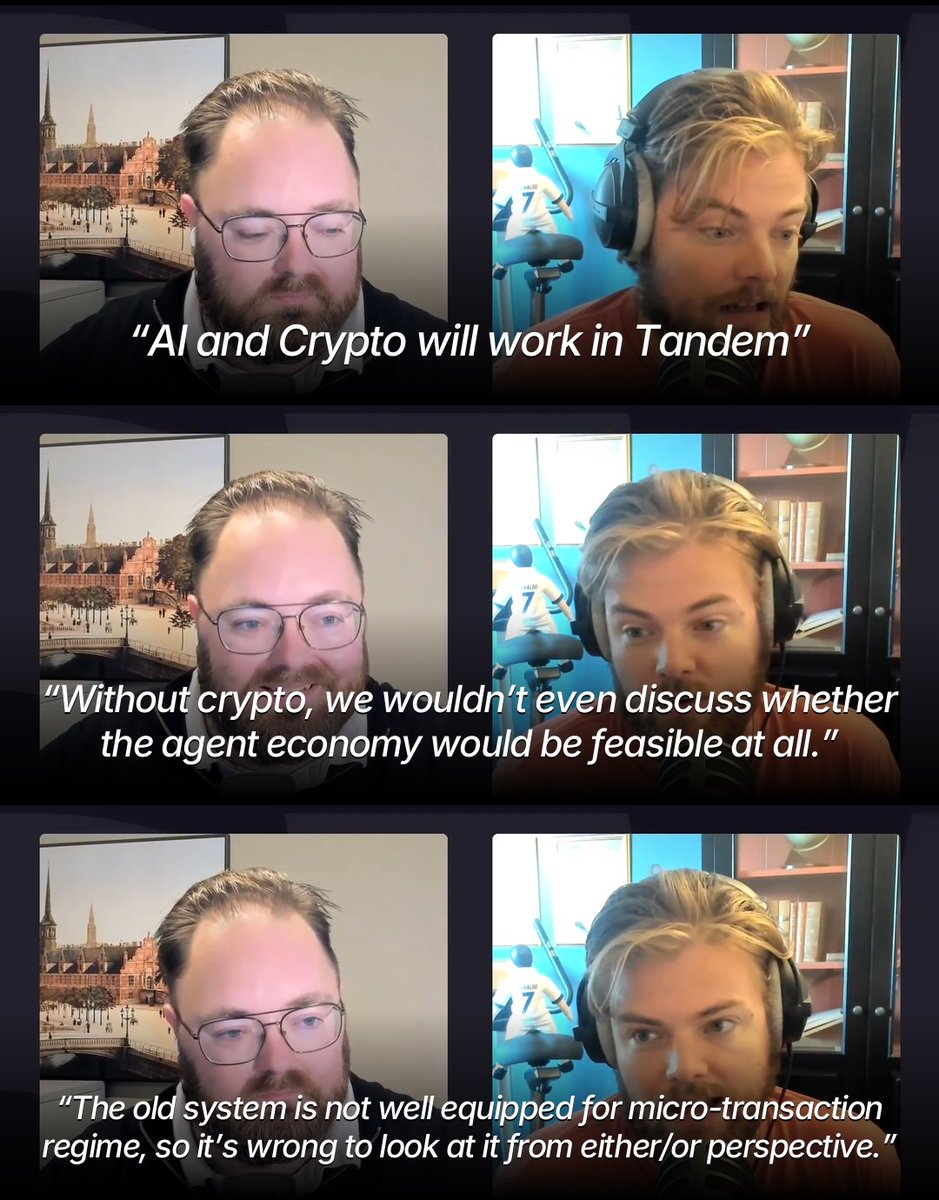
The agentic economy doesn't work without crypto.
Steno: AI agents need to pay each other in tiny amounts, constantly. Card rails and banks were never built for that.
Stablecoins were. That's why the two run together.
Stablecoins could become one of America’s most powerful financial exports. By putting more dollars into global circulation, they can strengthen demand for the dollar while giving people around the world easier access to it.
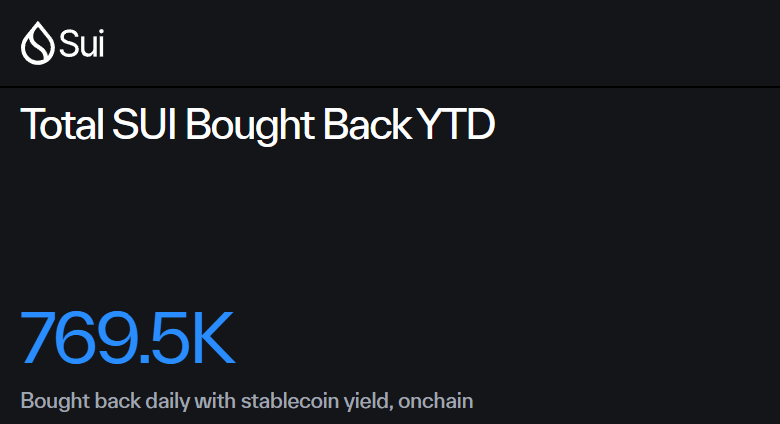
🚨 $SUI BUYBACKS ARE ALREADY HAPPENING
Mysten Labs has reportedly repurchased 769.5K $SUI year to date.
The interesting part is how those buybacks are being funded:
→ Stablecoin yield
→ Onchain fee revenue
That means ecosystem activity is being recycled back into $SUI demand.
Small for now, but this is exactly the kind of mechanism worth watching as network usage grows.
@aaronburnett It is increasingly probable that Starlink will carry a majority of Earth’s IP traffic long-term.
At that point, Starlink would de facto become the Internet and everything else would connect to Starlink.
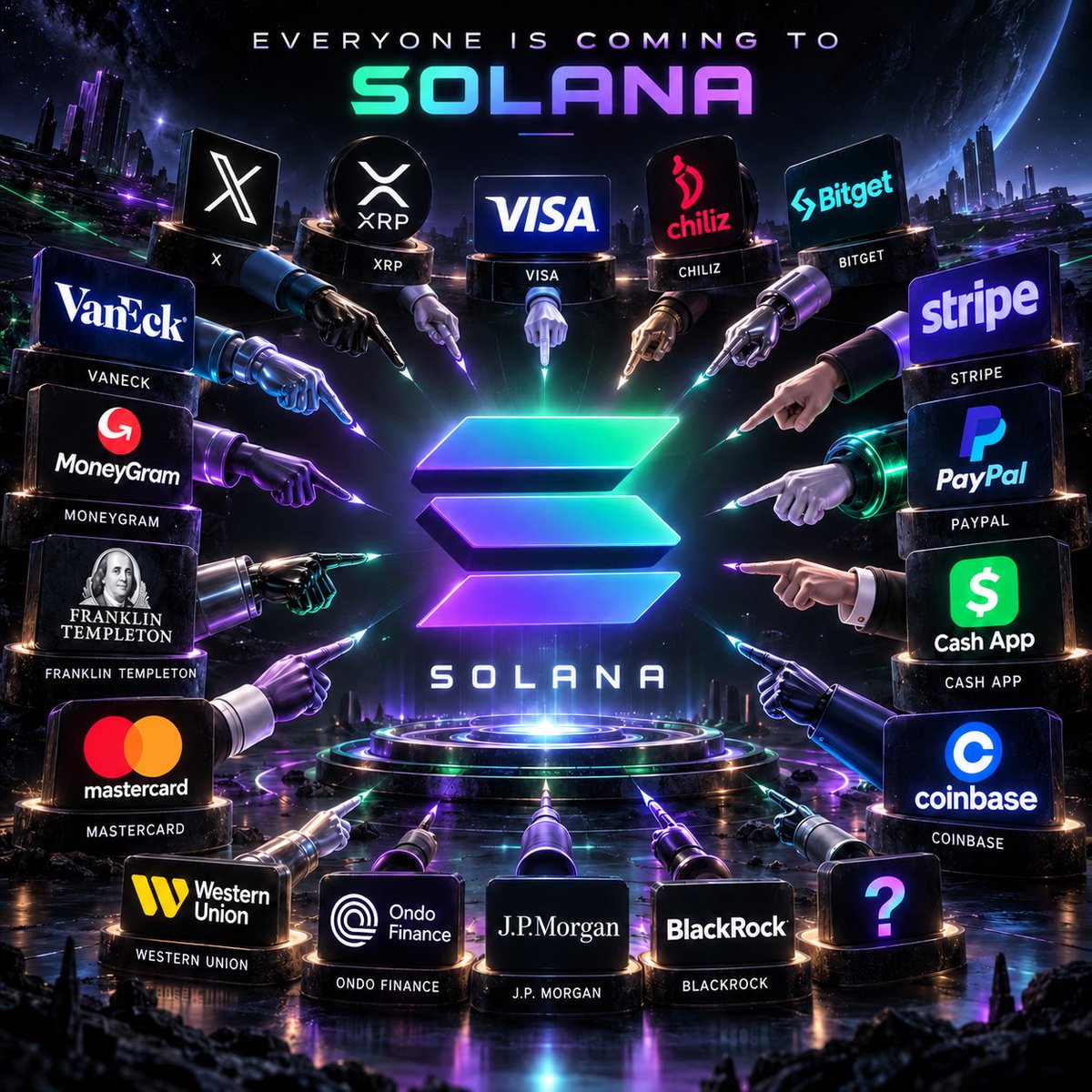
Everyone is coming to Solana.
𝕏 integrated Solana.
XRP expanded to Solana.
Visa is settling on Solana.
Mastercard supports Solana.
Chiliz expanded to Solana.
Bitget integrated Solana Pay.
Stripe supports payments on Solana.
PayPal launched PYUSD on Solana.
Cash App supports USDC on Solana.
Coinbase integrated Solana DEX trading.
BlackRock brought BUIDL to Solana.
J.P. Morgan has used Solana for tokenized commercial paper.
Franklin Templeton brought BENJI to Solana.
Ondo brought 200+ tokenized stocks & ETFs to Solana.
Western Union launched USDPT on Solana.
MoneyGram integrated Solana.
VanEck brought VBILL to Solana.
What's next?👀
The market is living through a time mismatch.
People are still debating rates, breadth and old-cycle recession signals while AI agents, tokenization and machine-speed economics are changing the rules underneath them.
In my new video:
• Why there’s a bear market inside the bull market
• Why consumer agents are the next major AI inflection point
• Why AI + tokenization changes how we should think about growth, money and competition
• Why I want to be long speed and short friction
• And why I believe crypto has reached its App Store moment with AI consumer agents filling the Ghost Rails
The speed of intelligence is accelerating.
The speed of money now has to catch up.
New video 👇
https://t.co/fAz9gF8mWU
One more thing about yesterday’s "Oscars of Optimism". When the winning film of the $2.5M Future Vision XPRIZE was announced, it became the first prize winner in XPRIZE's 30-year history that the public can invest in. Anyone can now invest and share in its profit potential. Link below 👇 https://t.co/plgwCb87Jv
I've created a new Grok Bot Tutorial template for anyone new to Grok @Bot.
This hands-on course includes 20 lessons. It walks you through every feature step by step, with real exercises and tips so you get the most out of Grok Bot.
Download: https://t.co/Nyf5muUF23
The 20 lessons:
1) Talking to your assistant
2) Files, images, and voice
3) Research & writing
4) Connecting your apps
5) Calendar and scheduling
6) My own computer & browser
7) Working on your own computer
8) Routines
9) Staying in control
10) Privacy and security
11) Memory and preferences
12) Skills
13) Showing it how to do something
14) A team of assistants
15) Sharing and templates
16) Customizing, and fixing things
17) Using it for your job or business
18) Travel and everyday errands
19) Money and finances
20) Buying things for you
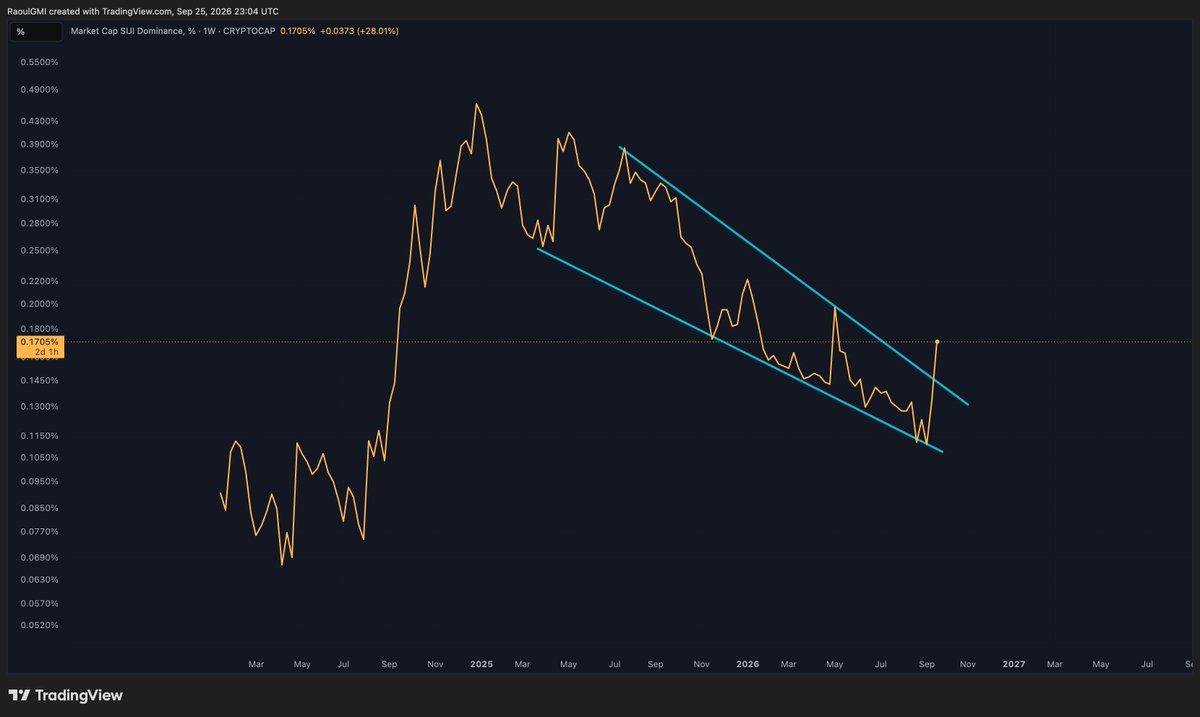
Sui dominance is a function of its beta. It has a low free float, 70% locked up in staking and it's earlier stage, and therefore any $ of capital in, or out, leads to outside moves over time.
Meanwhile the density of its network (TVL per active user) remains constant in up and down markets (a sign of network coherence), and higher than most of its peers. It still has a way to go but the sui:native team is shipping the future of finance and the agentic economy rails.
See you at @SuiBasedcamp in Singapore!
Jeff Gundlach laid out the Fed's dilemma this week:
Hike, and the interest bill on all that short-dated debt balloons. Cut, and inflation reignites.
He’s right. But I think it’s the wrong framing, and I haven’t seen anyone unpack this properly yet in response.
Here’s my take…
The US now spends roughly $1trn a year servicing its debt. And with a deficit bigger than the entire interest bill, every dollar of that interest is effectively borrowed.
They’re using a new credit card to pay the interest on the old one. Oldest trick in the book.
Every cycle the principal gets bigger, the refinancing wall gets bigger, and the liquidity it takes to refinance the debt gets bigger.
Once you understand that, the “dilemma” dissolves. There’s only one exit, and it runs through balance sheets.
The Fed is already back at it. It has added around $365bn of Treasuries since December, and the line is still climbing. Call it bill buying, call it reserve management... it's the Fed monetizing government paper.
But the Fed doesn't want to finance this alone. The real plan is to hand the baton over to the banks.
That's what the leverage rule changes in April were for: free up bank balance sheets to absorb Treasuries and, more importantly, to lend. And they are.
Bank loans are up almost $1trn in a year. When banks lend or buy government debt, they expand the money supply. And unlike QE, far more of it reaches the real economy.
Here's the catch though, and it's the whole game...
Banks borrow short and lend long. A flat yield curve does nothing for them. It squeezes the margin on every new loan.
So the Fed is still pulling liquidity higher as a bridge, waiting for the one thing that makes the handoff work: a steeper yield curve. And it has to be the right kind of steep.
What they need is a bull steepener. Front end falling faster than the long end.
Right now we have the opposite problem.
Markets saw Warsh's hike coming. Yields are up across the curve, with the 10-year and 30-year hitting their highest since 2007, but the front end has sold off hardest, flattening the curve. Exactly what banks don’t want/need.
Warsh delivered last week and signaled more to come. But strip oil out and inflation looks a lot tamer. Core CPI is at 2.4% and still edging lower.
This hike was about independence and credibility with the bond market, not broad-based inflation.
Which brings us back to oil…
Trump wants a deal, and he's saying so openly. Iran has put a road map on the table: a phased reopening of the Strait in exchange for the blockade coming off.
And with the midterms less than six weeks away, nobody in Washington wants voters staring at gas prices the way they are right now.
We've seen one deal fall apart already this year, so I'm not taking it on faith... but the incentives have never been more aligned.
If the Strait reopens and crude heads lower, headline inflation loses its biggest tailwind and inflation expectations cool.
That’s the pressure valve.
Warsh has shown the bond market he’s serious. Take oil out of the picture and he has room to stop hiking, then reverse course.
The front end rips, the curve bull steepens, and banks finally have the spread to put those freed-up balance sheets to work.
Then the dominoes fall…
A bull steepener pulls the dollar lower. A weaker dollar lets gold run. And when rates, the dollar and oil are all falling together, that's liquidity rising.
Here's why:
Every one of those forces the world to hedge.
A strong dollar forces anyone with dollar debt or dollar assets to pay up to protect against it.
High short rates make it expensive to hedge dollar exposure, which is why foreign buyers like Japan have largely stepped away from Treasuries.
Expensive oil forces airlines, shippers and importers to lock up capital in margin just to hedge their fuel bill.
When all three ease, that hedging demand falls away and the capital sitting behind it gets released.
And released capital doesn't sit still. It gets levered, lent and financialized.
But that's only act one...
The bigger play is Greenspan, mid-90s. The consensus said above-trend growth had to be inflationary. The consensus was wrong.
Greenspan saw what technology was doing to productivity and refused to fight an inflation wave that wasn't coming.
Real GDP ran at 4-5% for years. Core CPI held around 2-2.5%.
He eased, held his nerve through the boom, and only leaned against it late in the decade.
The Nasdaq 100 rose more than 500% from 1996 to 1999.
Warsh has made it clear he believes the same thing. Growth without inflation, because productivity lowers the cost of everything it touches.
Except this time around the productivity engine is AI and robotics, and it will dwarf what the internet did.
That's how you actually escape the debt trap. Not by paying it down. By growing nominal GDP faster than the debt itself. Debt to GDP stops rising, then eventually starts to fall, without a single dollar being paid back.
So does the party end when the need for debasement fades?
I don't think so. I think it changes shape...
In the 90s there was no QE. The Fed’s balance sheet grew mainly to keep up with the economy’s demand for cash.
Instead, the liquidity came from the private sector: bank lending, bond markets and a booming IPO market funding the buildout.
That's exactly where the banks come back in. Today they’re absorbing government debt so the refinancing gets done. Tomorrow they're lending into the AI capex boom. And that boom is only just getting started.
The big four hyperscalers alone are on track to spend more than 2% of US GDP on capex this year, most of it AI. NASA at the height of Apollo peaked at 0.7%. The Manhattan Project at 0.4%. And it's companies footing the bill, not governments, increasingly with borrowed money.
If you’ve followed my work for a while, you’ve heard me say this before, and I’ll keep saying it:
We’ve spent the last few years teaching AI to think. The next decade is about teaching it to move, see and build.
Robots, factories, power plants, grids… and almost none of that hardware exists yet. Someone has to finance it. That’s the banks’ next job.
So what does this all mean?
Risk assets stop rising on a dollar losing purchasing power (debasement) and start rising on an economy that’s worth more (productivity).
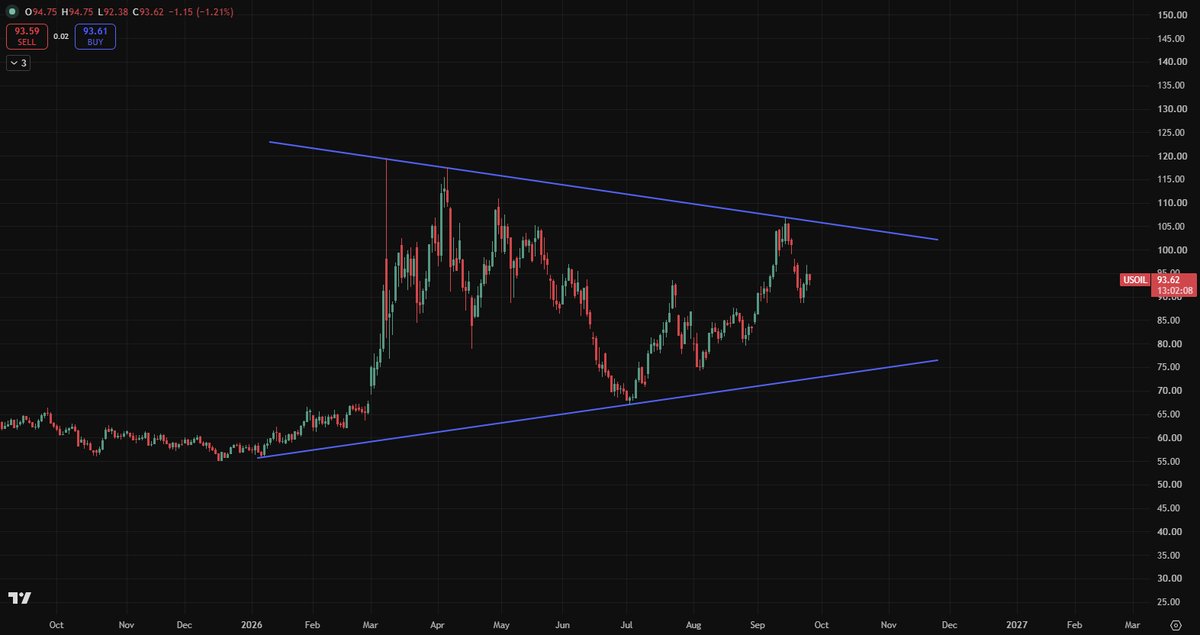
Now, act one hinges on the chart below…
WTI has spent the whole year coiling inside this large range. It just tested the top of it near $107 and got rejected.
So long as crude stays below that downtrend, and especially below $110, act one is on track.
If it breaks out and clears $110, it probably means the Strait deal isn't happening. Inflation stays sticky and Warsh loses his cover.
That delays act one. It doesn't cancel act two. The debt still needs rolling and the productivity wave is still coming.
That’s the playbook as I see it right now.
Act one: a Strait deal lands before the midterms, oil moves lower, the curve bull steepens ahead of the Fed, Warsh pauses then reverses, the dollar falls, gold runs, liquidity rises.
Act two: the productivity boom takes the wheel and the banks finance it.
Watch the yield curve, the dollar and gold for confirmation, then own what outruns debasement now and compounds with productivity later: tech and crypto.
The regime changes. The trade doesn’t.
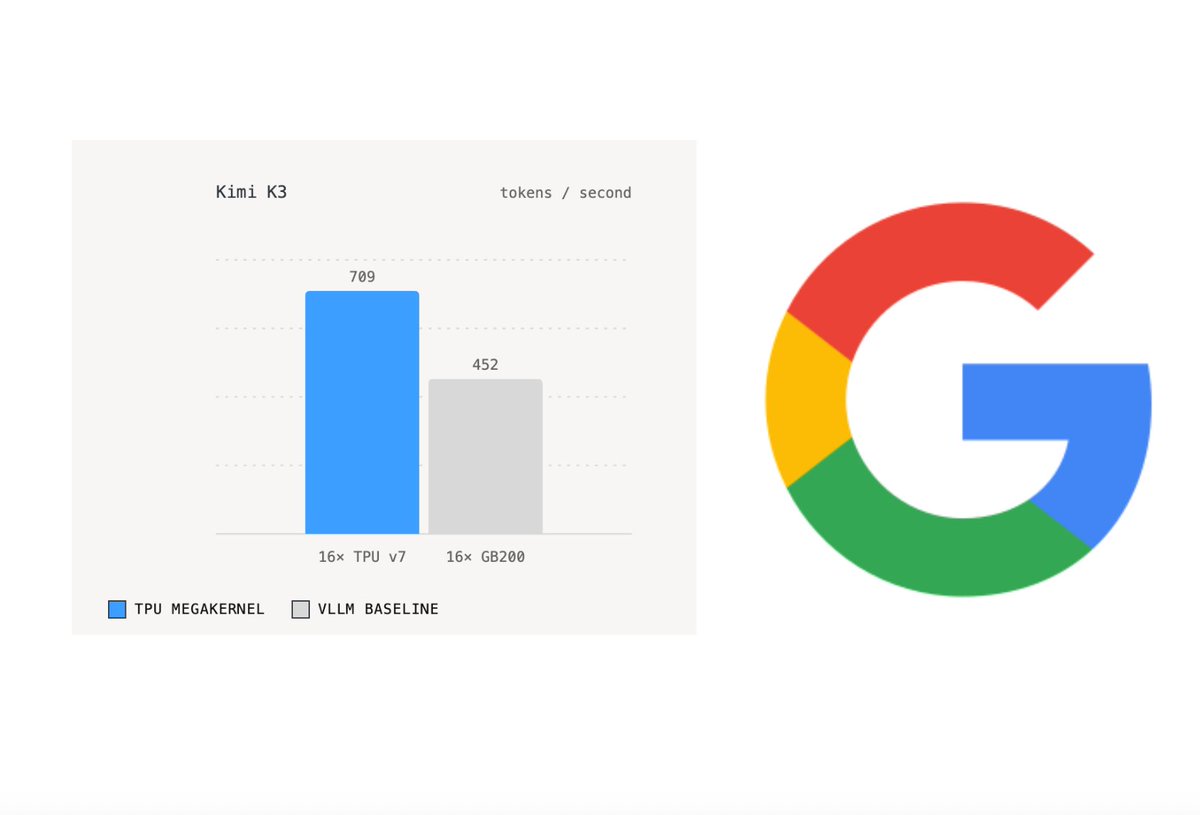
ALERT ALERT ALERT 🚨 🚨 🚨 VLLM MAINTAINERS HAVE JUST SHOWN THAT TPUv7 CAN GET 700 tok/s/user, 56% BETTER PERFORMANCE THAN NVIDIA GB200 NVL72 THROUGH MEGAKERNEL OPTIMIZATION ON KIMI K3.
As we said awhile ago, the TPU externalization of software is full steam ahead. This is ultra important to follow the progress of this.
Ten banks are providing a $22 billion loan to support Alphabet and Blackstone’s new AI cloud JV, Crux AI, with Blackstone investing an initial $5 billion to bring 500MW of capacity online in 2027.
$GOOG $AVGO