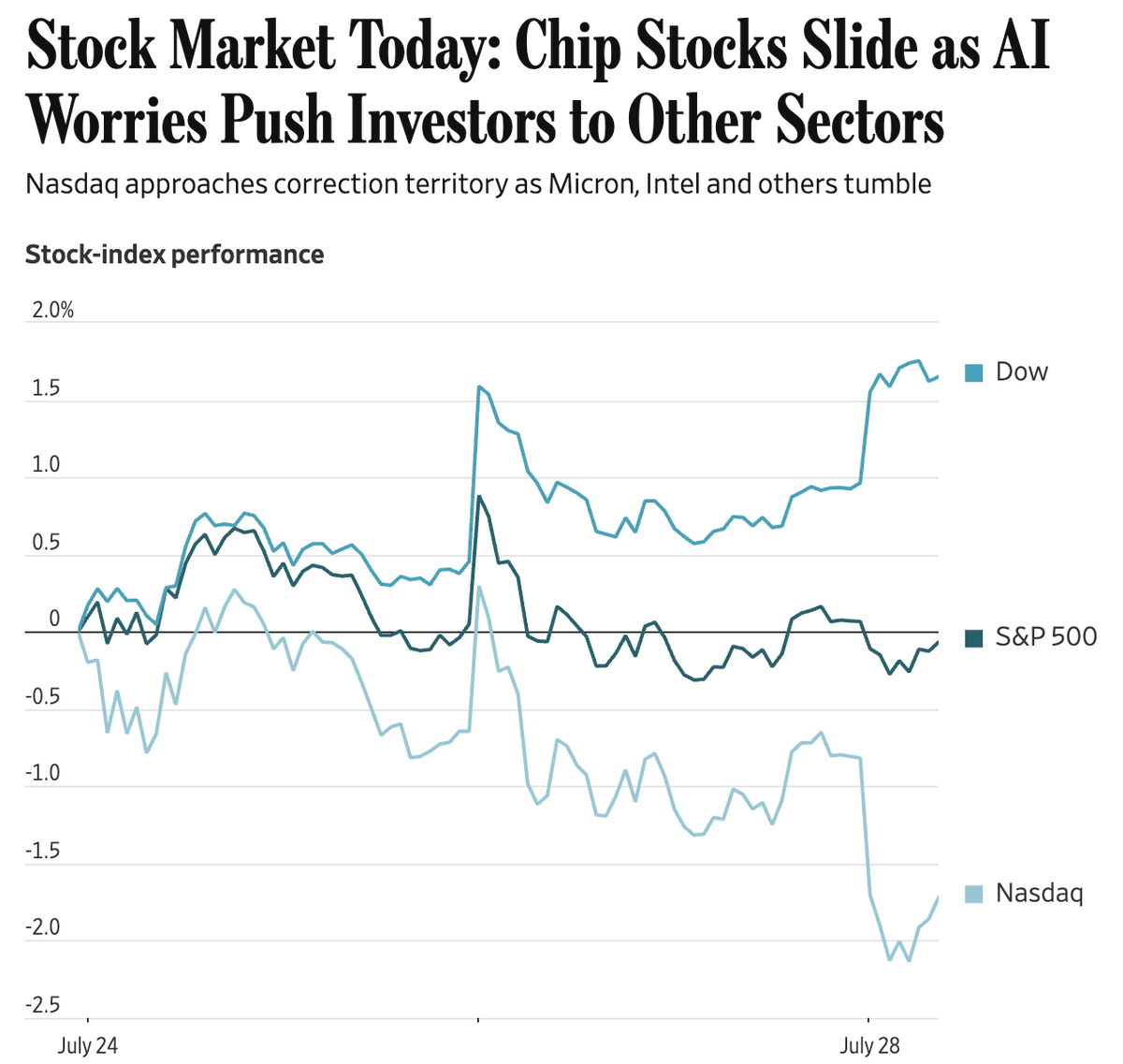
The most interesting thing about this market move is not that stocks are falling, but that leadership is rotating. While the headline focuses on chip stocks sliding and AI worries weighing on sentiment, the divergence between the Dow, S&P 500, and Nasdaq tells a more nuanced story. The Dow finished the period up roughly 1.5%, suggesting that capital is not leaving the market altogether. Instead, investors appear to be reallocating toward sectors that have lagged behind the AI trade. When money rotates from one pocket of the market into another, index performance can diverge significantly even when the broader market remains relatively healthy.
The Nasdaq's underperformance reflects how crowded the AI and semiconductor trade has become over the last few years. AI beneficiaries have delivered extraordinary returns, which naturally raises expectations for future earnings growth. At some point, even great businesses need time for fundamentals to catch up with their valuations. When investors become uncertain about the pace of AI monetization, data center spending, or the sustainability of semiconductor demand growth, taking profits becomes a rational response. Markets rarely move in straight lines, especially after prolonged rallies. Corrections are often the mechanism that allows excessive optimism to normalize without necessarily changing the long term investment thesis.
Another important observation is that the S&P 500 remains relatively resilient despite weakness in technology. If this were the beginning of a broad market breakdown, we would expect to see all three indices selling off aggressively together. Instead, the Dow is strengthening while the S&P 500 is trading near flat. That suggests this is currently more of a sector-specific repricing rather than a systemic risk event. Investors are asking whether AI infrastructure spending will generate adequate returns, but they are not abandoning equities as an asset class. Capital is simply becoming more selective about where it wants exposure.
This type of market behavior is actually quite common during powerful secular trends. Whether it was cloud computing, smartphones, or the internet, periods of excessive enthusiasm are usually followed by consolidation phases. The companies building tomorrow's infrastructure do not suddenly become bad businesses because their stock prices decline for a few weeks or months. Instead, markets periodically reassess expectations, earnings trajectories, and valuations. The AI story has always been a multi-year investment cycle rather than a straight line upward. Short term volatility should be expected when trillions of dollars in capital expenditures are involved.
My personal view is that this looks more like profit-taking than something investors should panic about. The AI narrative has not fundamentally changed over the past few days. Companies are still spending aggressively on data centers, semiconductors remain strategically important, and demand for compute continues to grow. After such a strong run, some correction is healthy for the market. Not every decline needs a new bearish narrative attached to it. Sometimes stocks simply go down because they went up too much, too quickly. Unless we start seeing a meaningful deterioration in earnings or a collapse in AI spending itself, I would view this as a normal correction rather than the beginning of something more concerning.
The Fed kept interest rates unchanged at 3.50%–3.75%, but the vote itself was arguably the biggest takeaway. Three Fed officials dissented in favor of another 25 bps hike, making it one of the most hawkish splits we've seen in recent years. While the headline says "no change," the internal disagreement suggests the battle against inflation is far from over. The Fed continues to describe the economy as expanding at a solid pace, with resilient employment, strong productivity growth, and ample liquidity in the banking system.
What stands out to me is that the Fed still doesn't sound like a central bank that believes inflation has been fully defeated. If policymakers were convinced inflation was sustainably heading back to 2%, there would be little reason for multiple governors to argue for another rate hike. Instead, they're acknowledging that underlying economic strength remains surprisingly resilient despite restrictive monetary policy.
One question I keep coming back to is oil. Energy prices have remained elevated compared to earlier expectations, and historically oil has been one of the biggest contributors to broad inflation through transportation, manufacturing, and consumer goods. If oil remains firm, it becomes much harder to see inflation falling smoothly back to target. Either the pass-through into consumer prices is weaker than previous cycles, or the strength of U.S. productivity is offsetting some of those inflationary pressures.
That leads to an even bigger question: is the U.S. economy simply stronger than many expected? Productivity growth has accelerated, unemployment remains relatively low, and corporate investment—especially around AI infrastructure—has stayed robust despite higher financing costs. If the economy can continue growing while absorbing higher interest rates, the Fed has less urgency to cut rates quickly.
Another factor that shouldn't be ignored is tariffs. Higher tariffs effectively raise the cost of imported goods, which can feed directly into inflation depending on how much businesses pass on to consumers. If tariffs remain elevated or expand further, they could offset some of the disinflation the Fed is hoping to achieve. That creates a difficult balancing act where inflationary pressures come not just from demand, but also from supply-side policy decisions.
The market continues to price eventual rate cuts, but the Fed's message is more cautious than many investors want to believe. Between sticky energy prices, potential tariff-driven inflation, and an economy that refuses to slow meaningfully, the path back to 2% inflation may be much slower than expected. A hawkish hold is still hawkish, and today's split vote reinforces that the Fed is not yet convinced the inflation fight is over.
$SPY $QQQ
FED HOLDS RATES, HAWKISH SPLIT EMERGES
The Federal Reserve left its benchmark rate unchanged at 3.50%–3.75%, saying inflation remains above its 2% target while the economy continues to expand at a solid pace.
The decision passed 9–3, with Hammack, Kashkari and Logan dissenting in favor of a 25-basis-point rate hike.
The Fed also highlighted strong productivity, resilient job growth and ongoing ample reserves in the banking system.
I used to read Lilian Weng's blog back when I was in college. Her posts were some of the best explanations of AI concepts I've ever come across—deeply detailed, yet incredibly intuitive. I learned a lot from her writing long before she became one of the most recognizable voices in AI research.
I've loved what she has done throughout her career, from OpenAI to co-founding Thinking Machines. Seeing someone who contributed so much to the field decide to step away is genuinely sad.
Reading her message, one thing stood out to me: she isn't leaving because the company failed. Thinky is doing well. She's leaving because of her health. She wrote that the consistent stress and workload had pushed her beyond what her health could physically sustain. That's the reality of building frontier technology that people often don't see.
It also made me think about founders and the physical cost of endurance. Building one startup is already brutal. Lilian stepped away after recognizing the limits of what her body could sustain and I have a lot of respect for that decision.
Then there's Elon Musk (@elonmusk). I don't know if he's ever had serious health issues or not, and nobody outside his circle really knows what trade-offs he's made personally. But running Tesla, SpaceX, xAI, Neuralink, The Boring Company, and X at the same time for years without stepping away because of health reasons is honestly difficult to comprehend.
Whether you like him or hate him, his durability and energy as a serial founder are extraordinary. Lilian's post is also a reminder that this level of endurance isn't normal. Behind every successful founder are very real physical and mental limits and sometimes the most difficult decision is knowing when to stop for a while.
It is a hard and sad decision. I shared this message with folks at Thinky. Thank you all for the time together♥️ Just as the last sentence in my message: The future worth building is human.
The thesis was right. The timing was right. The only thing I got wrong was position sizing.
Should've put more margin on my memory stock short yesterday.
$SKHY $MU $SNDK
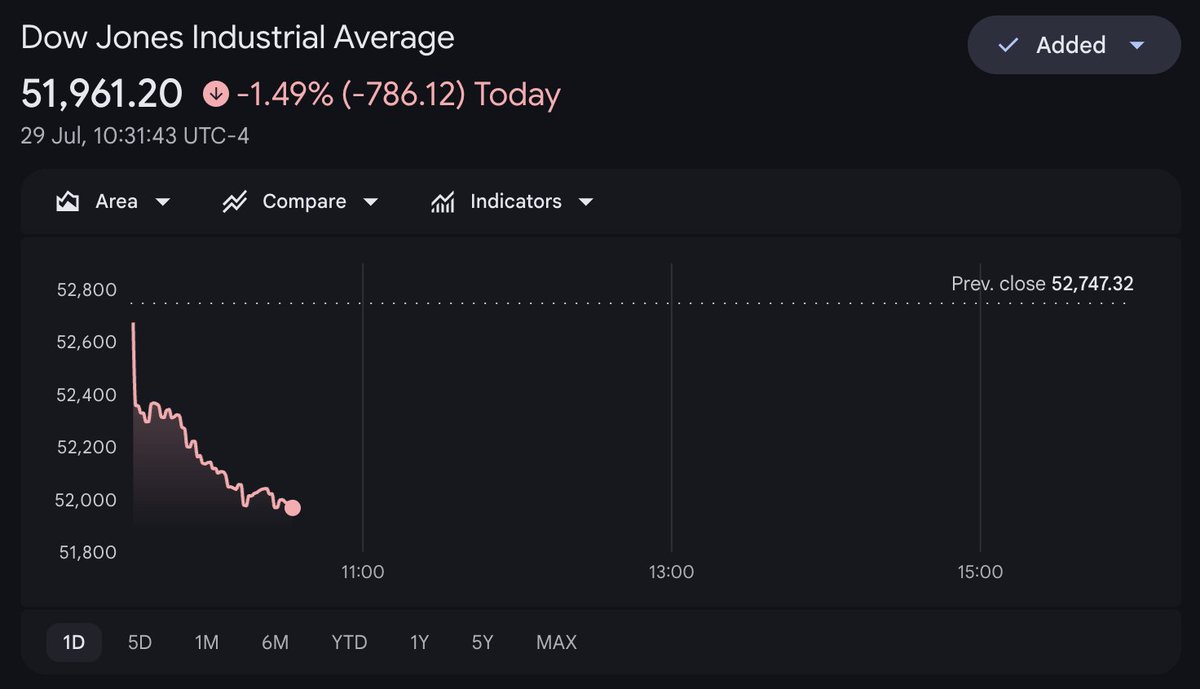
Dow Jones fell over 400 points today as investors rotated into defensive sectors ahead of the Fed decision, while rising oil prices and escalating Middle East tensions added another layer of uncertainty. Consumer staples and industrial names such as Procter & Gamble and Sherwin-Williams were among the biggest drags on the index.
My takes:
The Dow's weakness looks more macro-driven than company-specific. Higher oil prices raise inflation concerns, while investors are positioning cautiously before the Fed. That's a combination that typically pressures cyclicals and value stocks.
Unless geopolitical risks escalate further or the Fed delivers a major surprise, I see today's move as a sentiment-driven pullback rather than a signal that the broader economic outlook has materially deteriorated.
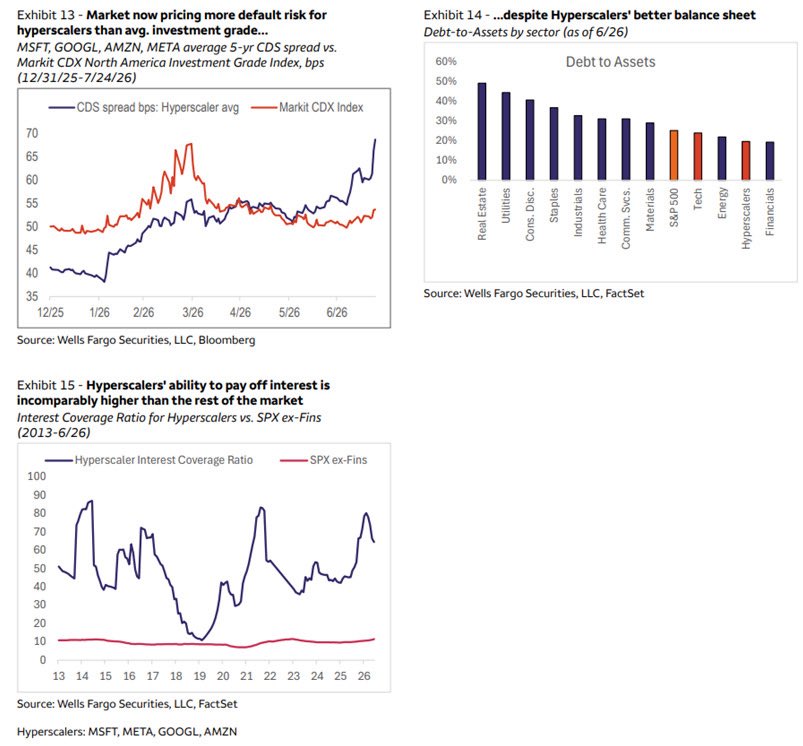
One thing that caught my attention isn't that CDS spreads are widening—it's where they're widening. For almost two years, the market has been willing to underwrite virtually unlimited AI capex under the assumption that demand would always outrun supply. Today, that narrative is starting to face its first real stress test. The widening CDS spreads across hyperscalers and AI beneficiaries suggest that credit markets are beginning to ask questions that equity markets have largely ignored. This doesn't necessarily mean the AI story is broken, but it does mean capital is no longer being viewed as free. When debt investors start demanding a higher premium, they're effectively pricing in more uncertainty around future cash flows and returns on investment.
The biggest question remains whether the economics will eventually justify the spending. We're talking about trillions of dollars being deployed across GPUs, data centers, networking infrastructure, and power generation before monetization has fully materialized. Unlike previous cloud cycles, this capex is extraordinarily front-loaded while the revenue opportunity remains somewhat back-loaded. AI will almost certainly create enormous value over the next decade, but the timing matters. If monetization takes five to seven years instead of two to three, the return profile looks very different once depreciation expense and financing costs are taken into account. Investors shouldn't simply ask whether AI wins—they should ask who captures the economics of that victory and when.
The financing side of the equation deserves more attention than it's currently getting. Companies like the hyperscalers still generate massive free cash flow, so this isn't a liquidity problem. However, we're beginning to see debt increasingly becoming part of the funding mix for the AI buildout, and widening CDS spreads reflect that reality. Higher spreads mean a higher cost of capital, which eventually raises the hurdle rate for future investments. At some point, if the incremental return from another billion-dollar data center isn't sufficiently attractive relative to financing costs, management teams will naturally become more disciplined. Markets rarely kill secular trends—they simply force them to become economically rational. The question isn't whether AI capex stops, but whether its growth rate eventually normalizes.
What I find particularly interesting is the divergence we're seeing within the ecosystem. Companies sitting closest to the infrastructure layer naturally carry more risk if demand expectations prove too optimistic. The Oracle and CoreWeave CDS charts are particularly noteworthy because they reflect how leveraged bets on AI infrastructure are being scrutinized much more aggressively than the large-cap hyperscalers. The market is effectively differentiating between companies that can comfortably absorb periods of lower returns and those whose entire investment thesis depends on maintaining exponential demand growth. Not all AI exposure carries the same risk profile.
The demand question is probably the most difficult one to answer. The bullish argument—that compute demand will become effectively insatiable—isn't unreasonable. Inference workloads, AI agents, robotics, and next-generation models could collectively create demand far beyond what today's forecasts imply. At the same time, history suggests technology adoption rarely follows a perfectly linear path. More efficient models, lower compute requirements, slower enterprise adoption, or commoditization could significantly reduce how much infrastructure is ultimately needed. We don't need demand to collapse for valuations to become problematic—we simply need demand growth to be lower than what's currently being priced into multi-trillion dollar investment plans.
My view remains cautious, but not bearish. I don't think this is an AI bubble waiting to burst, nor do I believe the capex cycle suddenly stops tomorrow. If anything, I think the risk is more about mispriced expectations than technological failure. AI is real, demand is real, and the opportunity is massive. What remains uncertain is whether earnings can catch up quickly enough to justify today's level of investment and financing costs. CDS spreads are simply reminding us that even the most transformative technologies are still constrained by economics. The market isn't questioning whether AI matters—it's questioning how much we're willing to pay today for returns that may take much longer to arrive than many investors currently expect.
The remarkable thing about this chart is not simply that volatility has reached an all-time high, but that it is happening after years of relatively subdued market behavior. The 30-day volatility of South Korea's stock market (KOSPI) has surged to almost 80%, surpassing previous episodes during the Asian Financial Crisis, the Dot-com bubble aftermath, the Global Financial Crisis, and even the COVID-19 shock. Markets can recover from declines relatively quickly, but volatility at this magnitude suggests investors are struggling to price the future. When markets become this unstable, it usually reflects uncertainty rather than just pessimism.
What's particularly interesting is that South Korea currently sits at the center of several global investment themes. The country is highly exposed to semiconductors, AI infrastructure spending, memory chips, batteries, automobiles, and global trade flows. The KOSPI has increasingly become a leveraged bet on the global technology cycle, especially given the outsized importance of its semiconductor champions. That means investors are simultaneously pricing multiple risks: slowing global growth, potential corrections in AI-related spending, geopolitical tensions in East Asia, currency fluctuations, and domestic political developments. Higher concentration in several globally important industries can amplify both upside and downside moves.
Another factor worth highlighting is how market structure has changed over the past decade. Retail participation in South Korea has grown substantially, while foreign institutional flows remain extremely influential. The combination of aggressive retail trading behavior and large foreign capital movements can significantly increase short-term volatility. When sentiment shifts, both groups tend to move quickly, creating larger swings than fundamentals alone would justify. Volatility itself can become self-reinforcing as leveraged positions are unwound and momentum-driven strategies accelerate price movements.
This spike also serves as a reminder that volatility should not automatically be interpreted as a bearish signal. Historically, some of the most profitable long-term investment opportunities emerge during periods of elevated volatility because markets tend to overreact in both directions. Volatility simply means disagreement. Some investors are aggressively buying future growth narratives while others are rapidly discounting downside scenarios. The larger the disagreement, the larger the price movements become. Today's record volatility may therefore reflect a repricing process rather than the beginning of a structural decline.
My biggest takeaway from this chart is that South Korea has become increasingly sensitive to global macro developments. Twenty years ago, KOSPI volatility was driven largely by domestic or regional events. Today, it reacts to developments ranging from U.S. monetary policy and AI spending trends to semiconductor demand and geopolitical headlines. In many ways, South Korea has become one of the purest proxies for global technological and industrial cycles. When investors become uncertain about where the world economy is heading, KOSPI tends to feel that uncertainty disproportionately.
For long-term investors, record volatility should probably be viewed less as a reason to panic and more as a signal that risk management matters more than ever. Markets rarely reward emotional decisions during highly volatile periods. If anything, this chart highlights how interconnected modern markets have become. South Korea is no longer just an emerging Asian market—it has become a global technology and manufacturing powerhouse whose stock market now amplifies both global optimism and global fear. Record volatility tells us less about where prices will go next and more about how uncertain the path forward has become.
Asian private credit's fundraising collapse is more than just a cyclical downturn. It reflects a deeper problem: Asia is losing its investment narrative. The region used to sell three powerful stories simultaneously—rapid economic growth, digital transformation, and an emerging middle class. Today, all three are facing challenges. Political uncertainty has increased across many markets, economic growth has slowed, and the next technological cycle is no longer as democratized as the software boom was in the post-2020 era. Investors aren't simply becoming more risk-averse; they're becoming more selective. When private credit fundraising falls from $20.2 billion in 2022 to just $1.2 billion in the first half of 2026, it suggests that global capital is asking whether Asia can still deliver outsized returns relative to its risks.
For Southeast Asia specifically, the problem is even more structural. The list of investable markets is becoming increasingly narrow. Singapore remains attractive because of its regulatory stability and role as a financial hub, while Malaysia has quietly benefited from supply chain diversification and semiconductor investments. However, neither market is large enough to absorb the amount of capital that once flowed across the region. Indonesia was previously one of Southeast Asia's biggest investment stories through infrastructure spending, commodity exports, and digital economy growth. Today, many investors are becoming more cautious as fiscal priorities shift toward populist programs and social spending initiatives that are more difficult to translate into long-term productivity gains. Capital is increasingly demanding predictability, and private credit investors are perhaps the most sensitive to that requirement because they're lending money rather than participating in upside equity returns.
The decline also coincides with the end of Asia's software-driven investment cycle. Following 2020, it was relatively easy for capital to chase technology themes throughout Southeast Asia. Building software businesses required less capital, market expansion was rapid, and private funding markets were highly accommodative. Private credit naturally benefited from this environment as startups matured and alternative financing became increasingly attractive. The AI cycle is fundamentally different. Building frontier AI capabilities requires enormous amounts of capital, access to leading semiconductors, computing infrastructure, world-class talent, and supportive industrial ecosystems. Realistically, only the United States and China currently possess all four ingredients at scale. This leaves Southeast Asia largely positioned as either an adopter of AI technologies or a supporting ecosystem rather than a global leader. Singapore has managed to establish itself as a proxy—a neutral platform for capital seeking exposure to China's innovation ecosystem without directly accepting Chinese political risks—but proxies rarely capture the full economic benefits of being the underlying innovator.
At the same time, macroeconomic conditions have become increasingly unfavorable for private credit. Higher interest rates have exposed businesses that previously survived in an environment of cheap capital. Rising corporate bankruptcies aren't merely statistics—they're fundamentally changing investor behavior. Private credit performs best when economic growth remains sufficiently robust to support debt servicing while banks become more restrictive in their lending practices. Today, many Asian economies are facing slower growth while simultaneously experiencing tighter financial conditions. Oil prices only add another layer of difficulty. Many Asian economies remain net importers of energy, meaning higher energy costs immediately pressure corporate margins and consumer spending. Local supply constraints are struggling to keep pace with regional demand growth, creating persistent inflationary pressures that complicate monetary policy decisions throughout the region.
Perhaps the most telling aspect of this story is where capital is going instead. Institutional investors haven't abandoned private credit as an asset class—they're reallocating toward larger and more established managers, particularly in the United States. Investors are effectively paying a premium for certainty. When faced with choosing between lending to AI infrastructure projects in the United States or financing smaller, economically sensitive businesses in emerging Asia, many institutions have decided the risk-adjusted returns favor the former. Capital always follows narratives, and today's dominant narrative is increasingly concentrated around AI infrastructure, semiconductors, and hyperscale computing—all industries where the United States and China possess substantial competitive advantages. Asia isn't competing against its own past performance anymore; it's competing against the most attractive investment opportunity of this decade.
The collapse in Asian private credit fundraising, therefore, should not be viewed as a temporary fundraising problem alone. It is a symptom of broader changes in global capital allocation. Markets that fail to provide political stability, technological leadership, or compelling economic narratives inevitably struggle to attract capital over time. Southeast Asia still possesses significant long-term potential through demographics, manufacturing diversification, and growing consumer markets, but those advantages are becoming insufficient on their own. The post-2020 playbook of abundant liquidity financing regional growth stories has ended. Global capital is becoming more concentrated, more selective, and increasingly willing to pay for quality over growth narratives. Until Asia produces its next compelling investment theme—or successfully positions itself within the AI value chain—private credit fundraising will likely remain under pressure. The money hasn't disappeared. It has simply become much harder to earn.
One thing that immediately stands out to me is that 2026 isn't necessarily a year of broad market euphoria—it's a year of extreme market selectivity. The chart shows the number of weeks in which the performance spread between the best and worst-performing S&P 500 sectors exceeded 10 percentage points. Historically, we only see this kind of divergence during major market regime shifts: the dot-com boom and bust (2000-2002), the Global Financial Crisis (2008-2009), and the pandemic period (2020-2022). What's interesting is that we're only halfway through 2026, yet we've already seen around eight weeks of these extreme divergences. That's not normal behavior for a healthy, synchronized bull market where most sectors move together. The market is telling us that capital isn't flowing everywhere—it's becoming increasingly selective.
To me, this is one of the strongest arguments against the "everything bubble" narrative. If we were truly in a bubble, I would expect indiscriminate buying across sectors similar to what we saw during the later stages of previous speculative episodes. Instead, we're seeing the exact opposite. Some sectors are being aggressively repriced higher because investors believe they deserve it, while others are being left behind despite respectable fundamentals. The dispersion itself is becoming the story. This isn't a market where buying the index automatically guarantees participation in the biggest winners. Stock and sector selection matters again, something we haven't consistently seen over the last decade of liquidity-driven rallies.
I also think this explains why so many people simultaneously feel that the market is expensive and cheap. Both camps are technically correct. If you're looking at AI infrastructure, semiconductors, cloud platforms, or software companies benefiting from structural tailwinds, valuations look extremely rich. If you're looking at other parts of the market, multiples are much more reasonable. We're no longer trading one market—we're trading multiple markets operating under the same ticker symbol called the S&P 500. That's why aggregate valuation metrics are becoming less useful than they used to be. Market averages are hiding enormous differences underneath the surface.
Another interesting implication is what this means for passive investing. Passive strategies have obviously worked exceptionally well over long periods of time, but periods of extreme dispersion historically create opportunities for active allocation. When the spread between winners and losers widens substantially, being positioned in the right sectors matters far more than simply having market exposure. Investors who are overweight in secular winners can significantly outperform, while those concentrated in lagging sectors can materially underperform despite both claiming they're invested in "the market." Dispersion creates both opportunity and risk simultaneously.
My biggest takeaway isn't that we should become bearish because divergences are widening. It's that we're probably witnessing another market transition. Previous spikes in divergence coincided with major economic and technological shifts—the internet revolution, the post-GFC recovery, and the pandemic-driven digitization wave. Today's divergence is likely being driven by another structural shift centered around AI, infrastructure spending, power demand, cloud computing, automation, and changing capital allocation priorities. Markets are trying to determine who will become the next generation of dominant businesses and who will merely participate without capturing the economics of the transformation.
The lesson I take from this chart is relatively simple: this is becoming a market of narratives being tested by fundamentals. Being right about a theme is no longer enough—you also have to be right about where the value accrues. Not every company exposed to AI will win. Not every sector will participate equally. The widening dispersion suggests we're moving away from a tide that lifts all boats and toward a market that rewards precision. In my view, that's neither inherently bullish nor bearish. It's simply a reminder that we're living through another regime change, and regime changes are usually uncomfortable precisely because they create both extraordinary winners and painful losers at the same time.
I've been reading The AI Future is for Everyone, and I find myself agreeing with most of its core arguments—not because I'm blindly optimistic about AI, but because I think it frames the most important question correctly.
The biggest risk of superintelligence isn't necessarily that it becomes too powerful. It's that the power becomes concentrated in the hands of a few institutions. Even with good intentions, whoever controls the most capable models will inevitably influence economics, science, education, and politics. History has shown that concentrated power rarely stays neutral forever.
That's why I particularly agree with the idea that safety requires checks and balances. We don't build resilient societies by asking everyone to trust a single institution. We build them by distributing power widely enough that people, markets, and institutions naturally balance one another. I believe AI should follow the same principle.
I also like the argument that AI should be viewed primarily as a tool for empowerment rather than automation. The mainstream narrative today tends to focus on "AI will take all our jobs," but we often ignore the other side of the equation—AI dramatically lowers the cost of building things. Starting a business, developing software, conducting research, or creating content has never been more accessible.
If everyone has access to increasingly capable AI systems, I don't think the future necessarily means fewer jobs. It may simply mean different jobs and a more entrepreneurial economy. A single person can become a team of ten. Small businesses can compete with larger incumbents. People can experiment and build without needing massive amounts of capital upfront.
Of course, there will be disruption, and not every outcome will be positive. But I'd much rather live in a world where billions of people are empowered by superintelligence than one where only a handful of organizations get to decide how humanity should use it.
The future I'm optimistic about isn't AI replacing humans, it's AI amplifying what humans are capable of creating.
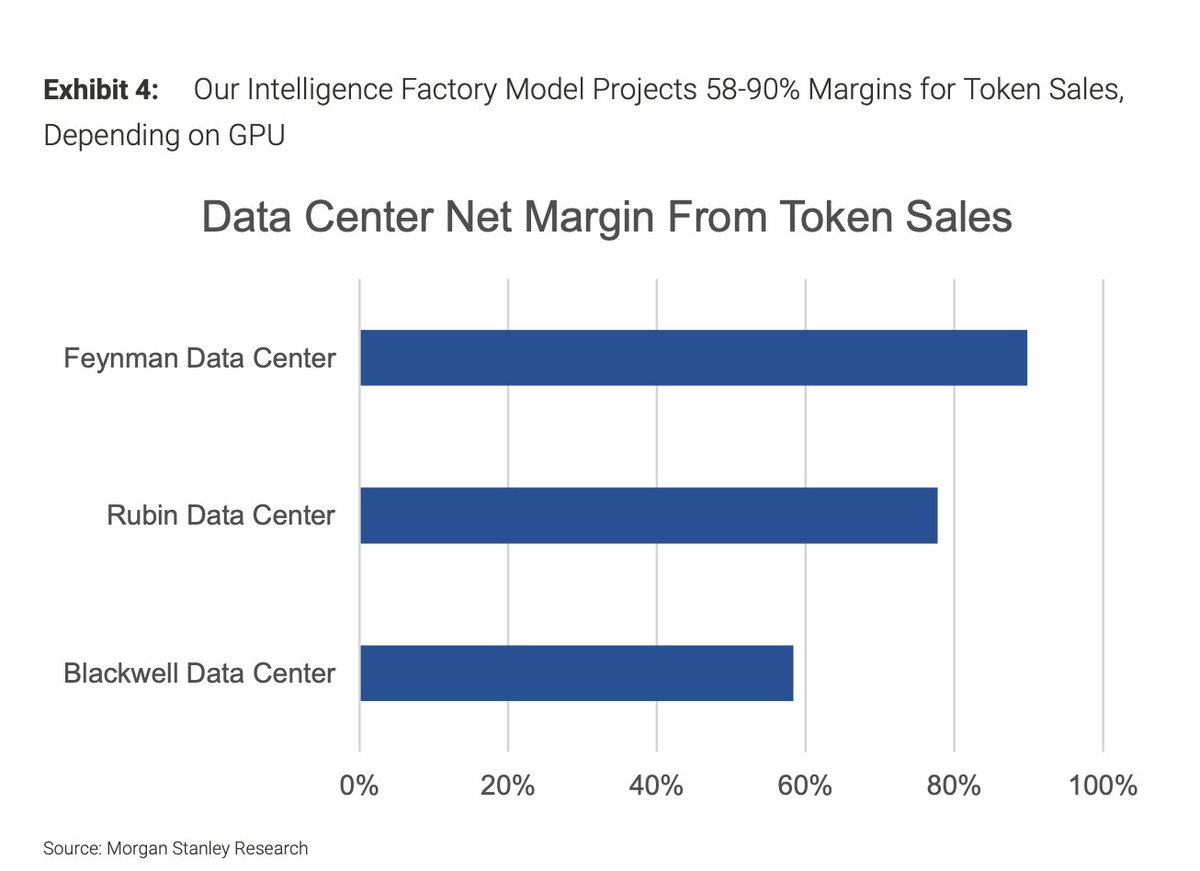
The most interesting thing about this chart isn't the margin itself, it's what it implies about the future business model of AI infrastructure. We've spent the last two years debating whether AI is a GPU story, a cloud story, or a software story. Morgan Stanley's Intelligence Factory model suggests it could be something much bigger: AI infrastructure providers eventually selling tokens could generate 58-90% net margins at the data center level. That's software-like economics sitting on top of hardware-intensive businesses.
If this projection is remotely accurate, then we're massively underestimating the economic transformation happening inside data centers. Traditionally, data centers have been low-margin businesses. Cloud providers are better, but they're still constrained by enormous capex requirements and competitive pricing pressures. Token sales fundamentally change that equation. Once the infrastructure is built, every additional token generated has extremely high incremental profitability. The GPU simply becomes the factory machine, while tokens become the product being manufactured. Suddenly, NVIDIA isn't just selling shovels anymore—it's enabling the creation of highly profitable digital factories.
What's also fascinating is how margins differ across GPU generations. Blackwell projects around 58% net margins, Rubin moves closer to 78%, and Feynman approaches 90%. This isn't just Moore's Law applied to AI. It suggests that GPU improvements aren't linear—they're compounding economically. If future architectures deliver exponentially better performance-per-watt and performance-per-dollar, token generation costs continue collapsing while demand continues expanding. The economics become increasingly attractive for hyperscalers and AI infrastructure providers because every GPU generation dramatically improves the profitability of token production.
This brings me to something I don't think the market fully appreciates yet. We've been valuing companies like NVIDIA primarily based on GPU shipments and data center revenue growth. But perhaps that's too simplistic. If AI eventually resembles utilities or factories, then token generation becomes the actual end market. The GPU is merely one layer of the stack. In that world, whoever controls the intelligence factory—the combination of compute, networking, software, and distribution—captures substantially more value than people currently model. NVIDIA's investments across CUDA, networking, DGX Cloud, and its entire AI ecosystem suddenly make much more strategic sense. They're not simply trying to sell more GPUs; they're trying to become indispensable infrastructure for token production.
That said, I think investors should be careful not to extrapolate these projections blindly. A 90% net margin business attracts competition very quickly. Economics this attractive rarely remain untouched. Token prices could compress significantly over time as supply increases. Open-source models continue improving, inference costs are declining aggressively, and competitors ranging from custom silicon to other accelerator architectures will inevitably pressure industry economics. History has shown that extraordinary margins tend to normalize as industries mature. The question isn't whether margins eventually decline—it's whether demand grows faster than pricing compression occurs.
My takeaway remains largely unchanged: I don't think we're looking at an AI bubble as much as we're looking at a massive valuation debate. The technology is real, the economics are increasingly compelling, but perhaps the market is struggling to price where value ultimately accrues. If token sales truly become the economic engine of AI, we're still in the very early innings of understanding this business model. The biggest risk to the entire ecosystem isn't necessarily competition or valuation compression—it's if demand for intelligence itself doesn't materialize at the scale being projected. Because if token demand disappoints, then everyone suffers. And if token demand explodes, then this chart might end up being conservative rather than optimistic. The entire AI stack is ultimately making the same bet: that the world will consume exponentially more intelligence than it does today.
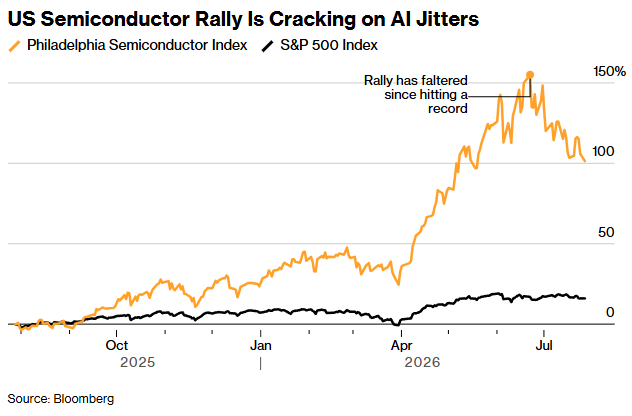
The market is finally reminding us that even the strongest secular trends don't move in a straight line. Looking at this chart, what's striking isn't that semiconductor stocks are falling—it's that they went up almost 150% in less than a year before starting to crack. The Philadelphia Semiconductor Index massively outperformed the S&P 500 during the AI boom because the market treated semis not just as another sector, but as the foundation of the entire AI economy. Every dollar flowing into AI infrastructure eventually finds its way to chips. That's why semiconductors became the highest-beta expression of the AI trade. When investors become optimistic about AI, semis rally first and hardest. When doubts emerge, they're also the first to get punished.
I don't think this is the bursting of the AI bubble. The bigger issue is valuation running much faster than fundamentals can catch up. Markets tend to price five years of growth into today's stock price when they're convinced they're looking at the next technological revolution. We saw it during the internet era, cloud computing, and now AI. The difference is that AI is very real—companies are spending hundreds of billions of dollars building infrastructure—but expectations became even bigger than reality. The question isn't whether AI will win. The question is whether earnings can grow fast enough to justify what investors were already willing to pay six months ago.
What concerns me the most is how concentrated the AI ecosystem has become. If semiconductor spending slows down, it doesn't stop at one company. The entire value chain feels the impact. Foundries, memory manufacturers, networking providers, cloud hyperscalers, software companies, and even power infrastructure players are interconnected through one massive capex cycle. That's why I've always viewed AI as an ecosystem bet rather than a company bet. When semiconductors rally 150%, people forget they're pricing perfection. When they fall 20-30%, people suddenly price disaster. Reality usually sits somewhere in the middle.
The recent weakness could simply be the market transitioning from the "everything AI goes up" phase into the "show me the earnings" phase. That's actually healthy. A sustainable bull market isn't built on multiple expansion forever—it eventually needs revenue growth, profitability, and cash flow to catch up. Some companies will justify their valuations, some won't. The winners of the next five years may not necessarily be the winners of the last twelve months. Market leadership changes more often than people realize.
Personally, I find this correction more interesting than worrying. Excessive optimism and excessive pessimism create opportunities for long-term investors. During euphoric periods, people underestimate execution risks. During corrections, they underestimate secular trends. AI isn't disappearing because semiconductor stocks corrected, just like the internet didn't disappear after the dot-com crash. Infrastructure spending may slow, growth rates may normalize, and valuations may compress, but that doesn't invalidate the underlying technological shift that's taking place globally.
My biggest takeaway from this chart is simple: this looks less like an AI bubble bursting and more like a repricing of expectations. The market got ahead of itself, and now fundamentals are being asked to catch up. AI will probably become larger than what most people imagine over the next decade—but that doesn't mean every AI-related asset deserves infinite multiples today. Sometimes the healthiest thing a bull market can do is disappoint investors for a while. The long-term story can remain intact even when stock prices need time to digest the future they already priced in.
The market is treating widening hyperscaler credit spreads as a warning that AI infrastructure spending has become unsustainable. I think that interpretation misses one of the most important dynamics happening beneath the surface. If GPU spot rental prices remain materially above contracted rates, then today's hyperscaler earnings are likely understating their true earning power rather than overstating it. Companies that locked in long-term compute contracts during 2024 and 2025 are enjoying below-market pricing, while hyperscalers are effectively subsidizing future revenue growth. As those contracts expire and renew at higher market rates, revenue and operating cash flow should naturally accelerate without requiring a proportional increase in infrastructure.
That is why I mostly agree with the argument that operating cash flow is being underestimated as a funding source for AI capex. Consensus models continue to focus on the size of future capital expenditures while assuming cash generation slows over time. But if pricing power is only beginning to normalize, then that assumption could prove too conservative. The market is pricing AI infrastructure as if hyperscalers will need to rely heavily on debt financing, when in reality a significant portion of future investment may be funded internally through expanding operating cash flow. If that happens, concerns around leverage and deteriorating credit quality become far less compelling.
The capex math also looks more manageable when viewed through that lens. Estimates calling for 25 to 35 gigawatts of additional capacity by 2028 translate into enormous investment requirements, but they also assume operating cash flow forecasts that may be too low. Even under current consensus, the remaining financing gap is relatively modest compared to the size of these businesses and would represent less than one additional turn of leverage. If operating cash flow estimates move meaningfully higher as GPU contracts reprice, much of that perceived funding gap could disappear entirely. Markets often fixate on gross spending while overlooking the earnings power that accompanies the assets being built.
Another point that deserves more attention is demand. Public data continues to show strong acceleration across AI applications, from OpenAI to Anthropic, Grok, Cursor, and the broader open-source inference ecosystem. This is not a story where infrastructure is being built without customers. Utilization remains exceptionally strong, and spot pricing suggests demand continues to exceed available supply. If anything, today's pricing indicates compute remains scarce rather than abundant. That reinforces the view that hyperscalers are temporarily under-earning while customers with legacy contracts are the primary beneficiaries.
None of this means there are no risks. The biggest constraint is still execution. Building data centers, securing power, energizing clusters, and deploying GPUs at scale remain incredibly difficult engineering and logistical challenges. Those bottlenecks, rather than financing, are likely the limiting factor for AI infrastructure growth over the next several years. Credit spreads can widen on sentiment, and CDS markets have historically amplified bearish narratives beyond what fundamentals justified. While they should not be ignored, I would be cautious about treating them as definitive evidence that the AI investment cycle is breaking. From my perspective, the market is overreacting to credit spreads while underappreciating how much pricing power and operating cash flow acceleration hyperscalers still have ahead of them.
Market is overreacting to hyperscale credit spreads widening from my perspective. TL;DR Spot pricing for renting GPU compute materially above contracted rates implies hyperscalers are underearning while operating cash flow acceleration is an underestimated source of funds for AI capex.
The fact that spot prices for GPU rentals are at least 2x higher than contracted rates is the missing piece from the discussion about hyperscaler credit, which is the only fundamental factor behind this selloff. Multiple private companies are planning on spending at least 2x more per GPU for compute as contracts roll-off and some have spoken about this publicly.
As contracts roll-off, hyperscale growth rates are going to continue to accelerate as their installed bases of compute reprice higher. Hyperscale operating cash flow growth using a mix of estimates and actuals is modeled to accelerate from 31% in the first quarter of 2026 to 50% in the second quarter. This acceleration should continue for the rest of the year and this is not in estimates which incorrectly model a deceleration in the third quarter from my perspective.
Some math. Consensus estimates are probably for 25-35 gigawatts added by hyperscale and neoclouds in CY28 (using a range as standing up datacenters is hard and a lot of the neos plus labs are still private). At 60b per gigawatt, that is 1.5 to 2.2 trillion in capex. Consensus estimates for hyperscale/neo operating cash flow is 1.3 to 1.4 trillion. I think this gets revised up materially as contracts reprice and growth accelerates so the 100b to 700b that would hypothetically need to be plugged by debt goes away. And their credit profiles materially improve. Not to mention the said 100b to 700b would be less than 1 turn of incremental leverage on consensus EBITDA estimates. And obviously the Nvidia and Broadcom “credit wrappers” help improve creditworthiness as well given their FCF profiles.
OpenAI, Cursor/Grok and the various Open Source inference clouds have accelerated materially over the last two months per public data and Anthropic continues to grow insanely fast while likely generating FCF. This - along with the fact that spot prices for GPU rentals are so far ahead of contract - are the missing pieces from the BofA chart on hyperscale FCF vs. semiconductor FCF.
Hyperscalers are underearning and anyone who signed a contract for GPU compute in 2024 and 2025 is overearning. Operating cash flow will be enough to fund capex but as contracts reprice and cloud growth continues to accelerate then spreads likely come in as well.
Would also note that CDS markets are easy to manipulate - was a huge feature of the GFC - short the stock and then buy the CDS. So I would not put attach much signal to CDS.
Net, net I’m not that concerned about the widening spreads in hyperscale credit. The real risk is that bringing power online and energizing all these GPUs is really hard but we are getting better at this every day.
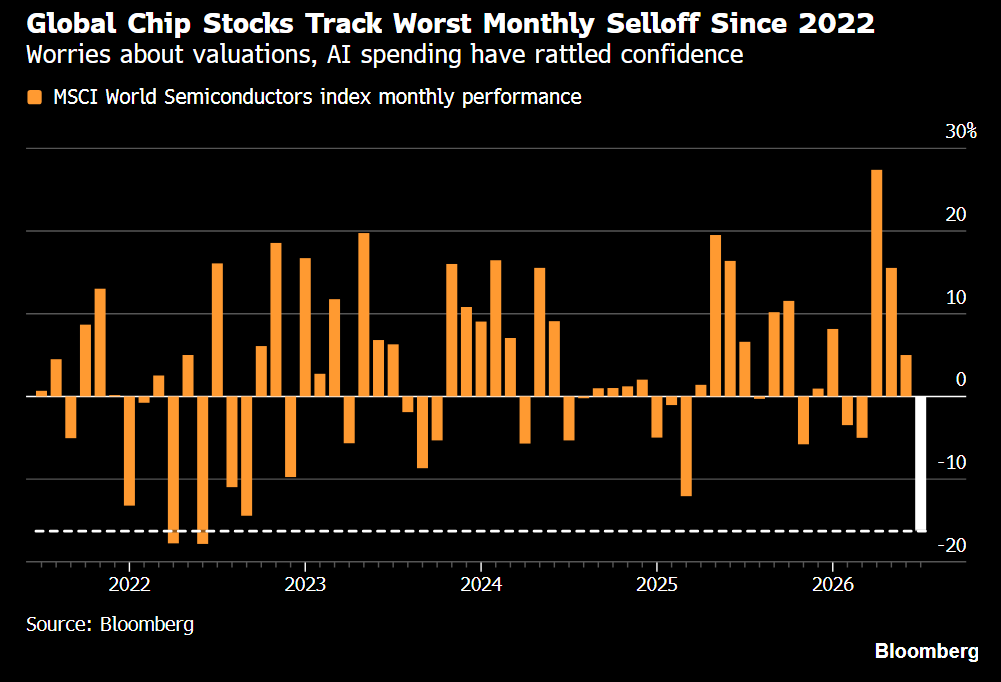
Global semiconductor stocks are on track for their worst monthly performance since 2022. The market narrative is familiar: AI valuations have gone too far, hyperscalers will eventually slow spending, and the AI infrastructure trade is running out of steam. We've seen this movie before. Every major technology cycle experiences periods where sentiment moves much faster than fundamentals, especially after an extended rally.
What stands out is that this selloff is being driven more by expectations than by actual deterioration in demand. AI infrastructure spending has not collapsed. Cloud providers are still deploying capital aggressively, enterprise AI adoption continues to expand, and governments worldwide are increasingly viewing semiconductors as strategic assets rather than just cyclical products. The market is simply recalibrating how much future growth should be priced in today.
Ironically, corrections like this often separate the companies with durable competitive advantages from those that were simply riding AI momentum. The winners are unlikely to be the businesses with the loudest AI story. They will be the companies that continue generating earnings, expanding cash flow, and capturing increasing share of AI infrastructure spending regardless of monthly market sentiment. Markets can compress multiples much faster than businesses lose their competitive positions.
I also think investors are underestimating the second-order effects. Lower semiconductor valuations reduce the cost of capital for buyers, improve expected long-term returns, and create opportunities for patient investors. At the same time, cheaper compute eventually benefits software companies, hyperscalers, enterprises, and ultimately customers. AI demand does not disappear because semiconductor stocks fall 15 to 20% in a month. If anything, lower infrastructure costs can accelerate adoption across the broader economy.
My view remains unchanged. This looks much more like a positioning reset than the end of the AI cycle. The market has become extremely sensitive to any headline questioning AI capex, but the structural drivers remain intact. Unless we see clear evidence that hyperscalers are materially cutting investment plans or enterprise AI demand is rolling over, I view this as volatility within a long-term secular uptrend rather than the beginning of a structural bear market for semiconductors.
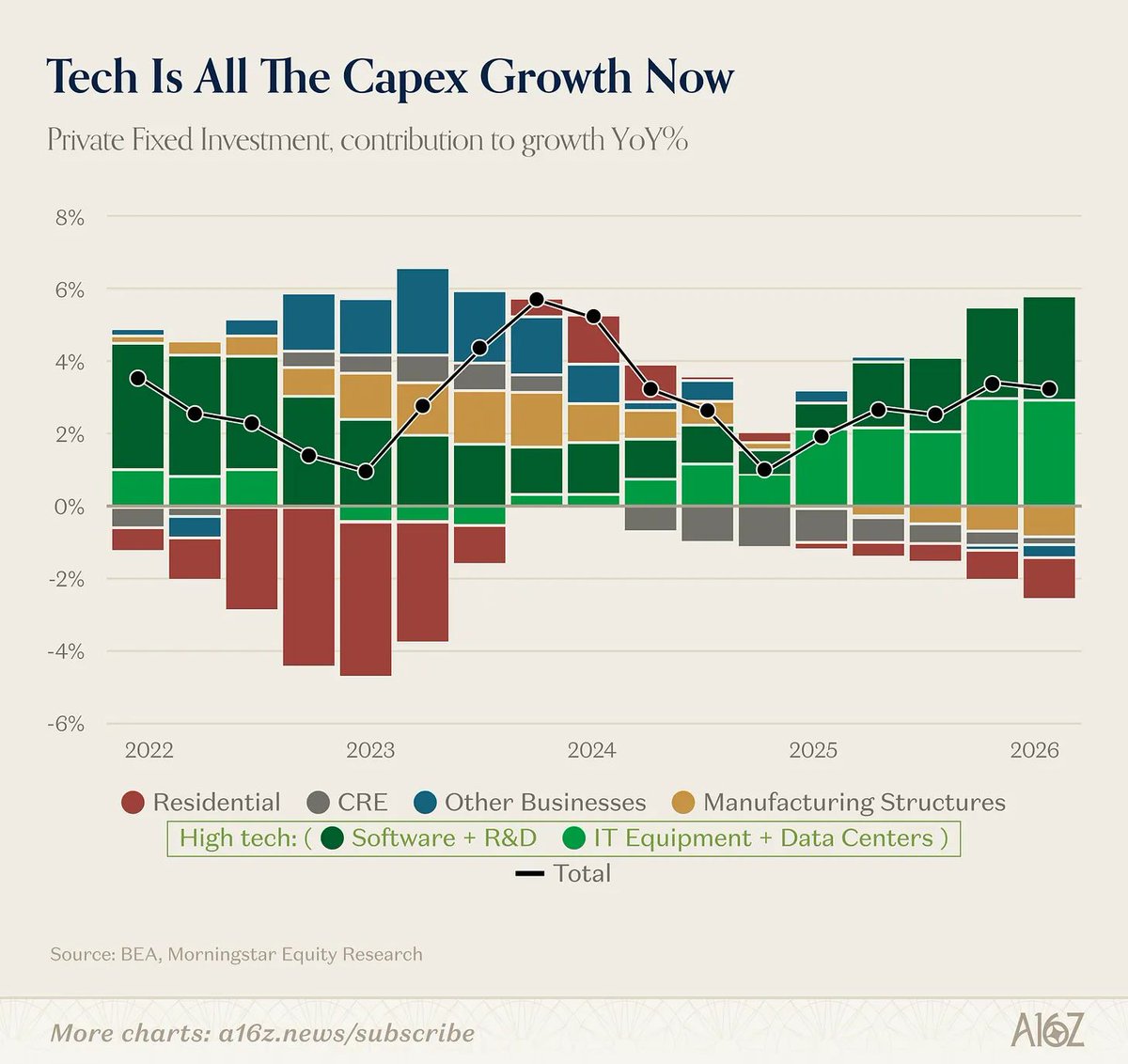
Tech is no longer just another contributor to capex growth. It has become the dominant source of private fixed investment while traditional sectors continue to weaken. Residential investment remains a drag, commercial real estate is still struggling, and manufacturing structures have cooled after their post-CHIPS Act surge. Meanwhile, software, R&D, IT equipment, and data centers are carrying an increasingly larger share of total investment growth. The chart shows a structural shift rather than a cyclical one. Capital is flowing toward digital infrastructure because that is where companies expect the highest long-term return on investment.
This is why I think many investors are still underestimating the magnitude of the AI infrastructure cycle. The market often frames AI spending as a temporary capex boom that will eventually normalize. But if software and compute become the backbone of every industry, then these investments resemble railroads, electricity, broadband, and cloud computing more than a typical technology upgrade. Companies are not simply buying GPUs. They are rebuilding the productive capacity of the modern economy around AI-native infrastructure.
The second-order beneficiaries could end up being even more interesting than the obvious winners. Hyperscalers continue to spend aggressively because demand for compute keeps surprising to the upside. Semiconductor companies benefit from higher silicon demand. But infrastructure providers, networking companies, power equipment suppliers, cooling solutions, fiber operators, and neocloud platforms may capture years of sustained demand as enterprises migrate workloads to AI. Every additional dollar spent on AI creates incremental demand across the entire infrastructure stack.
What's equally notable is what this chart says about the broader economy. Despite weakness in housing and commercial real estate, aggregate investment growth remains resilient because technology is offsetting those declines. That suggests AI is already influencing macroeconomic investment trends, not just equity narratives. We are reaching a point where GDP growth, productivity growth, and corporate earnings become increasingly tied to digital capital formation instead of physical construction.
My takeaway remains unchanged. The market continues to focus on whether AI capex is "too high," while paying less attention to where the capital is actually going. As long as businesses believe AI can improve productivity and generate attractive returns, capital spending is likely to remain elevated. The companies enabling compute, networking, storage, software, and data center infrastructure may prove to be the most durable beneficiaries of this investment cycle. Frontier AI labs will compete aggressively for model leadership, but the infrastructure providers supplying the picks and shovels are positioned to capture value regardless of which model ultimately wins.
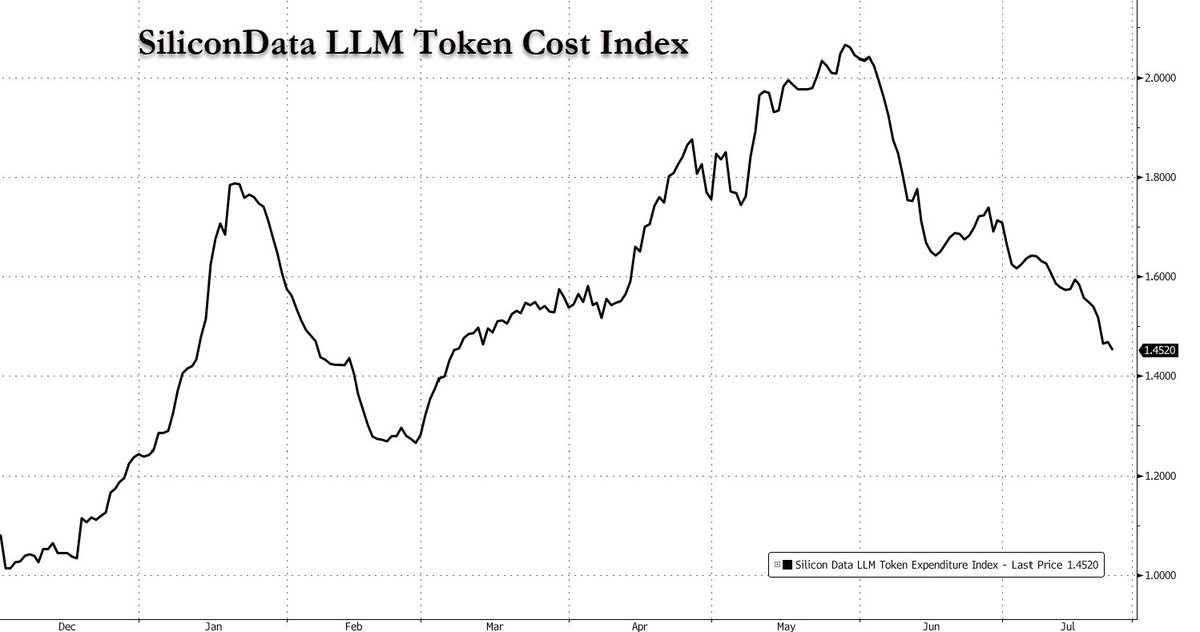
The SiliconData LLM Token Cost Index continues to trend lower, and I think this is one of the most underappreciated developments in the AI ecosystem. Lower inference costs are not bearish for AI. They expand the addressable market. History has shown that when the cost of a foundational technology falls, demand rarely falls with it. Instead, consumption explodes. We saw it with storage, bandwidth, compute, and cloud infrastructure. AI tokens are likely following the same path.
The biggest winners are customers. As inference becomes cheaper, companies can deploy AI into far more workflows that previously didn't make economic sense. Customer support, coding assistants, document processing, enterprise search, autonomous agents, and consumer applications all become more profitable. Lower token costs increase AI ROI, which ultimately drives higher adoption across every industry rather than reducing usage.
The hyperscalers also benefit. Many investors assume cheaper tokens mean pricing pressure and weaker economics for cloud providers. I think that misses the bigger picture. Lower prices stimulate significantly higher volume. AWS, Azure, and Google Cloud are not just selling tokens. They are selling compute, networking, storage, security, databases, orchestration, and managed AI services. If AI usage grows multiples faster than pricing declines, total infrastructure demand can continue rising. This is classic elasticity at work.
Neocloud providers may be an even bigger beneficiary. Their entire value proposition revolves around delivering AI compute more efficiently than traditional cloud vendors. As enterprises move from experimentation to production, they will increasingly optimize for cost per token and cost per inference. That creates a structural tailwind for specialized GPU clouds that can operate with better utilization, newer hardware, and more competitive pricing. Falling token costs should expand their customer base instead of shrinking it.
This is also why I think the market is mispricing many frontier AI labs. Too much attention is being placed on declining API prices while too little attention is being paid to the size of the market they are creating. If token prices fall 50% but usage increases 5x or 10x, revenue can still grow substantially. More importantly, frontier labs are evolving beyond simple API businesses. They are becoming full-stack AI platforms with enterprise products, agents, developer ecosystems, and proprietary applications. Valuing them solely on today's token pricing ignores where the industry is heading.
My takeaway is simple: falling AI costs are not a sign that the AI trade is ending. They are evidence that AI is moving from a scarce technology to abundant infrastructure. Customers win through lower costs. Hyperscalers win through higher utilization. Neoclouds win through infrastructure specialization. And the frontier labs that continue to lead on model quality may ultimately be worth far more than the market currently assumes because cheaper intelligence tends to create more demand, not less.
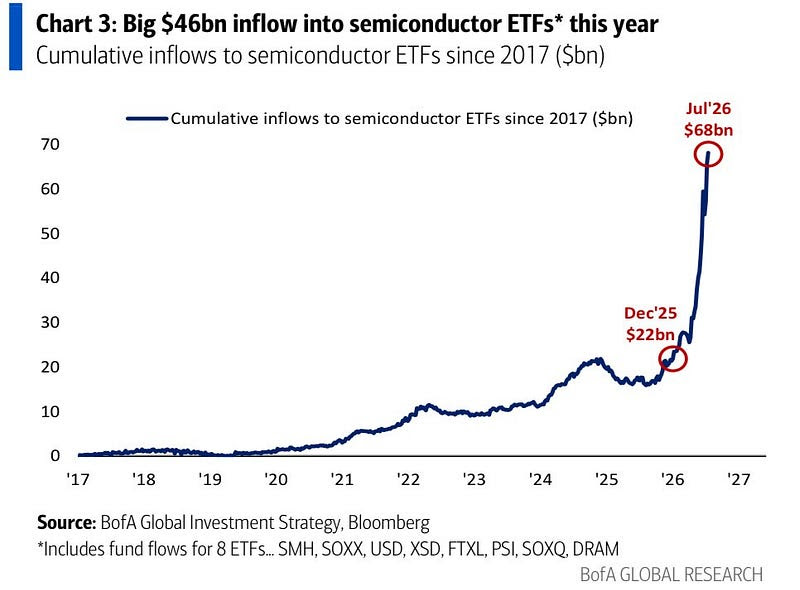
Semiconductor ETFs have attracted an extraordinary $46 billion of inflows in 2026 alone, pushing cumulative inflows since 2017 from $22 billion at the end of 2025 to $68 billion by July 2026. That's an acceleration rarely seen in thematic investing. The chart shows that capital isn't just flowing into semiconductor companies anymore. It's rushing into the entire ecosystem at an almost exponential pace. When passive money enters sector ETFs like SMH and SOXX, it mechanically buys the largest constituents regardless of valuation, creating a powerful feedback loop that pushes the leaders even higher.
The interesting part is that this isn't purely speculative. Unlike many previous technology booms, today's semiconductor demand is supported by real earnings growth driven by AI infrastructure. Hyperscalers continue to spend aggressively on GPUs, networking, memory, custom silicon, and power infrastructure because AI has become a strategic necessity rather than an experimental project. The underlying fundamentals are much stronger than what we saw during previous semiconductor cycles, which explains why investors continue allocating capital despite elevated valuations.
That said, flows can become a double edged sword. ETF-driven buying is wonderful on the way up because it amplifies momentum, but the same mechanism works in reverse during periods of risk aversion. If sentiment changes, passive outflows don't ask whether Nvidia, Broadcom, AMD, or TSMC deserve different valuations. The ETF simply sells everything according to its weighting. We've seen this dynamic play out across multiple sectors over the past decade, where liquidity temporarily dominates fundamentals.
This is why I think the market is increasingly becoming a story of positioning rather than just earnings. With so much money concentrated in semiconductor ETFs, price movements can become disconnected from individual company execution over shorter time horizons. Strong companies may get sold alongside weaker ones during corrections, while average companies can be lifted simply because they're included in the right index. Investors should recognize that passive capital is now one of the largest forces shaping semiconductor valuations.
I'm still constructive on the long term AI infrastructure story because compute demand continues to expand, but charts like this remind me to be mindful of expectations. When everyone is crowded into the same trade, even a fundamentally bullish sector can experience sharp corrections without the long term thesis changing. The secular trend may remain intact, yet the path forward is unlikely to be a straight line. The bigger these inflows become, the more violent both the upside and downside can be.
$SOXX
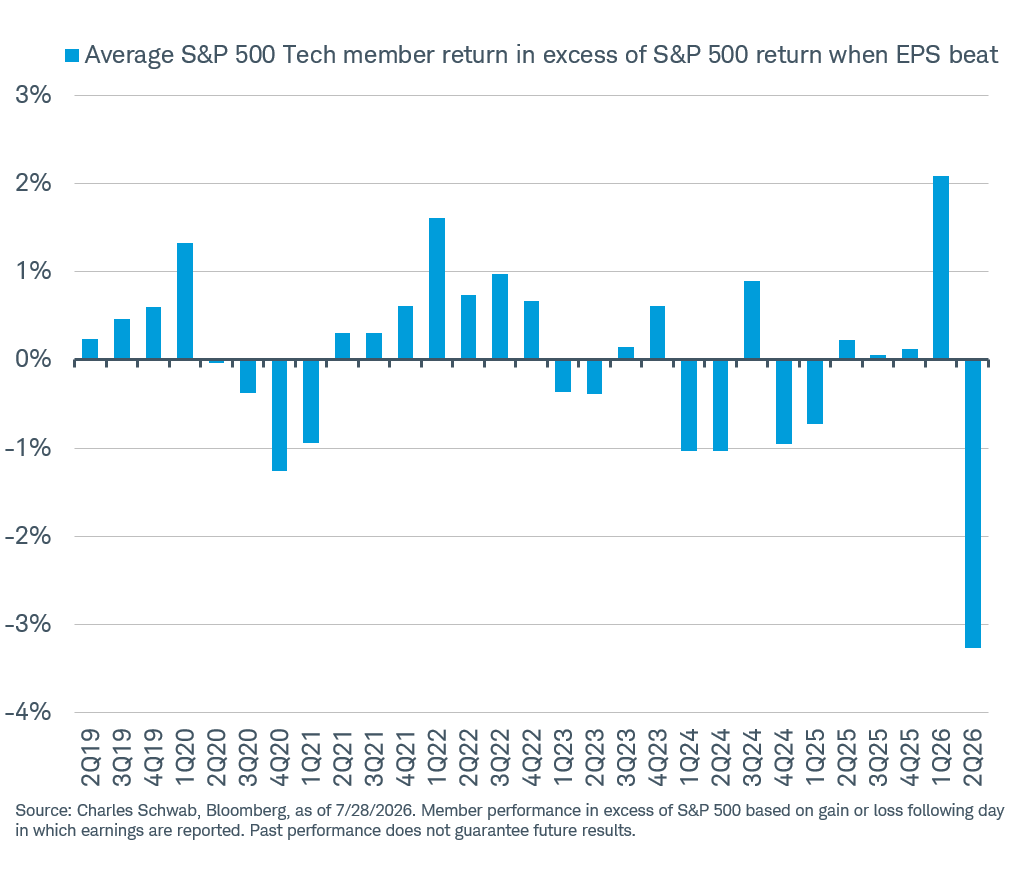
One of the more interesting shifts this earnings season isn't whether companies are beating expectations. It's how the market is rewarding those beats. This chart shows the average excess return of S&P 500 technology companies relative to the broader S&P 500 after reporting an EPS beat. Historically, a positive earnings surprise was often enough to generate outperformance. In 2026, that relationship appears to have broken down. Despite beating estimates, tech stocks are now underperforming the index by more than 3% on average, the weakest reaction in this dataset.
This is a sign that expectations matter more than absolute results. When valuations become stretched and investors price in near-perfect execution, simply beating consensus is no longer sufficient. The market starts asking tougher questions. Did revenue accelerate enough? Was guidance raised meaningfully? Are margins sustainable? Is AI monetization translating into cash flow today rather than tomorrow? The hurdle rate keeps rising, and anything short of exceptional execution gets treated as a disappointment.
I think this also reflects how crowded the AI trade became over the last two years. Many technology leaders entered earnings trading near all-time highs with aggressive positioning from both institutional and retail investors. When positioning becomes one-sided, even objectively good earnings can become liquidity events. Investors who accumulated shares ahead of earnings often use the release to lock in gains, creating selling pressure regardless of whether the quarter exceeded expectations.
This is why focusing solely on "beat or miss" has become an increasingly outdated framework. Markets are discounting future cash flows, not grading companies on whether they exceeded an analyst estimate by a few cents. A stock can fall after a record quarter if the future was already fully priced in, while another company can rally on mediocre results if expectations were sufficiently depressed. Earnings reactions have become more about the gap between expectations and reality than about the headline numbers themselves.
For long-term investors, this is actually a healthy reminder. Short-term price action around earnings is becoming less predictable because valuation, positioning, and sentiment now play just as large a role as fundamentals. Over time, businesses that consistently compound revenue, earnings, and free cash flow should still be rewarded. But in the current market, even excellent companies have to clear an exceptionally high bar. Beating estimates is no longer enough. They have to beat expectations that were already elevated to begin with.